
Letters To The Editor
All letters will be carefully considered; those of general interest will be used. Send to Model Aviation, 1810 Samuel Morse Dr., Reston, VA 22090.
XF2Y
To those who are building or just interested in the XF2Y, it might be well to know that the article you published was read with much interest by Billy Jack Long. As your article indicated, Billy Jack was one of the test pilots for this program. He has written articles on the testing of this aircraft and also has color film coverage of some of the most critical phases of the test flights. If anyone is interested, Billy Jack now lives at 14342 Baker St., Westminster, CA 92683. He's a member of the AMA.
In early June I took B.J. out to fly with the Bluegrass Soaring Society. After a couple of flights with an Oly II he reckoned that this was more fun than an F-102. It took him a little while to adjust to proportional controls instead of the beeper he had used to fly an F6F Hellcat.
Thomas P. Field Lexington, KY
Wants More on Canards
Just wanted to say thanks for the recent articles on canard aircraft. I started flying a Cressline Canard Stick and have a Long E-Z almost ready to fly.
I would love to see more articles on these unusual aircraft. I ordered plans 617 and 626 in hopes of learning more about canard stability so that I can design my own canards.
I have trouble with the Canard Stick on landings, as the nose wants to bounce excessively sometimes until it goes out of control or I go around. No one mentions this problem in other articles.
Alton Dobbins Shaw, SC
We referenced Mr. Dobbins to the article by Tom Hunt which appeared in the July 1988 issue under the title "Canards and Stability," though that article was directed more at flight characteristics than at landings.
Hendon Museum
What a delightfully written and photographed article you ran on the Hendon Museum by Don Berliner. It was informative, and the pictures gave me a good feel for the quality of the effort that Don put into his visit.
It is interesting to note that in my business (scale documentation) I so often see claims of "the only one left," or "the last remaining example in the world," yet as I go over my collection I in fact find one or more others. This is in no way a criticism of Don's article or his efforts, as I'm sure his information was supplied by the museum.
As an example, I have a Sopwith Triplane in my collection that is different than the one he shot. The reason for mentioning this is to remind those seeking scale documentation that, in some cases, they may find other examples if they put in a bit more effort in their search.
You might be interested to note that I have Foto-Paak studies of the aircraft mentioned in Don's article all shot in color, ranging from 10 to 50 photos of each. I would appreciate your sending a copy of this letter to Don to express my compliments on his fine photography under somewhat trying conditions — from a person who "has been there" in so many other similar museums.
Bob Banka Scale Model Research Costa Mesa, CA
After receiving the copy of Bob Banka's letter, Don Berliner telephoned us to say thanks and also to comment on the "only one left" aspect. Don says there are a number of faithful reproductions of early historic aircraft, which probably accounts for photography on different examples. As far as he's aware, the one at Hendon is the last remaining Sopwith Triplane of those originally manufactured.
Doing Something About It!
For many years I have thought about becoming part of the model airplane scene, but I have been unable to locate scale model reproductions of my favorite aircraft. This situation has prompted a drastic action. I am now compiling a new book entitled Flying Model Warplanes: An International Guide to Plans and Kits. I hope to have the book in print by next spring.
In the meantime I would appreciate hearing from fellow modelers regarding addresses of obscure kit and plan manufacturers. Their advice regarding magazines, associations, and companies in Japan, England, Germany, and Italy is also most welcome. I hope this book, once in print, will answer questions fellow fliers may have about sources for a favorite model airplane.
John C. Fredricksen 69 Flamingo Dr. Warwick, RI 02886
What a Field!
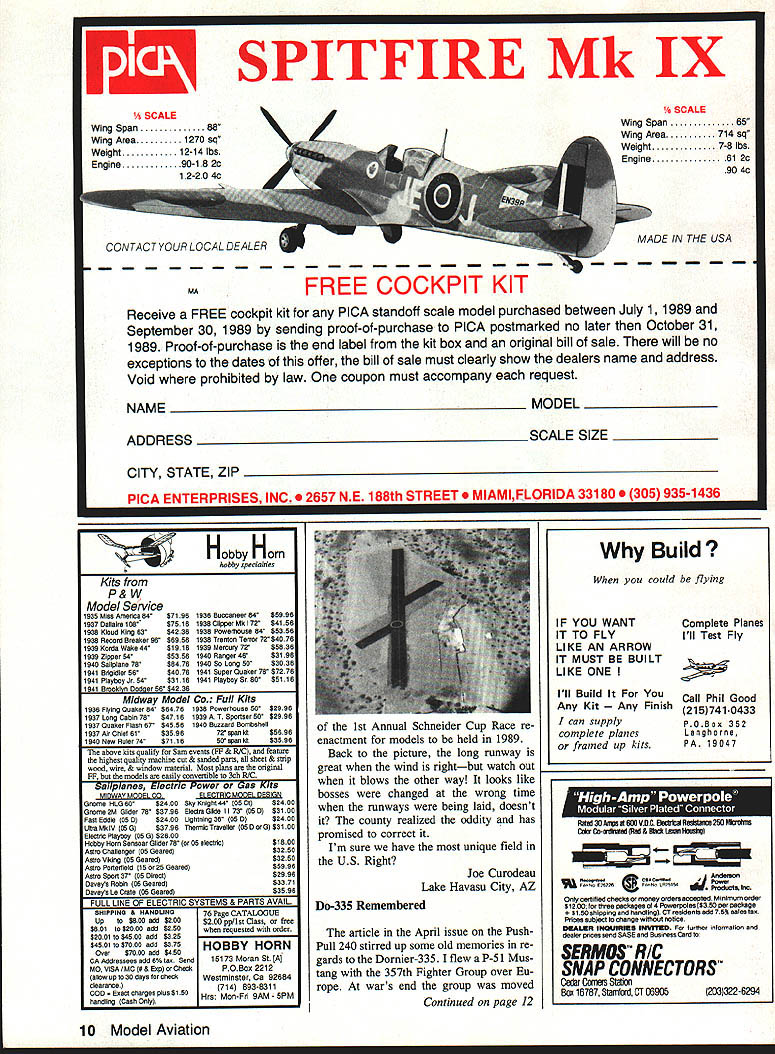
I'm enclosing an aerial view of our flying field with newly paved runways. It has recently been dedicated as the Jim Sterling Field of the Desert Hawks of Lake Havasu City, AZ. Lake Havasu, you know, is home of the 1st Annual Schneider Cup Race re-enactment for models to be held in 1989.
Back to the picture: the long runway is great when the wind is right—but watch out when it blows the other way! It looks like bases were changed at the wrong time when the runways were being laid, doesn't it? The county realized the oddity and has promised to correct it.
I'm sure we have the most unique field in the U.S., right?
Joe Curodeau Lake Havasu City, AZ
Do-335 Remembered
The article in the April issue on the Push-pull 240 stirred up some old memories in regards to the Dornier-335. I flew a P-51 Mustang with the 357th Fighter Group over Europe. At war's end the group was moved from Leiston, England to Neubiberg, Germany. I was lucky enough to get home for some R&R. While the group was there two Dornier-335s flew in, one by a middle-aged civilian pilot-mechanic. He and one of our boys who was familiar with the German language, one Anton (Tony) Froelich, relabeled all the switches and instruments to English so our guys could fly them.
The two-seater eventually wound up in England for air shows and research. Unfortunately at Cove, Hampshire, England it met an untimely end when the rear engine caught fire, burning out the rear controls and killing Group Captain Alan Hards.
One was flown by my squadron mate, Lt. R.D. Brown. During the war R.D. was forced to bail out of his damaged P-51 over Switzerland.
While the Dornier was up, Don Bochay (15 victories in the air) took up a P-51 for a little mock combat with it. The Dornier was a hair faster, but otherwise it was no match for Don in the Mustang.
Unfortunately, both pilots have passed away. If I may, I'll drop another name. Another 357th alumnus is Chuck Yeager. He is alive and well on TV again and again! I think a single-seat Dornier-335 is at the Air and Space Museum in Washington, DC—possibly the same one.
My wife Helen and I are beginning to push 70 pretty hard, but we are both still active licensed pilots. I have been dabbling with RC for several years.
I am enclosing a picture of my freehand, scratch-built models. The little one is a .50 Saito–powered 5 1/4–pounder—referred to as The Round One. The big one is a 13–lb., 8–foot–footer named Mr. Big; it's powered by a Zenoah 23. Both fly very well.
Harvey Mace Ft. Bragg, CA
Fly Baby
Gentle caresses are all that's needed. Take the model up a bit and throttle down to dead slow. Still isn't sinking much, is it? Find a little thermal, and shut the engine off . . . Now, isn't that something?
If that kind of flying is too sedate for your taste, try some slow, slow-speed touch-and-go bumps. How's that for easy? Did you ever do a preturnover one?
Whatever your style of flying, you'll find that this Old-Timer will oblige. Versatile, brisk, smooth, and responsive, the Fly Baby will do exactly what you want it to. See for yourself if this isn't as up-to-date an Old-Timer as you could ask for.
Transcribed from original scans by AI. Minor OCR errors may remain.

