



Letters to the Editor
Hal deBolt's CL Bipes
Thanks, Dick Sarpolus ("Hal deBolt's Classic CL Stunters," May 1990).
The famous Bipe design that got Hal deBolt into business also got me into business as my first control-line plane in 1948. Your coverage of this airplane sure brought back fond memories.
Mine was fire-truck red, powered by an OK .29 engine (made by Herkimer) on spark ignition. I mounted the Burgess square battery in the center section of the upper wing.
I taught myself how to fly it, resulting in the need for lots of repairs. It was tough to learn, but I finally mastered it and went on to the Super Bipe with a Fox .29 using an Arden glow plug. The days of spark ignition were over for me.
In later years I had two Stuntwagons, but I never could duplicate the fun I had with the Bipes. I still have the plans around here somewhere for that first Bipe.
Thanks for the good memories.
Robert E. Ford Long Beach, CA
Gravity Hole!
The regrettable dork of Bill Spathias' pretty Vagabond (July Letters to the Editor) was obviously caused by a gravity hole!
Having lost models to this source myself, I am well aware of the heartache they can cause. (For those who are unaware of these things, gravity holes are a sort of mini, earthly version of astronomy's famous black holes.)
Although gravity holes are well known for causing bicycles to fall over and golf balls to curve, a lesser-known effect is that they cause models to dramatically plunge earthward and crash—for no apparent reason. Full-scale aircraft are not immune to gravity holes. Such crashes are often labeled as occurring for "unknown causes."
Have you ever seen someone walking across a perfectly flat flying field—and trip? At first glance there was really nothing to trip over. Closer thought suggests what really happened: the person tripped against the edge of a gravity hole.
The lighter one builds a model, the less is the effect of gravity holes when the crash does take place. I strongly suggest great caution on the part of those who fly near proven or even suspected gravity holes.
Doug Dahlke Oshkosh, WI
Taperwing Update
When you published the Taperwing construction article in the January 1989 issue of Model Aviation, straightaway speeds of 1/2A pylon racers were in the 80–90 mph range. With the recent availability of modern engine technology—higher-performance engines (ABC construction, Schnuerle porting, etc., such as the BV Shuriken and Chinese CS)—the very low-drag Taperwing will easily exceed 110 mph.
At such speeds, G forces and structural requirements of the model are very different. Because of this, and because the Taperwing continues to be one of the best 1/2A pylon-racing designs available, I have made structural improvements and modified the original plan accordingly. Another modification provides a flat deck right behind the engine for a tuned pipe or muffler.
John Hunton Annandale, VA
From about the time of receipt of this issue, the MA Plans Service will be supplying the modified version of the Taperwing plan instead of the original. This is plan No. 609, $6.00.
Super Squire Credits
You and your staff did an excellent job on the Super Squire article in the July 1990 issue. I would like, however, to provide proper credit for the color photography. All color photos were taken by Mr. Mark Joseph. I apologize for omitting his name in the submission. Maybe you could mention it somewhere.
Larry Windingland Champaign, IL
Two dB Is Small?
A friend and I were out flying, and I casually mentioned that I had found one of the new APC propellers to be from 1 to 2 dB lower than conventional wooden props. My friend said, "Well, for that small difference in sound, why go to the trouble to change props?"
I think many of us don't realize how much difference 2 dB makes in the sound level. A sound which is 2 dB more intense than another sound is about 1.6 times as loud as the first sound. I'm sure Model Aviation has published this information before, but in case people missed it, they should be aware that a small dB-number change makes a big difference.
Ernest Tillman Corpus Christi, TX
How Could We?
No disrespect meant to John Oldenkamp, but how could he leave out the name of Jim Cahill in his list of Wakefield luminaries in his construction article, "BoomBox," in the July 1990 issue? Jim won the Wakefield contest in France in 1938 with the most advanced model of its time, the Clodhopper. It was a streamlined beauty and had the first folding prop I can remember seeing.
Lately I have seen Cahill's model referred to as the Clodhopper. He called it the Clodhopper for a very good reason. It was not a powerful climber, but once it was up and the one-bladed prop folded, it rarely came down until it had won any contest in which it was entered.
I saw Jim hand-glide the 'Hopper several times, and the distance it went on just a little toss was unbelievable. It also won the Moffett contest in 1937, by the way.
I refer anyone who might be interested in a Wakefield design that was way ahead of its time to Frank Zaic's 1938 Model Aeronautics Yearbook, page 88.
Ivan Kelley Canyon Country, CA
Where Are the Mufflers?
Re the 1/2A CL model article in the July 1990 issue (Shuriken Streak): with all the ballyhoo for the modern high-tech stuff… where are the mufflers? Isn't anybody into making real hardware to make these painfully high-pitched whiners quiet?
I love the 1/2A world so very much and have loved it for nearly 40 years, but the noise is just as unacceptable as with any two-cycle engine of any size.
Please, manufacturers and designers, there is probably a larger market out there for something to quiet these engines than for any other… and I'll be glad to test 'em for you.
Richard Ranney Hermosa Beach, CA
Building with Kids
I would like to tell you how much I enjoyed Dave Haught's article, "Building with Kids," in your June 1990 issue. The future of any hobby lies with the interest of youngsters, and Dave's writing shows a lot of thought and insight in helping them appreciate modeling.
Model Aviation is the best balanced magazine of its class. It has good-quality writing, variety of interests, and does not allow advertising to swamp the articles. Please keep up the good work.
Bruce Mickelson Campbell, CA
On Public TV
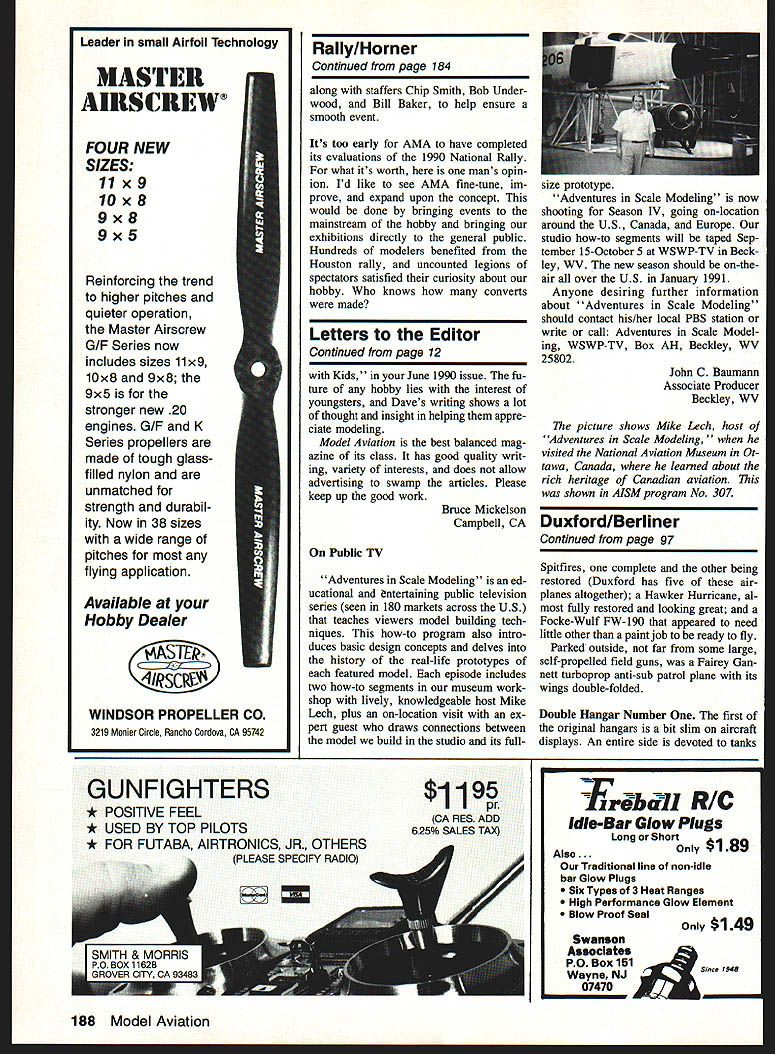
"Adventures in Scale Modeling" is an educational and entertaining public television series (seen in 180 markets across the U.S.) that teaches viewers model-building techniques. This how-to program also introduces basic design concepts and delves into the history of the real-life prototypes of each featured model. Each episode includes two how-to segments in our museum workshop with lively, knowledgeable host Mike Lech, plus an on-location visit with an expert guest who draws connections between the model we build in the studio and its full-size prototype.
"Adventures in Scale Modeling" is now shooting for Season IV, going on-location around the U.S., Canada, and Europe. Our studio how-to segments will be taped September 15–October 5 at WSWP-TV in Beckley, WV. The new season should be on the air all over the U.S. in January 1991.
Anyone desiring further information about "Adventures in Scale Modeling" should contact his or her local PBS station or write or call: Adventures in Scale Modeling, WSWP-TV, Box AH, Beckley, WV 25802.
John C. Baumann Associate Producer Beckley, WV
Transcribed from original scans by AI. Minor OCR errors may remain.

