
Letters To The Editor
All letters will be carefully considered; those of general interest will be used. Send to Model Aviation, 1810 Samuel Morse Dr., Reston, VA 22090.
New Special Interest Group Formed
We are pleased to announce the formation of a new subspecialty Special Interest Group in aeromodeling: RCCA — Radio Controlled Combat Association. The purpose is to "foster the spirit, challenge, and excitement of RC air-to-air combat." All interested parties are solicited for input—membership will be open to all AMA members. Bylaws are now being drafted. Charter memberships will be available soon.
To be in at the ground breaking of a new category of aeromodeling, please contact:
- RCCA, c/o Dr. Sandy Frank (AMA L-69)
- 105 North Brazos St., Weatherford, TX 76086
- Tel: 1-817-599-7131
- Fax: 1-817-594-6160
---
Aeromodeling in the Schools
Larry Gilbert Flagstaff, AZ
I am a science teacher at East Flagstaff Junior High and enjoy sharing my hobbies and interests with my students. Each year my students are introduced to the world of Amateur Radio, and we periodically get on the air from the radio station in my classroom.
A couple of years ago a student of mine sparked my interest in model aviation, and I became involved in our very fine local AMA club, the Flagstaff Flyers. I have been building sailplanes for a couple of years and flying them at some of the dry lakes and cinder hills in the Flagstaff area. Sometimes I bring one of my sailplanes to school and fly it for my students, and every time I do that it generates a great deal of interest in the kids.
For the last year I have given thought to the possibilities of starting a winter or summer school class in model aviation. I think my administration here would be willing to listen to and consider the idea. I read with great interest the article "Summer School Model Aeronautics" (July 1990 issue of Model Aviation) and sent a letter to Dr. William Hendry at Gulf Comprehensive High School asking for any help or advice he could give me toward starting a model aviation program here at East Flagstaff Junior High. So far I have not had any response from him, and I am wondering if you could help me with this subject.
I would appreciate any advice and direction you could give me, especially in the area of a model aviation curriculum guide. Also, any suggestions for a simple-to-interpret immediate-level model kit (sailplane especially) that my students could build and fly at school would be helpful. Are there any model companies that are interested in school aviation programs and willing to help?
---
More thoughts on switching RC systems On and Off
Tom Brennan West Covina, CA
Here's another thought about the subject of switching RC systems on and off, as mentioned in John Preston's "Safety Comes First" column (November 1990). I'm sure everyone would agree that you should make sure the plane's engine is off prior to turning off either the transmitter or receiver, but I have to disagree with the title "Switch RC transmitters On First."
I think it's better to switch on the receiver first, then wait a few moments while watching the control surfaces before turning on the transmitter. With luck, this may reveal if another person is flying on the frequency you thought was clear. Of course, your servos may try to run past their end points, but that's a lot better than turning on your transmitter and knocking someone else out of the sky (even if the other person is in error).
---
Love that article!
Jim Bliss Houston, TX
"Those Days of Wonder and Change"—what a beautiful tribute to a hobby. Fred Lehmberg's chronology of a bit of model aviation history (November 1990)—its people, sponsors, and events—was all well done and, I am sure, appreciated by many.
Thank you, Carl Wheeley, for selecting such a fine piece on model aviation. You will be remembered.
P.S. "Old modelers never die, they just max out."
---
Learned a lot
Roger J. Schroeder Overland Park, KS
Your coverage of the AMA/NFFS Indoor contests and the World Championships (October 1990) was splendid. Jim Richmond is certainly the best indoor modeler in the world. I hope you can induce him to describe some of his designs and techniques in a future issue.
I have really learned a lot from the series of technical articles by Blaine Rawdon. His simplified treatment of the complex subject of spiral stability provided a good insight into the important parameters that govern spiral stability. His is probably the best work since Frank Zaic explained pitching moments in his series of Year Books and in Circular Airflow. Keep up the good work.
---
How do you do it?
Dennis C. Harris Liberal, KS
On page 81 of the July 1990 issue there was a feature by Mr. Raul Pavon about piggyback launching of sailplanes. The idea caught the eye of several of our club members (Southwest Skyhawks RC Flying Club, #2862). Our only problem is that we would really like some details on the release hooks and how to make them.
It was a neat article intended to whet our appetites and get us frustrated—you did it. How about a follow‑up article with some plans, or if not, maybe you could pass this along to Mr. Pavon?
---
Noise, noise, noise!
W. S. Johnson Montgomery, AL
The enclosed newspaper clipping ("Plane Noise Irritates Residents"—club vs. neighbors in Youngsville, NC) was sent to me by a Tar Heel friend. I thought it ironic that the club in the area where the AMA's noise study was conducted (North Carolina State University—my alma mater, incidentally) was losing its flying field because of noise.
Noise is certainly an area we should give some attention to, and I'm disappointed that the engine manufacturers haven't given it more attention. Fortunately, we still have lots of open land in our area. We moved our field three years ago to a rural, sparsely populated area and so far have had no problems.
I also saw the Electrics and think this may be the ultimate solution. When the club saw my Porterfield (with Astro .25 power), it convinced them that electrics don't have to be mere powered gliders.
---
How do they do it? (retract doors)
Bill Neumann Glendale, CA
I am a longtime member of AMA, and unless I've missed it, I have never seen really good ideas in your magazine on how to build retract doors. How about asking some of our top builders to send in an article with drawings and photos of good, strong, workable systems for nose and main doors? Then publish, say, the best six or so of each. This would provide most builders an idea to fit their project.
How about it, readers? Send a query about your capabilities to produce an article to satisfy Bill's request, and I'll buy one or more of them! I already know that Bob Vollett has a book of handy hints on how to make many of the products he sells, and some tell how to accomplish this very task. —RMC/Ed.
---
Camera-carrying Old-Timer
Bob Herden Webster, NY
I saw in the September 1990 "RC Old-Timers" column that Doc Mathews is running some of our old photos of OTs, so I am enclosing one. There is no need to identify it as a Coronet 150 since Doc had a construction article on it in Model Aviation (October 1988). The model is powered by an O.S. 40 Surpass four-stroke and is a very fine flier. Under the right weather conditions it will practically thermal! Doc can be proud of this design.
If you look closely you will see the 35mm camera recessed into the belly. The camera is servo-actuated to take its pictures. It is mounted directly below the center of gravity so that balance is unaffected whether it is installed or not. I am very pleased with the photo results to date. It is in fact my second photo plane, the other being a P-38 with a motion-picture camera in the center pod.
The plane is finished in the same colors as the prototype (white and transparent green) and now carries a wooden prop. The construction was a real nostalgia trip for me, and the design seems to appeal equally to the other "mature citizens" who have seen it at the Rochester Aero Modelers' flying field.
---
A good fix for fuel line problems
David J. Barton Greenwood, LA
I have an idea that will fix the problem of fuel lines being cut by the ends of the brass tubing at the fuel tank outlets. Take a plastic drinking straw and cut a piece about 1/8 inch long. Push the piece onto the end of the fuel line that's going to be fitted onto the brass tube fuel pipe on the tank. By doing this you will stiffen the fuel line while it remains flexible. The piece of plastic straw also acts as a locking ring for an extra‑good seal of line-to-tube at that point.
For a fast fuel tank change, slip a plastic drinking straw over the flexible fuel line and overflow/filler tubing and it will be easier to feed them through the holes in the plane's firewall.
I hope this suggestion will help my fellow members. I'll try to come up with more helpful ideas in the future.
---
Welcome back
William Samarco Marlboro, MA
I am 53 years old, and the last time I built a model I was 13 and it was a control-line model. My new model is a Sig Clipped-Wing Cub, and I covered it with paper and dope. My friend Bob Osborne from Providence, RI flew it for me seven times, but the flying and exposure to heat as I carried the model in the back of my pickup truck saw the covering ripped and torn beyond repair.
Mike, one of the fellows who works at Don's Hobbytown in Seekonk, MA, recovered it for me with Coverite Black Baron film and did a super job. I put on new trim and lettering. It really flies great. Bob Osborne does inverted, hammerhead stalls, and snap rolls now.
I lettered "Ms. Betty B. Bagwell" on the plane. She is my Georgia sweetheart. I thought maybe you could put a small item about an old model builder and his copilot, Betty, in the magazine.
---
No tail to tell
Shaun Carroll P.O. Box 395, Palmerston, NT 0831, Australia
Due to your magazine's continuing support of Bill Evans's fabulous Simitar aircraft, literally hundreds of us "down under" also have no "tail" to tell. Our Simitar Squadron is located in Palmerston, Australia, just south of Darwin. RC is really popular here—but very expensive. Up until recently we have built Simitars straight from the magazine article plans, but it was tough fitting the radio into those tiny fuselages.
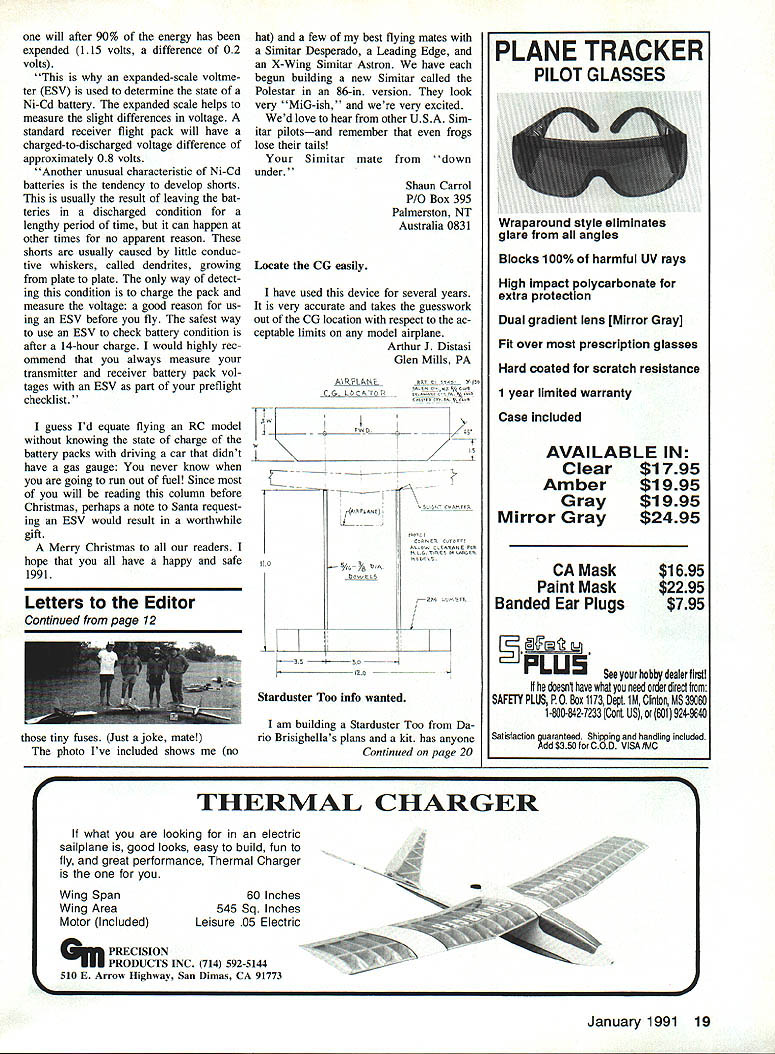
The photo I've included shows me (no hat) and a few of my best flying mates with a Simitar Desperado, a Leading Edge, and an X-Wing Simitar Astron. We have each begun building a new Simitar called the Polestar in an 86‑in. version. They look very "MiG-ish," and we're very excited. We'd love to hear from other U.S. Simitar pilots—and remember that even frogs lose their tails!
Your Simitar mate from "down under."
---
Locate the CG easily
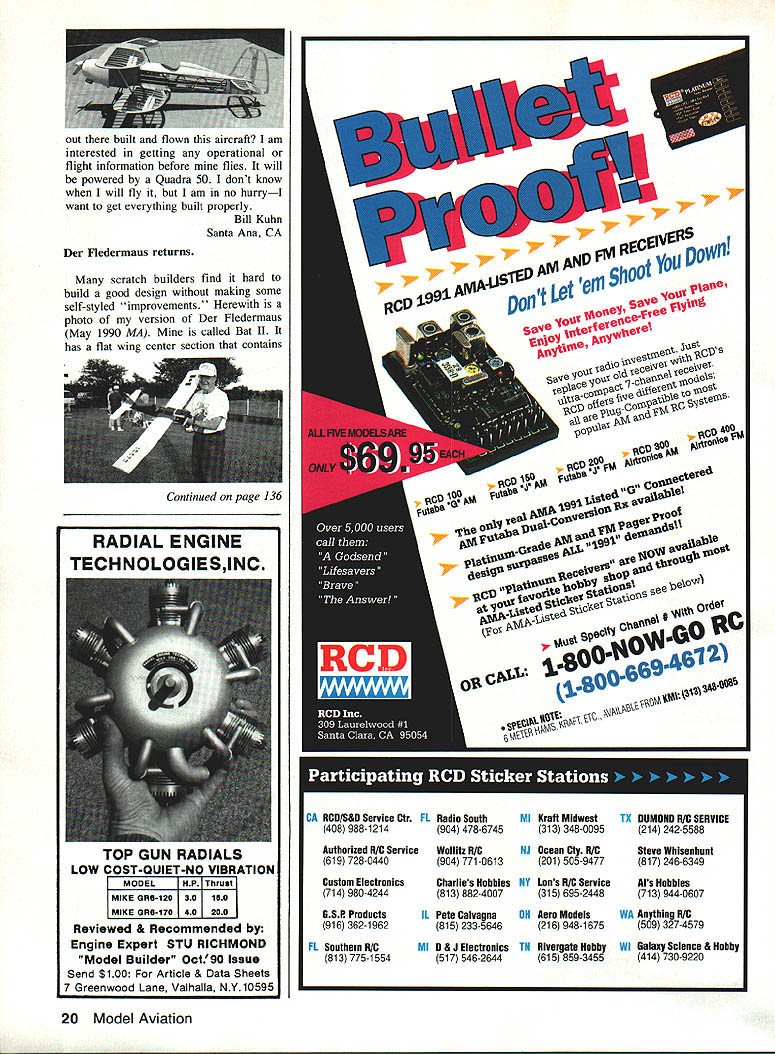
Arthur J. Distasi Glen Mills, PA
I have used this device for several years. It is very accurate and takes the guesswork out of locating the CG with respect to the acceptable limits on any model airplane.
---
Starduster Too info wanted
Bill Kuhn Santa Ana, CA
I am building a Starduster Too from Dario Brisighella's plans and a kit. Has anyone out there built and flown this aircraft? I am interested in getting any operational or flight information before mine flies. It will be powered by a Quadra 50. I don't know when I will fly it, but I am in no hurry—I want to get everything built properly.
---
Der Fledermaus returns
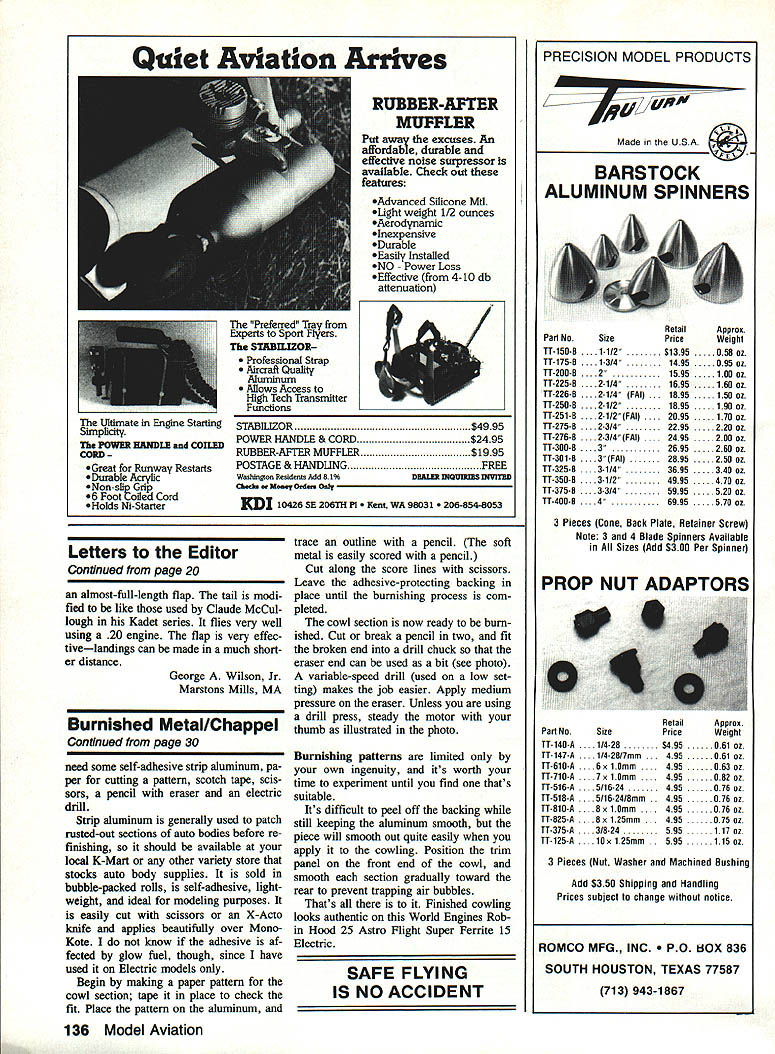
George A. Wilson, Jr. Marstons Mills, MA
Many scratch builders find it hard to build a good design without making some self-styled "improvements." Here is a photo of my version of Der Fledermaus (May 1990 MA). Mine is called Bat II. It has a flat wing center section that contains an almost-full-length flap. The tail is modified to be like those used by Claude McCullough in his Kadet series. It flies very well using a .20 engine. The flap is very effective—landings can be made in a much shorter distance.
---
Important clarification — R/CMA‑AMA Gold sticker
The caption under the reproduction of the R/CMA‑AMA Gold sticker on page 43 of the December 1990 issue of the magazine contains misleading information. The last part reads "you'll need to get AMA insurance." That sentence refers to the information just preceding concerning flying AMA‑sanctioned events. The Gold sticker is required for AMA‑sanctioned events. For general sport flying or for flying outside AMA‑sanctioned events, you do not need to get AMA insurance unless club field rules or the site require transmitters to have a Gold sticker.
---
On DIY battery chargers and safety
Editor
Several readers wrote about an article in another magazine that described an inexpensive dual-rate Ni‑Cd charger that "eliminated the usual power transformer and thus saved money." The writer justified direct-coupling the charger to the AC line by adding a 1.5‑amp fuse as a safety measure. This is unsafe.
A charger made by connecting a dropping resistor in series with the mains can leave one lead to the battery pack at mains potential (about 120 volts above ground). That lead could deliver a lethal current to an unwary modeler who contacts it while standing on a damp floor or touching a grounded object such as a water pipe. The Underwriters Laboratories standard for hobby and sports equipment (UL 961) requires that low-voltage circuits be derived via a step‑down transformer so that they are isolated from the line voltage. The standard does not permit deriving a low-voltage circuit merely by using series resistance.
A typical adult male may be unable to let go of a live conductor if the current through his body reaches about 15 mA. A fuse does not protect against that hazard. Transformers suitable for hobby chargers are inexpensive (for example, $3.49–$10 in current catalogs). That small cost is worth the safety it provides.
On another safety note, the November 1990 Safety column mentioned a safer engine‑starting device conceived by Bill Nelson known as a Kranking. The unit keeps the modeler behind the prop arc during engine starting and has received very favorable comments. Another modeler, Guy Coraccio, has developed a similar device. Both are good examples of thinking about safety in common tasks.
---
Letters will be carefully considered for general interest. Send to Model Aviation, 1810 Samuel Morse Dr., Reston, VA 22090.
Transcribed from original scans by AI. Minor OCR errors may remain.

