
Letters to the Editor
All letters will be carefully considered; those of general interest will be used. Send to Model Aviation, 815 15th St., N.W., Washington, D.C. 20005.
Safety Switch
I am writing this with the hope of preventing another horrifying experience. This weekend I was at a North Jersey model airplane field, and was literally attacked by a model airplane. After an investigation, we found that a modeler left his transmitter in the "on" position, then placed it in the safety rack. His frequency was the same as the modeler flying the above-mentioned plane.
When the plane flew by the pit area, the model lost radio control and flew toward me and into the pit. We all scattered in different directions. The plane seemed to follow me, and then crashed, only one foot away from me. It was a miracle that nobody was hurt. I have seen this happen on three different occasions since the beginning of this flying season. The reasons were always the same: someone left his transmitter on.
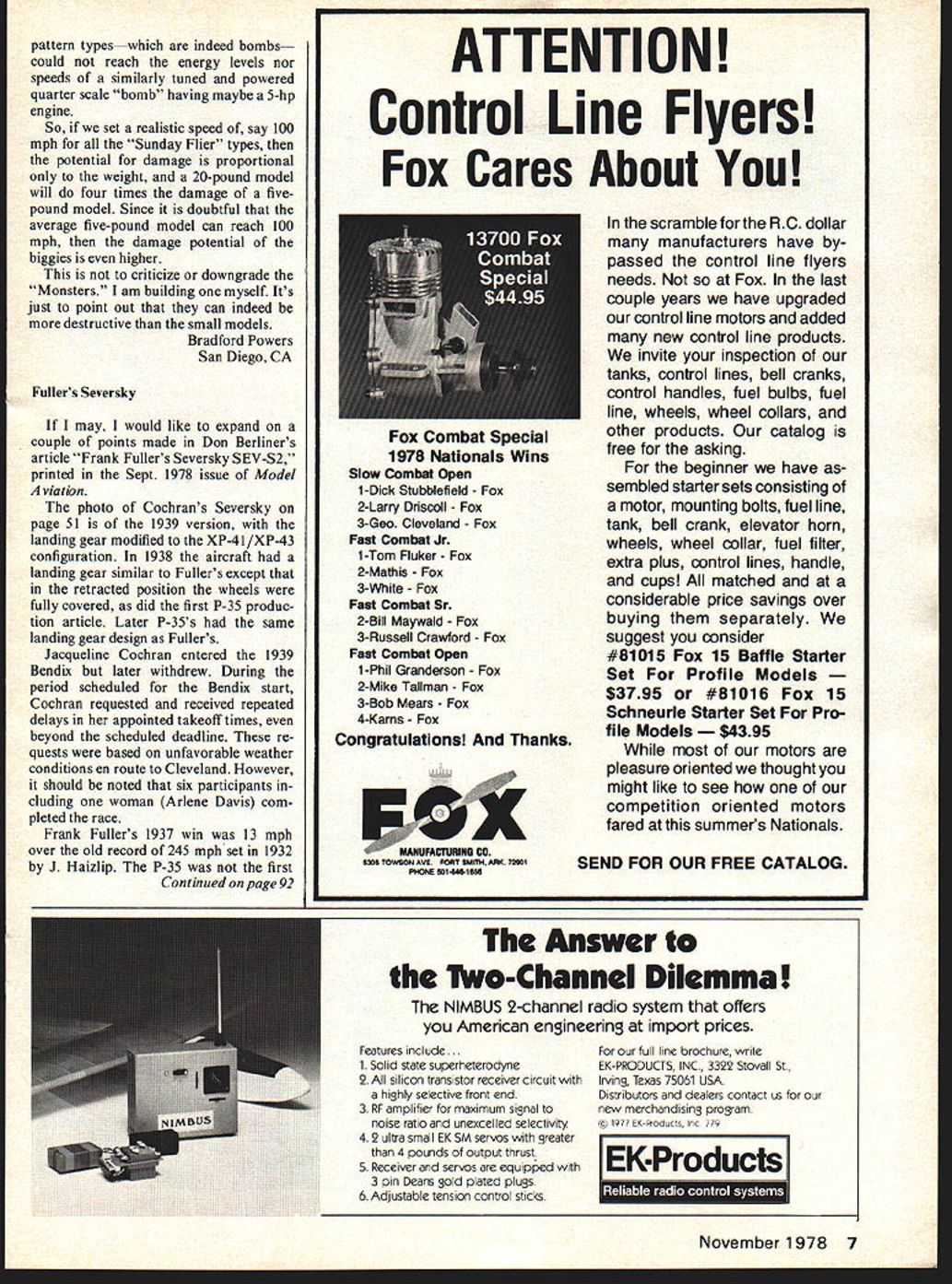
The solution: paint or mark a line across the switch of the transmitter; if you wish, you can do the same on your airplane. I found that white was the most effective color. In the on position, the white line would be straight across, and in the off position the line would be broken. In other words, "Break the line for safer flying."
To accomplish this, I used Monokote sticky-back. I cut 1/8" wide strips 2" long and tacked them across the switch (the switch was in the on position), then used a razor to cut on each side of the switch. Moving the switch into the off position, the line is visibly staggered, leaving no doubt that the transmitter is off. Just glancing around, you can readily see if a transmitter or airplane is on or off.
Enclosed are pictures of the above-mentioned system. All clubs or modelers wishing to use this system may do so. If a manufacturer wants to incorporate this system into their radio equipment they must get my permission.
Leo Greenstein Englishtown, NJ
Another Look at "Biggies"
With regard to the letter in the August issue by Robert Dunn, suggesting that both large and small models lie within the same "envelope" insofar as their potential for damage (energy levels) is concerned, I think it is important to consider the following:
Large 20-pound and bigger models appear to fly more slowly. Actually, a 20-pound model with a 2-hp Quadra engine going full bore can easily attain 100 mph.
On the other hand, while the smaller models "appear" to be going faster than the large ones, the average 5- and 8-pound models of the "Sunday Flier" type generally operate in the 60- to 80-mph speed range. Even the sleek tuned-up racers and similarly tuned, powered quarter-scale bomber might have a 5-hp engine.
So set a realistic speed, say 100 mph. Sunday Flier types' potential damage is proportional to weight; a 20-pound model will do four times the damage of a five-pound model. Since it is doubtful the average five-pound model can reach 100 mph, the damage potential of biggies is higher. I do not criticize or downgrade monsters — I am building one myself. It's just to point out that small models can indeed be destructive.
Bradford Powers San Diego, CA
Fuller's Seversky
If I may, I would like to expand on a couple of points made in Don Berliner's article "Frank Fuller's Seversky SEV-S2," printed in the Sept. 1978 issue of Model Aviation.
The photo of Cochran's Seversky on page 51 is of the 1939 version, with the landing gear modified to the XP-41/XP-43 configuration. In 1938 the aircraft had a landing gear similar to Fuller's except that in the retracted position the wheels were fully covered, as did the first P-35 production article. Later P-35s had the same landing gear design as Fuller's.
Jacqueline Cochran entered the 1939 Bendix but later withdrew. During the period scheduled for the Bendix start, Cochran requested and received repeated delays in her appointed takeoff times, even beyond the scheduled deadline. These requests were based on unfavorable weather conditions en route to Cleveland. However, it should be noted that six participants, including one woman (Arlene Davis), completed the race.
Frank Fuller's 1937 win was 13 mph over the old record of 245 mph set in 1932 by J. Haizlip. The P-35 was not the first U.S. military all-metal monoplane with a retractable landing gear. Consolidated's YP-25 and P-30/PB-2A (an operational type), Boeing's XP-29, XF7B-1 and YB-9 were all metal monoplanes with retractable landing gear and preceded the P-35.
The principal color of Fuller's 1939 Seversky was metallic medium green.
Howard McLeod Mira Loma, CA
What Have You Done for Me Lately?
How about a little more coverage of Control Line in Model Aviation? We Control Line fliers still do exist.
Chris Grey St. Charles, IL
Editor: We have assigned all sorts of nifty CL projects to appear throughout 1979. And free flight. And radio. Forward, the lily banners go...
Pen Pal
I should like to exchange letters with any American modeler for exchanging some model accessories and model mags. I am 23 years old. I build CL stunt models and models powered by Czech rocket engines. I look forward to a letter from any friend in America.
Pavel Chodora Dvorakova 8 32001 Plzen C.S.S.R.
Transcribed from original scans by AI. Minor OCR errors may remain.

