
Letters to the Editor
We helped straighten him out on "1991."
Probably two or three years ago I was troubled by all the talk about the proposed new rules concerning the changes in R/C frequency tolerance. I was so upset by all the talk about having to throw out all my old radios that I took the time to sit down and write you folks a long letter, explaining how I felt that you were interpreting the ruling from the FCC differently than I did.
The reason that I was miffed was because I had (and still have) 10 radios, and only one would pass the certification process, and I was not about to throw perfectly good radios away.
I explained how I thought the old radios should be grandfathered like they do with old cars (you couldn't build a 1951 Chevy today because of all the smog and other restrictions): as long as they still run you could use them!
I believed part of the motivation to jump on the bandwagon to push everybody to buy new radios was more fueled by the desire to generate revenues rather than the other issues.
My biggest gripe was in the way the FCC ruling read: I believed it to mean that the only restrictions were on new manufacture. It did read to me that you would be able to continue to use our old stuff!
Another problem I had was trying to buy new, supposed "1991" radios. I went to several of my old favorite stores and could not find any for sale. It was obvious that the factories were going to deplete their old stocks before making the new stuff readily available.
I was impressed at how quickly your organization replied to my letter. Your response was what I expected. You sent me a copy of the ruling and explained how you thought I was wrong. Well, I decided to forget about it and just roll with the punches—until I picked up the December 1990 issue of Model Aviation, and to my surprise I found the article on page 30 by George M. Myers.
This article echoes everything I felt years ago when I sent my own letter. I fully understand the reasoning the writer was trying to express concerning safety and the consideration of fellow fliers.
What upset me was the way in the beginning how folks were leading everyone to believe that in "1991" you had to throw your old stuff out and buy new.
Now, after reading in your publication that I wasn't full of hot air and that there were more people who felt the same way I did, I feel better ... Thank you.
Randy Melendez Chino, CA
We're glad to know that we helped a fellow modeler find some satisfaction. Thanks, Randy, for taking the time to write us. R/C M.
Making modeling friends
It's amazing sometimes just what an interest in R/C can do. I'm sure it has brought many people together as friends. This is just one such story.
I'm Hardware Department Manager in a large True Value store. After a year of employment here I still had not found a common ground on which to base friendship with my fellow employee over in the plumbing department. Last December I posted a copy of Prop Kicks, our R/C club newsletter, on the employees' lunch room bulletin board. The next day as I sat down for lunch, Mike looked at me and asked, "How do I get into R/C?"
It's been almost a year now, and Mike has built a Gentle Lady glider, an Electra Cub, and a Great Planes PT-40. He's soloed the PT-40 under supervision of the club instructor. Seldom does he miss a first-Sunday afternoon at the flying field.
At the store, we used to speak to one another only while assisting a customer, but our friendship has now been bound by an interest in building and flying R/C. Not a workday passes that we don't find time to have a "hangar-flying" session. Many of our hardware and plumbing customers are fellow club members of the Cloud Kings.
It seems that my work has become more efficient now that Mike and I have found our common ground in R/C! He has helped me learn many things about store operations from his years of experience there.
Alvin E. Johnson Oxford, PA
It's not just R/C, Al. I am still in touch with modeling friends I made over 40 years ago—and that was in the era of Free Flight and Control Line. I can look back with great fondness to the many lasting friendships made during my own modeling activities. In fact I owe my present occupation to some of them! R/C M.
More Tamecats
Thank you for the F-14 Tamecat article (June 1990). I purchased the plans and started flying the results in September. It flies like a dream! As yet I haven't cracked it up, and I am a novice flier. It really is a trainer-plus.
Using a tired O.S. .40 FP it loops, rolls, spins, and lands gently. I covered it with chrome MonoKote, and it flashes in the sunlight when it flies past.
Built to the plans it comes out a little tail-heavy. I have a two-ounce nut on the prop, one ounce of lead in the nose, and the battery forward of the fuel tank.
Dick Amsden Mt. Clemens, MI
R/C Combat fan
The following letter was addressed to Dr. Sandy Frank, who has been an active promoter of R/C Combat and who forwarded it to Model Aviation.
I am glad to hear there is the beginnings of a movement towards R/C Combat. The hobby needs the excitement and necessary skill level of Combat. If you're not into Scale or find Pattern flying boring, there is not much else in the hobby. Combat is the next logical step. The excitement of R/C Combat could breathe new life into our hobby.
Please keep me informed of any activities that are going on in the area of Combat. If I can be of any assistance, please feel free to call or write.
I believe we need some articles in the modeling magazines to create interest in this new area of R/C.
Michael Fredricks, DVM N8363 Schulz Dr. Beaver Dam, WI 53916
Reunion: Stewart Model Airplane Club
Wanted for reunion: Aging past members of the Stewart Model Airplane Club of Newburgh, New York (vintage 1938–1942). Contact:
- Edward Thuesen, 2 Valleyfield Rd., Newton, NJ 07860 — phone (201) 786-5662
- George Terwilliger, 20 Lowell Ave., Metuchen, NJ — phone (908) 548-3594
We flew Free Flight, mostly gas, at the original Stewart Field when it was one hangar and one runway. Some old names and faces come to mind: club sponsor and mentor Don Barclay, Don Fleming, Vince Beahan, Bill Brundage, Arch Whitehouse, Al and Stuart Innis, and Vic Frager who later joined the RCAF and flew Spitfires in the Battle of Britain. Where are you guys? They were fun years, and George and I would sure like to reestablish contact with those Stewart Club members to set up a reunion of sorts in the Newburgh area. Anyone knowing the whereabouts of the old gang please give us a call.
Edward A. Thuesen AMA 5759
Helping the children
Shands Hospital at the University of Florida endorses and authorizes the members of the Marion County Model Aircraft Association (MCMAA) to coordinate a Flyers Rally to benefit the Children's Miracle Network (CMN) and the pediatric programs of Shands Hospital at the University of Florida. Mr. Raymond Brown is the MCMAA coordinator for this important event. The Flyers Rally is scheduled to take place on June 1–2, 1991.
(Ed. note: The location of the Rally was not given. For more information call C/D Robert Jones (904) 245-0416. There is a $5/day landing fee and a suggested donation of $2 from each spectator car; this donation puts you in the door-prize drawing.)
We are grateful to all manufacturers and individuals who will be supporting the Flyers Rally and, thereby, helping to improve the quality of life for critically ill children throughout Florida and southern Georgia.
The Children's Miracle Network Telethon will be broadcast June 1–2 on WCJB TV-20. If you are giving an outright cash contribution to support the Flyers Rally event, please make your check payable to Children's Miracle Network and mail to:
Mr. Raymond Brown Children's Miracle Network P.O. Box 1057 Silver Springs, FL 32688
All in-kind donations, other than cash, can be mailed directly to Raymond Brown. If you have any questions or need additional information regarding this event, please contact Brenda S. Morgan at (904) 395-0191 or Mr. Brown at (904) 236-3667.
Brenda S. Morgan Special Event Coordinator
Improving the Original Fly Baby
I wish to tell all interested readers to build and fly Pete Bowers' Original Fly Baby. It is well worth the effort to build stick-by-stick with all the patience and skill you can muster. If you set to the task of building carefully—which means that the building process will be quite slow—there is no doubt that you will be rewarded with an airplane that flies as gracefully as it looks.
But watch for super performance with an O.S. .25 up front, throttle perhaps only three-quarters open! It is a real cloudscraper!
I am sure that the performance is enhanced by the thin, undercambered, elliptical wing. Some of you may find the wing difficult to build, but it is worth it. Like the WWII Spitfire, which had a thin, elliptical wing, the Original Fly Baby also has the ability to turn tight circles.
I have been a modeler for over 50 years, and I scratch-build all my airplanes. Although the plans I received from Model Aviation were somewhat disappointing, I would never discourage anyone from building. My intent here is simply to point out a few problem areas.
To help others who wish to build this nostalgic aircraft, please watch out for the following on Plan No. 630:
- I never build directly from a supplied set of plans. I usually trace over them, incorporating extra modifications to suit my equipment as well as different construction methods.
- I added about 2° of wing incidence (before I began building). The plans show the wing, elevator, and engine all at 0°. I also added a little down thrust and about 1½° of right thrust. My plane climbs straight and floats beautifully.
- Watch out for the forms F-2 and F-3. If built directly over the plans they will be difficult to fit (especially if you add incidence).
- Do not attempt to build the stab/elevator directly over the plan. Both the length and trailing-edge shape differ between the two sides on the plan.
- Check the rib carefully before you cut out the center ribs. You may find a discrepancy in the length of the ribs as shown.
I also surmised that seven inches of dihedral under each wing tip is excessive, so I reduced it to about three inches.
Good luck to all those who choose to build this interesting, good-natured model. Perhaps we shall see a float version in a future issue of Model Aviation. There is a picture of the model on floats in the March 1941 issue of Air Trails! Would you believe that it was powered by an Ohlsson .23 with only a four-foot wing?
Jim Halls Johnson, Vermont
Darn! Can't fool anybody any more!
The man on April's cover is not Bill Winter! As you say in that issue, Bill Winter has been bringing the joy and wonder of aircraft to legions of modelers for nearly 50 years. He has and does inspire us with a wonderful, uniquely poetic voice. There is some Bill Winter in every model that flies—and in thousands more yet to take wing.
Clearly, the man pictured on April's cover has yet to see 43! He is obviously too young to have given 50 years of service! Your ruse fools nobody! Just because many of us live in rural areas, you must not take us for yokels, sir!
We do remain steadfast readers and hope you will keep up your otherwise honest work.
Tom Mehl
A younger reader makes a good suggestion
I am a 13-year-old member of the AMA, and I would like to say a few things about model aviation.
I've been noticing that many kids my age are interested in learning to fly R/C sailplanes, electrics, and gas power. I don't really think that there is a lack of interest—but simply a lack of either motivation or funds (cash). The only reason I'm in the hobby is that I read model magazines and met, by chance, a guy that had been flying for at least 20 years. He has since taught me to fly.
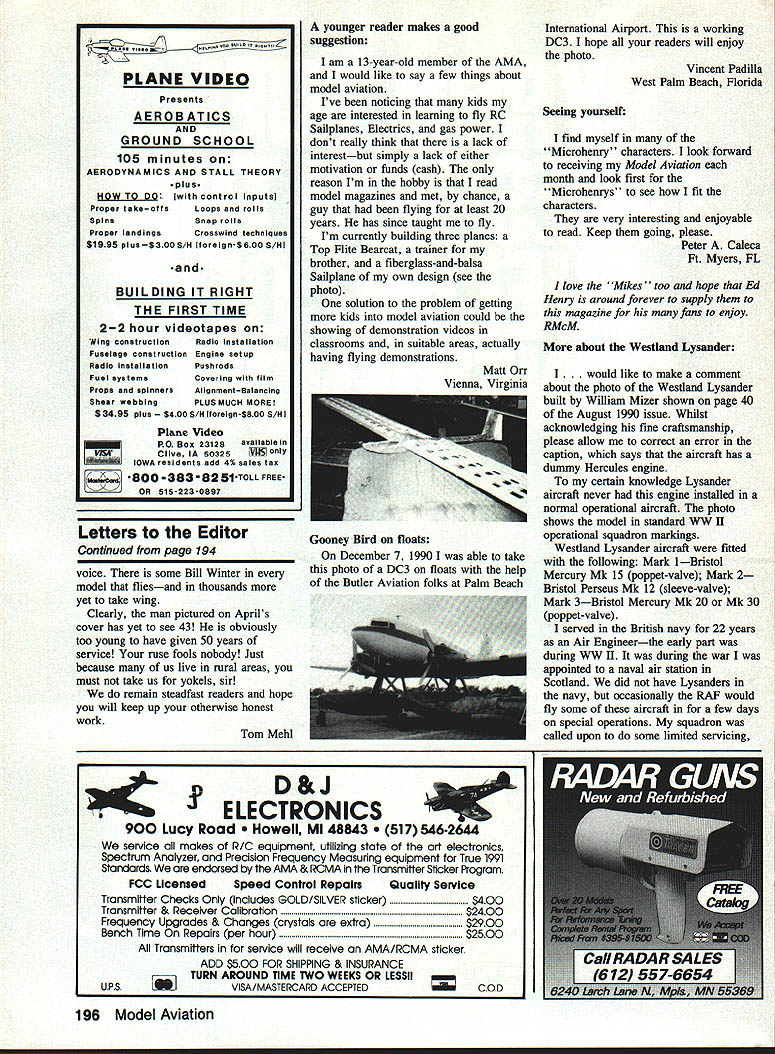
I'm currently building three planes: a Top Flite Bearcat, a trainer for my brother, and a fiberglass-and-balsa sailplane of my own design (see the photo).
One solution to the problem of getting more kids into model aviation could be the showing of demonstration videos in classrooms and, in suitable areas, actually having flying demonstrations.
Matt Orr Vienna, Virginia
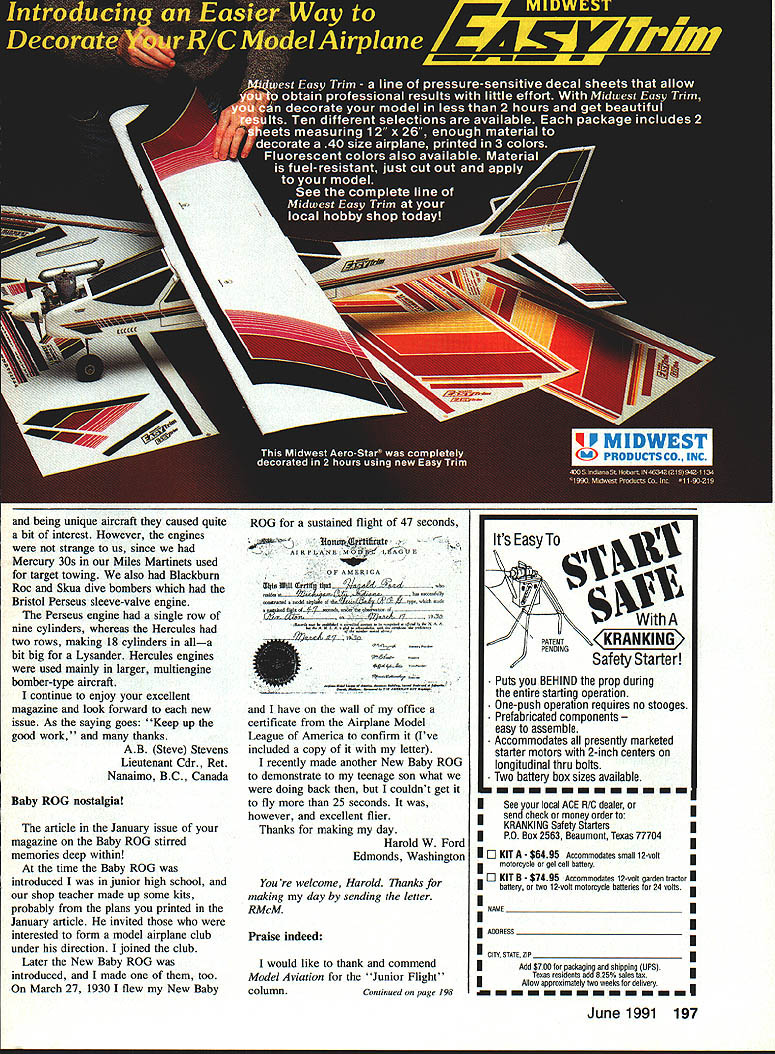
Gooney Bird on floats
On December 7, 1990 I was able to take this photo of a DC-3 on floats with the help of the Butler Aviation folks at Palm Beach International Airport. This is a working DC-3. I hope all your readers will enjoy the photo.
Vincent Padilla West Palm Beach, Florida
Seeing yourself
I find myself in many of the "Microhenry" characters. I look forward to receiving my Model Aviation each month and look for the "Microhenry" to see how I fit the characters.
They are very interesting and enjoyable to read. Keep them going, please.
Peter A. Calcera Ft. Myers, FL
I love the "Mikes" too and hope that Ed Henry is around forever to supply them to this magazine for his many fans to enjoy. R. McM.
More about the Westland Lysander
I would like to make a comment about the photo of the Westland Lysander built by William Mizner shown on page 40 of the August 1990 issue. Whilst acknowledging his fine craftsmanship, please allow me to correct an error in the caption, which says that the aircraft has a dummy Hercules engine.
To my certain knowledge Lysander aircraft never had this engine installed in a normal operational aircraft. The photo shows the model in standard WWII operational squadron markings.
Westland Lysander aircraft were fitted with the following:
- Mark I — Bristol Mercury Mk 15 (poppet-valve)
- Mark II — Bristol Perseus Mk 12 (sleeve-valve)
- Mark III — Bristol Mercury Mk 20 or Mk 30 (poppet-valve)
I served in the British navy for 22 years as an Air Engineer—the early part was during WWII. It was during the war I was appointed to a naval air station in Scotland. We did not have Lysanders in the navy, but occasionally the RAF would fly some of these aircraft in for a few days on special operations. My squadron was called upon to do some limited servicing.
Baby ROG nostalgia!
The article in the January issue of your magazine on the Baby ROG stirred memories deep within!
At the time the Baby ROG was introduced I was in junior high school, and with our shop teacher made up some kits, probably from the plans you printed in the January article. He invited those who were interested to form a model airplane club under his direction. I joined the club.
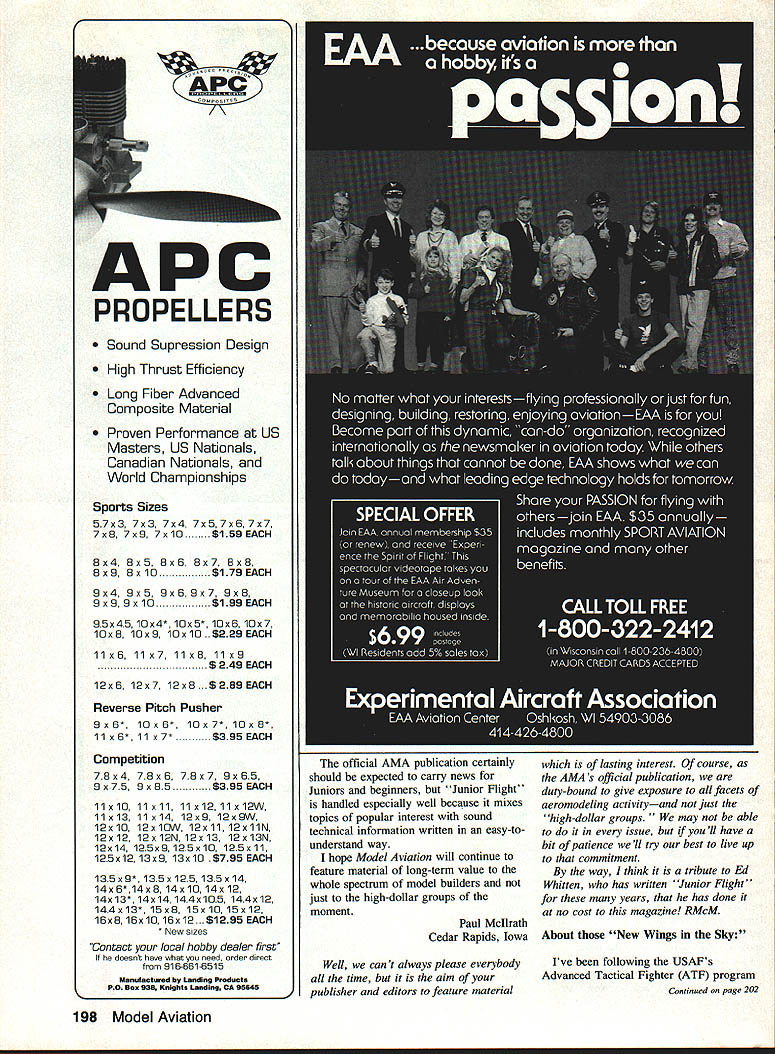
Later the New Baby ROG was introduced, and I made one of them, too. On March 27, 1930 I flew my New Baby ROG for a sustained flight of 47 seconds, and I have on the wall of my office a certificate from the Airplane Model League of America to confirm it (I've included a copy of it with my letter).
I recently made another New Baby ROG to demonstrate to my teenage son what we were doing back then, but I couldn't get it to fly more than 25 seconds. It was, however, an excellent flier.
Thanks for making my day.
Harold W. Ford Edmonds, Washington
You're welcome, Harold. Thanks for making my day by sending the letter. McM.
Praise indeed
I would like to thank and commend Model Aviation for the "Junior Flight" column.
The official AMA publication certainly should be expected to carry news for Juniors and beginners, but "Junior Flight" is handled especially well because it mixes topics of popular interest with sound technical information written in an easy-to-understand way.
I hope Model Aviation will continue to feature material of long-term value to the whole spectrum of model builders and not just to the high-dollar groups of the moment.
Paul McIlrath Cedar Rapids, Iowa
Well, we can't always please everybody all the time, but it is the aim of your publisher and editors to feature material which is of lasting interest. Of course, as the AMA's official publication, we are duty-bound to give exposure to all facets of aeromodeling activity—and not just the "high-dollar" groups. We may not be able to do it in every issue, but we try to maintain a fair balance across the hobby.
By the way, I think it is a tribute to Ed Whitten, who writes "Junior Flight" regularly, that he has done many more of those things in this magazine! RMcM.
About those "New Wings in the Sky"
I've been following the USAF's Advanced Tactical Fighter (ATF) program in the pages of Aviation Week and Space Technology with considerable interest. So I was pleasantly surprised to see the article by Don Berliner in the March 1991 issue of Model Aviation. I enjoyed the article but feel compelled to make a couple of corrections.
There is no "competitive fly-off" for the ATF. The Air Force calls it a "Demonstration/Validation program."
Each ATF team flies its aircraft to gather data to support its claims. The flying phase finished in December 1990, and the prototypes are now in flyable storage. The Air Force will examine the data collected and the production proposals and choose the winner on April 30, 1991. It seems like a sterile and unromantic way to buy a fighter!
Two-dimensional nozzles only vector thrust up and down. Vectoring thrust up, down, left, and right requires a three-dimensional nozzle. Only the YF-22 is using two-dimensional nozzles. The nozzles of the YF-23 are buried too deeply to allow thrust vectoring. Apparently the YF-23 was designed for stealthiness and can supercruise faster than the YF-22, while the YF-22 was designed for maneuverability and has flown at a 60° angle of attack with its thrust vectoring.
As much as I like Lockheed for the P-38, P-80, SR-71, and F-117 I am pulling for Northrop's YF-23 if a plane flies the way it looks.
Incidentally, both ATF teams were on a nostalgic kick for a short time. The YF-23 sported a red hourglass on its belly reminiscent of the P-61 Black Widow. Lockheed called the YF-22 the Lightning II after the P-38. However, neither wanted to offend the Air Force with its penchant for naming fighters after birds of prey.
Personally, I think we should let the British name our planes, since they seem much better at it.
I'd dearly love to build an R/C YF-23. However, I haven't progressed to ducted fans yet. Would I be able to hide the engine between the twin tails? Wait a minute! There are slope-soaring F-16s and A-6s. A YF-23 slope-soarer? Where am I going to find a slope to soar in eastern Wisconsin?
Dan Gilbert Grafton, WI 53024
Ed Henry caught!
I have known Ed Henry for many years and have really enjoyed his "Microhenrys" for almost as many years as I have been an AMA member.
Ed and I generated the first set of model flying-field rules after I wrote John Worth regarding the "existing" AMA safety rules and his response was to advise me that there were none. These were for the McDonnell Aircraft Company's R/C club flying field.
Well, enough of that. Have you noticed that in the February 1991 issue's "Microhenrys" cartoon that the last group shows seven models flying under the control of six transmitters? Examining the models and transmitters from left to right, we have plane 1/xmtr 2, plane 2/xmtr 3, plane 4/xmtr 1, plane 7/xmtr 4, plane 5/xmtr 5, plane 6/xmtr 6, and obviously plane 3 is being controlled by the dog! Check that concentration. That is control!
R/C Combat is a wild thing and, as it started out, was also scary. Since safety is big with me, I have always followed the event with interest. To date it appears that it is well supervised and does not detract from the safety aspects of the hobby.
And since I have known Ed for, lo, these many years and he is also big on safety, which one of the editorial staff left the control of one of Ed's models to a dog? I couldn't have been Ed who did it—could it?
John W. Rawlings St. Charles, Missouri
Sometimes modeling isn't so much fun
The letter from Michael Patterson in the December 1990 issue brought back some unpleasant memories.
Years ago when I first started into model flying I could not get into a club. There are three AMA clubs, one of which is very large, in my immediate area. In trying to join the answers I got were: "Don't call us, we'll call you" and "Don't bother me, I'm busy." All this on more than three occasions and then by a club president. All I wanted to do was to learn to fly!
Three years and umpteen weeks later I heard about an open flying field where Thursday afternoons were beginners' days. Local AMA pilots would bend over backwards to help you get the models out to finish. After what I had been through this was like heaven.
The point I'm trying to make is, why aren't all chartered clubs like this last one? I almost quit trying because of it and personally know of others who have quit. This same open field puts on a yearly fun fly that sees both beginners and seasoned pilots meet and enjoy the day—it's just plain fun.
To date I've taught 10 people how to fly that were turned down by other clubs. That's 10 people who would not be AMA members and would not be going to the local hobby store.
Hey, AMA clubs! Please have a heart. There are a lot of people, both young and old, who want to learn if only you would take them under your wing.
L. Russeau Ida, Michigan
Are you clubs out there listening? RMcM.
Transcribed from original scans by AI. Minor OCR errors may remain.

