

Letters to the Editor
Hunting that perfect definition
It's been a number of years now, but I once read in your magazine a special definition, an elegant explanation of our hobby. I believe it was in a column by one of the contributing editors or feature columnists. I can't remember which one or the date of the issue—probably somewhere in the late '70s or early '80s. I've paged through those back issues but haven't been able to find it. I don't believe it was written by Bill Winter, Carl Wheeler, or another MA editor.
I've come across many definitions of the hobby before and since, but none like this one. Obviously put together by someone who had designed, crafted, engineered, and flown many models and enjoyed every minute of it, it seemed to distill all the elements that make the sport so enjoyable. Maybe it just spoke to me. In any case, I'd sure like to get my hands on a copy of it.
Maybe you can pass along a note about my search to some of the old-timers around the office. Why, someone must have copied it in calligraphic script and placed it on a plaque, or hung it above the door to their shop—it was that good!
Thanks for any help you can provide.
Bob Parazin Richland, Washington
If it impressed Mr. Parazin that much, it must have done the same for at least some of our other readers. Can any of you help in his search for a slogan that seemed to capture the essence of our sport? — RMcM
A wrong turn . . .
Someplace between my typewriter and the published account of trips to old-time model contests (Earl F. Stahl, "Looking Back at Contests," June 1991 MA), the bus took a wrong turn. No way would I ride atop those Greyhounds with my valued model boxes! What I did was climb the ubiquitous chromed ladders back on the old vehicles, carefully place and secure the fragile cargo under the canvas covers.
Earl F. Stahl Yorktown, Virginia
Letters to the Editor
The way it really was . . .
I find myself puzzled by a letter from Joshua Teague in this column of the May issue. I don't know what the subject of the letter to which he refers might have been. At first I thought he was stating that the Corsair entered service with the British in 1944, but he goes on to write that that date was months before the planes were put on active duty for the U.S. Navy.
I don't know what Mr. Teague might have "seen or not seen," but I can tell him that the Corsair entered service with the Marines—specifically, with the VMF-124 squadron—on February 12, 1943 on Guadalcanal. As Operations NCOIC for VMF-221, I was responsible for pilot, aircraft, engines, and propeller logs, and we received our Corsairs at Espiritu Santo on May 19, 1943.
Unless Mr. Teague feels, as most Marines do, that they should not be considered part of the U.S. Navy, he is clearly incorrect.
While I can truthfully state that I was on Espiritu when VMF-124 and our squadron, VMF-221, got their Corsairs, and served with both squadrons on Guadalcanal and the Russells in 1943 while Corsairs were flown, that information can be verified on page 134 of Robert Sherrod's History of Marine Corps Aviation in World War II.
James Yocum Rancho Cordova, California
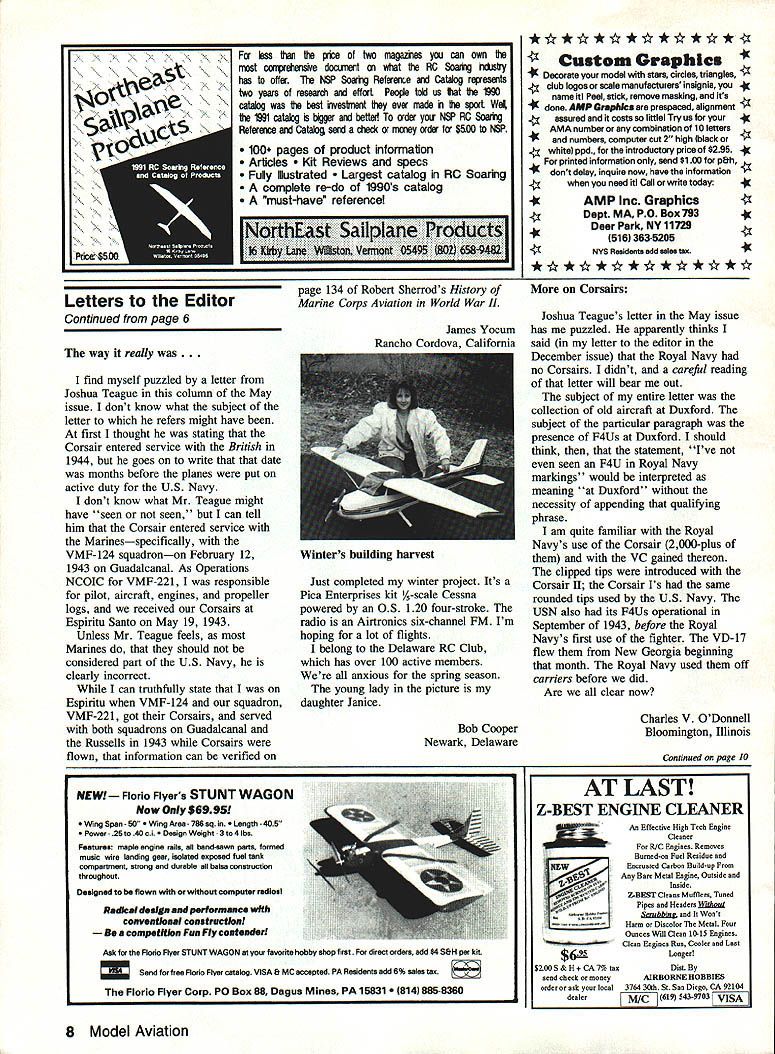
Winter's building harvest
Just completed my winter project. It's a Pica Enterprises kit 1/5-scale Cessna powered by an O.S. .120 four-stroke. The radio is an Airtronics six-channel FM. I'm hoping for a lot of flights.
I belong to the Delaware RC Club, which has over 100 active members. We're all anxious for the spring season.
The young lady in the picture is my daughter Janice.
Bob Cooper Newark, Delaware
More on Corsairs
Joshua Teague's letter in the May issue has me puzzled. He apparently thinks I said (in my letter to the editor in the December issue) that the Royal Navy had no Corsairs. I didn't, and a careful reading of that letter will bear me out.
The subject of my entire letter was the collection of old aircraft at Duxford. The subject of the particular paragraph was the presence of F4Us at Duxford. I should think, then, that that statement, "I've not seen an F4U in Royal Navy markings" would be interpreted as meaning "at Duxford" without the necessity of appending that qualifying phrase.
I am quite familiar with the Royal Navy's use of the Corsair (2,000-plus of them) and with its service record. The clipped tips were introduced with the Corsair II; the Corsair I had the same rounded tips used by the U.S. Navy. The USN also had its F4Us operational in September of 1943, before the Royal Navy's first use of the fighter. The VDD-17 flew them from New Georgia beginning that month. The Royal Navy used them off carriers before we did.
Are we all clear now?
Charles V. O'Donnell Bloomington, Illinois
Letters to the Editor
Continued from page 8
Diesels revisited
David Boddington's article "Diesel Delights," in the March 1991 MA, was good publicity for these too-little-known and underappreciated engines. While much of the article was interesting, some of the information was years out of date.
Specifically, Boddington's 1:1:1 fuel formula should be taken out and given a decent burial, except for antique diesels that might need a one-third oil content. Diesels made with modern materials need no more than 25% oil if they have new iron-piston, steel-sleeve construction. The content can be lower for ball-bearing engines (about 20% seems okay for the above-mentioned construction), and I have run an ABC buggy engine (.21-size) on fuel made up of only 12% castor oil with no distress.
Fuels with high oil content coat the model with more oil than necessary. More important, the engine develops less power. My buggy engine would not run up to peak revs even with 16% oil in the fuel.
Another regrettable omission in Boddington's article is any mention of the need to add one of the organic nitrates (amyl, isopropyl, hexyl, etc.) to the fuel at a 1.5% to 2% (and sometimes higher) concentration. With this additive, a diesel becomes at least as smooth as a glow engine—perhaps smoother. (The O.S. .61SF is reputed to run more smoothly when converted to diesel power than as a glow engine.)
Without this additive, a diesel engine runs much rougher, is noisier (metallic rap), cannot reach as high a speed, and requires a higher compression-ratio setting, which in turn increases stress on the connecting rod and crankpin.
Mr. Boddington's comment, "Diesels larger than [.29 size] tend to become harsh or clunky, losing, for me at least, some of their charm and ease of operation," is years behind the times. Bob Davis showed that there is effectively no size limit for diesels. He made (and perhaps still makes) heads for engines as large as three (not 0.3) cubic inches. If the jury is using the prime 1:1:1 fuel, this size limit is probably correct, but with a modern fuel mix there is no "diesel roughness." Perhaps commercial fuel in the UK does not contain a nitrate. The PAW company recommends it in its instructions, so the chemicals are either unknown or unavailable. Davis' fuel, if still available, contains the required nitrate.
I hope these comments will encourage a few more modelers to try a diesel. I wouldn't want to have to use a glow engine again!
Ian McQueen Tokyo, Japan
Letters to the Editor
Continued from page 10
Errata . . .
I wish to correct two errors in my article "The Brickizer," published in your May 1991 issue.
In a sentence that appears on page 192, "Make two mounting squares of 1/8-in. ply, and drill them with a 1/8-in. bit," I should have written, ". . . and drill them with a 3/16-in. bit."
Another sentence, again on page 192, reads: "Neutralize all surfaces, then clamp the unit in place with clothespins and scrap ply." It properly should read: "Neutralize all surfaces by clamping them flat with clothespins and scrap ply."
I hope these corrections will benefit your readers.
E. P. Render San Antonio, Texas
Do we ever learn?
Twenty-five years ago I dropped out of FAI Power. Rubber power seduced me. I'm now retired and living in an area that has no Free Flight, only R/C.
My first shock, while watching the pilots fine-tune their carburetors with the engines going, was how close their fingers were to the prop—and yes, those boys know the dollars for emergency room patches!
You stress safety—and correctly so. But after 25 to 30 years? Come on! So it costs a couple of bucks to rotate the carb! Need I call Ralph Nader?
D. G. Eggensperger Grand Junction, Colorado
Transcribed from original scans by AI. Minor OCR errors may remain.

