
Letters to the Editor
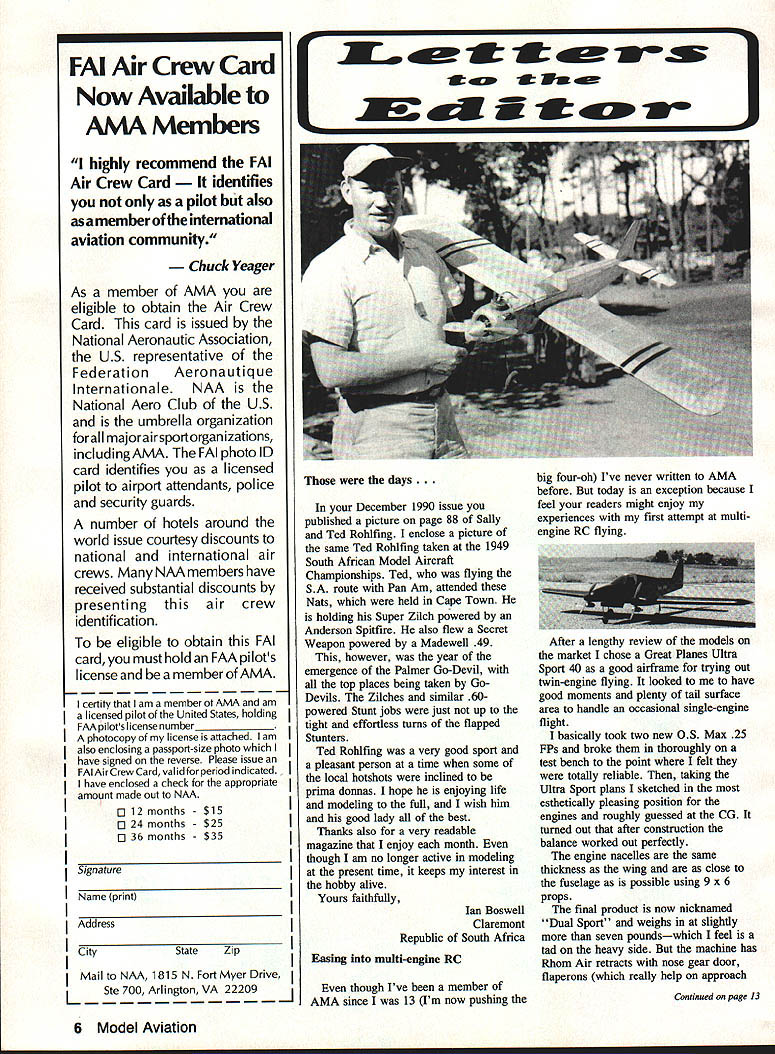
Picture of Ted Rohlfing
In your December 1990 issue you published a picture on page 88 of Sally and Ted Rohlfing. I enclose a picture of that same Ted Rohlfing, taken at the 1949 South African Model Aircraft Championships. Ted, who was flying the S.A. route with Pan Am, attended these Nats, which were held in Cape Town. He is holding his Super Zilch powered by an Anderson Spitfire. He also flew a Secret Weapon powered by a Madewell .49. This, however, was the year of the emergence of the Palmer Go‑Devil, with all the top places being taken by Go‑Devils. The Zilches and similar .60‑powered stunt jobs were just not up to the tight and effortless turns of the flapped Stunters.
Ted Rohlfing was a very good sport and a pleasant person at a time when some of the local hotshots were inclined to be prima donnas. I hope he is enjoying life and modeling to the full, and I wish him and his good lady all the best.
Thanks also for a very readable magazine that I enjoy each month. Even though I am no longer active in modeling at the present time, it keeps my interest in the hobby alive.
Yours faithfully, Ian Boswell Claremont Republic of South Africa
Easing into multi‑engine RC
Even though I've been a member of AMA since I was 13 (I'm now pushing the big four‑oh), I've never written to AMA before. Today is an exception because I feel your readers might enjoy my experiences with my first attempt at multi‑engine RC flying.
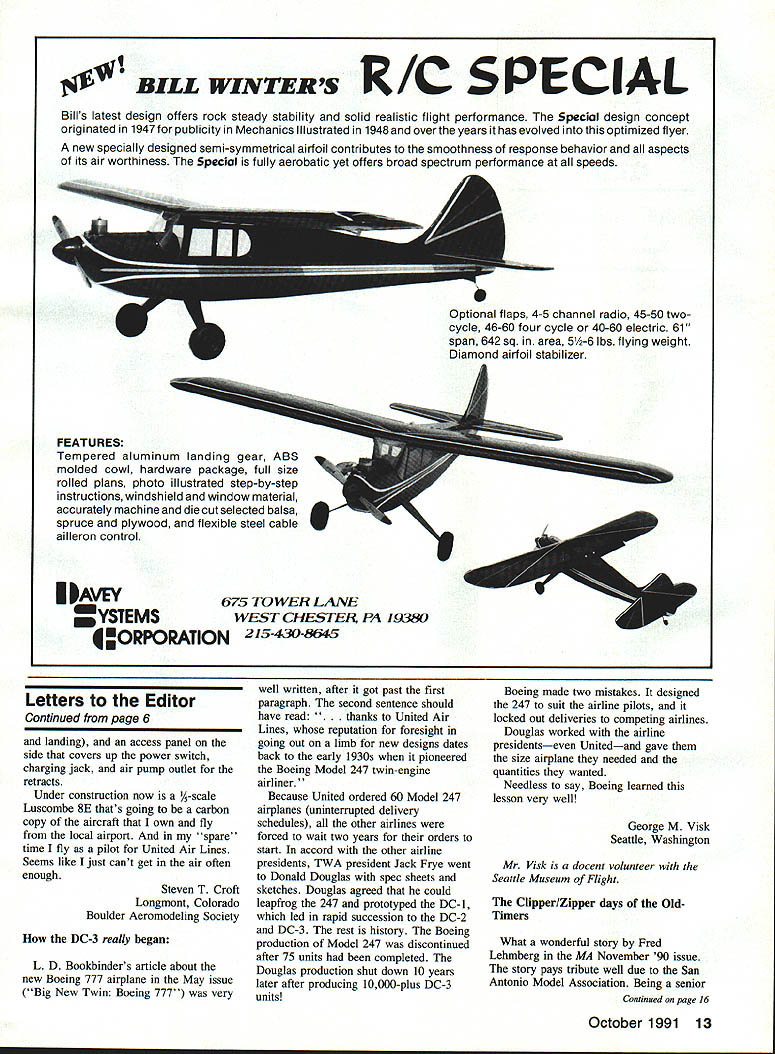
After a lengthy review of the models on the market I chose a Great Planes Ultra Sport 40 as a good airframe for trying out twin‑engine flying. It looked to me to have good moments and plenty of tail surface area to handle an occasional single‑engine flight.
I basically took two new O.S. Max .25 FPs and broke them in thoroughly on a test bench until I felt they were totally reliable. Then, using the Ultra Sport plans, I sketched in the most aesthetically pleasing position for the engines and roughly guessed the CG. It turned out that after construction the balance worked out perfectly.
The engine nacelles are the same thickness as the wing and are as close to the fuselage as possible using 9 x 6 props. The final product is now nicknamed "Dual Sport" and weighs slightly more than seven pounds — which I feel is a tad on the heavy side. The machine has Rhom Air retracts with a nose gear door, flaperons (which really help on approach and landing), and an access panel on the side that covers the power switch, charging jack, and air pump outlet for the retracts.
Under construction now is a 3/4‑scale Luscombe 8E that's going to be a carbon copy of the aircraft I own and fly from the local airport. In my "spare" time I fly as a pilot for United Air Lines. Seems like I just can't get in the air often enough.
Steven T. Croft Longmont, Colorado Boulder Aeromodeling Society
How the DC‑3 really began
L. D. Bookbinder's article about the new Boeing 777 airplane in the May issue ("Big New Twin: Boeing 777") was very well written, after it got past the first paragraph. The second sentence should have read: "...thanks to United Air Lines, whose reputation for foresight in going out on a limb for new designs dates back to the early 1930s when it pioneered the Boeing Model 247 twin‑engine airliner."
Because United ordered 60 Model 247 airplanes (uninterrupted delivery schedules), all the other airlines were forced to wait two years for their orders to start. In accord with the other airline presidents, TWA president Jack Frye went to Donald Douglas with spec sheets and sketches. Douglas agreed that he could leapfrog the 247 and prototyped the DC‑1, which led in rapid succession to the DC‑2 and DC‑3. The rest is history. Boeing production of the Model 247 was discontinued after 75 units had been completed. Douglas production shut down 10 years later after producing more than 10,000 DC‑3 units.
Boeing made two mistakes. It designed the 247 to suit the airline pilots, and it locked out deliveries to competing airlines.
Douglas worked with the airline presidents—even United—and gave them the size airplane they needed and the quantities they wanted.
Needless to say, Boeing learned this lesson very well.
George M. Visk Seattle, Washington
Mr. Visk is a docent volunteer with the Seattle Museum of Flight.
The Clipper/Zipper days of the Old‑Timers
What a wonderful story by Fred Lehmberg in the November 1990 issue. The story pays a fine tribute to the San Antonio Model Association. Being a senior modeler (71 years, 60 years modeling) I can well remember that great 1940 contest at Kelly Field, where the flagpole to the dirigible hangar was the thing to avoid (I didn't). The best thing of all was the association and lasting friendship of the modelers we had back in those days.
Not being from San Antonio, but from San Angelo 220 miles up the road (in Texas that's close), there was the great trip with three other modelers in John Casburn's Willys Americar and four six‑foot free flights. The Americar was about the size of a Volkswagen. John Casburn—remembered for his Miss Behave CL kits—started modeling here in San Angelo about 1937.
The old gang says that if you didn't model through the Clipper and Zipper days you are not an Old‑Timer. The days of the Southwest Gas Model Association mentioned brought back many fond memories. Fred, I believe you left out San Angelo and Brady as chapters.
In later years (1950 to 1979), as a hobby merchant, I had close associations with Ollie Philo, who stayed in the business. However: George Aldrich, how did you get in that 1985 reunion picture? (You're not that old . . .)
Thanks for printing a wonderful story.
Eldon Wilson San Angelo, Texas
CL Combat fan speaks
I was very pleased to see feature articles on CL Combat in several recent issues of Model Aviation. The article by Mr. Taib on the Caudimorax Combat ship in the December 1990 issue was highly informative and interesting. I also thoroughly enjoyed Mr. Rutherford's article on CL Combat in Russia. Keep these CL Combat articles coming!
I would also like to see Charlie Johnson's "CL Combat" column on a monthly rather than bimonthly basis. Thanks.
John R. Pezzulli New York, New York
There's more to modeling than RC!
Just a brief note in appreciation for the December 1990 Model Aviation cover not featuring some sort of nondescript RC model! That, plus the tag line "Supporting all form of model aviation," was very welcome.
Though I know RC pays the bills for MA and other magazines, it's nice to see other facets of modeling given a prominent display. Maybe we'll see some Control Line stuff on the cover once in a while too? I once asked about using a shot of my CL Smoother for the cover when my "Smoother" construction article ran. The answer was that editorial policy dictated having an RC model on the cover.
I always wondered about that policy, since MA isn't sold on any newsstands I've ever been to and in very few hobby shops.
As it is mailed directly to most buyers, what dollars‑and‑cents difference could a non‑RC cover make in terms of lost revenue? Anyhow, it was good to see a deviation from that old policy. Hey, you even avoided the cliché "pretty, sexy, barely‑clothed girl, too!" Good work! The inside stuff is good, too.
Tom Dixon Marietta, Georgia
More folks like the December '90 cover
I'm sure that all of us in the CL and FF categories were heartened to see the December cover! How refreshing to see a cover without the usual megabucks RC monster on it. Your phrase, "Dedicated to All Phases of Aeromodeling Activity," gives hope to those of us who have it up‑to‑here with the incessant emphasis on RC! Please continue this policy.
Mike Keville Mesa, Arizona
Safety notes
Regarding switching on the receiver before turning on the transmitter: I was taught to switch on the receiver first specifically for safety reasons. When these models are flying at the speeds they do and weigh as much as some of them do, I sure don't want to be responsible for locking the controls on one in the air and possibly having it crash into people on the ground.
Michael A. Mizer Bolivar, Ohio
Transcribed from original scans by AI. Minor OCR errors may remain.

