


Letters to the Editor
Oops!
Dear Editor:
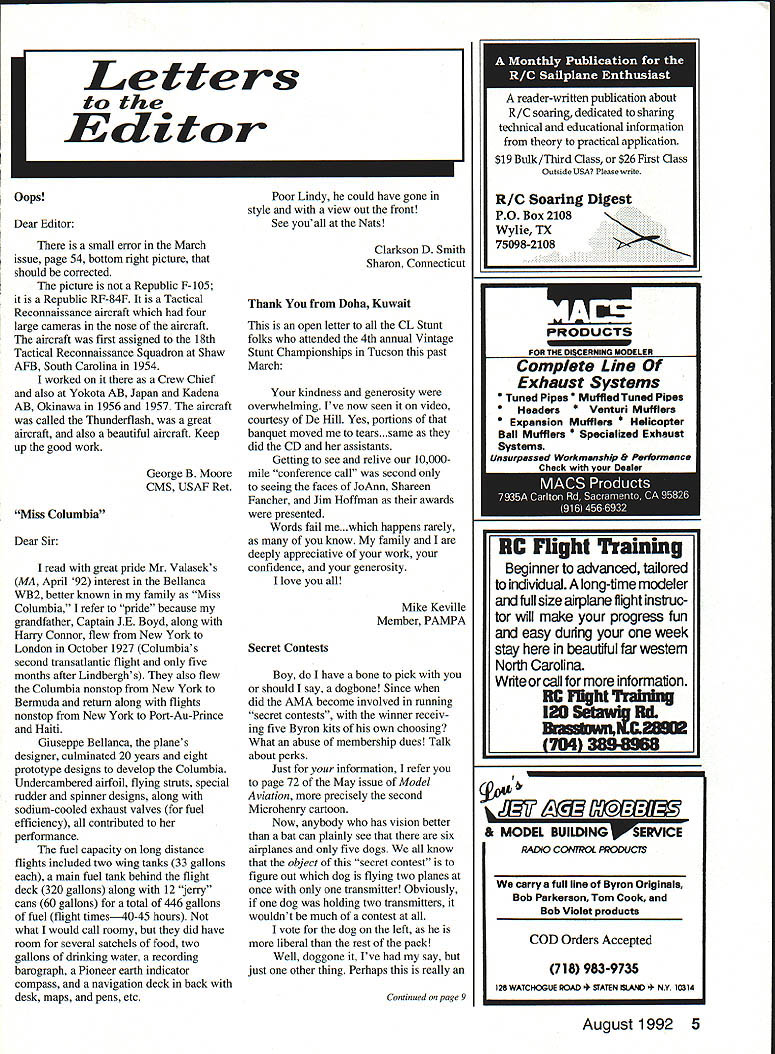
There is a small error in the March issue, page 54, bottom-right picture, that should be corrected.
The picture is not a Republic F-105; it is a Republic RF-84F. It is a tactical reconnaissance aircraft which had four large cameras in the nose. The aircraft was first assigned to the 18th Tactical Reconnaissance Squadron at Shaw AFB, South Carolina, in 1954.
I worked on it there as a crew chief and also at Yokota AB, Japan, and Kadena AB, Okinawa, in 1956 and 1957. The aircraft was called the Thunderflash, was a great aircraft, and also a beautiful aircraft. Keep up the good work.
George B. Moore CMS, USAF Ret.
"Miss Columbia"
Dear Sir:
I read with great pride Mr. Valasek's (MA, April '92) interest in the Bellanca WB-2, better known in my family as "Miss Columbia." I refer to "pride" because my grandfather, Captain J.E. Boyd, along with Harry Connor, flew from New York to London in October 1927 (Columbia's second transatlantic flight and only five months after Lindbergh's). They also flew the Columbia nonstop from New York to Bermuda and return, along with flights nonstop from New York to Port-au-Prince and Haiti.
Giuseppe Bellanca, the plane's designer, culminated 20 years and eight prototype designs to develop the Columbia. Undercambered airfoil, flying struts, special rudder and spinner designs, along with sodium-cooled exhaust valves (for fuel efficiency), all contributed to her performance.
The fuel capacity on long-distance flights included two wing tanks (33 gallons each), a main fuel tank behind the flight deck (320 gallons), along with 12 jerry cans (60 gallons) for a total of 446 gallons of fuel (flight times—40–45 hours). Not what I would call roomy, but they did have room for several satchels of food, two gallons of drinking water, a barograph, a Pioneer earth-indicator compass, and a navigation desk, maps and pens, etc.
Poor Lindy — he could have gone in style and with a view out the front! See you all at the Nats!
Clarkson D. Smith Sharon, Connecticut
Thank You from Doha, Kuwait
This is an open letter to all the CL Stunt folks who attended the 4th annual Vintage Stunt Championships in Tucson this past March:
Your kindness and generosity were overwhelming. I've now seen it on video, courtesy of De Hill. Yes, portions of that banquet moved me to tears... same as they did the CD and her assistants.
Getting to see and relive our 10,000-mile "conference call" was second only to seeing the faces of JoAnn, Shareen Fancher, and Jim Hoffman as their awards were presented.
Words fail me... which happens rarely, as many of you know. My family and I are deeply appreciative of your work, your confidence, and your generosity.
I love you all!
Mike Keville Member, PAMPA
Secret Contests
Boy, do I have a bone to pick with you—or should I say, a dogbone! Since when did the AMA become involved in running "secret contests," with the winner receiving five Byron kits of his own choosing? What an abuse of membership dues! Talk about perks.
Just for your information, I refer you to page 72 of the May issue of Model Aviation, more precisely the second Microhenry cartoon.
Now, anybody who has vision better than a bat can plainly see that there are six airplanes and only five dogs. We all know the object of this "secret contest" is to figure out which dog is flying two planes at once (one dog holding two transmitters). Obviously, if one dog was holding two transmitters, it would not be much of a contest at all.
Perhaps this is really an underhanded way of finding out how many of us are going to be taking advantage of the AMA eyeglass program. Well, keep your tails wagging — er, uh, I mean light — and send all the Byron kits to my house!
Jim Hobelsberger La Crescent, Minnesota
To Add to Your Information File (F-89 Scorpion)
Dear Editor:
On page 54 of your March 1992 issue, you describe the F-89 Scorpion as "the first all-weather interceptor plane in service with the U.S. Air Force." This is not correct. It would be more correct to say that the P-61 Black Widow was the first. This was followed by the P-82 Twin Mustang. Both of these aircraft were propeller-driven. The first jet all-weather interceptor was the F-94A Starfire, followed shortly by the F-94B. (For all practical purposes, both were the same airplane.) They carried four .50-caliber machine guns for armament. Then came the F-89C, the first version of the Scorpion. It carried six 20mm guns. Like the F-94A and B, it flew a "pursuit curve" attack—that is, from behind the quarry and required visual sighting through a gunsight.
Shortly thereafter came the F-94C Starfire, which carried 24 2.75" FFARs (folding-fin aerial rockets). The F-94C was a vastly different machine than the F-94A and B. It flew a 90-degree beam attack and visual sighting of the quarry was not necessary. However, unlike the F-89C, it lacked true all-weather niceties, such as wing and engine anti-icing, heated windshield, or even a windshield wiper.
The F-86D became operational about the same time, and it, too, carried 24 2.75" FFARs and attacked in a 90-degree beam approach. It also lacked true all-weather niceties. (It was the only single-seat fighter-interceptor; all the rest carried a crew of two: a pilot and an R/O [radar observer].)
The most formidable all-weather interceptor at the time of its introduction was the F-89D Scorpion. It carried 104 2.75" FFARs that could be launched in a 90-degree beam, computerized-firing attack. Visual sighting of the target was not required. The rockets could be fired in three bunches, two bunches, or one big salvo of all 104 at one time. (This salvo was equivalent to the broadside firepower of a Navy light destroyer!) Revell Models touts that the rockets could be fired individually. This is not true.
The F-89s had heated wings and engines for protection against in-flight icing, heated windshields, and even windshield wipers (just like airliners) for better cockpit visibility during low-visibility approaches and landings in the rain.
The F-89s also had two engines (along with afterburners) that made them much more reliable airplanes—especially when flying around in the mid-1950s in remote areas such as Alaska and Greenland. The F-89D was three times bigger and heavier than other front-line fighters of its day. It was easily the most sophisticated fighter of its time—the entire nose section was made up of "black boxes and computers." I was a 20-year-old fighter pilot in 1953. (Oops, I've given away my age.)
Starting in 1954, I flew the F-94A and B with the 449th Fighter Interceptor Squadron (Fairbanks, Alaska), and then flew the F-89D for an even greater period after the squadron converted. (The 449th flew F-82 Twin Mustangs prior to the F-94s.) The F-89D was truly a remarkable airplane with many state-of-the-art enhancements. Among other things, it had the first flight-control system that was 100% dependent on the hydraulic system. The speed brakes were actually the ailerons, which split apart and were called "decelerons." They could be opened to any degree (unlike other fighters' speed brakes which were either open or closed), and while open they continued to function as ailerons.
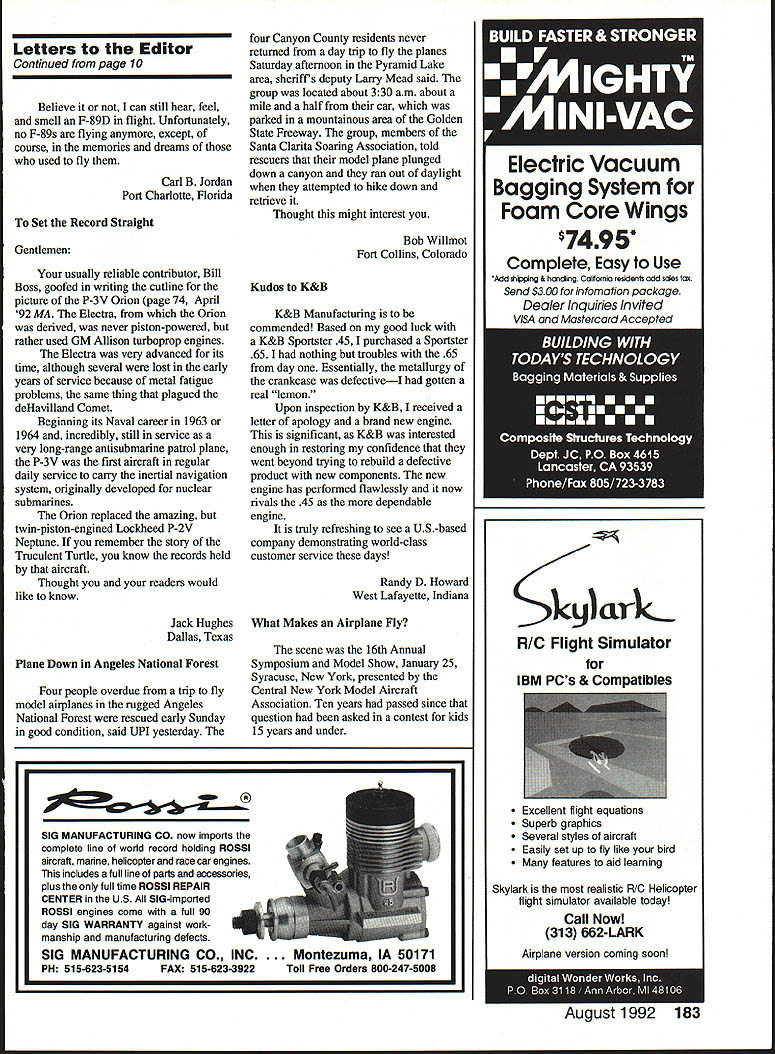
Believe it or not, I can still hear, feel, and smell an F-89D in flight. Unfortunately, no F-89s are flying anymore, except, of course, in the memories and dreams of those who used to fly them.
Carl B. Jordan Port Charlotte, Florida
A Satisfied Reader Comments
Dear Editor:
I want to thank and commend you for that superb article you published in the March/April issue of Model Aviation. It is the best I have seen after years of reading the model literature.
In one afternoon, it enabled me to make three troublesome models fly beautifully, simply by making the vertical tail small enough. Two of these were free-flight flying-scale models, and one was an original .051-powered gas duration model that wouldn't climb really steeply (it does now).
I hope you will publish other articles for us by that author. I am not an AMA member, so I borrow the magazine from a flying friend who is. I plan to join the AMA now or subscribe to the magazine.
We are in transit now (moving from Memphis to California), presently visiting relatives in Dallas, but as soon as we get located, you will be hearing from me again as to getting your magazine.
Patrick Johnson Dallas, Texas
To Set the Record Straight (P-3 Orion / Electra)
Gentlemen:
Your usually reliable contributor, Bill Boss, goofed in writing the cutline for the picture of the P-3V Orion (page 74, April '92 MA). The Electra, from which the Orion was derived, was not piston-powered but rather used Allison turboprop engines.
The Electra was very advanced for its time, although several were lost in the early years of service because of metal fatigue problems, the same thing that plagued the de Havilland Comet.
Beginning its naval career in 1963 or 1964 and, incredibly, still in service as a very long-range antisubmarine patrol plane, the P-3 was the first aircraft in regular daily service to carry the inertial navigation system, originally developed for nuclear submarines.
The Orion replaced the amazing, twin-piston-engined Lockheed P-2V Neptune. If you remember the story of the Truculent Turtle, you know the records held by that aircraft.
Thought you and your readers would like to know.
Jack Hughes Dallas, Texas
Plane Down in Angeles National Forest
Four people overdue from a trip to fly model airplanes in the rugged Angeles National Forest were rescued early Sunday in good condition, UPI reported.
Four Canyon County residents never returned from a day trip to fly planes Saturday afternoon in the Pyramid Lake area, sheriff's deputy Larry Mead said. The group was located about 3:30 a.m., about a mile and a half from their car, which was parked in a mountainous area off the Golden State Freeway. The group, members of the Santa Clarita Soaring Association, told rescuers that their model plane plunged down a canyon and they ran out of daylight when they attempted to hike down and retrieve it.
Thought this might interest you.
Bob Willmot Fort Collins, Colorado
Kudos to K&B
K&B Manufacturing is to be commended! Based on my good luck with a K&B Sportster .45, I purchased a Sportster .65. I had nothing but troubles with the .65 from day one. Essentially, the metallurgy of the crankcase was defective—I had gotten a real "lemon."
Upon inspection by K&B, I received a letter of apology and a brand-new engine. This is significant, as K&B was interested enough in restoring my confidence that they went beyond trying to rebuild a defective product with new components. The new engine has performed flawlessly and now rivals the .45 as the more dependable engine.
It is truly refreshing to see a U.S.-based company demonstrating world-class customer service these days!
Randy D. Howard West Lafayette, Indiana
What Makes an Airplane Fly?
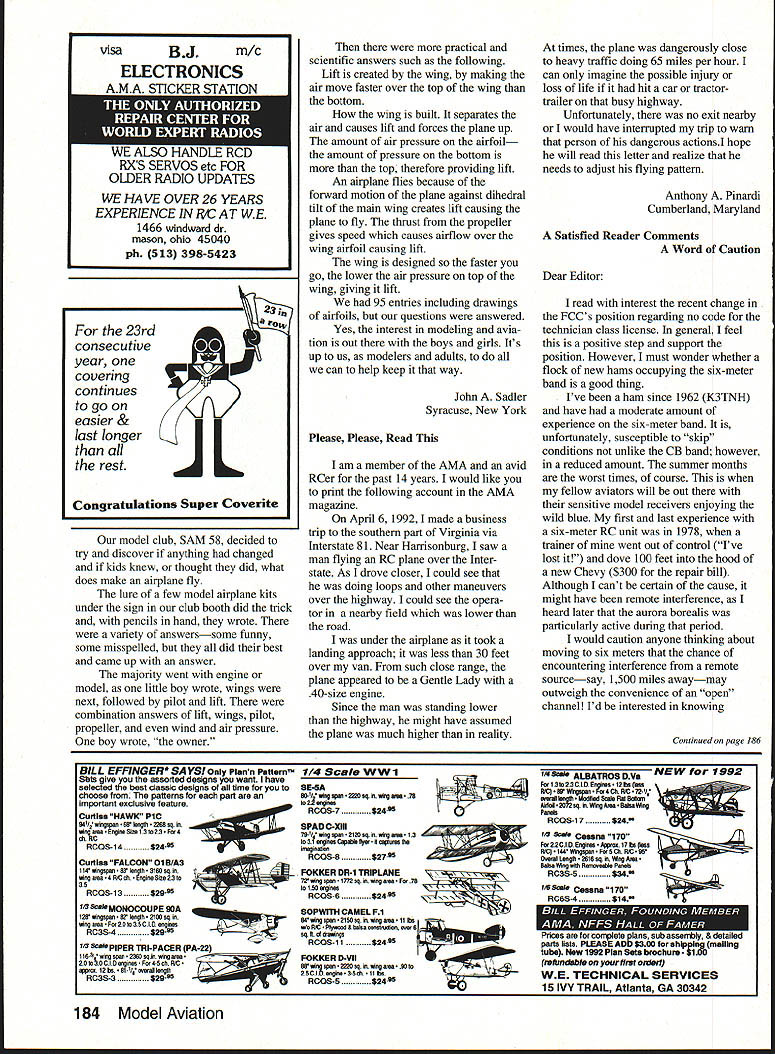
The scene was the 16th Annual Symposium and Model Show, January 25, Syracuse, New York, presented by the Central New York Model Aircraft Association. Ten years had passed since that question had been asked in a contest for kids 15 years and under.
Our model club, SAM 58, decided to try and discover if anything had changed and if kids knew, or thought they did, what makes an airplane fly.
The lure of a few model airplane kits under the sign in our club booth did the trick and, with pencils in hand, they wrote. There were a variety of answers—some funny, some misspelled, but they all did their best and came up with an answer.
The majority wrote "engine" or "motor"; wings were next, followed by pilot and lift. There were combination answers of lift, wings, pilot, propeller, and even wind and air pressure. One boy wrote, "the owner."
Here are some of the more practical and scientific answers:
- "Lift is created by the wing, by making the air move faster over the top of the wing than the bottom."
- "How the wing is built. It separates the air and causes lift and forces the plane up."
- "The amount of air pressure on the airfoil—the amount of pressure on the bottom is more than the top, therefore providing lift."
- "An airplane flies because of the forward motion of the plane; the dihedral tilt of the main wing creates lift causing the plane to fly. The thrust from the propeller gives speed which causes airflow over the wing airfoil causing lift."
- "The wing is designed so the faster you go, the lower the air pressure on top of the wing, giving it lift."
We had 95 entries including drawings of airfoils, but our questions were answered.
Yes, the interest in modeling and aviation is out there with the boys and girls. It's up to us, as modelers and adults, to do all we can to help keep it that way.
John A. Sadler Syracuse, New York
Please, Please, Read This
I am a member of the AMA and an avid R/Cer for the past 14 years. I would like you to print the following account in the AMA magazine.
On April 6, 1992, I made a business trip to the southern part of Virginia via Interstate 81. Near Harrisonburg, I saw a man flying an RC plane over the interstate. As I drove closer, I could see that he was doing loops and other maneuvers over the highway. I could see the operator in a nearby field which was lower than the road.
I was under the airplane as it took a landing approach; it was less than 30 feet over my van. From such close range, the plane appeared to be a Gentle Lady with a .40-size engine.
Since the man was standing lower than the highway, he might have assumed the plane was much higher than in reality.
At times, the plane was dangerously close to heavy traffic doing 65 miles per hour. I can only imagine the possible injury or loss of life if it had hit a car or tractor-trailer on that busy highway.
Unfortunately, there was no exit nearby or I would have interrupted my trip to warn that person of his dangerous actions. I hope he will read this letter and realize that he needs to adjust his flying pattern.
Anthony A. Pinnardi Cumberland, Maryland
A Word of Caution
Dear Editor:
I read with interest the recent change in the FCC's position regarding no code for the technician-class license. In general, I feel this is a positive step and support the position. However, I must wonder whether a flock of new hams occupying the six-meter band is a good thing.
I've been a ham since 1962 (K3TNH) and have had some experience on the six-meter band. It is, unfortunately, susceptible to "skip" conditions not unlike the CB band, though to a reduced amount. The summer months are the worst times, of course. This is when my fellow aviators will be out there with their sensitive model receivers enjoying the wide blue. My first and last experience with a six-meter RC unit was in 1978, when a trainer of mine went out of control ("I've lost it!") and dove 100 feet into the hood of a new Chevy ($300 for the repair bill). Although I can't be certain of the cause, it might have been remote interference, as I heard later that the aurora borealis was particularly active during that period.
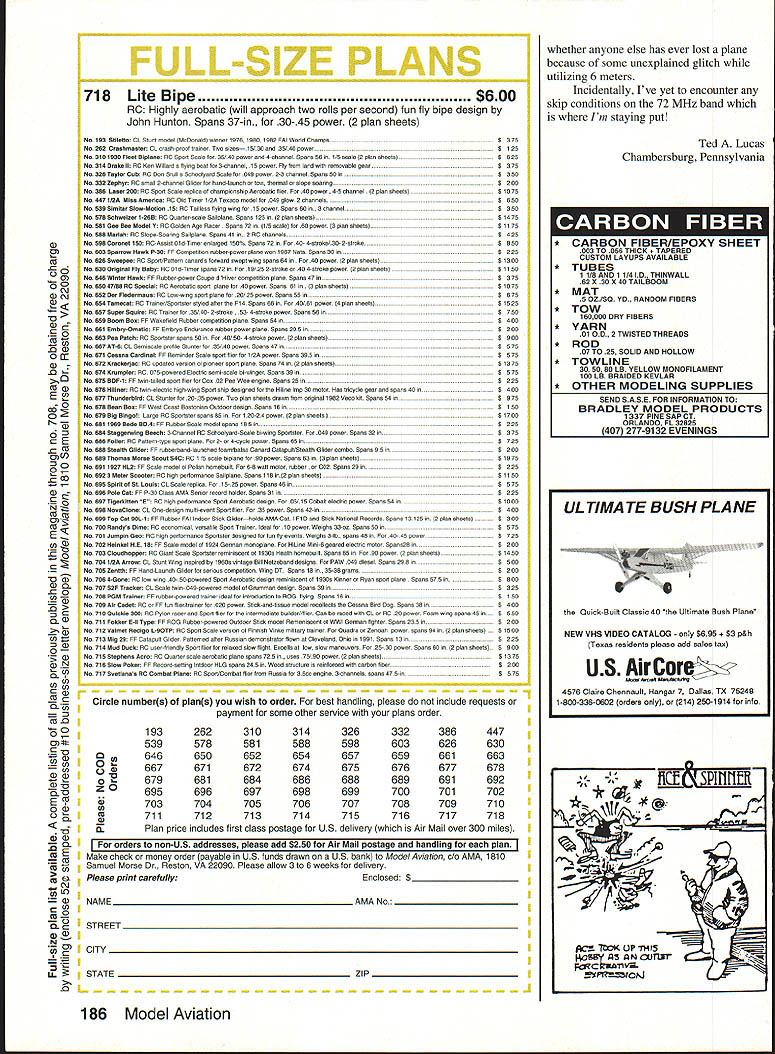
I would caution anyone thinking about moving to six meters that the chance of encountering interference from a remote source—say, 1,500 miles away—may outweigh the convenience of an "open" channel! I'd be interested in knowing whether anyone else has ever lost a plane because of some unexplained glitch while utilizing 6 meters.
Incidentally, I've yet to encounter any skip conditions on the 72 MHz band, which is where I'm staying put!
Ted A. Lucas Chambersburg, Pennsylvania
Transcribed from original scans by AI. Minor OCR errors may remain.

