
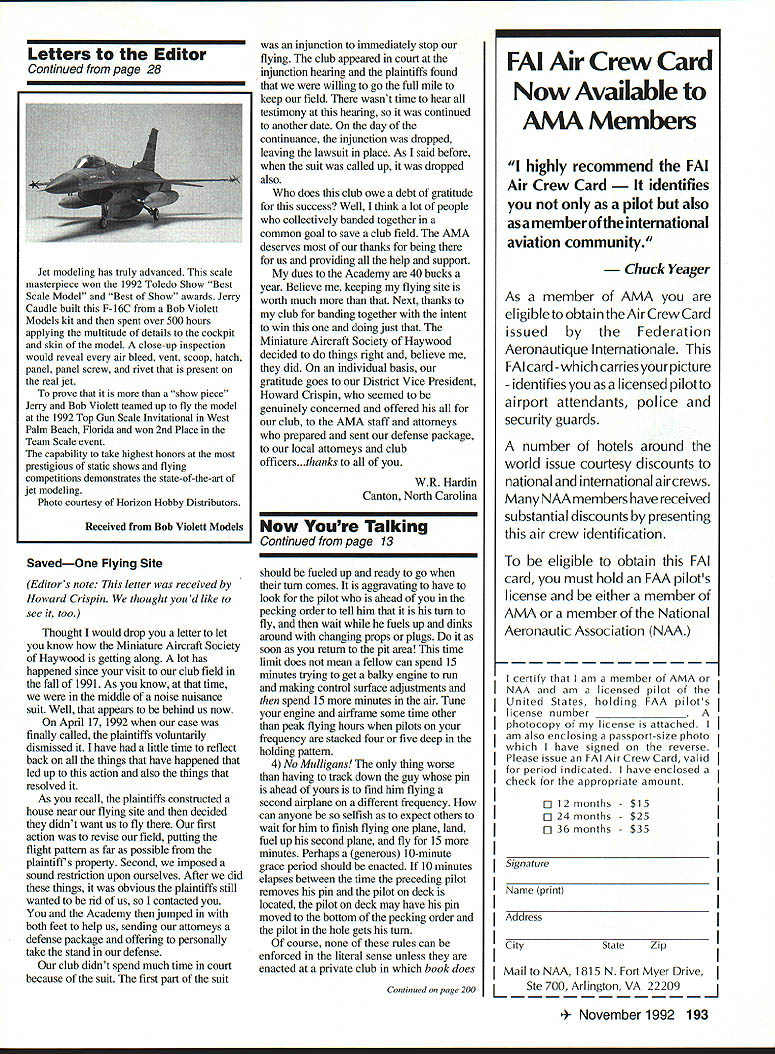
Letters to the Editor
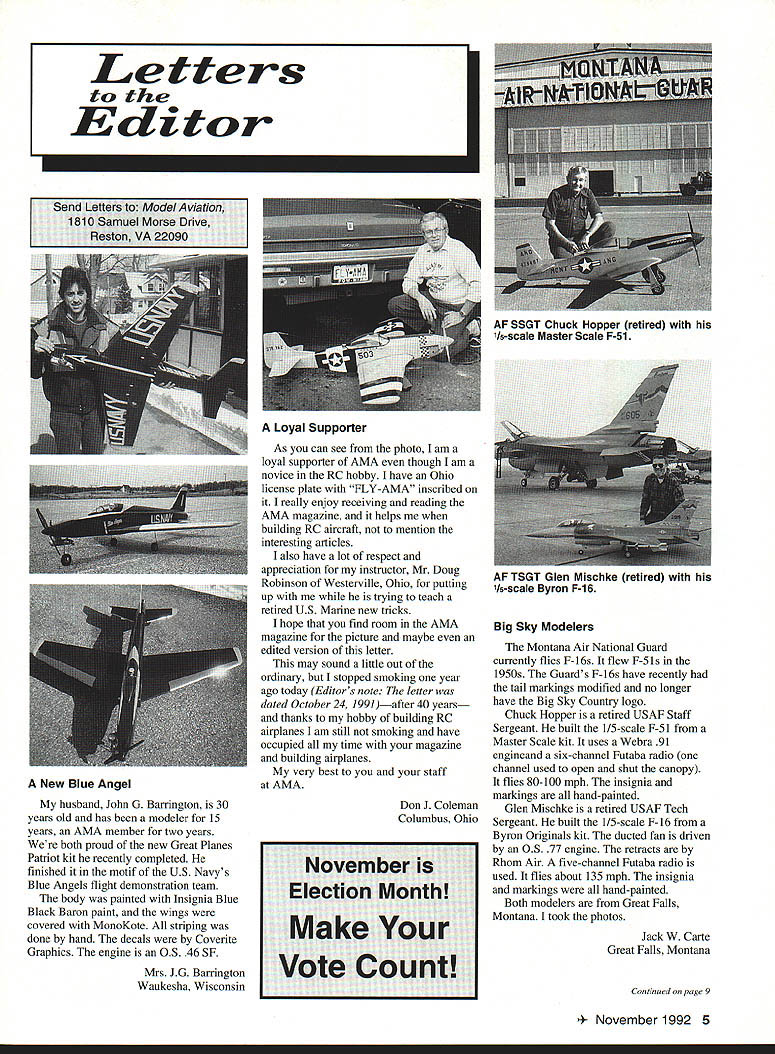
A New Blue Angel
My husband, John G. Barrington, is 30 years old and has been a modeler for 15 years, an AMA member for two years. We're both proud of the new Great Planes Patriot kit he recently completed. He finished it in the motif of the U.S. Navy's Blue Angels flight demonstration team. The body was painted with Insignia Blue Black Baron paint, and the wings were covered with MonoKote. All striping was done by hand. The decals were by Coverite Graphics. The engine is an O.S. .46 SF.
Mrs. J. G. Barrington Waukesha, Wisconsin
A Loyal Supporter
As you can see from the photo, I am a loyal supporter of AMA even though I am a novice in the RC hobby. I have an Ohio license plate with "FLY-AMA" inscribed on it. I really enjoy receiving and reading the AMA magazine, and it helps me when building RC aircraft, not to mention the interesting articles.
I also have a lot of respect and appreciation for my instructor, Mr. Doug Robinson of Westerville, Ohio, for putting up with me while he is trying to teach a retired U.S. Marine new tricks.
I hope that you find room in the AMA magazine for the picture and maybe even an edited version of this letter.
This may sound a little out of the ordinary, but I stopped smoking one year ago today (Editor's note: The letter was dated October 24, 1991) — after 40 years — and thanks to my hobby of building RC airplanes I am still not smoking and have occupied all my time with your magazine and building airplanes.
My very best to you and your staff at AMA.
Don J. Coleman Columbus, Ohio
Big Sky Modelers
The Montana Air National Guard currently flies F-16s. It flew F-51s in the 1950s. The Guard's F-16s have recently had the tail markings modified and no longer have the Big Sky Country logo.
Chuck Hopper is a retired USAF Staff Sergeant. He built the 1/5-scale F-51 from a Master Scale kit. It uses a Webra .91 engine and a six-channel Futaba radio (one channel used to open and shut the canopy). It flies 80–100 mph. The insignia and markings are all hand-painted.
Glen Mischke is a retired USAF Tech Sergeant. He built the 1/5-scale F-16 from a Byron Originals kit. The ducted fan is driven by an O.S. .77 engine. The retracts are by Rhom Air. A five-channel Futaba radio is used. It flies about 135 mph. The insignia and markings were all hand-painted.
Both modelers are from Great Falls, Montana. I took the photos.
Jack W. Carte Great Falls, Montana
He Also Does Cartoons
(Editor's note: Claude Reed's hilarious cartoons appear now and again in this magazine.)
This Spitfire was built from a Pica kit. It is powered by a SuperTigre .61 and flies just great—although it's not for beginners. I thought your readers might enjoy seeing what your sometimes-cartoonist builds and flies with a local club called the Hudson Area R/C Fliers.
Claude E. Reed North Adams, Michigan
Update on "Building Mufflers Made Easy"
I have been receiving phone calls about the muffler made of stainless steel flex tubing (Model Aviation, June 1992).
I bought the tubing at Peterson Industrial Products, Inc., 2300 N.W. 29th Avenue, Portland, OR 97210; (503) 222-9446.
Perhaps you could publish this address. I am sure a lot of modelers would appreciate it.
Martin J. Dietrich Beaverton, Oregon
Tom Hicks, Modeler
When I recently received my September issue of Model Aviation, I saw the "FF Minute Man" article and model design by Tom Hicks. If you or any of the membership were not aware, Tom Hicks suffered a debilitating stroke in the fall of 1991 and died in January 1992.
Tom and I corresponded several times a year by telephone and letter, since I last saw him back in the late seventies. Tom was an avid hand-launch glider flier and we often competed against one another at East Coast contests in those earlier years.
He was thrilled when he phoned to tell me of the purchase of his article/plan when Model Aviation purchased it for publication. I know he would have liked to see it as you published it in this past issue.
For Tom, I say thank you for making his dream come true.
Jim Kutkuhn Augusta, Kansas
Paint/Finish Precautions: Spray vs. Brush
(Editor's note: Are any readers authorities on this problem? We'll be glad to forward answers to the writer.)
Over the years, I have read a number of articles in Model Aviation warning of the hazards associated with the use of current finishing materials. It is my impression these dealt with anticipated spray-painting application methods.
I am embarking on an experimental aircraft construction project. It is infeasible to provide spray facilities with safe air circulation equipment and temperature control in my home. I would like to work year-round to expedite progress, so do not wish to be restricted to spray application during five to eight months of warmer weather in this locale.
My principal concern during construction is effective priming of structural metal parts before they are riveted together. This will be an ongoing procedure regularly carried out, but involving relatively small amounts of painted area because only a few parts will be involved on any given priming operation. I expect to use a self-etching primer.
My analysis is that the hazard of application of such materials presupposes spray painting. If they are brush-applied, presumably only volatile liquids go into the air; solids, the principal hazardous elements, remain deposited on the work. If the analysis is correct, it should be possible to safely apply primer of the type mentioned by brush without need for a mask or other than ordinary air circulation and household precautions.
In the late thirties, before most of us had access to spray equipment, I recall brushing nitrate dope on fabric-covered models (silk was used) with excellent results, although it undeniably took longer than spray application would have done.
My purpose in writing is to test my hypothesis. Why, in the admonitions for safe finishing procedures you have presented over the years, was it never suggested that brush application was safer and did not require sophisticated masks, etc.? Is my analysis wrong or have I overlooked something?
I realize I can inquire of the primer manufacturers (and I will do so), but it occurred to me that modelers are an even larger group of users and might have a useful perspective.
Noah S. Rosenbloom New Ulm, Minnesota
The First Big One
Here's the picture of my first big RC plane (wingspan is 65 in.). It weighs 7 1/2 lb with the retracts. I installed a K&B .61 with a 15-oz. fuel tank. It is a T-28B from a Pica kit. It hasn't been in the air yet. I'm now working on a Carl Goldberg Models Super Chipmunk kit.
Bud Lane Lakewood, Calif.
Where Are the Juniors? Here!
I am writing this letter to inform you that even your simpler model designs have a use. This summer I took on the task of directing the nature and science section of the Cub Scout day camp here in Muscatine. During this camp, we try to run programs and projects that will help the young scouts earn credit toward meeting their Wolf, Bear, and Webelos ranks, and for arrowhead points. In the Bear program for seven- and eight-year-old boys is a section on airplanes. One of the requirements is to describe the forces acting on an airplane and how a wing produces lift. As a retired science teacher of 40 years, I knew I could explain all this to them, but to have them remember what I said, they had to work with the information I gave them.
John N. Franke's "FF Freebie: Stunt Glider" in the July issue of Model Aviation seemed perfect. It was a simple design suited for mass production and easy to assemble (I only had the boys for 45 minutes at a time). Most important, the wings were made of foam found under meat in the supermarket. The foam is easy to sand to shape. In short, 54 Scouts formed airfoils and assembled their gliders, some better than others. All the gliders flew, some better than others. All the Scouts were enthusiastic, some more than others.
Afterward, several parents came to me and asked where they could purchase flying model kits for their boys. I was sorry to inform them I did not know of any place in Muscatine, nor could I tell them of an organized activity for young boys interested in building flying models.
When I was a boy in the thirties, we had model airplane clubs in school and model airplane contests at school. (We loved to fly our smaller models in the large gym.) When I started teaching in a high school in the fifties, I organized a model airplane club. (I still have a Kenhi Bobcat I built then, and still fly occasionally. It is 40 years old.)
Later while teaching in college in the '60s, I had my students building rockets, and they loved it, both the men and women. I guess nowadays young people have to break into flying model building on their own. Come to think of it, that is the way I got started.
Vernon Ohlendorf Muscatine, Iowa
P.S. I have used the AMA Cub flying model in Cub Scout dens with great success. It is a great model for beginners.
Saved — One Flying Site
(Editor's note: This letter was received by Howard Crispin. We thought you'd like to see it, too.)
Thought I would drop you a letter to let you know how the Miniature Aircraft Society of Haywood is getting along. A lot has happened since your visit to our club field in the fall of 1991. As you know, at that time, we were in the middle of a noise nuisance suit. Well, that appears to be behind us now.
On April 17, 1992, when our case was finally called, the plaintiffs voluntarily dismissed it. I have had a little time to reflect back on all the things that have happened that led up to this action and also the things that resolved it.
As you recall, the plaintiffs constructed a house near our flying site and then decided they didn't want us to fly there. Our first action was to revise our field, putting the flight pattern as far as possible from the plaintiffs' property. Second, we imposed a noise restriction upon ourselves. After we did these things, it was obvious the plaintiffs still wanted to be rid of us, so I contacted you. You and the Academy then jumped in with both feet to help us, sending us attorneys, a defense package and offering to personally take the stand in our defense.
Our club didn't spend much time in court because of the suit. The first part of the suit was an injunction to immediately stop our flying. The club appeared in court at the injunction hearing and the plaintiffs found that we were willing to go the full mile to keep our field. There wasn't time to hear all testimony at this hearing, so it was continued to another date. On the day of the continuance, the injunction was dropped, leaving the lawsuit in place. As I said before, when the suit was called up, it was dropped also.
Who does this club owe a debt of gratitude for this success? Well, I think a lot of people who collectively banded together in a common goal to save a club field. The AMA deserves most of our thanks for being there for us and providing all the help and support.
My dues to the Academy are 40 bucks a year. Believe me, keeping my flying site is worth much more than that. Next, thanks to my club for banding together with the intent to win this one and doing just that. The Miniature Aircraft Society of Haywood decided to do things right and, believe me, they did. On an individual basis, our gratitude goes to our District Vice President, Howard Crispin, who seemed to be genuinely concerned and offered his aid for our club, to the AMA staff and attorneys who prepared and sent our defense package, to our local attorneys and club officers... thanks to all of you.
W. R. Hardin Canton, North Carolina
Transcribed from original scans by AI. Minor OCR errors may remain.

