
Letters to the Editor
Send letters to: Model Aviation, 1810 Samuel Morse Drive, Reston, VA 22090
$25 Reward
ATTENTION, USAF KOREAN VETS—I need the USAF registration number of the Douglas RB-26C Lonesome Lili. The aircraft was assigned to 67th TAC Recon. Wing, Kimpo AB (K-14), 1952–1954 for weather and recon. Legible photo/slide, color preferred, for authentication.
R. H. Langill P.O. Box 162 Plainfield, NH 03781 (603) 675-6938
MA Adds Another Dimension
Mr. Hugh Maxwell's two-part article about radio-controlled drones in WWII was fascinating. His well-written and illustrated story added greatly to our knowledge of a little-known aspect of aviation in general and model aviation in particular.
Model Aviation continues to publish articles on unconventional subjects, greatly adding depth and breadth to our hobby. I look forward to each new issue anticipating the unusual, and I am seldom disappointed.
Jan P. Koniarek Briarcliff Manor, New York
Junkbox Air Compressor
Our 12-year-old son is a member of the AMA and receives your publication each month. As a dutiful parent I read his mail of this sort. Included are Boys' Life, World (National Geographic), Scouting and others.
To put it mildly, I was shocked and extremely disappointed by the recent article on page 188 describing the "Junkbox Air Compressor." Articles of this sort have no business in any publication, let alone in one that can mold the ideas of young people.
What you have outlined is the procedure for building a bomb! Evidently the author has never seen the havoc that can be produced by the rupture of a pressure vessel when used in a manner other than for which it was intended.
I could go on at length regarding the entire article and the many violations of wise and prudent engineering. These range from the use of a salvaged tank with God-only knows what pressure capacity, a drive system with no belt guard, a soft-soldered plumbing line, to using a microwave to dry out the desiccant when it becomes waterlogged.
Suffice to say, I hope that you use more discretion when reviewing submittals for your fine publication.
Michael Oswalt Father of James Michael Oswalt AMA #420860 Vacaville, CA
I am sending this letter in regard to the "Junkbox Air Compressor" article.
On page 188 of your November issue, there is an article showing how to make a "homemade" compressor. The article shows using an empty refrigerant cylinder for an air storage tank. Refrigerant cylinders should not be used as air tanks. Air contains moisture; air-holding tanks have a drain to remove this moisture. More importantly, air-holding tanks are coated on the interior. The coating prevents rust from forming. Refrigerant is dry and free from moisture. Therefore refrigerant tanks are bare steel inside. When these tanks are exposed to moisture, they will rust from the inside out. This will go undetected. When the tank gets weak, it will explode and could cause great damage and bodily harm. Even with 60 lb. of pressure, a tank of this size can explode with a tremendous amount of force.
There used to be a kit on the market to convert refrigerant tanks to air tanks. For the reason given above, these kits were taken off the market. Even if you run the air through driers and try to separate the moisture, you can't get all the moisture out of the air.
Spend a few extra dollars and purchase an air-holding tank. You could save someone's life or possibly your own.
Randy Sciuto Refrigeration Products Manager Crescent Parts & Equipment Co., Inc. St. Louis, Missouri
"Golden Age" Amplification
Regarding Don Berliner's "The Golden Age of Air Racing" article in your September 1992 issue: The exceedingly successful replica 1932 Gee Bee R-1 was built by Steve Wolf and crew at Wolf Aircraft of Creswell, Oregon. Wheel pants and wing ribs were built by the R-2's owner, Delmar Benjamin, of Shelby, Montana.
First test flights were made on December 23, 1991 by Delmar Benjamin, followed by his busy 1992 air show schedule in which he has been flying his Gee Bee R-2 all over the U.S. (including Oshkosh), performing acrobatics that are dispelling 60 years of bad Gee Bee myths and stunning the appreciative public who never dreamed they would get to see a Gee Bee "R" fly!
Steve Wolf and Delmar Benjamin excel in their achievements.
Vern Clements Caldwell, Idaho
Information File Update
The letter from Carl B. Jordan in the August 1992 issue in which he wants to add to your information file is very good; however, somewhat in error.
With regard to all-weather aircraft and interceptors, I believe that the F-94s were the first to be designated; Mr. Jordan forgets that the P-61 and the radar-equipped P-82s were designated night fighters.
I flew the F-82F and it had no better weather capability than the P-51, which was nothing compared to what was available in the 1960s.
We flew at night, but had the same minimums for flying (takeoffs and landings) as did the day fighters. There were few GCAs around in the late 1940s, and the ones that were around worked only part of the time.
It should be noted that the first version of the F-89 was the F-89B model, not the F-89C as stated. The first F-89Bs were assigned to the 78th Fighter Group, Hamilton AFB, California, and I flew them in the 84th Fighter Squadron.
Now we have a complete information file.
Archie Caldwell Grass Valley, California
AMA Members' Photo Album
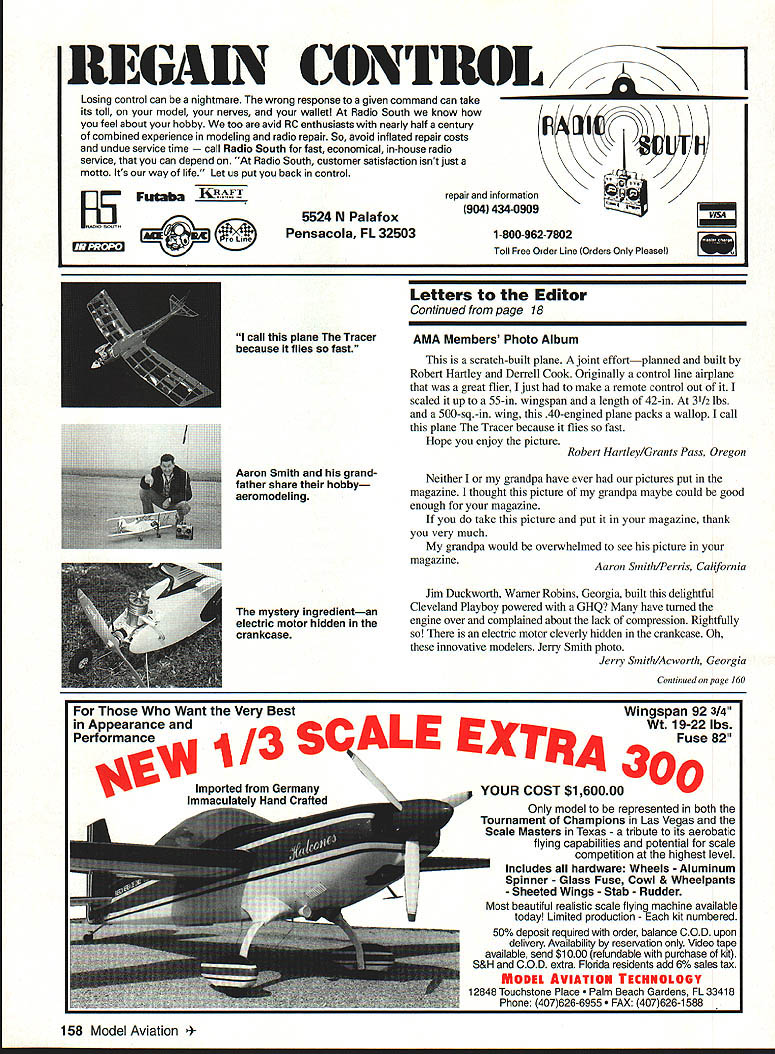
This is a scratch-built plane. A joint effort—planned and built by Robert Hartley and Derrell Cook. Originally a control-line airplane that was a great flier, I just had to make a radio control out of it. I scaled it up to a 55-in. wingspan and a length of 42 in. At 3 1/2 lbs. and a 500-sq.-in. wing, this .40-engined plane packs a wallop. I call this plane The Tracer because it flies so fast.
Hope you enjoy the picture.
Robert Hartley Grants Pass, Oregon
Neither I nor my grandpa have ever had our pictures put in the magazine. I thought this picture of my grandpa maybe could be good enough for your magazine.
If you do take this picture and put it in your magazine, thank you very much. My grandpa would be overwhelmed to see his picture in your magazine.
Aaron Smith Perris, California
Jim Duckworth, Warner Robins, Georgia, built this delightful Cleveland Playboy powered with a GHO? Many have turned the engine over and complained about the lack of compression. Rightfully so! There is an electric motor cleverly hidden in the crankcase. Oh, these innovative modelers.
Jerry Smith Acworth, Georgia
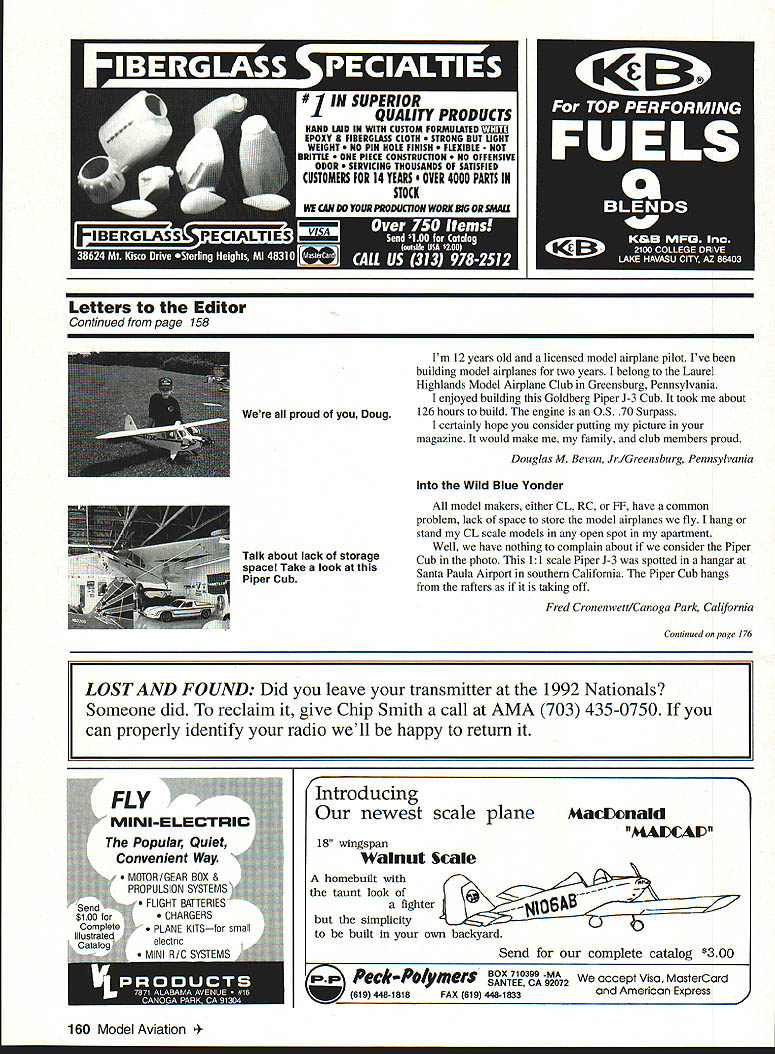
I'm 12 years old and a licensed model airplane pilot. I've been building model airplanes for two years. I belong to the Laurel Highlands Model Airplane Club in Greensburg, Pennsylvania.
I enjoyed building this Goldberg Piper J-3 Cub. It took me about 126 hours to build. The engine is an O.S. .70 Surpass.
I certainly hope you consider putting my picture in your magazine. It would make me, my family, and club members proud.
Douglas M. Bevan, Jr. Greensburg, Pennsylvania
Into the Wild Blue Yonder
All model makers, either CL, RC, or FF, have a common problem: lack of space to store the model airplanes we fly. I hang or stand my CL scale models in any open spot in my apartment.
Well, we have nothing to complain about if we consider the Piper Cub in the photo. This 1:1 scale Piper J-3 was spotted in a hangar at Santa Paula Airport in southern California. The Piper Cub hangs from the rafters as if it is taking off.
Fred Cronenwett Canoga Park, California
Glad You Like It
Your cover design for the September 1992 Model Aviation was right on target. Randy Archer really deserves it. Of course, I am a little biased because the subject was FAI Power World Champion.
Apart from that, what better way to encourage dedicated competitors in any type of model flying than to give them recognition on your magazine covers. It takes a lot of blood, sweat, and tears to achieve that level of world-class competition. I hope to see other world-class models—R/C, gliders, control line, etc.—gracing your covers. Sometimes (most times) the only recompense is the respect and recognition given by fellow modelers.
Model Aviation has done more of this type of modeler publicity than any of the model magazines. I do appreciate your not using psychedelic colors and mishmash to attract attention.
Incidentally, please put the winner's model in his hands, not a nosegay of flowers. Keep up the good work.
Larry Conover Longmont, Colorado
Transcribed from original scans by AI. Minor OCR errors may remain.

