

Letters to the Editor
He's Done It Again!
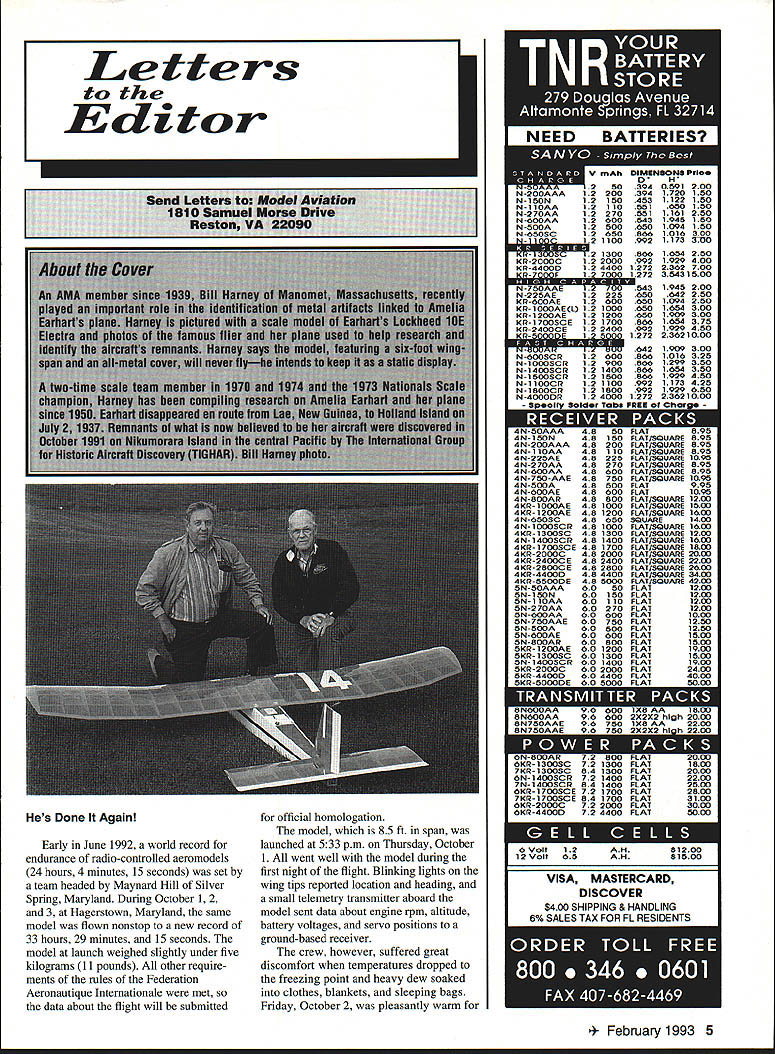
Early in June 1992 a world record for endurance of radio-controlled aeromodels (24 hours, 4 minutes, 15 seconds) was set by a team headed by Maynard Hill of Silver Spring, Maryland. During October 1–3 at Hagerstown, Maryland, the same model was flown nonstop to a new record of 33 hours, 29 minutes, 15 seconds. The model at launch weighed slightly under five kilograms (11 pounds). All other requirements of the rules of the Fédération Aéronautique Internationale were met, so the data about the flight will be submitted for official homologation.
The model, which has an 8.5 ft. span, was launched at 5:33 p.m. on Thursday, October 1. All went well during the first night of the flight. Blinking lights on the wingtips reported location and heading, and a small telemetry transmitter aboard the model sent data about engine rpm, altitude, battery voltages, and servo positions to a ground-based receiver.
The crew, however, suffered great discomfort when temperatures dropped to the freezing point and heavy dew soaked into clothes, blankets, and sleeping bags. Friday, October 2, was pleasantly warm for a time, but the crew had to contend with bothersome thermal currents. Steep, hazardous dives at low throttle and nearly full-throttle power were alternately needed to stay at safe altitudes. Jubilant shouts rose when the crew's 24-hour record was surpassed at 5:39 p.m. Sunset (7 p.m.) brought calmer air, welcome after hectic battles with thermals.
Preflight expectation was that the model would stay aloft about 40 hours, at least until daybreak Saturday, October 3. Often, however, Murphy's Law took over: the model's engine stopped prematurely. Spotlights were quickly aimed at the model; sleepy, cold, wet timers snapped to attention. The model landed dead-stick at 3:15 a.m. Saturday, October 3, about 20 meters from the launch point, having been aloft 33 hours, 29 minutes and 15 seconds.
Maynard Hill, designer, builder and pilot of the model and past president of the Academy of Model Aeronautics, has established 20 world records for R/C models during the past three decades. He currently holds records for distance (283 miles), altitude (26,980 ft.), speed (closed course, 150.3 mph) and seaplane altitude (18,980 ft.).
John Patton Frederick, Maryland
---
Hear! Hear!
Well done. I really liked the November 1992 issue pictures of the Nationals.
Roger J. Schroeder Overland Park, Kansas
---
Thank Walt Van Gorder
Thank Walt Van Gorder for his update. I enjoyed Mr. Van Gorder's "Pieces Revisited" in the November '92 issue; the author was thoughtful and gave thanks to many helpers. One major helper who was overlooked, however, is Wallace Miller of Coeur d'Alene, Idaho, who created the EZB model 30 years ago. It is still able to lift and fly models, and for many years he has been instructing others (myself included). The joy of building and flying the not-necessarily-easy EZB warrants giving him credit and recognizing his contribution to the sport.
Bob Edwards Coeur d'Alene, Idaho
---
Some Thoughts on the Junkbox Air Compressor
I found Joel Hamm's junkbox air compressor interesting; however, there are some flaws. The first and most important is the use of PVC pipe (especially drain pipe) for any compressed gas (air) application. It can explode like a hand grenade and be just as lethal.
A single-stage compressor at 100 psig can have discharge temperatures around 300°F. The temperature will decrease as the pressure drops. An air-cooled compressor normally has a cooling fan; without this, temperatures could be even higher.
Safety valves are just that. Make sure you have a safety valve between the compressor discharge and any shutoff valve.
Moisture is easily removed by reducing the temperature. This changes the moisture vapor into liquid form where it can be removed via a drain.
There are formulas for sizing motors and drive systems. I personally prefer the compressor rpm to be between 500 and 1,000 rpm.
Because of the combustion area this will change rules of thumb; however, if you divide the piston displacement (see formula) by five, you should not overload the electric motor.
Please remember compressed air is dangerous if not handled properly. Treat it with respect, and it can be of great value.
- Comp. rpm = motor pulley p.d. × motor rpm / comp. pulley p.d.
- Motor pulley p.d. = comp. pulley p.d. × comp. rpm / motor rpm
- Comp. pulley p.d. = motor pulley p.d. × motor rpm / comp. rpm
- Motor rpm = comp. pulley p.d. × comp. rpm / motor pulley p.d.
- Piston displacement (cu. ft./min.) = (cyl. bore in. × cyl. bore in. × stroke in. × rpm) / 2200
*Piston displacement for multi-stage compressors—only the low-pressure cylinders are considered.*
Always think safety around spinning props and compressed air.
My background? Over 25 years in service and sales of compressed air systems.
Bruce Morse Auburn, Maine
---
Paint Thinner Fumes ARE Risky
This is in response to the letter from Noah Rosenbloom in the November 1992 issue of MA about the danger from inhaling paint thinner fumes.
I can tell Noah from personal experience that breathing the vapor given off by "modern" solvents such as xylene and toluol can be highly damaging. It doesn't matter whether the paint gets sprayed or brushed. In either case the vapor passes into the surrounding atmosphere—the air you breathe.
I foolishly brush-painted some small model parts in a confined area a few years ago. As a result of inhaling the evaporating thinner fumes, I suffered three or four days of disorientation, temporary memory loss, and dizziness.
The health of a friend of mine was permanently ruined by longer exposure to xylene/toluol fumes from a large brush-painted project. His lungs, liver, and overall body chemistry were affected, and he's been unable to work for years.
In the good old days we got away with brush-doping indoors with nitrate dope, because the thinner was acetone or a similar solvent. These chemicals are organic and essentially free from long-term effects. In fact, human body chemistry actually produces acetone under certain conditions (ketosis).
Modern dope (and primer) uses toxic thinners, such as xylene, because the resins under the finish are different from the old nitrocellulose type. Today's paint finishes are nonflammable, long-lasting, and resistant to alcohol—but they do require poisonous (that's what "toxic" means) chemicals to thin them to brushing or spraying consistency.
Joe Wagner New Wilmington, Pennsylvania
Letters to the Editor (Continued from page 11)
Write to PAMPA at . . .
Quick note of thanks for the great article on Windy Urtnowski's Cardinal. Also a short correction which we at PAMPA would appreciate having published.
On page 191, Windy's text asks readers to write for membership info on PAMPA to Mike Keville. This information is a little dated. I suspect it was true at the time Windy wrote the article (I noticed the latest date on the plans was 1989).
Our current secretary/treasurer and the person to whom membership inquiries should be sent is:
Tom Morris, Secretary/Treasurer PAMPA 1019 Creek Trail Anniston, AL 36206
PAMPA thanks you in advance for publishing this correction.
Ted Fancher, President Foster City, California
---
Another Answer—Same Risk
This is a hasty response to serious questions/statements relative to the biological safety of finishing materials raised in a letter by N. S. Rosenbloom (New Ulm, Minnesota) published in November '92.
As a preface, I have been an aircraft constructor since my first rubber-powered free flight (c. 1932), including scratch-built, large-scale RC as well as a full-size craft. I've been involved with aviation since Naval Air Service in WWII, and have flown sailplanes with the MIT club (MITSA) since the mid-seventies. Recently, two of us flew a 600-hp restored '41 Stearman coast to coast, from Lawrence, Massachusetts to Palomar, California (below ground level in the Grand Canyon). I'm a materials and applications junkie.
Taken in the order stated by Mr. Rosenbloom:
To a greater or lesser degree, all finishing materials (and many adhesives, such as solvent-based contact types, spray, epoxy, etc.) must be considered injurious to human health—the macho factor of youth (presumed "invulnerability") and the profitability factor of manufacturing suppliers notwithstanding. As we are realizing daily with other toxics common in the American landscape, the injury (e.g., cancer) shows up long after the chemical insult.
Liquid finishing materials—finely divided resin(s)-binder and solvent—often contain one or more of the following:
- acetone
- ethyl acetate / alcohol / etc.
- methanol
- methyl ethyl ketone / butanone / etc.
- toluene / toluol (cresol)
- urethanes
- xylene / xylol
They may be packaged as enamels, A/C dope, epoxies, alkyds, acrylics, urethanes and/or other coatings.
All of these materials fume while curing or air-drying, presenting undesirable volatiles to our unknowing respiratory system, and thence to interior organs. Whether brushed, rolled, or sprayed, the larger the wetted surface, the more intense the biological risk. A sculptor once made all of his life-size work from cloth saturated with polyester resin. After near-fatal illness, he can no longer be near any volatilizing solvent without becoming seriously ill.
Spraying fills the work atmosphere with finely divided "mist" paint. Etching involves the eating action of a mordant such as acid. "Self-etching" primers are active enough to microscopically burrow at the surface of metal. Those chemicals will be breathed in the workplace.
To say that "only the volatile liquids go into the air... hazardous elements remain deposited..." is, alas, not a true description of toxics. The object in an intimate coating mixture is to have all elements bind together to retain an integral surface. The question is how much base material is carried up in the thermal of volatilization, until the process finally stops with polymerization or catalysis.
The point is not to cause fear, but to recognize what the finishing process demands and, using appropriate tools, do what is required. Having a serious, lifetime fondness for the perfume called "nitrate dope," it is difficult to put on my sci-fi-looking Norton respirator. Over time I've come to treat it as just another tool—the belt sander or my band saw. It is a two-canister (filters) face-fitted rubber mask rated for Dusts and Mists by the U.S. Bureau of Mines. Forget the paper "muffin cup" workman "mask"—for any application: they are designed to make you feel good about "taking precautions." They will not protect your body. Rule of thumb is: if you can smell the work INSIDE the mask, it's not working.
The work setup should be arranged to provide a fresh-air flow at your back which streams past the workpiece into a window-mounted exhaust fan. Any fan setup is better than none. (Don't forget that the area work light can't be too bright and that most finishes like the ambient warm—as well as dry.)
Asking manufacturers if their products will make you sick has not enjoyed a glorious history of Lincoln-esque responses. I have had a great deal of head-patting avoidance from producer/sellers—in place of facts requested to keep my family healthy. Let the buyer beware means it is usually up to the user to bring his or her toxics awareness up to speed. Your library, high school or college chemistry department, agricultural experiment station, public health department, or state/city medical facilities will answer questions about chemical risk.
The bottom line is that by doing a proper "preflight," and "suiting-up"—like using the seat belt in an open-cockpit biplane—the work will proceed without any risk of slow and silent serious injury. Imagine all those 94-year-olds with no neurological disorders, launching tissue-covered Luscombes into a windless summer sky, with arms (and lungs) that still work.
Harris Barron Brookline, Massachusetts
---
Lost—But Not Forgotten
Having just returned from a month-long vacation in England (and having visited Ron Prentice at his home in Taunton), I was fortunate to attend two vintage model meets. The first was an OT meet at Old Warden aerodrome and the second just north of Birmingham.
The Birmingham meet was a SAM event for OT CL models. One model at that contest was a 1943 CL speed model powered by a McCoy .60 on spark ignition. The name of the model escapes me, but the designer was Don Newberger of the U.S.
As a youngster in 1948, I watched Don Newberger fly his speed models at our flying field in South Gate (southern California). I especially remember the day that one of his .60-powered speed models broke loose and punched a neat hole in a concrete wall that surrounded the flying field.
If any reader can give me a line on Don Newberger, I would like to get in touch with him, if he is still around.
Floyd E. Carter 2029 Crist Drive Los Altos, CA 94024
---
Correction to Baker November MA Article
Overall I was very pleased with the way my electric OT article was handled in the November '92 issue.
I would like to correct one error in the captions. I included the photo of the rubber-powered Hi-Ho to make the point that since the rules do not exclude rubber-powered designs, I assume they would be legal. However, Mr. Phelps has not yet "electrified" his, as the caption suggests. The only typo in the text that I noticed is sort of amusing, as Long Cabin (designed, I assume, by a Mr. Long) came out as Log Cabin. Hope no one wears himself out a brazzle looking for plans for a Log Cabin!
Bill Baker Norman, Oklahoma
---
Boy Scouts Treated to Unexpected Souvenirs
This past summer, the Alvin R/C Club was contacted by the local Boy Scout troop. They were having a jamboree and invited the club to demonstrate remote-control airplanes. Those who participated were Jack Larsen (flying a Morrisey), Jack Gillespie (showing a Yard Dart), and myself, Skip Evans, with my Sweet and Lo airplane.
There were approximately 100 Boy Scouts eagerly awaiting our demonstration when we arrived. Jack Gillespie demonstrated his Yard Dart while Jack Larsen and I prepared our big birds for flight. After the Yard Dart demonstration, I took off with my Sweet and Lo; Jack Larsen followed. The troops stood in awe and delight as they watched our planes soaring through the sunny blue skies, performing every maneuver we had learned during years of practice. We were being extremely careful as the flying field was small and there were many trees close to the field.
After a few maneuvers, I decided to perform a low pass to give the kids a little thrill. During my first pass I was below treetops but far enough away from the trees, just in case. The first pass turned out so well that I decided on a second one. Every aspect of the pass seemed perfect, but in the very next minute my plane met head-on with a tree, leaving the airplane in pieces strewn about. I was so intent on my flight and what might have happened that I didn't hear the yells and screams of the boys.
After we had flown and I had gathered up all the pieces, the kids were encouraged to ask questions. The only thing they seemed to be interested in was whether they could have a piece of the "crashed airplane." Parts of my Sweet and Lo were distributed as souvenirs.
I must admit I didn't exactly show them the right way to fly, but I bet they will never forget the "old man" who crashed his big red airplane. The Boy Scout troop really enjoyed the demonstration, and by this story I encourage other clubs to contact their local Boy Scout troops for similar demonstrations—without the crash.
Skip Evans Rosharon, Texas
---
Fifty Years of Change
The plane was powered by a Brown Junior gas-burning engine. Of course, the flying was strictly free flight, so rigging and proper center of gravity were of critical importance. The plane was adjusted to climb in circles to the left and glide power-off in circles to the right. Flights originated at the Outagamie Airport in Appleton, Wisconsin. Very seldom, however, did they land at the airport; invariably flights terminated on one of the adjacent farms.
The original plane met with disaster not in the air, but on the ground. While starting the engine, the spark-plug lead shorted to the metal gas tank and the spark ignited residual gas, starting a fire. A brother of the plane owner saw what happened and rushed to the emergency with a dishpan of water. Unfortunately, his aim was poor, and he overturned the pail over the fire by about five feet. Needless to say, the fuselage was destroyed. (The brother, incidentally, went on to become chief of the Kaukauna, Wisconsin, fire department.)
In retrospect, the changes that have taken place in model building and flying in the past 50 years are phenomenal: radio control instead of free flight; self-contained engines rather than independent coils, condensers and breaker points; instant glues replacing LePage's overnight hardening; iron-on covering rather than cloth and numerous coats of dope.
Fifty years ago modeling was a challenge; today it is a pleasure.
Norval L. Smits DePere, Wisconsin
Transcribed from original scans by AI. Minor OCR errors may remain.

