

Letters to the Editor
Send your Letters to the Editor to: Model Aviation, 5151 East Memorial Drive, Muncie, IN 47302
The Rest of the Story
In the "Letters to the Editor" column in the July 1993 issue of Model Aviation you published a letter from Tim Davis of Las Vegas, Nevada. Tim was concerned about an incident reported in Aviation Safety about an alleged collision between a Beech Baron (full-scale) and a model aircraft in Chattanooga, Tennessee.
This incident was reported to AMA Headquarters the same day it was reported to the Federal Aviation Administration (FAA). As AMA's liaison with the FAA, I immediately contacted FAA Air Traffic Rules in Washington, D.C., then spoke with a hobby shop owner in Chattanooga who is also a member of all three area clubs. He confirmed that there is no model field in the area of the alleged incident. He stated that a club member, who was also a police officer, was involved in the investigation along with the FAA, FBI, and National Transportation Safety Board.
To keep the story short, no model airplane parts were found on the Baron or on the ground in the area of the alleged collision. The Baron was inspected on the ground and damage was found that could have been caused by the aircraft striking a stationary object on the ground. AMA has received no further reports or requests for information since October 1992 from the FAA. No proof has been provided to substantiate the pilot's report. As of now, this item is a dead issue as far as the FAA is concerned.
I do agree wholeheartedly with Mr. Davis, however, that all model fliers need to exercise complete and proper safety precautions when operating in the vicinity of full-scale traffic.
Geoffrey Styles Reston, Virginia
An AMA Thank-You
Recently the Illinois legislature considered a bill (SB-869) that carried an amendment with dire consequences for model aviation attached to it. The details of the bill are not critical to the purpose of this letter.
AMA's marketing director called Kevin Hisel, marketing director at Tower Hobbies/Hobbico, to explain the significance of the bill and its potential effects on model aviation in the state. He also called other manufacturers. The response from everyone was immediately supportive.
Kevin Hisel organized his staff, and a telephone call was made to every AMA-chartered club in Illinois. Out of 104 clubs, 52 calls reached a live club officer and 52 received messages to contact Tower. During the next few days, hundreds of phone calls were made to legislators and senators in Springfield, the state capital. At this time, we are awaiting a final reading on the situation.
We feel sincere thanks are due to Tower/Hobbico and to Kevin for the sustained and dedicated work that was done in the interest of all aeromodelers in the state. AMA has worked for the sport and its enthusiasts since 1936, always willing to assist and cooperate with others. Thanks to Kevin Hisel, his staff, and all AMA members who contacted their state legislators with their objections to this unfortunate bill.
Vince Mankowski Executive Director
We Regret the Error
I would like to bring to your attention a gross error that appeared on page 33 in the April 1993 edition of Model Aviation.
George Jenkins, under the subtitle "Hurricanes Can't Hold You Back," incorrectly referred to "Greg Namey's Keylime Classic." The Keylime Classic Scale Qualifier under no circumstances was Greg Namey's. The AMA sanction was applied for by the president of the Broward County Radio Control Association, who later appointed Greg Namey as event manager only.
The event was sponsored, hosted, and financed by the Broward County Radio Control Association. I have received numerous telephone calls from members of the BCRCA who have taken exception to this error, and we feel a correction is in order.
Thank you for your attention and forthcoming correction.
Skip Henricks Fort Lauderdale, Florida
Three Little Words
I have been an advertiser in the Academy's yearly Supply and Service catalog bonus offers to members for the past four or five years.
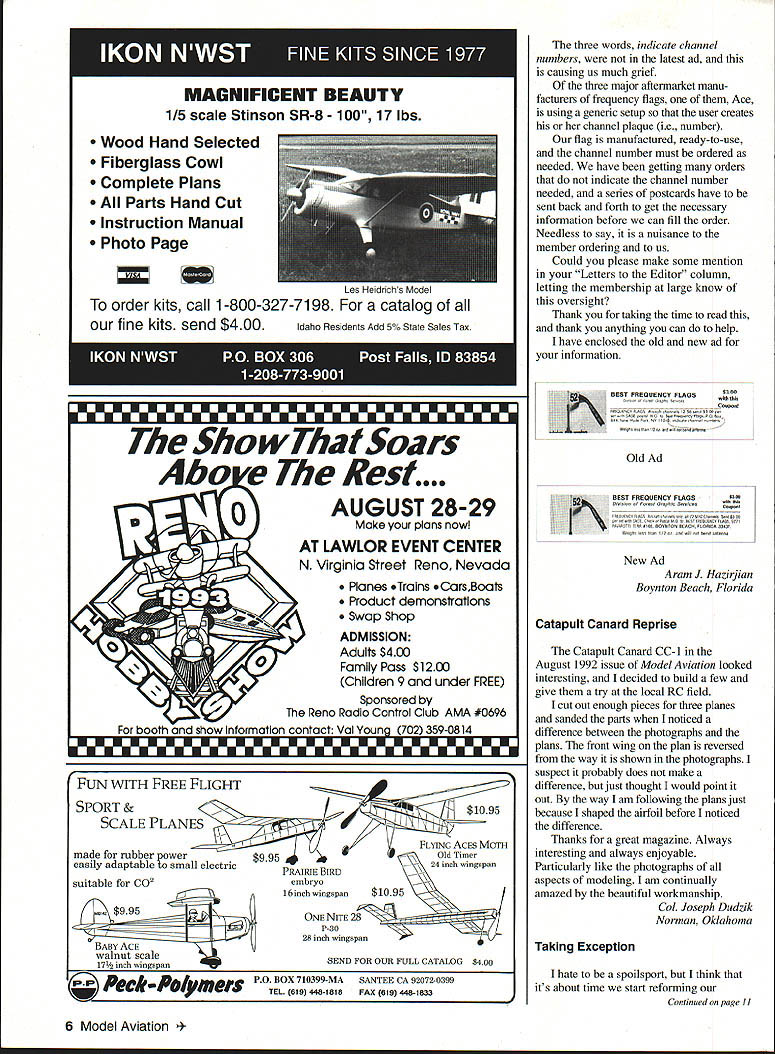
This past year we moved to Florida, and the address change was reflected in our ad. However, because of a typo on our part, we have a small problem that I hope you will be able to help us with. The three words, "indicate channel numbers," were not in the latest ad, and this is causing us much grief.
Of the three major aftermarket manufacturers of frequency flags, one of them, Ace, is using a generic setup so that the user creates his or her channel plaque (i.e., number). Our flag is manufactured, ready-to-use, and the channel number must be ordered as needed. We have been getting many orders that do not indicate the channel number needed, and a series of postcards have to be sent back and forth to get the necessary information before we can fill the order. Needless to say, it is a nuisance to the member ordering and to us.
Could you please make some mention of this in your "Letters to the Editor" column, letting the membership at large know of this oversight?
Thank you for taking the time to read this, and thank you for anything you can do to help. I have enclosed the old and new ad for your information.
Aram J. Hazirjian Boynton Beach, Florida
Catapult Canard Reprise
The Catapult Canard CC-1 in the August 1992 issue of Model Aviation looked interesting, so I decided to build a few and give them a try at the local RC field.
I cut out enough pieces for three planes and sanded the parts when I noticed a difference between the photographs and the plans. The front wing on the plan is reversed from the way it is shown in the photographs. I suspect it probably does not make a difference, but I thought I would point it out. By the way, I am following the plans just because I shaped the airfoil before I noticed the difference.
Thanks for a great magazine — always interesting and always enjoyable. I particularly like the photographs of all aspects of modeling. I am continually amazed by the beautiful workmanship.
Col. Joseph Dudzik Norman, Oklahoma
Taking Exception
I hate to be a spoilsport, but I think it's about time we start reforming our attitude toward the crashing and destruction of model aircraft. I am writing about the tendency to treat crashes as a normal, expected, and inherent part of our hobby. The worst part is when our national organization and its members seem to celebrate these failures.
I am writing specifically about some items in the AMA catalog and the comic series "Microhenrys." Patch #1032 proudly proclaims the wearer a member of the AMA whose main interest is crashing. Patch #1033 goes one step further and creates something called the "Society of Aircraft Demolishers."
I like fun as much as the next guy, but this attitude is unacceptable if our hobby is to flourish and grow. With the great increase in power and size, safe operation can no longer be treated as optional. The public will not tolerate an activity whose participants demonstrate unconcern or recklessness for the safety of those around them.
As far as the Microhenrys go, I realize it's only a comic, and I shouldn't take it seriously. However, I believe that the numerous crashes depicted eventually undercut the efforts of those who are trying to create a safer hobby.
RC has come a long way from the days of 1/2 A and rudder-only controls. I believe that the reliability of modern radios, engines, and aircraft is such that crashes can be nearly eliminated — that is, they can be eliminated if all modelers make a commitment to safe operation and piloting. As long as we keep on treating crashes as jokes, we will not improve the safety record.
Stephen Scotto Bronxville, New York
Mud Duck
I recently built Tom Chipley's Mud Duck from your May 1992 plans and have really enjoyed it. Many thanks to him for the design and to you for publishing the plans.
Enjoy the magazine and appreciate the AMA. When I hear critics of AMA, I say my piece; it's easy to complain, but without AMA, we might not be flying RC. I've flown rubber, free flight, control line, now RC, and some indoor with Miami and HLG.
Keep up the good work, and you have my support.
Fred Beeson Tampa, Florida
Have a Brewsky
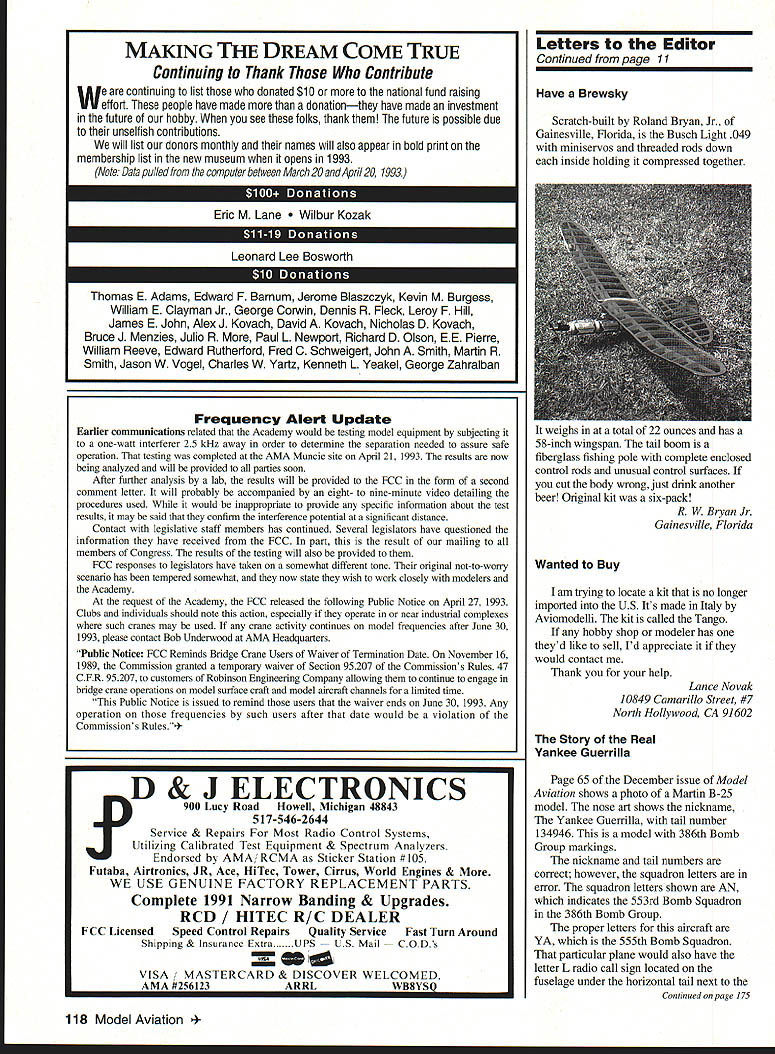
Scratch-built by Roland Bryan, Jr., of Gainesville, Florida, is the Busch Light .049 with miniservos and threaded rods down each side inside holding it compressed together.
It weighs a total of 22 ounces and has a 58-inch wingspan. The tail boom is a fiberglass fishing pole with completely enclosed control rods and unusual control surfaces. If you cut the body wrong, just drink another beer! Original kit was a six-pack!
R. W. Bryan Jr. Gainesville, Florida
Wanted to Buy
I am trying to locate a kit that is no longer imported into the U.S. It's made in Italy by Aviomodelli. The kit is called the Tango. If any hobby shop or modeler has one they'd like to sell, I'd appreciate it if they would contact me.
Lance Novak 10849 Camarillo Street, #7 North Hollywood, CA 91602
The Story of the Real Yankee Guerrilla
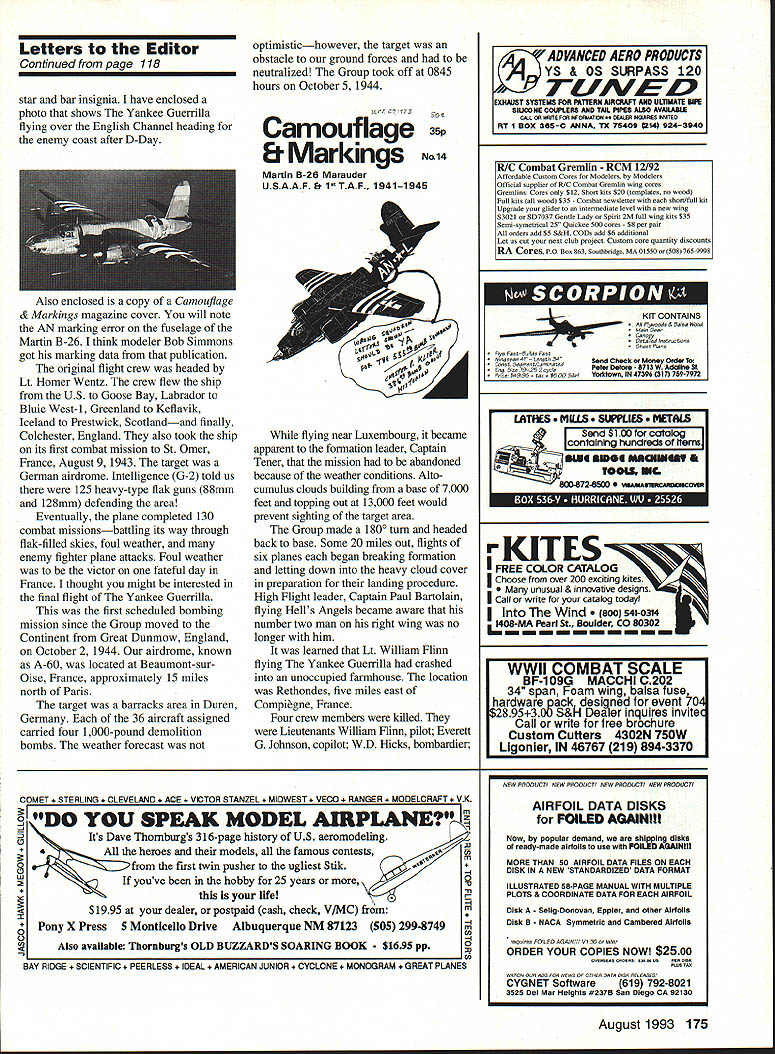
Page 65 of the December issue of Model Aviation shows a photo of a Martin B-25 model. The nose art shows the nickname "The Yankee Guerrilla" with tail number 134946. This is the 386th Bomb Group marking. The nickname and tail numbers are correct; however, the squadron letters are in error. The squadron letters shown are AN, which indicates the 553rd Bomb Squadron in the 386th Bomb Group. The proper letters for this aircraft are YA, which is the 555th Bomb Squadron. That particular plane would also have the radio call sign letter "L" located on the fuselage under the horizontal tail next to the star-and-bar insignia.
I have enclosed a photo that shows The Yankee Guerrilla flying over the English Channel heading for the enemy coast after D-Day. Also enclosed is a copy of a Camouflage & Markings magazine cover that shows an AN marking error on the fuselage of a Martin B-26. I think modeler Bob Simmons got his marking data from that publication.
The original flight crew was headed by Lt. Homer Wentz. The crew flew the ship from the U.S. to Goose Bay, Labrador; to Bluie West-1, Greenland; to Keflavik, Iceland; to Prestwick, Scotland; and finally to Colchester, England. They also took the ship on its first combat mission to St. Omer, France, on August 9, 1943. The target was a German airdrome. Intelligence (G-2) told us there were 125 heavy-type flak guns (88 mm and 128 mm) defending the area.
Eventually, the plane completed 130 combat missions—battling through flak-filled skies, foul weather, and many enemy fighter attacks. Foul weather was to be the victor on one fateful day in May.
This was the first scheduled bombing mission since the Group moved to the Continent from Great Dunmow, England, on October 2, 1944. Our aircraft, known as A-60, was located at Beaumont-sur-Oise, France, approximately 15 miles north of Paris. The target was a barracks area in Duren, Germany. Each of the 36 aircraft assigned carried four 1,000-pound demolition bombs. The weather forecast was not optimistic; however, the target was an obstacle to our ground forces and had to be neutralized. The Group took off at 0845 hours on October 5, 1944.
While flying near Luxembourg, it became apparent to the formation leader, Captain Tenney, that the mission had to be abandoned because of the weather conditions. Altocumulus clouds building from a base of 7,000 feet and topping out at 13,000 feet would prevent sighting of the target area. The Group made a 180° turn and headed back to base. Some 20 miles out, flights of six planes each began breaking formation and letting down into the heavy cloud cover in preparation for their landing procedure.
High Flight leader, Captain Paul Bartolini, flying Hell's Angels, became aware that his number two man on his right wing was no longer with him. It was learned that Lt. William Flinn, flying The Yankee Guerrilla, had crashed into an unoccupied farmhouse at Bethonvillers, five miles east of Compiègne, France.
Four crew members were killed: Lieutenants William Flinn (pilot), Everett G. Johnson (copilot), W. D. Hicks (bombardier), and another crew member. Seriously injured in the crash were Staff Sergeants R. C. Naylor (radioman) and Robert G. Johnson (tail gunner). The aircraft was destroyed in the ensuing fire.
The three officers had been quartered in the same tent with their flight leader, Captain Bartolini. After recovering from his injuries, Robert Johnson was assigned to Bartolini's crew as tail gunner. I recently talked with Paul Bartolini on the telephone; he is doing fine and lives in a suburb of Chicago.
The wartime personnel listing for the 386th Bomb Group was 3,759 members—to date I have been able to locate more than 800 of them. I am writing a multivolume history of the 386th Bomb Group's operations. My first volume with 800-plus pages is complete, and I am well into volume two. One of my mission stories was made into a one-hour film documentary by a German movie company and was shown on German television in 1985.
I began building model airplanes in 1932, finally moved into gas models after World War II, and in recent years have worked on RC models. I was also involved in building full-size jobs, such as the Skyhopper and the Smith Miniplane; also the restoration of the 1908 Quick Monoplane that now hangs in the Aerospace Museum in Huntsville, Alabama.
I am now retired from 38 years of engineering work in aviation, including flight-simulator design on the Lockheed C-5A and the Vought A-7 Corsair, some structure design on the McDonnell Douglas F-15, and cockpit design on the F-18 and the Gates Learjet 35.
Chester P. Klier 1455 Bluefield Drive Florissant, Missouri
Stanley
My son wrote this story for an English class. I thought you and your readers might find it amusing.
He belongs to the Cape Ann R/C Club in Massachusetts. Greg is 12 years old.
Carol Guba Exeter, New Hampshire
"The big day had come, and my heart was pumping faster than a beaver gnaws down a tree. The day had come to solo my remote-control airplane, Betsy May. I knew many people had done it before me, but it was still an exciting moment.
"The runway looked greener than ever, and it seemed to beckon me to crash. I couldn't let that happen, because I would be laid up for about three months trying to fix the damages or build a new plane.
"I taxied my plane to the runway. The engine started to roar, ready to take off, but I hadn't moved any controls. The plane started straight down the runway and took off perfectly. Realizing that I had no control, I began to stammer and tell the instructor, but decided against it. I thought it best to keep quiet. I pretended to control the plane by moving the stick in the same flight pattern the plane flew.
"The goal of my test pilot's wings was to make three takeoffs and landings without crashing or losing control. My first two landings I had no control over, and I began to concentrate intently before each turn. Then, suddenly, whatever I did, the plane did, and whenever my concentration lapsed, the plane flew erratically.
"I finally decided there was something terribly wrong with my plane, and it had to be fixed. In my mind, I started to yell at the plane—telling it to land. I seemed to take an unbelievably long time before it landed. I ran down the runway to retrieve my plane. The cockpit to my plane opened as I approached, and out jumped a tiny man.
"'I just saved your hide! Your plane would have crashed handling her as rough as you were. I earned your pilot's wings for you. What do I get in return?' You yell at me. I wasn't ready to crash and burn with you at the stick.'
"My jaw dropped so low that flies could swarm in. After I managed to close my mouth, I apologized and thanked him gratefully. I also told him to keep it down. He was raising quite a stink.
"'His name was Stanley. He said he had helped most pilots through the rigors of flight, but never met any as inconsiderate as me.'
"It all turned out fine in the end. That day I was awarded my pilot's wings, and Stanley flew back home for vacation—I think. I practiced flying when the instructors weren't at the flying field. I got pretty good at loops and rolls. The grass turned dull again, and didn't beckon to my plane. I guess it knew I wouldn't give it up."
A Burt Rutan Design
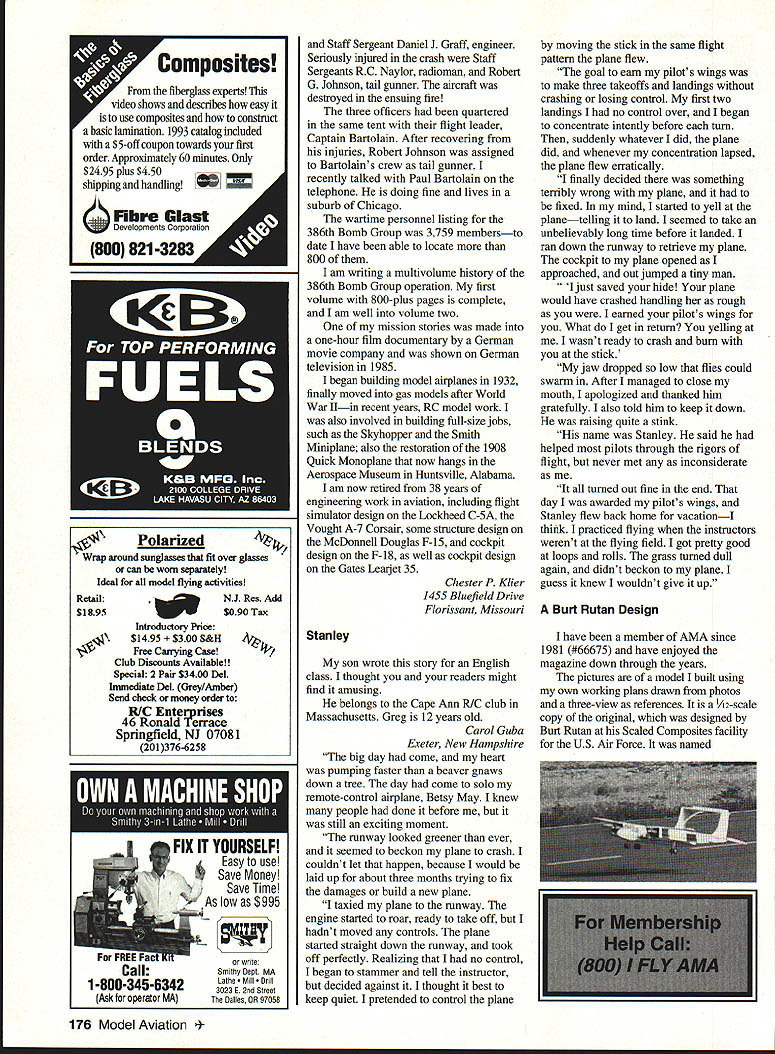
I have been a member of AMA since 1981 (#66675) and have enjoyed the magazine over the years. The pictures are of a model I built using my own working plans drawn from photos and a three-view as references. It is a 1/2-scale copy of the original designed by Burt Rutan at his Scaled Composites facility for the U.S. Air Force.
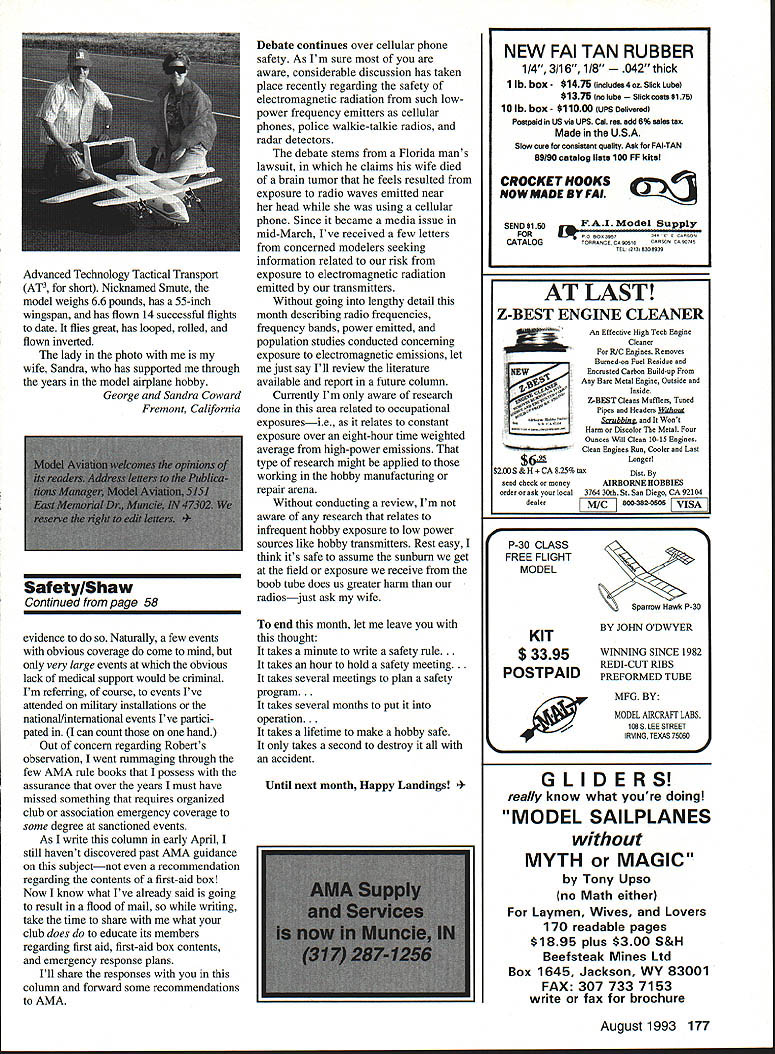
The full name of the design is Advanced Technology Tactical Transport. Nicknamed "Smute," the model weighs 6.6 pounds, has a 55-inch wingspan, and has flown 14 successful flights to date. It flies great, has looped, rolled, and flown inverted.
The lady in the photo with me is my wife, Sandra, who has supported me through the years in the model airplane hobby.
George and Sandra Coward Fremont, California
Transcribed from original scans by AI. Minor OCR errors may remain.

