
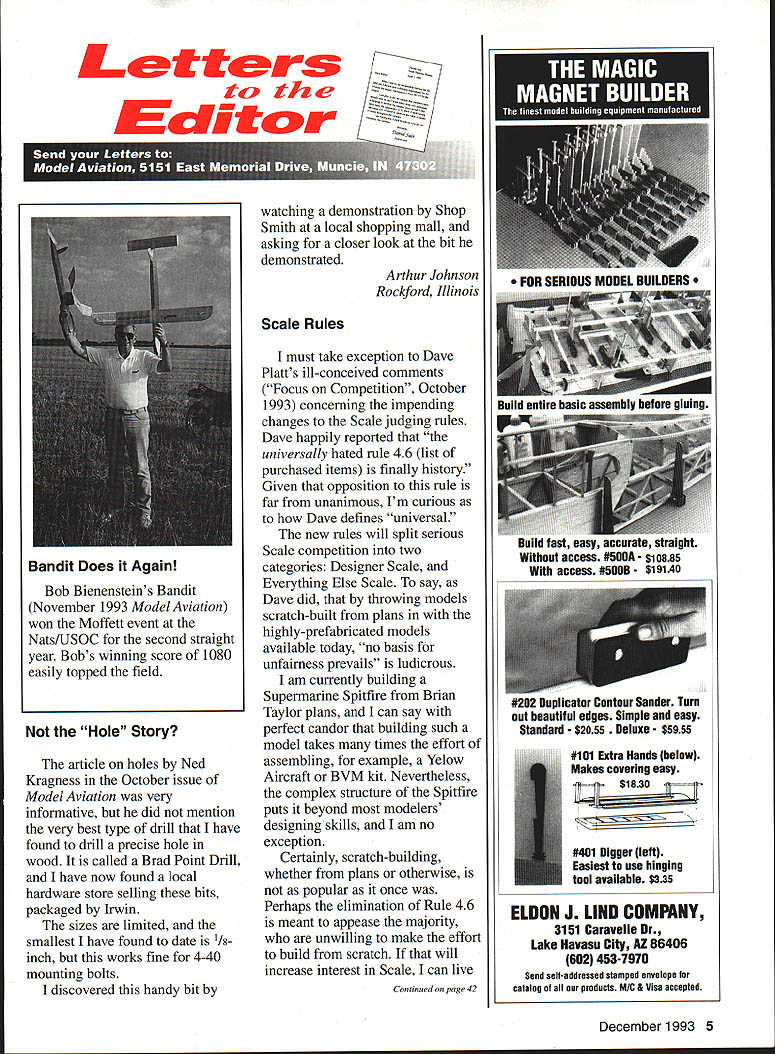

Letters to the Editor
Send your Letters to: Model Aviation, 5151 East Memorial Drive, Muncie, IN 47302
Not the "Hole" Story?
The article on holes by Ned Kragness in the October issue of Model Aviation was very informative, but he did not mention the very best type of drill that I have found to drill a precise hole in wood. It is called a Brad-point drill, and I have now found a local hardware store selling these bits, packaged by Irwin.
The sizes are limited, and the smallest I have found to date is 1/8 inch, but this works fine for 4-40 mounting bolts.
I discovered this handy bit by watching a demonstration by ShopSmith at a local shopping mall, and asking for a closer look at the bit he demonstrated.
Arthur Johnson Rockford, Illinois
Scale Rules
I must take exception to Dave Platt's ill-conceived comments ("Focus on Competition", October 1993) concerning the impending changes to the Scale judging rules. Dave happily reported that "the universally hated rule 4.6 (list of purchased items) is finally history." Given that opposition to this rule is far from unanimous, I'm curious as to how Dave defines "universal."
The new rules will split serious Scale competition into two categories: Designer Scale, and Everything Else Scale. To say, as Dave did, that by throwing models scratch-built from plans in with the highly prefabricated models available today, "no basis for unfairness prevails" is ludicrous.
I am currently building a Supermarine Spitfire from Brian Taylor plans, and I can say with perfect candor that building such a model takes many times the effort of assembling, for example, a Yellow Aircraft or BVM kit. Nevertheless, the complex structure of the Spitfire puts it beyond most modelers' designing skills, and I am no exception.
Certainly, scratch-building, whether from plans or otherwise, is not as popular as it once was. Perhaps the elimination of Rule 4.6 is meant to appease the majority, who are unwilling to make the effort to build from scratch. If that will increase interest in Scale, I can live with that.
Jim Ryan Cincinnati, Ohio
Help Provided
Thanks so much for publishing the letter on the Lockheed Electra 10B — the response was greater than expected. The quality of information is indicative of the quality of the membership of the AMA. We have extended thanks to Bill Harney, Neil Reid and Henry Farrar for the wealth of information. Thanks again — great magazine.
Carl W. Lybarger Springfield, Missouri
Shhh
I would like to reply to the letter "Hawks vs Models" (September 1993 issue, Model Aviation). Mr. Larry Renger relates his experience as a police officer flying a Cox EZ-Bee II and unfortunately makes light of an increasingly serious problem — noise levels. Clearly the model power-on mode caused the noise complaint. He implies he fooled the local law enforcement official by thinking the irate neighbor was overly sensitive. He further points out, to absolve himself of further blame, that the engine muffler met AMA specifications. Clearly too loud — Mr. Renger's actions and attitude do a disservice and jeopardize efforts by serious modelers attempting quiet model engines to save flying sites.
Scott Schroeder Newark, California
Theory or Fact?
Part of the AMA's charter is to promote education, and the AMA is justly proud of its young members who have gone on to careers in aviation and aerodynamics. In this regard, it is important that technical issues and terminology be presented accurately. I regret to have found a large number of errors in Mr. deBolt's articles, most recently in the September 1993 Model Aviation. These are not mere "difference of opinion" issues. To give just three examples:
Different airfoils do not generate different amounts of lift: if you change one wing for another and retrim the plane for steady horizontal flight, the lift will exactly equal the weight in both cases. Yet deBolt speaks of the wing with the Davis airfoil as creating "the most lift of all" of those he tested. A wing can have a better or worse lift-to-drag ratio, a different zero-lift angle of attack, or a higher or lower maximum coefficient of lift, but the amount of lift is not a property of the airfoil.
At one point deBolt says: "The tail lift was increased, which moved the mean coefficient of lift (C) aft." He means "center of lift" and not "mean coefficient of lift." There is no way to move the coefficient of lift since it is not a place, but a dimensionless number. Since the correct notation for coefficient of lift is used and the error is repeated, I don't think it's a typo, but a confusion on the author's part that the editors should have caught.
In the August issue deBolt called a wing whose tips have all their sweep on the leading edge a "canard," whereas the term usually means an aircraft configuration where the main lifting surface is in the rear and the horizontal stabilizing surface (the canard) is in front.
Hal deBolt is a well-known and respected designer and flier of model planes, and to have published these articles without sufficient editorial care and checking does him and your readers no service.
Jef Raskin Pacifica, California
Response
It seems that every time a technical article is presented, any number of folks out there will claim it's wrong, regardless of the material presented. I am well aware of the problems that have occurred with previous deBolt articles, but you must remember one thing: the content of the pieces we present represents the authors' opinions. As such, we must allow room for divergence. Whether the material is actually useful is up to the individual's needs.
I also rechecked the canard reference, and found no indication that deBolt meant to use the term in anything other than its standard context, i.e., with the main lifting surface in the rear.
Transcribed from original scans by AI. Minor OCR errors may remain.

