
Letters to the Editor
Send your Letters to: Model Aviation, 5151 East Memorial Drive, Muncie, IN 47302
Joe Bilgri
Joe Bilgri, world champion in Indoor (F1D), passed away in his sleep on September 29, 1993.
Mentor to Wakefield (F1B) world champion Joe Foster and to Indoor (F1D) world champion Bud Romak, Joe was on several National Teams representing the United States in Indoor, Nordic glider (F1A) and Wakefield, where he gained second place.
Joe was best known for his innovative designs, which, in addition to their aerodynamic qualities, were simple in concept and easy to build. The Bilgri X propeller block is one example: while the rest of the world was laying out propeller blocks in a complicated manner, Joe developed his own layout system. He used half the amount of balsa provided, essentially the same wood grain in each blade and assured a perfectly helical pitch. He and Joe Foster were the first to adopt Hank Cole's O-So-Long type Wakefields.
Joe was a gentle person, often appearing shy, but was a fierce competitor and loved a good contest. Even though he could no longer fly, under doctor's orders, he was planning to attend the World Championships in Lost Hills and the SAM Champs in Taft with his friend Joe Foster. He wanted to encourage his longtime friend George Xenakis, current F1B team member at the World Championships, and Joe Foster and Bud Romak in the SAM Championships. He passed away hours after talking with Joe, making final plans for the trip.
For over 50 years Joe was the respected elder statesman for the Oakland Cloud Dusters and will be remembered, over a gin and tonic or two, at each championship contest.
Charles Dorsett Walnut Creek, California
Centrifugal Force
I'm writing in response to two Letters to the Editor on page 117 of the October issue regarding George Abbott's article "Centrifugal Force" (July 1993 issue).
Centrifugal force, the outward force on a body resulting from its traveling in a curved path, is as real a force as you can get. It is balanced by an equal and opposite centripetal force.
The statement that "we are here because of a centripetal force called gravity" is true, but misleading. Since the word centripetal is defined as "directed or moving toward a center or axis", gravity could indeed be considered a centripetal force. But this has nothing whatsoever to do with motion in a curved path; it is not the usual definition applied in that context, and so when used in that context is misleading. For gravity to supply the total centripetal force associated with the speed of rotation of the Earth's surface, that speed would have to equal escape velocity!
Gravity is universally regarded as a force. I sit in a chair. Gravity pulls me downward so that I exert a force on the chair equal to my weight. The chair pushes back with an equal and opposite force.
Now let me go to sleep while you put me and the chair in a big box and send the whole shebang into space. Out there my box is connected to a separate but equal box by a long cable. Then both boxes are set into motion, by rockets perhaps, about each other at a speed equal to my weight on Momma Earth. Then I wake up. I feel exactly the same as I did sitting on the chair on Earth. I push down with the same force, it pushes back with the same force.
In fact, there is no experiment I could perform within that box — with pendulums, atomic particles, light rays, etc. — that would give results different from those of the same experiments performed on Earth. In short, centrifugal force is as real as the force of gravity.
As to whether the inward acceleration of a body traveling along a curved path causes the associated force or the force causes the associated curvature of the path, since the force and path curvature cannot exist independently, it makes little sense to argue about which is cause and which is effect.
Bob Meuser Oakland, California
---
I see in the current issue of MA there are two letters taking exception to my treatment of the basic concept of centrifugal force, and taking me to task for not presenting the relationship and distinction between centrifugal and centripetal force.
Since you did not ask me to respond to these letters before you published them, I assume that you did not feel that they detracted from the value of the article and so did not think that a published response was warranted. This is okay with me, because I think the average reader would be only confused by such a discussion, which is why I chose not to address it in the article.
However, I do want to assure you and the two letter writers that I do, in fact, understand the distinction between centrifugal and centripetal force; further I am confident that my presentation is strictly correct, although certainly not a fully comprehensive treatment of the subject.
The writers are quite correct that the inward force exerted by a small boy swinging the rock is centripetal force. This force constrains the rock to follow a circular path, and is opposed by the inertial force of the rock which wants to proceed along a linear path; Newton's first law.
It is argued that since force is defined as a push or pull acting upon a body, inertial forces are not really forces. This is not a very satisfying notion, rings false in the face of common experience, and also gets us in trouble when we apply D'Alembert's Principle. This Principle states, in part, that for a dynamic system to be in equilibrium all forces must be balanced.
Since in our rock-swinging example the centripetal force is balanced by the inertial force, we can define the inertial force resulting from the acceleration of the rock as a virtual force, and call it centrifugal force. I believe this is a commonly accepted definition.
The concept of virtual force, and virtual work, are used in a variety of problems in dynamics. I would suggest to Mr. Kuhnle that virtual and fictitious are not the same, and I would hope that Mr. Harrison's college physics teacher would not consider virtual force, virtual work and D'Alembert's Principle mysterious.
Now all of the above discussion applies to the case where we have a fixed frame of reference, which is the case with a person standing on the ground swinging the rock. When we consider a moving frame of reference, i.e. the rock, or more to the point an airplane, the force resulting from centrifugal acceleration acting on the mass of the body in motion is no longer virtual. It is just as real as weight, which is the force resulting from the acceleration of gravity acting on a mass.
I am sure that nowhere in the article did I refer to any forces other than those acting upon the body in motion; i.e. the airplane. Even in the rock example I stated that the rock experiences the force.
Both writers pointed out that I did not explain that the airplane turns due to a component of lift directed toward the center of the curving path. They are quite correct—I did not. I was primarily interested in discussing the forces experienced by the airplane and their effect on the airplane's behavior. I could very well have included another parallelogram of forces resolving the lift vector into vertical and horizontal components, and maybe I should have.
When I prepared this article, I felt I was addressing a lay audience in which a minority would have a college-level engineering background. I was interested in providing a "feel" for the magnitude of the forces that our models experience in flight and describing their effects. I did not want to confuse the issue with a detailed discussion, which would distract the reader from the primary point of the article.
George Abbott Raleigh, North Carolina
Reliant Help Requested
My son and I have taken up RC flying in January of this year, and have averaged about five hours of flight time per month. While my 13-year-old has advanced from a Tower .40 trainer to the faster planes like the Super Decathlon, I have opted to stay with the slower and more stable models, such as the Goldberg Eagle 2.
I like the looks of the older and classic models and have purchased a Sterling kit (Stinson Reliant) that took more effort than the easier models such as Goldberg or Great Planes, of which I have built several. I powered the gull-wing Reliant, the 57-inch wingspan version, with a Royal .40 and a 10 x 6 propeller. Not having confidence in flying scale models, I asked my trainer to test-fly the model, to which he agreed.
On the first attempt, the Stinson took off effortlessly, but after climbing to about 15 feet, the tail suddenly squatted and the plane began to violently pitch back and forth, from wing to wing. The flight was aborted and the power was shut off. The plane dropped like a ton of bricks straight down, but managed to land on its landing gear. No damage was sustained, but it was determined that more nose weight was needed. After adding about two ounces, a second attempt was made.
Again the plane took off normally, but after gaining about 40 feet of altitude, the Royal .40 stalled just as the plane was leveling off. This caused the plane to go into an uncontrollable dive and spiral. The result was a crash that was too extensive to fix. I would like to hear from you or your readers who have flown this particular model, the problems they have experienced and how the problems were corrected.
By the way, I found modeling/RC flying a great way to spend time with teenage sons or daughters, and recommend that parents look into it as a possible means to entertain and spend meaningful hours with your children. And don't be surprised if they advance faster than you, and soon become your trainer.
Karoly C. Fogassy Seattle, Washington
More Help Wanted
It was deep-down satisfaction to read the article by Robert H. Munn, "Covering Model Airplanes With Silk" [October 1993 MA]. When I saw the beautiful Buccaneer, a model that I built as a twelve-year-old in the forties, I was truly moved.
I have been trying to find a set of the Berkeley plans for the Buccaneer B Special for some time. After reading the article, I feel there may be hope.
My finished model did not look anything like I believe his does. However, Mr. Munn has encouraged me to try again, if I can find my beloved model plans.
If you can shed any light on my search, it would be very much appreciated.
Bill Dabney E. Elmhurst, New York
Too Proud?
I usually read, laugh, and forget about your letters to the editor, but one in the November issue made me ponder. Genie Brown of Miramar, Florida, says her 62-year-old husband, Tom, is having problems learning to fly, and wonders if he is too old to learn.
It sounds as if Tom is making the age-old mistake of letting his ego get in the way. Nowhere does she mention an instructor.
I retired as an electronics engineer at the age of 67, and accidentally got interested in the hobby—mainly out of boredom. However, it only took about two days of observing to decide that the only way to fly was to get with a qualified instructor, at least for the first few flights. There is no other sensible way.
Usually there are qualified instructors, either for fee or free, at most flying sites. Believe me, it is worth paying $100 or so for lessons, rather than creating a couple of hundred dollars in crash damage.
Fortunately, I asked an old pro if he would help, and he said "sure." I have now made over 400 flights, including over 400 landings, with 11 different airplanes, and am now starting aerobatics.
Yes, I have had my share of crashes (10), but nothing compared to what I would have had without proper instruction. So my advice to Tom is to swallow his pride and ask for help.
Glen Benskin Tarzana, California
Cover Story
In reply to "An Eagle-Eyed Member Compliments" [Letters, October 1993]: the Thush Mike on the June '93 cover did look in a bad attitude but it was not unstable. Just at release, a strong wind gust caught the model. After release it recovered and made a good flight. Actually, the plane is not flying in the picture and ol' Ron has a death grip on the fin. We had no idea the photo was made of the action. It was a total surprise to get the June issue of MA and find we were on the cover!
Jim Allbach, who took the photo, is legendary to me. He is the guy who always has the answer to flying in the San Diego Aeroneers club (SAM 41).
Bill Albright San Diego, California
Seven Lakes Helps Out
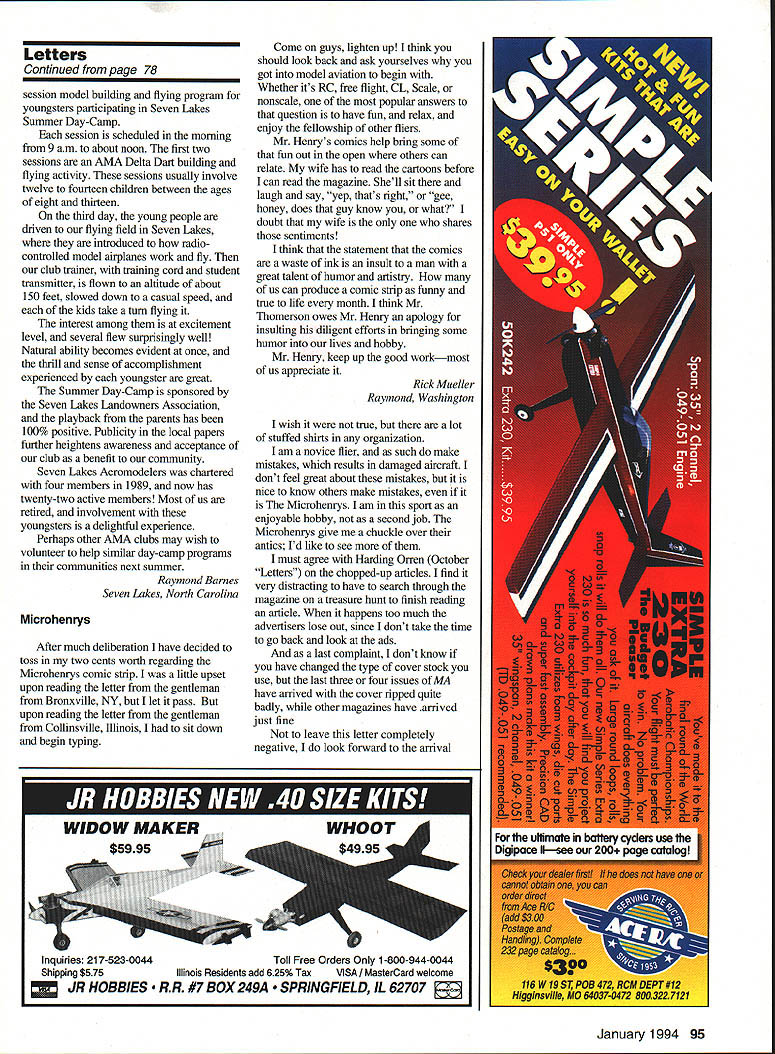
Here is a report of an AMA club activity which positively impacts acquainting young people with model aviation, and increases general interest in radio control model building and flying.
The Seven Lakes Aeromodelers Club (AMA chartered) has for three years volunteered to conduct a two- or three-session model building and flying program for youngsters participating in Seven Lakes Summer Day-Camp.
Each session is scheduled in the morning from 9 a.m. to about noon. The first two sessions are an AMA Delta Dart building and flying activity. These sessions usually involve twelve to fourteen children between the ages of eight and thirteen.
On the third day, the young people are driven to our flying field in Seven Lakes, where they are introduced to how radio-controlled model airplanes work and fly. Then our club trainer, with training cord and student transmitter, is flown to an altitude of about 150 feet, slowed down to a casual speed, and each of the kids takes a turn flying it.
The interest among them is at an excitement level, and several flew surprisingly well! Natural ability becomes evident at once, and the thrill and sense of accomplishment experienced by each youngster are great.
The Summer Day-Camp is sponsored by the Seven Lakes Landowners Association, and the feedback from the parents has been 100% positive. Publicity in the local papers further heightens awareness and acceptance of our club as a benefit to our community.
Seven Lakes Aeromodelers was chartered with four members in 1989, and now has twenty-two active members! Most of us are retired, and involvement with these youngsters is a delightful experience.
Perhaps other AMA clubs may wish to volunteer to help similar day-camp programs in their communities next summer.
Raymond Barnes Seven Lakes, North Carolina
Microhenrys
After much deliberation I have decided to toss in my two cents regarding the Microhenrys comic strip. I was a little upset upon reading the letter from the gentleman from Brownsville, N.Y., but I met it in passing. Upon reading the letter from the gentleman from Brownsville, Illinois, I had to sit down and begin typing.
Come on, guys, lighten up! I think you should look back and ask yourselves why you got into model aviation to begin with. Whether it's RC, free flight, CL, Scale, or nonscale, one of the most popular answers to that question is to have fun, relax, and enjoy the fellowship of other fliers.
Mr. Henry's comics help bring some of that fun out in the open where others can relate. My wife has to read the cartoons before I can read the magazine. She'll sit there and laugh and say, "yep, that's right," or "gee, honey, does that guy know you, or what?" I doubt that my wife is the only one who shares those sentiments!
I think that the statement that the comics are a waste of ink is an insult to a man with a great talent of humor and artistry. How many of us can produce a comic strip as funny and true to life every month? I think Mr. Thomerson owes Mr. Henry an apology for insulting his diligent efforts in bringing some humor into our lives and hobby.
Mr. Henry, keep up the good work—most of us appreciate it.
Rick Mueller Raymond, Washington
---
I wish it were not true, but there are a lot of stuffy shirts in any organization.
I am a novice flier, and as such do make mistakes, which results in damaged aircraft. I don't feel great about these mistakes, but it is nice to know others make mistakes, even if it is The Microhenrys. I am in this sport as an enjoyable hobby, not as a second job. The Microhenrys give me a chuckle over their antics; I'd like to see more of them.
I must agree with Harding Orren (October "Letters") on the chopped-up articles. I find it very distracting to have to search through the magazine on a treasure hunt to finish reading an article. When it happens too much the advertisers lose out, since I don't take the time to go back and look at the ads.
And as a last complaint, I don't know if you have changed the type of cover stock you use, but the last three or four issues of MA have arrived with the cover ripped quite badly, while other magazines have arrived just fine.
Not to leave this letter completely negative, I do look forward to the arrival of MA and read all the articles, with those geared toward beginners being of most interest.
Russ Staska Ketchikan, Alaska
---
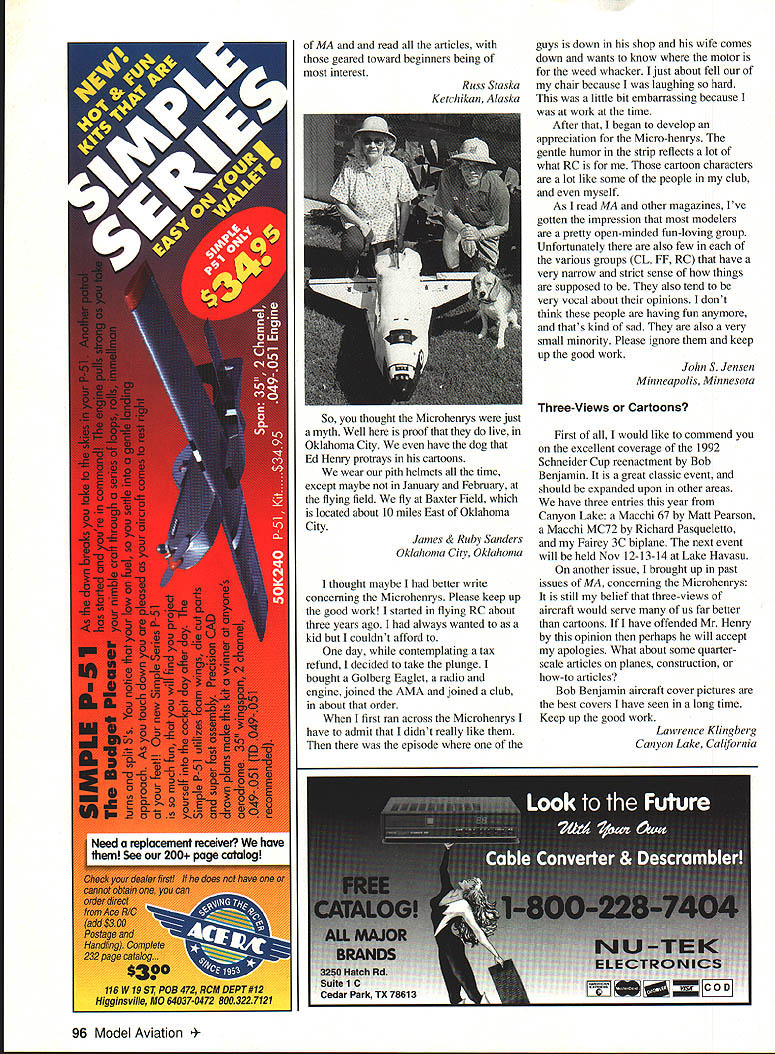
So, you thought the Microhenrys were just a myth. Well, here is proof that they do live, in Oklahoma City. We even have the dog that Ed Henry portrays in his cartoons.
We wear our pith helmets all the time, except maybe not in January and February, at the flying field. We fly at Baxter Field, which is located about 10 miles east of Oklahoma City.
James & Ruby Sanders Oklahoma City, Oklahoma
---
I thought maybe I had better write concerning the Microhenrys. Please keep up the good work! I started in flying RC about three years ago. I had always wanted to as a kid but I couldn't afford to.
One day, while contemplating a tax refund, I decided to take the plunge. I bought a Goldberg Eaglet, a radio and a club, in about that order.
When I first ran across the Microhenrys I have to admit that I didn't really like them. Then there was the episode where one of the guys is down in his shop and his wife comes down and wants to know where the motor is for the weed wacker. I just about fell out of my chair because I was laughing so hard. This was a little bit embarrassing because I was at work at the time.
After that, I began to develop an appreciation for the Microhenrys. The gentle humor in the strip reflects a lot of what RC is for me. Those cartoon characters are a lot like some of the people in my club, and even myself.
As I read MA and other magazines, I've gotten the impression that most modelers are a pretty open-minded, fun-loving group. Unfortunately there are also a few in each of the various groups (CL, FF, RC) that have a very narrow and strict sense of how things are supposed to be. They also tend to be very vocal about their opinions. I don't think these people are having fun anymore, and that's kind of sad. They are also a very small minority. Please ignore them and keep up the good work.
John S. Jensen Minneapolis, Minnesota
Three-Views or Cartoons?
First of all, I would like to commend you on the excellent coverage of the 1992 Schneider Cup reenactment by Bob Benjamin. It is a great classic event, and should be expanded upon in other areas. We have three entries this year from Canyon Lake: a Macchi C.67 by Matt Pearson, a Macchi MC72 by Richard Pasqualetto, and my Fairey 3F biplane. The next event will be held Nov. 12-13-14 at Lake Havasu.
On another issue I brought up in past issues of MA, concerning the Microhenrys: It is still my belief that three-views of aircraft would serve many of us far better than cartoons. If I have offended Mr. Henry by this opinion then perhaps he will accept my apologies. What about some quarter-scale articles on planes, construction, or how-to articles?
Bob Benjamin's aircraft cover pictures are the best covers I have seen in a long time. Keep up the good work.
Lawrence Klingberg Canyon Lake, California
Transcribed from original scans by AI. Minor OCR errors may remain.

