
Letters to the Editor
Microhenrys Debate
Enough already—is this Letters to the Editor or a forum on the pros and cons of a cartoon? If a reader doesn't like it, turn the page—it's like a switch on a TV (that's what I do).
Robert Ford Long Beach, California
Scale Corrections
I've got to make a few corrections to some of the information contained in the "Radio Control Scale" article in the December issue of Model Aviation.
In the article, the author identified the Bell Airacobra as a P-39-400. That is in error. There was a P-39 and a P-400, but not a P-39-400. The P-400 was the Bell export model of the P-39, and both played a major role in the ground support of the Marines—and later the Army—on Guadalcanal. The 67th Fighter Squadron (not the 367th Fighter Sq.) of the 347th Fighter Group, U.S. Army Air Corps, was based in New Caledonia and flew P-400s.
In August 1942, a detachment flew to Guadalcanal by way of the New Hebrides, just a few days after the Marines had landed. The photo in the article is very good, showing the Fighting Cock on the door of the plane.
In October, a group of us were transferred from the 70th Fighter Sq. in the Fiji Islands to New Caledonia. We then flew some P-39s to Guadalcanal and flew as the 339th Fighter Sq., with the 67th Fighter Sq. So there were P-39s and P-400s flying from Guadalcanal at the same time.
The P-39 was not a high-altitude fighter plane. We would be scrambled prior to the daily noontime bombing raids and would climb to our maximum height. We'd be hanging on our props at about 27,500 feet and the Bettys and the Zeroes would be 3,000 to 4,000 feet above us. Joe Foss and the Marine pilots in the F4Fs would be making overhead passes at the Japanese planes. It was another story when the 339th Fighter Sq. got the Lockheed P-38Gs in November.
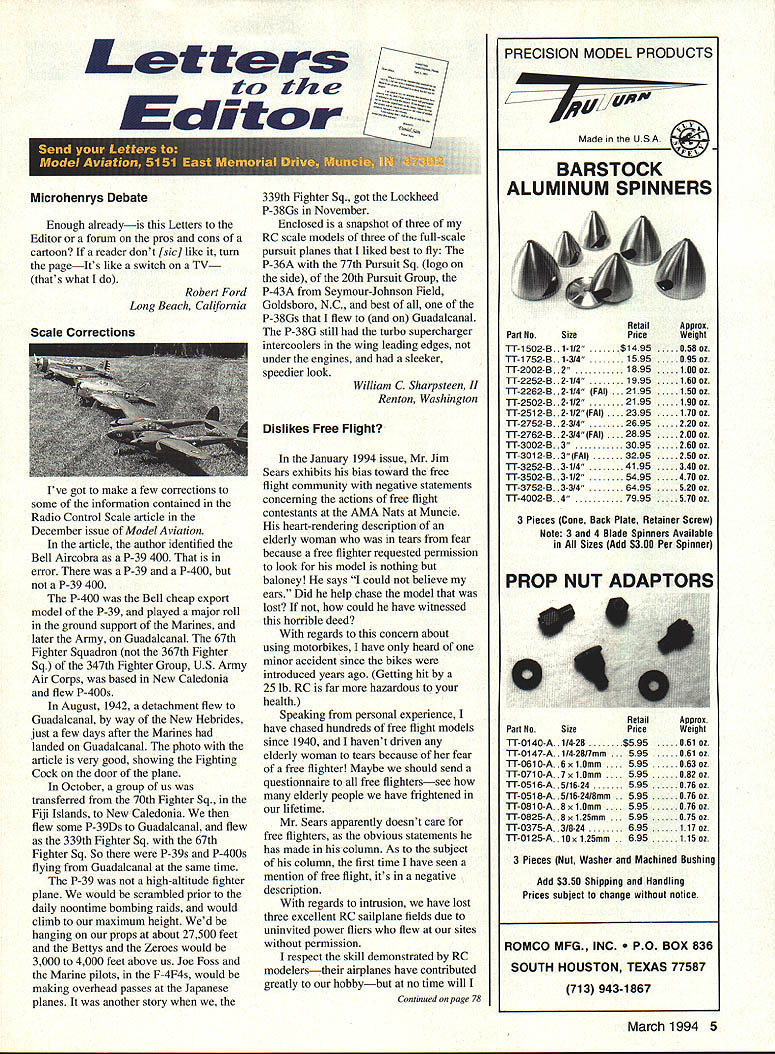
Enclosed is a snapshot of three of my RC scale models of three full-scale pursuit planes that I liked best to fly: the P-36A with the 77th Pursuit Sq. (logo on the side) of the 20th Pursuit Group; the P-43A from Seymour-Johnson Field, Goldsboro, N.C.; and—best of all—one of the P-38Gs that I flew to (and on) Guadalcanal. The P-38G still had the turbo-supercharger intercoolers in the wing leading edges, not under the engines, and had a sleeker, speedier look.
William C. Sharpsteen II Renton, Washington
Dislikes Free Flight?
In the January 1994 issue, Mr. Jim Sears exhibits his bias toward the free flight community with negative statements concerning the actions of free flight contestants at the AMA Nats at Muncie. His heartrending description of an elderly woman who was in tears from fear because a free flier requested permission to look for his model is nothing but baloney! He says, "I could not believe my ears." Did he help chase the model that was lost? If not, how could he have witnessed this horrible deed?
With regards to the concern about using motorbikes, I have only heard of one minor accident since the bikes were introduced years ago. (Getting hit by a 25-lb RC is far more hazardous to your health.)
Speaking from personal experience, I have chased hundreds of free flight models since 1940, and I haven't driven any elderly woman to tears because of her fear of free flight! Maybe we should send a questionnaire to all free fliers—see how many elderly people we have frightened in our lifetime.
Mr. Sears apparently doesn't care for free fliers, as the obvious statements he has made in his column show. As to the subject of this column, the first time I have seen a mention of free flight, it's in a negative description.
With regards to intrusion, we have lost three excellent RC sailplane fields due to uninvited power fliers who flew at our sites without permission.
I respect the skill demonstrated by RC modelers—their airplanes have contributed greatly to our hobby—but at no time will I demean their efforts. As a regional VP, how can we expect an impartial representation in District VI?
This written propaganda is not accepted by people like myself, who have learned and enjoyed free flight for most of our lifetimes. I suggest Mr. Sears sit and look back at what he writes and who he represents in the AMA. This article reaffirms what we have known for a long time: he just doesn't like free flight!
Art Christensen Renton, Washington
Reply: Art, I was present at the USOC, and I can assure you that the elderly woman/garden incident was very real, as discussed in my USOC report in the February issue. Regardless of your feelings about what was written, this was a shameful, disgraceful incident. Perhaps the other free flight references in my column are subject to debate, but not this one.
—Jim Sears
Liked "The Box"
The article in the December issue, "What's In The Box?" was great. Let's hear more from L. F. Randolph.
As a youth (when radios had those big jars that glowed and got hot) I tried to digest electronic theory but got lost in the holes in semiconductors. Mr. Randolph has perked my interest again with his very simple approach. The man should consider writing a book on an introduction to electronics.
How about a series of articles on how our equipment works? I have caught on to the little crosses and dashes on the battery; now I would like to learn more, like why don't the companies color-coordinate their wires better? The colors of the wires clash and do not have style.
Duke Iden Lima, Ohio
Type too Small?
Question: Why is the print or type size smaller when compared to other printed articles or subjects versus the AMA News section? Refer to the January 1994 issue and other earlier publications.
I, for one, am interested in the AMA News details, information, and all whatever to the RC hobby. The "President's Corner" titled "Communications" has some relevance to the subject above.
The comment of an "I don't care" attitude toward the AMA elections may be associated with the readership as a reason for neglect or lack of concern by other AMA members. Every organization—business, fraternal, industry, banking, education, health care, agriculture, and many others—has a center group for leaders. For those who are not in that center group, it is not to say they do not care. It is their choice for many reasons.
To maintain reader interest, improvement toward a print-size standardization could lead to enhanced reading. The larger print size is used in the larger sections of the magazine; why not in the AMA News section? If you don't have dimmed eyesight before you read that section, you will shortly after you are into it.
Donald Kreis Troy, Ohio
Editor’s note: AMA News pages feature smaller type because each VP/officer is allowed one magazine page for his column. Using smaller type allows more copy to fit on the page, and jumping officers' columns (continuing text on another page) is not allowed. Increasing type size means less news from each district or officer, so there's a tradeoff here.
Technical Matters
Article II, Purposes, of the AMA bylaws states: "...the primary object of the AMA is to promote and foster educational and scientific advancement in model aviation..."
I am disturbed by the way Jeff Raskin's letter to the Editor was presented and commented upon in the December issue of Model Aviation. To put the label "Theory or Fact?" on his eloquent and factually unassailable discussion of aeronautical science misses the point entirely. And to imply in the editorial response that Raskin's critique is in the realm of "opinions" can only serve to lead the uninitiated further into the wilderness.
Raskin's letter deals with aerodynamic concepts that have been misunderstood by an author of recent articles in Model Aviation. An example of an aerodynamic concept is the lift coefficient, which is defined as the ratio of wing loading to dynamic pressure. It is not representative of lift, but rather defines a flight condition. One might say it is a measure of how close to stall one is.
A small lift coefficient means that stall is remote; a large lift coefficient means that one is closer to stall. In both cases the lift is exactly the same.
To use the terms "lift" and "lift coefficient" interchangeably is not a matter of opinion. One has opinions on novels or art work. But a definition is a definition.
A suggestion: subject technical articles to a peer review, such as is done in technical and scientific journals. There is a vast pool of knowledge and talent available among AMA members, and it would probably be a simple task to set up a panel of competent reviewers.
Jorgen Skogh La Honda, California
As a university professor, I devote myself to teaching mathematics to engineering students and to convincing them of the importance of being precise and of really understanding "theory." Thus, I am writing to take exception to your rather alarming response to a letter by Mr. Jeff Raskin (in the December 1993 issue) which deals with those issues. Mr. Raskin quite rightly described errors he found in the latest article on aerodynamic design written by Mr. deBolt in the September issue of Model Aviation.
I must say that I am sorely disappointed in your expressed position that Mr. deBolt's articles should be considered as representing his opinions, and as such they are undeserving of the types of criticism they always seem to generate. Unfortunately, Mr. deBolt's errors are not a mere "divergence of opinion," as you would put it. His very glaring errors are in regards not to aerodynamic theories themselves, which, despite their long-standing use, could be questioned, but to the application of those theories and to the use of precisely defined terms and mathematical objects whose meaning and use are beyond question.
I dare say you would not publish an article in which the author was of the "opinion" that the F-86 was designed and built by Cessna and was propeller-driven, would you? I assure you that Mr. deBolt's articles abound with the same types of mistakes—they are factually incorrect, and you do a disservice to the aeronautical sciences to treat such errors so casually.
Finally, I find it hard to fathom your position that Mr. deBolt's August article does not miss the word "canard." Mr. deBolt writes, "The canard is a small planform worthy of mention..." This clearly indicates his belief that "canard" refers to the type of wing planform (i.e., the shape of the wing as viewed from above), and not (as would be correct) to the spatial arrangement of the wing relative to the horizontal stabilizer, as you suggest he meant.
Mr. deBolt later writes, "...for the canard, I put all the taper in the LE—sweep the tips back, so to speak. I first flew this wing on the normal configuration." Any reasonable person would take Mr. deBolt's words as meaning that a wing (the main lifting surface) with all of its leading-edge sweep near the tip is what a "canard" is.
Moreover, in his article, Mr. deBolt gives no indication, nor shows any pictures, of an airplane with the "tail-first" canard arrangement. He seems just as confused about the meaning of this term as he is about a number of others he uses in his articles, and your reproach of Mr. Raskin, chiding him for his criticism, is indeed unwarranted.
In spite of the laudable deference you have tried to show Mr. deBolt for his many years of experience, your negative attitude about the justifiable criticism you have received concerning Mr. deBolt's articles is in direct contradiction to what should be any editor's first duty: an uncompromising commitment to accuracy. I would like to suggest that in the future you owe it to your readers to have any of Mr. deBolt's (or similar "technical") articles reviewed for accuracy by persons competent to do so.
Vincent D. Panico Stockton, California
Editor’s note: Please see "Now You're Talking" in this issue.
Multiengine Control
It has been rumored that George Burns said, three days before Lindbergh left for Paris, "What this country needs is a good five-cent cigar." Mr. Burns knows that you won't get what you don't ask for.
Therefore, how come you can't buy an aircraft multiengine transmitter (one with two throttle controls)?
I checked with Bob at the hobby shop, and he said, "ACE makes such a device for boats."
"How come nobody does for model aircraft?" I inquired.
He explained, "Aircraft transmitter manufacturers are keeping a low profile; they feel that anyone that would risk $500 to several thousand dollars on a radio signal is unstable. And if they made a product that had the intent of breaking several engines at once, they could be forced over the edge and be subject to even more government regulation."
I got to thinking: in the half-million members of the AMA there might be a thousand or so borderline psychotics that have jobs and pay taxes, that might be interested in a transmitter that would permit differential operation of at least two engines in a model aircraft.
If anyone should agree, please send me a postcard, and if I get a dozen or so, I will try to interest a manufacturer in producing such a device. By the way, do it today!
Jim Squires 625 Oregon Ave. St. Cloud, Florida 34769
Mufflers for All?
As president of an active control line club, I receive a lot of criticism from fliers of events other than Aerobatics, complaining that we don't include them in our contests. Because our club's flying areas are noise sensitive (mufflers required), we don't include Racing, Combat, and Speed events at our contests, since these airplanes are not required to use mufflers.
If the AMA rules were to require mufflers, we too would have such events as Racing, Combat, and Speed, and achieve good participation. But unless the AMA requires mufflers, our contests will not include the "loud" events, because the participation just wouldn't be there.
If everyone had to use mufflers, the public would be more likely to support these unusually loud events.
Thanks for listening (I didn't have to shout).
Larry Barickman Orlando, Florida
Reliant Help
I would like to respond to the letter in the January issue from Karoly C. Fogassy concerning the Sterling Stinson Reliant.
I too struggled through building one of these kits. I am retired, and was then, but I still used up a whole winter on that thing. It finally turned out to be one beautiful airplane, and although I had not planned on flying it, I did install all the control linkages, etc., so I could fly it if I decided to do so at a later date.
After it just hung there looking pretty for a few years, I did get the urge to see how it would fly, so I installed a radio and got it all ready to go. Immediately after the first takeoff, it rolled to the left and went in. I knew right away what I had to do, so after repairing the slight damage, I tried it again on a sunny, calm morning, with no witnesses.
This time, I held in down elevator until it had picked up about all the speed it could on the ground, then I let it lift off, keeping the climbout angle shallow. It flew just beautifully, and what a sight to behold.
I tried some loops, and they were great; then I tried some rolls, and they were not so great. It would start the roll slowly at first to a certain point, then would sort of flip through the rest of the roll. I have never before or since seen an airplane roll like that.
Anyway, I continued the flight for a while, mostly just in awe at the beauty and the fact I was actually flying that Stinson. Not knowing how long the Enya .45 would run on the 12-ounce tank, I throttled back and brought it in for a perfect landing, rested a short while for the fuel tank, taxied into position and took off again.
After a while the engine suddenly quit. I don't know why, as it was still not out of fuel, but it was too low and heading away from the runway. I attempted a dead-stick landing, made it, and it was heading for what looked like another perfect landing when it suddenly just started rolling, and went in a few feet short of the runway.
I repaired that damage best as I could (plastic cowls and landing gear fairings are not easily repaired), took the radio out of it and hung it back up where it still is, and will probably always be there.
The only suggestions I can make, if you try it again, are to be sure, first of all, that it is not tail-heavy; then let it get plenty of speed before it comes off, and don't ever let it slow down very much until it is on the ground again.
It will fool you—looks like it is floating like a sailplane, but when the critical speed is reached, it doesn't stall and drop its nose like most will do; it just turns into an uncontrollable brick.
I suppose most Scale models are that way, especially the smaller ones, but I sure thought that Stinson would be an exception to that rule; surprisingly enough, it was not.
William E. Stodgell Jefferson City, Missouri
Reply: The experience a writer to this column had concerning the Sterling Stinson Reliant kit might be approached as follows: use an Enya FS 53 with an 11x7 prop, add an extra wing bay bringing the wingspan to 62 inches, cut the elevator throw and mind the ailerons. My rebuild flies accordingly. However, it was attempted after many intermediate and advanced training flights. Originally a control-line kite kit, it had both a gullwing and a pronounced tapered wing. Building light is a must. Any and all construction sins will immediately convert to power-curve, wing-loading and stall syndrome.
I used the lightest iron-on covering available, in white and green, copying the New York City Police Department Reliants that flew out of Holmes Airport in Jackson Heights during the late 1930s. Having arrived in that area in May of 1940, it was my first "must-build someday" aeroplane.
Lionel J. Lusardi Maywood, Illinois
Safety Concerns
I just received my January '94 issue, and could not believe the picture shown on page 18: the one with C. R. Price's feet controlling the sticks and the note that he flew two models simultaneously.
This goes against all my better judgment and safety practices.
How can a major event like that allow for this type of dangerous flying to happen with the public at hand?
Considering all the young people and new fliers reading your articles, this type of "novelty" flying should be condemned. It certainly would not be allowed at our field.
I strongly urge your "Safety Comes First" editor to review this stunt!
Al Arnold Budd Lake, New Jersey
Buccaneer B
If you can shed any light on Bill Dabney's search for the Buccaneer B Special ("Letters to the Editor"—January 1994 MA), maybe you can send a beam in my direction.
I would also like to congratulate Robert H. Munn on his article "A Neglected Art: Covering Model Airplanes With Silk." I have read and reread his rendition of this subject, and with the help it has provided, I believe I can do a fairly decent job. The detail he has given on this subject is magnificent, and the pictures are great.
I have a set of plans for the Buc that have been "beefed-up" for RC, but I'm not happy with them. Any info you can supply will certainly not go unappreciated.
Bud Smith Mishawaka, Indiana
Moffett
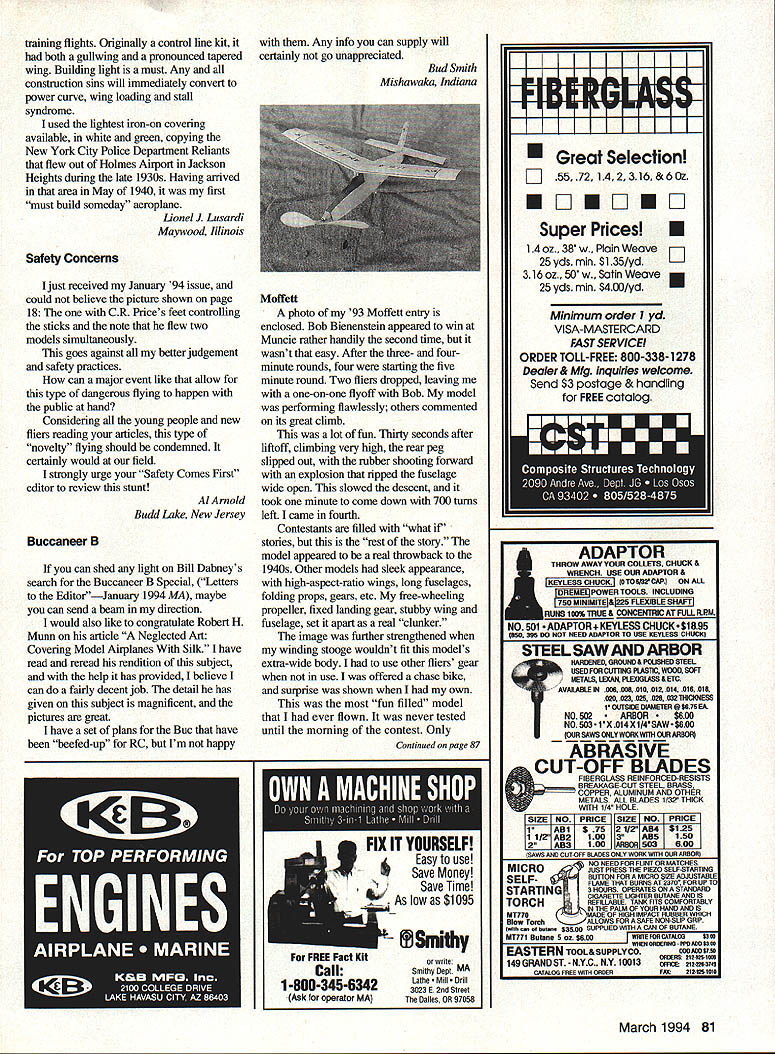
A photo of my '93 Moffett entry is enclosed. Bob Bienenstein appeared to win at Muncie rather handily the second time, but it wasn't that easy. After the three- and four-minute rounds, four were starting the five-minute round. Two fliers dropped, leaving me with a one-on-one flyoff with Bob. My model was performing flawlessly; others commented on its great climb.
This was a lot of fun. Thirty seconds after liftoff, climbing very high, the rear peg slipped out, with the rubber shooting forward with an explosion that ripped the fuselage wide open. This slowed the descent, and it took one minute to come down with 700 turns left. I came in fourth.
The model appeared to be a real throwback to the 1940s. Other models had sleek appearance, with high-aspect-ratio wings, long fuselages, folding props, gears, etc. My free-wheeling propeller, fixed landing gear, stubby wing and fuselage set it apart as a real "clunker." The winding stooge wouldn't fit this model's extra-wide body, so I had to use other fliers' gear when not in use. I was offered a chaser bike, and surprise was shown when I had my own.
Innovations included an extra-long rubber motor that stops with a full row of knots left, so the CG won't be upset for the glide. This takes extra weight for the unused rubber, but so do return gears. Gears would be located in the rear, with a wing shaft aft, to maintain the correct CG location. A shorter tail moment arm would result and reduce performance. The shorter fuselage uses less cross section with a penalty for longer lengths. The shorter motor length also concentrates the inertia of this heavy mass nearer the CG for improved stability. The slender top of the triangular body makes an ideal location for the wing and stabilizer, with minimum obstruction of the maximum 202 square inches allowed. The fuselage as built in profile is very unusual, but provides incredible lateral stability. Glide circles were so concentric that it never flew as far as other models on each round, as it never reached the beam field.
The wing was placed two degrees negative to the centerline of the body, which works well on F1B designs. The thrust line is almost parallel to the wing chord. The glide is nose-high. The flight attitude, combined with the flat-bottom fuselage, is believed to make this a flying surface too, which could improve the glide duration. Aerodynamics have stated that this only adds drag, but I am not convinced.
This model was named Pace Shuttle by Jack Phelps at a SAM 56 club meeting. The profile resembled the Space Shuttle and the wing was from a Pacemaker, hence the name Pace Shuttle.
I strongly urge that Moffett rules switch back to the original rule of a larger fuselage cross section (2-1/4 in.). This reduces performance slightly, but makes the category more interesting and fun. Models can have character when you have a larger fuselage to work with when designing the new model.
Just look at the variations in old Wakefield designs: Korda, Clodhopper, California Champ, Hi-Ho, Gypsy, Linn's Kansas winner, etc. Note how boring all of the designs are in P-30, Coupe, and Wakefield, at least to the casual observer. They all look alike. Why not preserve a little more of the great Moffett tradition? Modification of an existing design would only require an addition of a simple fairing, with a minimal drop in performance.
This should be a very popular event in many meets around the country. I am not alone—that Bennett is to be congratulated for making this category a reality again.
Les DeWitt Wichita, Kansas
Tech Debate Continues...
The January "Letters" contained a comment by Bob Meuser on a recent article on centrifugal force, and reader reaction to it. Reader John Vesper replied to Bob's letter with criticism of his own. I forwarded Mr. Vesper's letter to Meuser and asked for his comments. Both letters follow.
I am writing in response to the two letters appearing in the January 1994 issue defending the previously published article on centrifugal force. While the article itself was factually inaccurate, the letters which followed can only be described as scientifically illiterate.
Mr. Meuser states that if he were to fall asleep in a box, and that box were to be put into space and set spinning, he would not be able to determine whether the "force" holding him to the floor was gravity or the acceleration of his body in a circular path. He further states that he could perform no experiment within that box which would have an outcome any different from that same experiment performed on Earth. Both statements are in error.
For Mr. Meuser to tell, he would only have to rotate his head 90° to either side, and the fluid within the semicircular canals in his ears would immediately tell him that something was amiss. And any experiment he chose to perform involving momentum would immediately show the system and frame of reference to be under acceleration.
Were he to release an object at the top of his box, and let it "fall" to the bottom, it would not fall straight down. When released, the object would have an instantaneous velocity tangent to the circle it described about the center of rotation. Once released, there would be no forces acting upon it, so its motion would no longer change, and it would follow a straight line along that tangent (straight in relation to the Universe).
As the box continued to rotate about the center of rotation, the object would not only appear to "fall" toward the bottom of the box, but would start to approach the rear wall of the box, as seen from the inside of the box. This is because the instantaneous velocity of the box has changed in direction, while the object has continued in the same direction it was headed when released.
If the object were able to pass unimpeded to the exterior of the box, once the box had rotated 180° the object and the box would be headed in exactly opposite directions.
Similarly, a gyroscope set in motion in any plane of rotation other than that of the box would be seen to tumble, as it maintained its orientation to the Universe while the box has an angular momentum in that same Universe.
What he has done is to misapply the fact that you cannot detect the velocity of a frame of reference from within that frame of reference. An object in circular motion is not in constant motion, but accelerating, which can be detected from within that frame.
The author's rebuttal is even worse: he quotes Newton profusely regarding every force being opposed by an equal and opposite force, but neglects another of Newton's laws: that force = mass × acceleration.
If the force on an object is opposed by an equal and opposite force, the net force on that object in that direction is zero, and thus there can be no acceleration. No acceleration, no circular motion.
He further misuses D'Alembert's Principle, which pertains only to objects in equilibrium, and states that for this equilibrium to be maintained, all forces must be balanced. Circular motion is not a state of equilibrium; it is a steady acceleration.
Acceleration is defined as a change in velocity, and velocity is a vector quantity, which means it has both magnitude (in this case speed) and direction. While the speed may remain constant, the direction is constantly changing, which means acceleration, which means no equilibrium. Ergo D'Alembert's Principle does not apply.
He goes on to state that virtual forces are not, in his opinion, fictitious. This is precisely what the term virtual means in a scientific context: that which appears to be there, but isn't. I refer you to the term virtual reality, which means that you experience a world which has been artificially created for your senses but isn't really there.
To return to Mr. Meuser's box in space, what he experiences as gravity is not a force of him trying to go directly away from the center of rotation. It is due to the fact that the box is having to force him into the same path as it is taking. It is having to accelerate him directly in the direction of the center of rotation, 90° from the direction of the instantaneous velocity at any given moment.
We do not speak of "retrograde force" when our car's acceleration forces us back in the seat. This is due to the fact that our car is trying to pass us, our body mass is resisting the change in our velocity, and the car is having to exert an unopposed force on our body in order to match our body's velocity with its own.
The only difference with centrifugal force is that in the case of circular motion, the acceleration is in a direction at right angles to the direction of motion instead of being in the line of motion.
The saddest part of all this was that the numerical formulae quoted in the article were all correct, but they were for the force necessary to accelerate the plane through a turn or a loop, not the centrifugal force on the object within that motion.
John Vesper Tulsa, Oklahoma
Mr. Vesper's description of the statement in my previous letter is a gross distortion of what I said. Either he didn't really read my letter, or read it but didn't understand it, or read it, understood it, and chose to deliberately distort it. Since I did not state, intend, or imply what Vesper bases his criticism on, there is little point in responding to his criticism.
If one wants to nitpick one can poke holes in my argument, but not the ones described by Vesper. My argument is valid, however, to first order. And I stand by my point, which seems to have gotten lost somewhere, that centrifugal force is indeed a force.
Bob Meuser Oakland, California
Transcribed from original scans by AI. Minor OCR errors may remain.

