
Letters to the Editor
Send your Letters to: Model Aviation, 5151 East Memorial Drive, Muncie, IN 47302
Amateur Radio
Let's start this letter by asking a simple question: would any of us let a person fly at our site without being a member of the AMA? We would offer assistance, but we would not let him or her fly until they were a member. After all, those are the rules that govern our club and our hobby in general.
Now let's ask another question: would any of us let a person fly at our site using a radio on the amateur frequencies without the proper license? Sadly, the answer is sometimes yes.
What is the big deal? A $10,000 fine! But that is not the crux of this matter.
Licensed amateurs have studied and put forth some real effort to obtain the privilege of using those frequencies, and they feel cheated when a "pirate" uses them without the proper license. You pirates put us hams in the impossible situation of having to choose between a friend and the law.
Make no mistake about it: a pirate is a felon, pure and simple.
If modelers want to use these exclusive frequencies, then they should get their license. It is very easy. The license is free, and is good for 10 years.
The study guides have the exact questions and answers that are on the exam (by law, not one word may be changed!), and learning Morse code is no longer necessary. The radio amateur society is just as helpful to newcomers as any RC flying club.
Contact your local amateur radio club. They offer classes, study guides, and a warm welcome!
Arthur C. Clark Sacramento, California KD6GBY
Sea Cruise
The world of RC modeling has come to the world of cruise-ship entertainment. Last summer, during an evening show in the Chorus Line Lounge aboard the Majesty of the Sea, one segment of the show portrayed the dreams of three youths for their futures. One youth wished to be an astronaut, and as his dream began in the dimly lit lounge, two flying saucers silently floated from the rear corners of the lounge to the accompaniment of various outer-space themes. They slowly moved toward the stage, circled each other, dipped down close to the heads of the audience, and then rose to the edge of the balcony to return to their starting points.
Each saucer was about five feet in diameter and 30 inches high. They appeared to be made of metallized plastic film. Each had red lights randomly flashing along the edge of its perimeter.
When silhouetted against the stage lights, the means of propulsion became apparent. At the perimeter of the cross axis on each side were two electric-motor-powered shrouded props, one above the other, to move the ship forward or back. On the fore-and-aft axis, similar single units were mounted to control yaw or rotation. Mounted outboard at each axis was also a single vertical unit to control the elevation of the craft. With the center of gravity below the center of buoyancy, the craft remained level at all times. It was almost spooky to watch them move silently through the semi-darkness.
After the show we tried to get a better look at the craft. Each was tethered to a roped-off lounge table. It appeared that a four-channel radio was used for control, but we were unable to get close enough to see much detail. One pilot said his unit had been slowly leaking gas, and this had caused him some problems near the end of the performance.
For indoor entertainment in a gym or auditorium these craft would be a sure crowd pleaser. The show was probably copyrighted, but that wouldn't prevent a modeler from making a saucer for his own use. Design and construction would be quite challenging.
I hope that this may be of interest to you and your readers. Keep up the good work.
Barney Ruckdeschel Starke, Florida
So Long
Harry Murphy's "So Long" plane and article (January 1994) were a real treat! The combination of accurate plans for the 54-inch version of this famous design by Bill Englehardt, along with its history, is an outstanding addition to our record of model aviation before World War II.
I attended the 1940 Nationals in Chicago where the original 50-inch So Long won the Class B event, so I have a personal interest in the design. At the same contest the Buzzards Club had another great original design in Joe Konefes' Buzzard Bombshell, the Class C winner. Both planes went on to be published and kitted.
About 10 or 15 years ago I saw Bill Englehardt at its "original" So Long at a Chicago-area Old-Timer contest, but I didn't know at the time it was not actually the same one I had seen flying at the Nationals some 40 years earlier. Harry Murphy's story shed a whole new light on that.
Thank you for publishing such a fine-flying model design and the most interesting history that accompanies it!
Jim Alaback San Diego, California
Hooked!
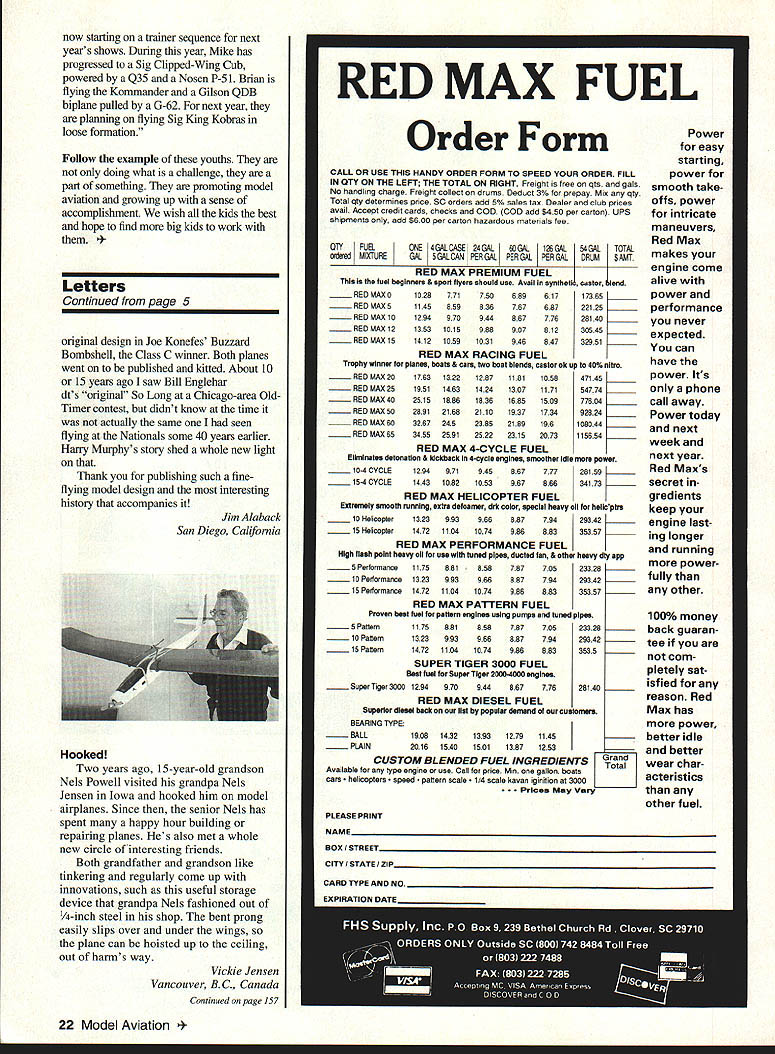
Two years ago, 15-year-old grandson Nels Powell visited his grandpa Nels Jensen in Iowa and hooked him on model airplanes. Since then, the senior Nels has spent many a happy hour building or repairing planes. He's also met a whole new circle of interesting friends.
Both grandfather and grandson like tinkering and regularly come up with innovations, such as this useful storage device that Grandpa Nels fashioned out of 1/4-inch steel in his shop. The bent prong easily slips over and under the wings, so the plane can be hoisted up to the ceiling, out of the barn's way.
Vickie Jensen Vancouver, B.C., Canada
Never Too Old
I just read the letter in the November 1993 issue of Model Aviation from Genie Brown of Miramar, Florida. She asked if Tom was too old at 62—no way! I'm 73, the oldest RC flier in Nodaway RC Flyers Club.
My advice is to start with a high-wing, tricycle-gear trainer. Be sure balance is correct—a little nose heavy won't hurt. If training cord cannot be used, let an experienced pilot take off and fly to control on the start, but you will soon get the feel of the controls. Let the experienced pilot land the plane. It won't be long before you will be able to fly by yourself.
Harold Poppa Sr. Maryville, Missouri
Debased deBolt?
Your debasement of Hal deBolt in the December issue of Model Aviation sets a new low in irresponsible publishing.
The current level of interest in model aircraft is the result of innovative design approaches generated by pioneers such as Hal deBolt. AMA exists today because of such men.
Contest wins by deBolt and deBolt aircraft designs over the many years attest to Hal deBolt's knowledge of aircraft design and performance.
I do not suggest that deBolt's articles are flawless. Those who produce also make mistakes. Did you ever hear Hal deBolt claim that he is perfect? I do state, however, that deBolt deserves better than to have Model Aviation publish a denouncement by the California expert concerning deBolt's aircraft design knowledge. Who the hell ever heard of said expert? Is he an expert? If he is, I suggest that you publish his offerings, rather than accept and then denounce other authors.
As a member of the AMA, I am ashamed and disgusted that our organization would publicly denounce one of the truly great pioneers of our hobby.
Paul W. Koenig Clyde, New York
Please see my comments on Hal deBolt in "The Haugh Corner."
Quarter Midget
The following was sent to our Pylon columnist, Bill Hager:
Just received my latest issue of Model Aviation, and after reading the start of your article on RC pylon racing, I felt that I had to at least let you know my feeling and thoughts.
I'm a 10-year member of PGRC and the AMA, and reside in District IV, which has Rick Moreland on the Contest Board. Your statement that representatives were voting for themselves and not their members doesn't hold true in District IV. While I only race Q-500, I relish the thought of being able to use my same motors in another class (Quarter Midget).
A little background on PGRC over the past several years: we have held at least three races a year at our site (both Q-500 and 1/4 Midget races). This entails closing our club field for both days for about 10 hours. Q-500 has been growing in popularity, while 1/4 Midget had dwindled in support, mostly due to noise (being in a highly populated area) and the added cost of additional equipment. The 1/4 Midget races were not well attended. After several 1/4 Midget races where the course workers outnumbered the contestants, our Board of Directors didn't want to have any more 1/4 Midget races.
Then along came the 1/4 Midget rules change. It seemed to fit lots of local clubs in our district. Our Contest Board member for District IV talked to a lot of racers, and only had two complaints about the proposed rule changes, and one of those was solicited by him. If there was opposition, they either didn't speak out before the vote or spoke out only after the rule changes were voted on and passed.
I have gladly attended the last two Nats events. You made mention of 40 1/4 Midget contestants. I wonder how many of those people ever put on races at their local club fields. Please correct me if I'm wrong. At the last Nats, I also saw 119 entries in Q-500. Most of the racers in District IV that I have talked to welcome the chance to be able to race another event with only building another type airplane and swapping motors. I also realize that Henry Nelson has said that he will just create a super 1/4 Midget motor. Again, most clubs in our district can and will put special exceptions in their contest sanctions that limit motors to front intake, side exhaust. So what will be gained?
One last item and then I'll get off my soapbox. I believe that it's up to the Contest Board members to promote participation by as many entrants as possible. With noise being a real problem with 1/4 Midget and dwindling support, changing rules will let more people race, which equals more participation.
Art Edsall Huntingtown, Maryland
Helicopter Pilot
I just received the February issue of Model Aviation, and read with interest the letter on page 48 titled "More Helicopters."
I also wrote you a letter three months ago concerning the exact same thing—that your magazine does very little for the helicopter enthusiast. I also asked why we have to sign a waiver saying that we will not sue you over insurance problems. We join the AMA for insurance, but if we have a claim, we are at the mercy of your decision. I would not sign a waiver for my homeowners or car insurance. I also suggested that you lower the dues for us heli pilots and let us choose our own magazine. I did not have a response from you, personally or in your magazine, so that shows me where your priorities are.
I did rejoin the AMA this year, but unless things change I will not be a member in 1995. I wonder how many other heli pilots feel this way?
Raymond R. Beck Pittsburgh, Pennsylvania
Editor response: Since we have a monthly helicopter column by Contributing Editor Paul Traldius, I don't see how that can be construed as "doing very little." We cover a very broad slice of the modeling spectrum and serve more special interests than any other modeling publication. I have checked out the insurance question with several staff members, including Carl Maroney of Special Services, who indicates that helicopter pilots' coverage is identical to that of any other AMA member.
Transcribed from original scans by AI. Minor OCR errors may remain.

