

Letters to the Editor
Send your Letters to: Model Aviation, 5151 East Memorial Drive, Muncie, IN 47302
She likes RC
I have been wanting to write to you for some time now, to let you know, as a woman, I really enjoy flying these radio-control airplanes.
I built my own Eagle II, powered by an O.S. Max FP-40, in January 1993. It is still flying (a lot of glue does wonders). I am so proud of this airplane that I am now building my second one. It is a Big Stick .40, and will also be powered by an O.S. Max FP-40.
Getting the feeling of the airplane going up into the air and putting a hole in the sky is awesome.
I am trying to do some lazy eights, and right now believe me they are lazy, but with a lot of practice I will do fine.
I don't know how many women do fly these planes, but believe me it is a great sport. My husband, Cecil, and I fly these together. It makes a great family fun time.
Jan Hodge Killeen, Texas
Unwelcome Visitor?
On a recent trip to central Florida, I took along a couple of models, hoping the weather would permit a little flying. Boy! was I surprised!
The weather cooperated but did I ever get the bums' rush! As a member of AMA for forty years, I have participated in many contests, meets, and fly-ins around the country. I have never, ever experienced anything like this!
These guys make it perfectly clear they do not want to be bothered by visitors. They run their clubs like a big corporation on the brink of bankruptcy. There is so much club politics and so many rules they could not possibly enjoy flying. I can now understand why AMA has been having its problems.
One former member said he was reprimanded by a letter from the safety officer for chasing a bird! When questioned by phone, the safety officer admitted that he did not see the incident, but was informed by a reliable inside source. Come on now! This is not what it's all about!
At Volunteer Aeromodelers, sanctioned since 1970, we welcome anyone to fly as long as they are current AMA members. We also welcome spectators, especially the younger generation, even though it may take a few minutes of our time. We are solvent, have money in the bank and lease our field.
We have flown, on request, for schools and other groups in places where we know the hazards involved could cause us damage or destroy our aircraft. We try to do at least one mall show per year.
Our membership has been as much as, but not limited to, a hundred modelers. Our club rule is to adhere to the AMA code. We have no problems. We do have our share of "expert advisors," but hopefully it is all in fun.
Now, get this! We have two business meetings a year: one in January for donuts and coffee and the election of officers, secretary's report, etc.; and one in July, with a picnic to which all members and their families and guests are invited. The business portion of the meeting sometimes lasts as long as fifteen minutes.
I have been thinking all along that we were a normal average AMA club. Wrong again!
I personally could not enjoy flying my favorite model while watching my back at the same time!
Jack Tillett Knoxville, Tennessee
Editor: You didn't mention the offending club(s) you encountered; probably a good thing. Let's hope that your experience is an aberration—the result of an unfortunate misunderstanding.
Reader Comments (Helicopter Coverage)
I have to agree with Edward McWilliams (Feb. '94) of Berlin, Maryland, that Model Aviation magazine is geared toward airplanes only. In order to be a member of the Orlando Radio Control Helicopter Society I am required to join the AMA, and as an AMA member I must say Model Aviation magazine does almost nothing to help or promote the rotary-wing flyer.
We deserve more than the typical monthly product test report. Come on, we're part of the AMA as well.
Roy Harrison McMurdo Station, Antarctica
Editor: One of the things we hope to learn from our demographic survey is the number of active participants in specialized modeling disciplines such as helicopters. Our coverage of these disciplines may then be adjusted accordingly.
Printing and Readability
Regarding the printing of Model Aviation: understanding the need to contain the page count doesn't contain my protest over (1) the small type, (2) reduced photo size — why print something too small to be understood? (3) Cease the background color under the copy. It's too hard, if possible, to read.
I appreciate the quality of the magazine and read each copy page by page.
Ed Lidgard Perry, Georgia
Article Continuation (Page Jumps)
I read with amazement yet another article about "article continuation" (April, page 11). I have, over the years, been tempted to write about this inconvenience and annoyance, but just as I was about to put pen to paper, another AMA member would write to you about this issue. Obviously it was not deemed important, since no corrections were made.
I think you have a certain obligation to your membership, as well as the advertisers you serve, to make the magazine comfortable to read. Forget all the ad-target marketing stuff. If the reader is already annoyed having to look up yet another page, how receptive do you think he's going to be to any ads that have caused this annoyance?
Our family subscribes to 20 magazines, and in not one do they jump around as much as Model Aviation. You mentioned in your article that "it is naïve and idealistic to believe that money is not a factor." I think it's also naïve to believe that, and even though we have to take Model Aviation as part of our membership in AMA, we members have to read your magazine.
How about responding to your "customers," the members of AMA.
Bill Mitchell Woodinville, Washington
Editor: The number of "jumps" (continuations) was reduced before we received your letter. Hope you like the improvement.
Compliment on April Cover
One more comment—great cover on the April issue. Keep up the fine work with Model Aviation.
William Whitten Birmingham, Alabama
Builder of the Model / Buy-Tech
Just a few words regarding your BOM comments ("The Haught Corner," March 1994). Right on, brother!
An ex-free flighter (Illinois, So. Cal., 1966–76), I too saw my share of Daddy-Builts among the younger set. It's disgusting. (Big surprise, however, was when San Valeres CD made the young Calhoun boys demonstrate building a Satellite stalk—on the field, at a contest—to prove they'd built the models. Yes—they did it...and did it well, too.)
You're a gutsy guy. It took courage to print the remarks about "buy-tech" in a publication that derives much (most?) of its income from high-dollar ARF and "Ready To Crash" RC products!
We're beginning to see some of this "buy-tech" stuff in CL events, too. To be competitive in Stunt today, you need a $400 power package; in fact, it's possible to buy RTFs here too...which I think is pretty disgusting.
Nice stand, Jim! Please keep it going.
The real modelers out here support you. Incidentally, this letter is late because my March MA just arrived here in Kuwait. Transit time averages 30 days; wish I could afford to send you First Class postage. Oh well....
Mike Keville APO 09689-9901
Editor: It wasn't my intent to knock the sport — if someone doesn't have the time/desire to build; my problem is with people buying their way into competition, instead of building and learning along the way.
Note: Mike is now a vice president for PAMPA (Precision Aerobatics Model Pilots Association).
Beyond the Call — Twice
About 10 years ago I obtained a Sig kit of Chuck Hollenberg's PT-19A model. The model was not quite finished in time to enter into the '83 Nats at Westover AFB. I had hoped to finish it and enter it into the Nats in 1985 again at Westover.
Unfortunately the aircraft was lost after four flights, due to a "new" defective radio (whose brand shall remain unmentioned). Needless to say I was devastated with the loss.
The three flights that we did manage, the model flew flawlessly. On the fourth flight the radio failed, and all I could do was watch a year-and-a-half worth of hard work auger itself into a pile of sticks. My PT-19 was now just a fond memory.
This brings us up to today. On February 5 and 6, my club (the Northern Connecticut Radio Control Club) held its 13th annual auction and swap shop, and there on the auction shelf was the same kit that I had built in 1983. I had to have it, and did outbid two other modelers for the kit.
Upon opening the box it was discovered that all the parts were there—except the cowling. I called Sig's hotline and was told that the kit had been out of production for 23 years, and a cowl was unobtainable.
As a last resort, I wrote to Hazel Sig herself explaining my dilemma. Lo and behold, on the 19th of February a package arrived from Sig bearing a cowl for my kit. Hazel either had the old mold brought out of storage, or they located a cowl in the archives of Sig and sent it to me.
It's because of Hazel's intervention I now have all the parts needed to complete the kit. I want all the modelers who read this to know that Hazel Sig-Hester is a woman who is truly dedicated to helping the average modeler.
Her efforts have made this modeler very happy. How many other companies would get you parts for a kit so old and out of production? If Model Aviation has a Woman of the Year award, I wish to nominate Hazel.
I very much appreciate what she has done.
Thank You, Hazel
Modeling industry, the advancement of model aviation, and her dedication to the average modeler, is second to none.
Thank you Hazel, you're a person that all modelers should appreciate. You're a valuable asset to the modeling industry.
Dennis Thibodeau Enfield, Connecticut
Help from the Industry (Saito Parts)
Two years ago I let a fellow club member fly my R.C.M. 25L with a Saito 30. At the same time there were three two-cycle planes in the air, and he could not tell if the motor was running. He therefore throttled back and unknowingly killed the engine. Needless to say, the tree gods claimed the plane and motor.
I tried for the next year and a half to obtain a cylinder head, new or used, from Saito. The motor was no longer in production and therefore no parts were available. I called around and wrote everyone I could.
I decided to try again with Saito, and I received a reply from John at P&P Enterprises, Plano, Texas. We made contact on the phone and discussed what I needed. The result was that he sent me numerous parts from a different motor that he thought I could use. They could not be used, and to date are being sent back. Never once was a price mentioned. I am thanking him very much for his time and effort. In these times when trust is a forgotten word, it is enlightening that there are people like John who will go the extra step for a stranger.
George Pedersen Mastic, New York
Soaring Report
Paging through the May 1994 Model Aviation, I was surprised to find coverage of the F3B World Championships on page 150. It's one thing to have inadvertently omitted the copy from earlier issues, but another to bury it back with all the standard contest statistics and notices. Contrast this with your recent coverage of the World Pattern and Helicopter Championships. Is this how world-class soaring is to be covered in the future?
I am new to soaring but have seen enough to know that there is incredible variety in the sport. People are flying everything from gas bags to molded/composite lead sleds. Hopefully, your magazine will be able to capture a good cross-section of the soaring community in future features and contest reports.
Philip D. Weihe Cleveland Heights, Ohio
Editor: Team managers' reports are generally contained in the "Focus on Competition" section, as this one was.
SAM Champs
I want to thank you for publishing the excellent article on the 1993 SAM Champs in the May issue of Model Aviation. Your choice of John Oldenkamp to write the story of last year's SAM Champs was a very good one. Mr. Oldenkamp caught the wonderful atmosphere of the annual meet and wrote very well. He is an excellent writer as well as photographer.
Articles such as this one truly do a tremendous service for the large group of older and experienced modelers that make up a large share of your readers.
Jim Adams President, Society of Antique Modelers Santa Ana, California
Planes of Fame Corrections
Although we were very pleased with the statements made about The Air Museum "Planes of Fame" by George Jenkins in his Scale Masters article that was published in the May 1994 issue of Model Aviation, the article did contain a few misconceptions that should be brought to your attention.
The Air Museum Planes of Fame is an independent, non-profit corporation. Ed Maloney is the museum's founder and director, Steve Hirnston is the museum's president and chief operating officer, and Don Lykins is the chairman of the board.
The Air Museum benefits greatly from the valuable services provided by a core of very dedicated volunteers, one of whom is Steve Moriarty. However, Steve Moriarty does not have (and has never had) a formal position of responsibility with the organization. Video production is his volunteer specialty, though he does frequently render services in other areas as well.
The phone number published in the article is Steve Moriarty's home number. For direct information about The Air Museum "Planes of Fame," calls should be directed to (909) 597-3722.
By the way, the AT-6 (actually an SNJ-5) illustrated in the article actually belonged to Ray Dieckman at the time the photo was taken. Dieckman raced the airplane at Reno in 1993 and Phoenix in 1994. Don Lee is a friend of Ray Dieckman and has his own collection of classic aircraft at Chino.
If you have any questions, please do not hesitate to contact me.
Frank B. Morrill Public Relations Director 7000 Merrill Ave., Box 17 Chino, CA 91710
No Dummy Here!
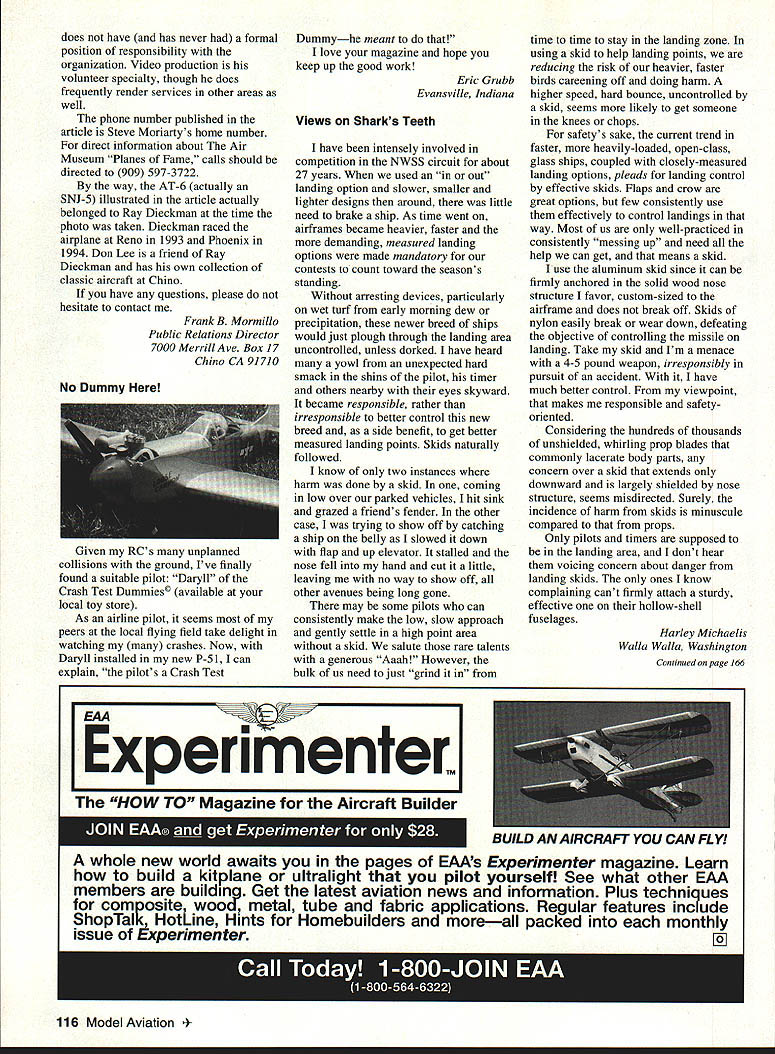
Given my RC's many unplanned collisions with the ground, I've finally found a suitable pilot: "Daryl" of the Crash Test Dummies (available at your local toy store).
As an airline pilot, it seems most of my peers at the local flying field take delight in watching my (many) crashes. Now, with Daryl installed in my new P-51, I can explain, "the pilot's a Crash Test Dummy—he meant to do that!"
I love your magazine and hope you keep up the good work!
Eric Grubb Evansville, Indiana
Views on Shark's Teeth
I have been intensely involved in competition in the NWSS circuit for about 27 years. When we used an "in" or "out" landing option and slower, smaller and lighter designs were around, there was little need to brake a ship. As time went on, airframes became heavier, faster and the more demanding, measured landing options were made mandatory for our contests to count toward the season's standing.
Without arresting devices, particularly on wet turf from early morning dew or precipitation, these newer breed of ships would just plow through the landing area uncontrolled. I have heard many a yowl from an unexpected hard smack in the shins of the pilot, his timer and others nearby with their eyes skyward. It became responsible, rather than irresponsible, to better control this new breed and, as a side benefit, to get better measured landing points. Skids naturally followed.
I know of only two instances where harm was done by a skid. In one, coming in low over our parked vehicles, I hit a car and grazed a friend's fender. In the other case, I was trying to show off by catching a ship on the belly as I slowed it down with flap and up elevator. It stalled and the nose fell into my hand and cut it a little, leaving me with no way to show off, all other avenues being long gone.
There may be some pilots who can consistently make the low, slow approach and gently settle in a high point area without a skid. We salute those rare talents. However, the bulk of us need to "grind it in" from time to time to stay in the landing zone. In using a skid to help landing points, we are reducing the risk of our heavier, faster birds careening off and doing harm. At a higher speed, a hard bounce uncontrolled by a skid seems more likely to get someone in the knees or chops.
For safety's sake, the current trend in plastic, more heavily-loaded, open-class, glass ships, coupled with closely measured landing options, pleads for landing control by effective skids. Flaps and crow are great options, but few consistently use them effectively to control landings in that way. Most of us are only well-practiced in consistently "messing up" and need all the help we can get, and that means a skid.
I use the aluminum skid since it can be firmly anchored in the solid wood nose structure I favor, custom-sized to the airframe and does not break off. Skids of nylon easily break or wear down, defeating the objective of controlling the missile on landing. Take my skid off and I'm a menace with a 4–5 pound weapon, irresponsibly in pursuit of an accident. With it, I have much better control. From my viewpoint, that makes me responsible and safety-oriented.
Considering the hundreds of thousands of unshielded, whirling prop blades that commonly lacerate body parts, any concern over a skid that extends under the downward arc and is largely shielded by nose structure seems misdirected. Surely, the incidence of harm from skids is minuscule compared to that from props.
Only pilots and timers are supposed to be in the landing area, and I don't hear them voicing concern about danger from landing skids. The only ones I know complaining can't firmly attach a sturdy, effective one on their hollow-shell fuselages.
Harley Michaelis Walla Walla, Washington
Danger from Shark's Teeth (Counterpoint)
Try placing all persons as far away from the landing spot as a normal glider would cover in approaching the spot and you will have to be 500 feet away from the spot to have all gliders at six feet high when going by the pilots.
I was hit by a glider and could possibly have had an ear taken off or worse if the glider had shark's teeth. As it was I only got the wing root connected to my head.
My spotter did not see the plane approaching, did not hear anyone yell for caution, or to look out. At a 30:1 to 40:1 glide ratio it would take 6 x 30 or a distance of 180 feet to ensure a glider to pass over the head of a six-foot-tall person and hit the spot.
Get real: it is excessively dangerous to have sharp objects on the front of a glider.
Charles Bush Colorado Springs, Colorado
Helping Kids
In the May 1994 issue of MA, your editorial briefly touched on the need to encourage our young people into this wonderful hobby. And in the "Letters" section, you responded to Margret Edstrom from Dallas by sending some surplus magazines to her seven-year-old son.
I would also like to see what this youngster needs, and perhaps I can send something; I don't know exactly what a seven-year-old would want. I didn't build any model airplanes until the age of nine, and then the Comet, Megow, and Joe Ott rubber-powered kits were a handful and a major undertaking. If you will send me the Edstrom address, I'll write and see what the youngster would like.
In September, 1992, my wife and I spent a month in Royal Leamington Spa, England. There I met a delightful young lad of 14 named Alistair Charlett who is crazy about model airplanes, and who amazed me with his knowledge of vintage aircraft, both full-scale and model. He had constructed an RC glider—hopelessly overweight—and he had not much success with it.
I drove Alistair to the Old-Timer contest at Old Warden, and on the following weekend to an Old-timer control-line contest in Birmingham.
While at Old Warden, during a lull in the model flying due to rain showers, Alistair and I toured the airplane museum, and he knew more about the airplanes displayed there than I.
At Old Warden, Alistair bought the plans for an English OT FF model called the Junior-60, a 60-inch cabin model. He wanted to build it for OT RC, but he had no engine for it. So when I returned home, I packed up five surplus engines and sent them to Alistair. There was an Enya .60 RC, an Enya .19 RC, a Fox .15 RC, an old O.S. .049, and a Cox Baby Bee. He couldn't use the .60, so I advised him to sell it and buy something he needed.
Alistair reminds me so much of myself at that age, and I would encourage anyone to write to him and to find out what he needs in the way of model products. If anyone can help, we will have done something significant for young modelers. His address is:
Alistair Charlett 14 Ravensdale Ave. Royal Leamington Spa Warwickshire, England CV32 6NG
Floyd E. Carter Los Altos, California
Anyone wishing to help Margret Edstrom's son should contact: Thomas Edstrom 7165 Tabor Dr. Dallas, TX 75231
Lost Cause (On Language)
...I see that your reference is Webster's. I shall have to concede...If Webster's is your bible, there is no sense in my wasting time writing to you on the subject of the English language...You are a lost cause.
Now that I have wistfully consigned our beleaguered language to whatever butchery your magazine has in store for it, I will turn to your slightly peculiar question, "And just where is the Middle West?"
...I guess you just pays your money and takes your choice. And by all means, feel free to refer to it as the "Mid-West" if you think "Middle" raises the syllable count too high to be handled easily there in Webster Country.
I don't want you to get too comfortable now. While I will suffer in silence the outrages you allow to be committed on the English language in the future, there is bound to come a time when you make an absolute dog's breakfast of some bit of aviation history. Then I reserve the right to dash off a stinker to you beginning with the time-honored, "Dear Sir, you cur."
Says, Charles V. O'Donnell Eugene, Oregon
June Cover Depressing?
I am depressed by your June '94 cover. I bet nobody in the picture is under 50, and none of the airplanes cost less than $300. Historical significance of the airplanes is not at all evident on the cover, and is hard to find in the magazine.
The image projected is just a bunch of rich old boys and their expensive toys. I admire Maynard Hill's technical achievements as much as anyone. The cover image is what bugs me.
Dick Baxter Laguna Niguel, California
Editor: If ever there were models that are not "toys," it's this group. Exhaustive testing and development brought each model to the world-record-setting level it achieved.
As for the age of those holding the models, I prefer to see the cover as representing many years of modeling accomplishments, and a large slice of AMA history. With three past or present AMA presidents and a recent Executive Director in one photo, much of where AMA has been and will go is represented.
Museum curator Mike Fulmer is also in the photo, and he has the unique task of linking the administrations of these men as part of the museum story.
Transcribed from original scans by AI. Minor OCR errors may remain.

