
letters to the editor
All letters will be carefully considered, those of general interest used. Send to Model Aviation, 815 15th St., N.W., Washington, D.C. 20005.
For King Kong?
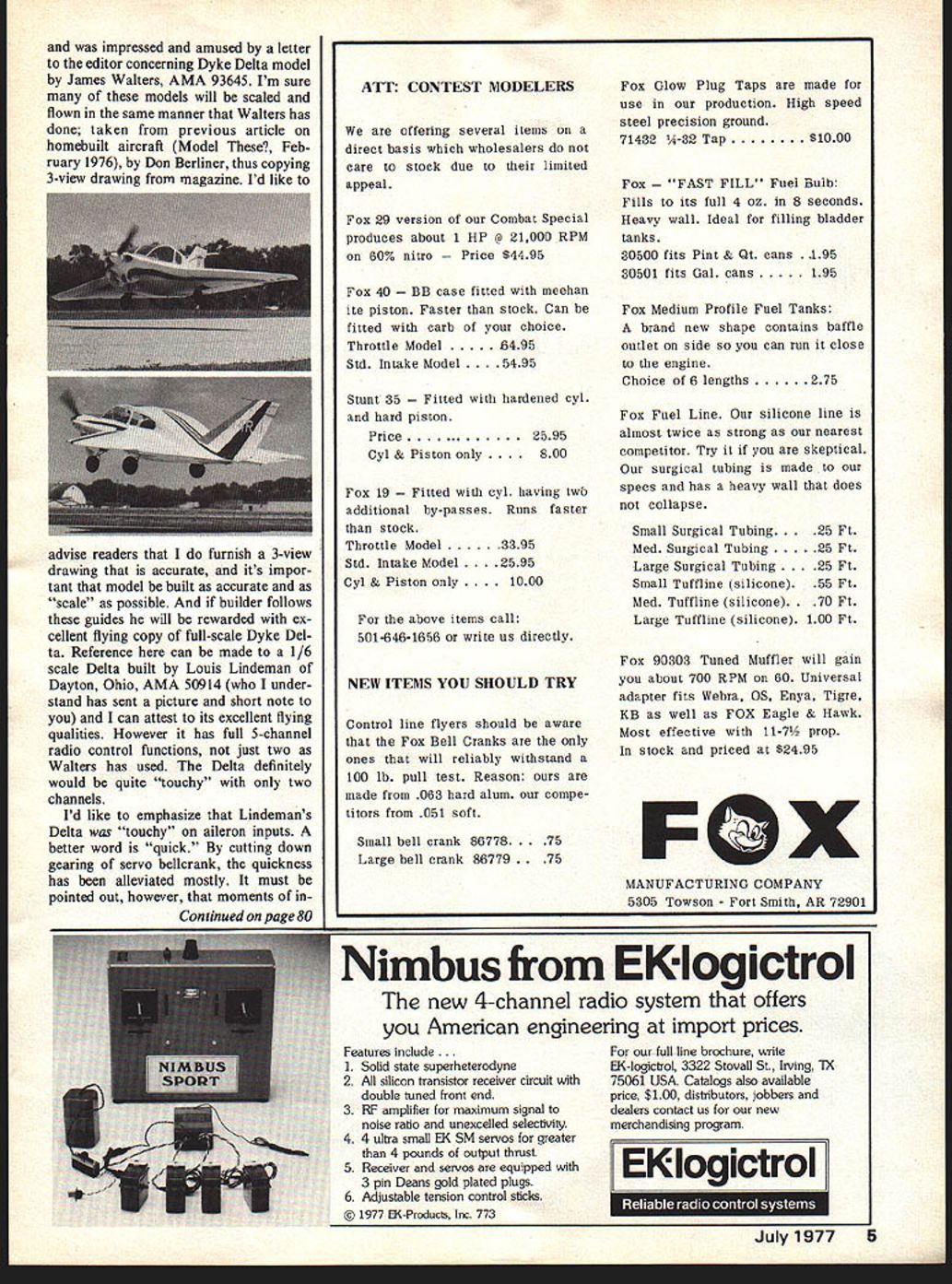
I finally was able to get a few pictures of my Skylark in flight. It flies very slow and very stable.... The engine is an O&R 1.34cc. We flew three flights. The engine heated up on a 20 X 5 pitch prop. I am looking for an engine a little larger—something in a 1.45 or 2.0. The O&R was just able to fly it.
Ed Fleury, AMA 58469 Detroit, MI
A picture of Ed's 14-ft. Skylark appeared in Ron Van Putte's column in last October issue. The 18½-lb. model has now flown successfully—as additional photos verify. Controls are moved by steel cables and bellcranks.
"See Your Model Dealer?"
I was very much impressed by your article on Nothing Fancy in the December '76 issue of Model Aviation. I've decided to build this model and I would appreciate it if you sent the plans. Enclosed is my check. Also, since this is my first RC plane, I would greatly appreciate any additional information you could provide regarding construction, flying, RC systems, etc.
I have one criticism of your and other comparable model aircraft magazines. That is the lack of good basic articles for the beginner. I've seen the words "See Your Hobby Dealer" far too often. It seems that those who are able to assimilate the technical information in your articles are those who need it the least.
Doug Schaefer Easton, PA 18042
Mr. Schaefer was put in touch with the designer of Nothing Fancy. While Model Aviation has only so much space and must devote a considerable portion of its pages to AMA matters, we do agree that there is a universal need for informative articles and features. The modeling field is so complex that all the magazines probably could run how-to things from cover to cover and still not adequately fill the need. And there are many books—some at the hobby shops. As is able, MA will publish such items—a massive two-parter on foam and the cutting thereof, skinning, etc. is coming up. One problem with "beginner" material is that everyone thinks it is just kids who need info. The average reader age of field magazines is very high—and most of the so-called beginners reading them are adults. Being a beginner is not a matter of age.
Flying Flat Iron
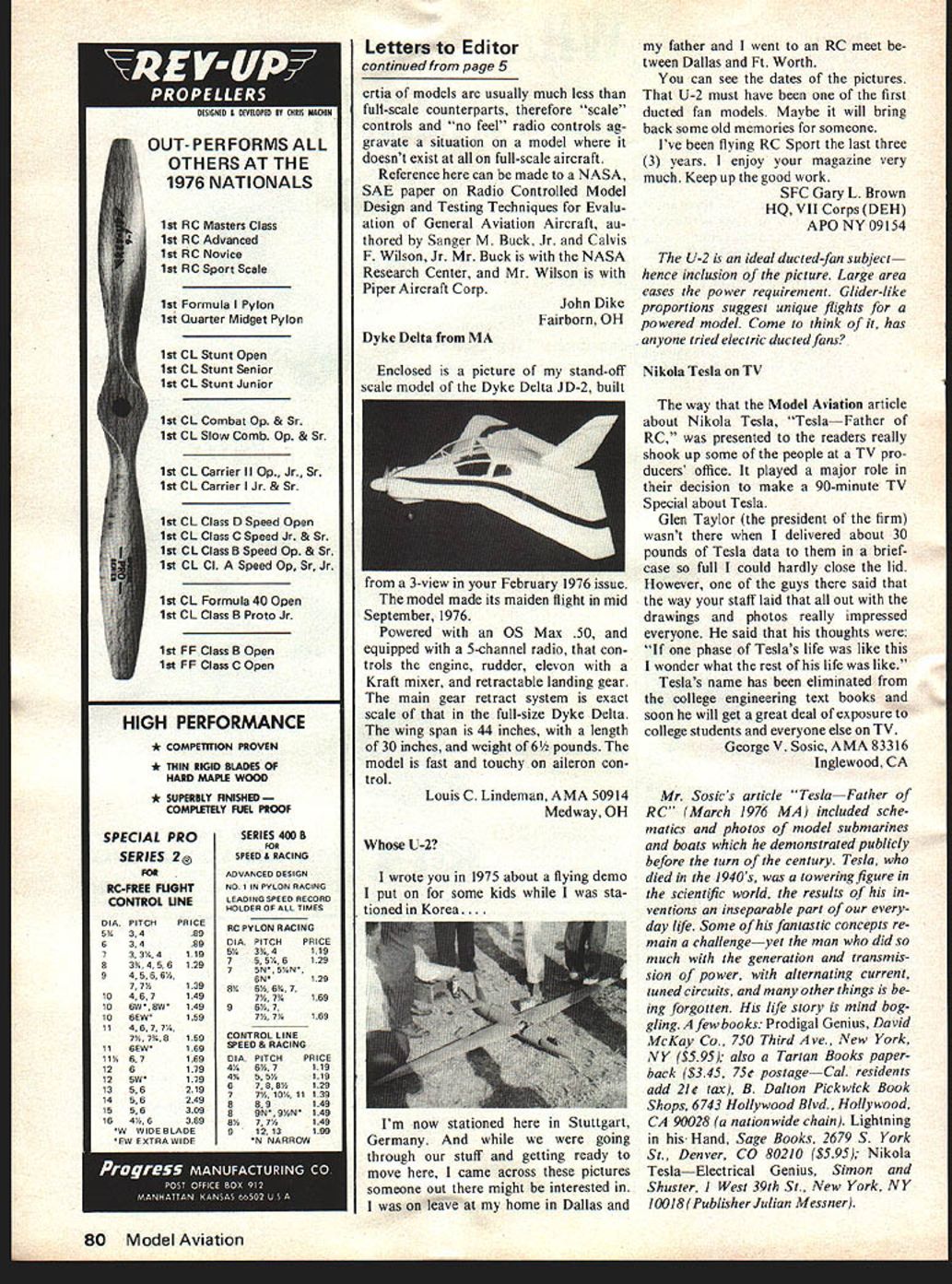
Enclosed is a picture of two DCRC members, Bill Musser and Bill Charbonneau, which appeared in the DCRC Newsletter.... both Bills have given a lot of their time and own money to the creation of the Flying Flat Iron. I saw a test flight last Sunday; what a sight!
Frank J. Magina, AMA 44359 Editor, DCRC Newsletter Columbia, MD
Dyke on Dyke Delta
Have just finished reading April '77 MA and was impressed and amused by a letter to the editor concerning Dyke Delta model by James Walters, AMA 93645. I'm sure many of these models will be scaled and flown in the same manner that Walters has done; taken from previous article on homebuilt aircraft (Model These?, February 1976), by Don Berliner, thus copying 3-view drawing from magazine. I'd like to advise readers that I do furnish a 3-view drawing that is accurate, and it's important that model be built as accurate and as "scale" as possible. And if builder follows these guides he will be rewarded with excellent flying copy of full-scale Dyke Delta. Reference here can be made to 1/6 scale Delta built by Louis Lindeman of Dayton, Ohio, AMA 50914 (who I understand has sent a picture and short note to you) and I can attest to its excellent flying qualities. However it has full 5-channel radio control functions, not just two as Walters has used. The Delta definitely would be quite "touchy" with only two channels.
I'd like to emphasize that Lindeman's Delta was "touchy" on aileron inputs. A better word is "quick." By cutting down gearing of servo bellcrank, the quickness has been alleviated mostly. It must be pointed out, however, that moments of in- ertia of models are usually much less than full-scale counterparts, therefore "scale" controls and "no feel" radio controls aggravate a situation on a model where it doesn't exist at all on full-scale aircraft.
Reference here can be made to a NASA, SAE paper on Radio Controlled Model Design and Testing Techniques for Evaluation of General Aviation Aircraft, authored by Sanger M. Buck, Jr. and Calvis F. Wilson, Jr. Mr. Buck is with the NASA Research Center, and Mr. Wilson is with Piper Aircraft Corp.
John Dike Fairborn, OH
Dyke Delta from MA
Enclosed is a picture of my stand-off scale model of the Dyke Delta JD-2, built from a 3-view in your February 1976 issue.
The model made its maiden flight in mid September, 1976.
Powered with an OS Max .50, and equipped with a 5-channel radio, that controls the engine, rudder, elevon with a Kraft mixer, and retractable landing gear. The main gear retract system is exact scale of that in the full-size Dyke Delta. The wing span is 44 inches, with a length of 30 inches, and weight of 6½ pounds. The model is fast and touchy on aileron control.
Louis C. Lindeman, AMA 50914 Medway, OH
Whose U-2?
I wrote you in 1975 about a flying demo I put on for some kids while I was stationed in Korea.
I'm now stationed here in Stuttgart, Germany. And while we were going through our stuff and getting ready to move here, I came across these pictures someone out there might be interested in. I was on leave at my home in Dallas and my father and I went to an RC meet between Dallas and Ft. Worth.
You can see the dates of the pictures. That U-2 must have been one of the first ducted fan models. Maybe it will bring back some old memories for someone.
I've been flying RC Sport the last three (3) years. I enjoy your magazine very much. Keep up the good work.
SFC Gary L. Brown HQ, VII Corps (DEH) APO NY 09154
Nikola Tesla on TV
The way that the Model Aviation article about Nikola Tesla, "Tesla—Father of RC," was presented to the readers really shook up some of the people at a TV producers' office. It played a major role in their decision to make a 90-minute TV Special about Tesla.
Glen Taylor (the president of the firm) wasn't there when I delivered about 30 pounds of Tesla data to them in a briefcase so full I could hardly close the lid. However, one of the guys there said that the way your staff laid that all out with the drawings and photos really impressed everyone. He said that his thoughts were: "If one phase of Tesla's life was like this I wonder what the rest of his life was like."
Tesla's name has been eliminated from the college engineering text books and soon he will get a great deal of exposure to college students and everyone else on TV.
George V. Sosic, AMA 83316 Inglewood, CA
Mr. Sosic's article "Tesla—Father of RC" (March 1976 MA) included schematics and photos of model submarines and boats which he demonstrated publicly before the turn of the century. Tesla, who died in the 1940's, was a towering figure in the scientific world; the results of his inventions are an inseparable part of our everyday life. Some of his fantastic concepts remain a challenge — yet the man who did so much with the generation and transmission of power, with alternating current, tuned circuits, and many other things is being forgotten. His life story is mind boggling. A few books: Prodigal Genius, David McKay Co., 750 Third Ave., New York, NY ($5.95); also a Tartan Books paperback ($3.45, 75c postage — Cal. residents add 2lc tax). B. Dalton Pickwick Book Shops, 6743 Hollywood Blvd., Hollywood, CA 90028 (a nationwide chain). Lightning in his Hand, Sage Books, 2679 S. York St., Denver, CO 80210 ($5.95); Nikola Tesla — Electrical Genius, Simon & Schuster, 1 West 39th St., New York, NY 10018 (Publisher Julian Messner).
Transcribed from original scans by AI. Minor OCR errors may remain.

