
Letters to the Editor
Send your Letters to the Editor to: Model Aviation, 5151 East Memorial Drive, Muncie, IN 47302
"Liquids and Chemicals..."
I commend Mr. Graham Hicks on an excellent article about workshop solvents (Sept. '94). I would, however, like to make a small correction to his otherwise accurate facts. Vaseline (or any petroleum-based product) is, in fact, flammable when it comes in contact with pure oxygen.
Due to the fact that many members of our organization may need to wear a nasal cannula or other O2 delivery device, it is important to keep in mind that any solvents or workshop chemicals should be used carefully—or better yet, not at all—in the presence of pure oxygen.
Jason C. Young Waco, Texas
"Liquids and Chemicals in the Workshop" was great! It demonstrates how subject matter can be of high interest and significance across the board for all varieties of modeling and modelers. I sure learned a few things!
Bob Hatschek Douglaston, New York
Groovy!
I thought that some of the readers might groove on this very unique and original model. It's made from two Sure‑Flite 50‑inch‑span foam Mk I Spitfire kits and a little bit of creativity.
I used a very similar setup to the P‑82 Twin Mustang (a near dead ringer). I made a rubber‑powered twin Spit four years ago; though the props turned clockwise (no counter‑effect), with enough right‑rudder "trim" it seemed to fly quite well—sometimes.
The plane flies very nicely and is forgiving, and lands at a near crawl. It also does an outstanding vertical climbout.
- Engines: two O.S. SF .46 with Du‑Bro muffler extensions
- Fuel capacity: two 12‑oz Sullivans
- Weight: 6.0 lbs (unfueled)
- Controls: separate aileron and throttle servos
- Rotation: left engine normal rotation; right engine counterclockwise
Mic Keresztessy Jupiter, Florida
Comments on Lee Letter
Very seldom am I moved to respond to "Letters to the Editor," but the letter in the September issue by Mr. Robert S. Lee aroused me to do so.
It is disturbing to read such a letter by one who may consider himself a member of the modeling fraternity. Model Aviation, from time to time, may contain articles that do not address one's total or specific interest to the degree that one wishes, but in the overall scheme of things what does a magazine do?
I would like to consider myself a modeler and as such, anything written about any aspect of the hobby is at least of some interest to me. I am sure that the same article that I may find of little interest is deeply interesting to someone else. If Mr. Lee indulges long enough, maybe he will understand that we are a fraternity of many modelers who have widely varied areas of interest and we are not just an adjunct group of individuals playing with toy airplanes.
Model Aviation over the span of twelve issues does fairly well cover the full spectrum of modeling activities and I enjoy every issue albeit some more than others. It appears that Mr. Lee's youth has not allowed him the luxury of patience. Just hang in there, Bob—it gets better when you get a little older.
Jay Helt Rockwall, Texas
I wish to blow off some steam and express my thoughts concerning Mr. Robert Lee.
I started in RC when you needed a ham license to fly. However, I left RC when my interest waned to the point that I left the hobby for several years. I returned three years ago and started flying FF. To me, FF is the purest form of model flying. Never would I criticize other disciplines of modeling. It is a fact though, that disciples of any discipline—be it RC, UC, FF—believe their style of modeling is overlooked by magazine staff.
Model Aviation magazine has far more RC columns and RC construction articles than some on FF, but I have no complaint on that. Mr. Lee must be reading a different magazine than the one I receive at my house.
I want to thank and compliment the magazine staff for the 1994 February cover; that was a great action shot of Terry Thorkildsen's B Gas FF. I also enjoy Jim "Haught's Corner" and it is the first thing I read. Keep it coming.
Whit Russell Roswell, Georgia
I don't know what July issue Mr. Lee was looking at, but mine had two RC construction articles, one on Maynard Hill's record RC flight, and eight columns under Radio Control Roundup, one of which, I must admit, was on Electric.
Before I go any further, I should mention that I too am a gas RC pilot. I have flown RC Pattern (Aerobatics) and am now moving toward RC Scale models. I have been flying models in some form for 20 years.
Mr. Lee seems to feel that the only important modelers are those who fly RC gas models. While I agree the majority of people in the AMA today fly RC, they by no means are the only people in the modeling hobby.
There are no unimportant modelers or fields in modeling. Open your eyes and get rid of that tunnel vision you have. Modeling started with Free Flight and I don't think they get enough credit sometimes. I think out of 27 articles, you can tolerate 3 on Free Flight and 1 on Electric. That is hardly "being smothered." Enjoy the hobby, Mr. Lee—I know I do.
Donald R. Sudbury Fort Mill, South Carolina
Generational Shift
I'm prompted to write by the "generational shift" item in "The Haught Corner" in the September issue, specifically the letter to Rob Kurek from the fellow who thinks that wisdom comes automatically with age and/or that young people can't know very much.
He mentions Hal deBolt and Bill Winter. I remember the first time I saw Hal deBolt. I was one of a number of people gathered around Hal, listening as he explained some of the finer points of a model he had just flown. We were all in awe of this guy, who was obviously a master designer, builder, and flier, and who certainly knew more about his subject than almost anybody else.
The place was the Mirror Model Flying Fair, a huge annual contest sponsored by a New York City newspaper, The Daily Mirror, and Hal had just flown his famous Speedwagon control line Speed model. The time was about 45 years ago.
I don't know how old Hal was then, but I'm willing to bet he was no older than you are now. It would have been my loss if I'd walked away and not learned from him because I thought he wasn't old enough to "have something worthwhile to listen to." As for Bill Winter, it was my good fortune to know him more than thirty years ago, and he was definitely worth listening to then, even though the letter writer seems to think it's only now that Bill's old enough to have something of value to say.
It's been my observation that some people who like to equate age with wisdom do so because age is the only thing that's got going for them. I've also noticed that open‑minded old guys who are always looking to learn more will seek out knowledgeable people of any age.
Jeez, I'd rather spend a few minutes listening to that young whippersnapper Dave Aronstein than spend a few hours listening to some of my contemporaries in this hobby. I'd learn a lot more!
Don Typond Warwick, New York
Just read your writings in the September issue of Model Aviation. Your thoughts and the magazine are just fine despite some carping by readers.
I am one of the old‑timers. I am aware that the reins are being passed along. I am, by far, the oldest member in our local club, and I am delighted to be in the company of younger and in some cases brand new flyers.
While the opinions and wishes of all are important, Model Aviation from time to time may contain articles that address one's specific interests to the degree he wishes. In the overall scheme of things, what the magazine does is aimed at a broad readership. I enjoy the issues. Just hang in, Bob; it gets better—get a little older.
Jay Helt Rockwall, Texas
I wish to blow off some steam and express thoughts concerning Mr. Robert Lee. I started RC when you needed a ham license to fly. However, my RC interest waned to the point I left the hobby for several years. I returned three years ago and started flying FF—FF being the purest form of model flying. Never would I criticize other disciplines...
Wayne M. Jenkins Brazil, Indiana
Don't usually write these kinds of letters, but I've been there and know the value of feedback. I recognize the subliminal request in the September editorial for some. I get tired of hearing about all the "giants" and how much effort is spent describing how things were and how we keep them that way, hoping to still enjoy them the way we used to. Change is inevitable; nothing stays the same.
I read somewhere that folks who look back are old and folks that look forward are young. Historic visions are easy; visions of the future are tough by comparison, and without them, we go nowhere.
You're on the right track; keep the channels of direct communication open while we both appreciate the old timers and formulate visions of the future.
Dick Schwieren Burns, Oregon
Likes the Look
Several comments regarding the September 1994 issue.
First: many, many thanks for (practically) eliminating the horrible number of jumps the publication used to contain. This is a wonderful improvement. Please don't ever go back to the old way. I wrote at least one letter regarding this problem and mentioned it in the Member Survey; thanks for listening to us. Just wanted to let you know that I noticed the change and appreciate it.
Second: I, for one (and I'll bet a lot of other AMA'ers) don't want you to cancel "The Haught Corner." You might offer that bored‑silly modeler try to do better, if he can. He seems to value his opinions and information rather highly, but I can ignore your column. I've been in this hobby for over forty years, and reading another's opinion hasn't hurt me yet.
Finally, I truly appreciate Graham Hicks' article, "Liquids and Chemicals..." Useful tips and solutions to problems many of us have.
Ralph Wenzel Westminster, California
Gipsy Moth
Thank you for sending me the extra copies of the September issue containing the Gipsy Moth article. It was very well presented. I don't know how you got such nice pictures from only a contact sheet. Congratulations again on an article well done.
Frank B. Baker Madison, Wisconsin
Nice Visit
When you plan an event, you have no way of knowing that the event will be better than originally thought. Such was our visit to the AMA field at Muncie, Indiana to fly radio control models for two days.
We (Jim Miller, Bob Ullman, and I of the Ashland Cloud Chasers) arrived at the Holiday Inn on Friday and checked in (regular rate $68.00, AMA $49.00). We went to the field and stood in awe of what we saw: asphalt that ran forever, a beautiful pavilion with electricity where we plugged in our coffee pot (can you imagine having fresh coffee while you fly?), and just for us, a full moon coming up in the eastern sky.
We were at the field early Saturday morning; the wind was light and variable down the runway, and we flew and flew! Don Lowe, the AMA President, came out in the afternoon and chatted about models. What a pleasure!
We took time out at 3 p.m. to visit the museum. We were amazed at the display of models, radios, engines, and equipment. Everything was well placed, and you could see that a lot of thought went into the whole program. What a wonderful trip through the history of our hobby.
Sunday's weather was a repeat of Saturday's and again we had a very fulfilling day. There is a sadness, however, because not all our members will be able to visit and see for themselves our wonderful facility.
Thank you to AMA, Don Lowe, the museum staff, and to all the people with the foresight to put such a fabulous package together.
Severn T. Green Ashland, Ohio
Wants More Sport Coverage
I'm sure the majority of those active in RC aircraft modeling have been in the hobby for a long time. My perception is that this is particularly true of those who write articles and columns for the various RC magazines (and perhaps even more so for Model Aviation). This is not necessarily bad, since their collective experience and wisdom could definitely benefit us all.
However, I believe one problem does arise from this situation. Most of the articles and columns are geared more toward those who have also been involved (and active) in the hobby forever. It seems that all too frequently those who are relatively new to the hobby, or who were once involved in RC and have come back to the hobby after a long absence (such as myself) and have forgotten many lessons once learned, are often overlooked by the authors and editors. I also tend to believe that this segment of the RC modeling community must represent a fair percentage of the total.
I also agree with some recent letters that Model Aviation concentrates too much on competition flying. How about the older guys who just fly for the fun of it? While I am not trying to push techniques from competition Pattern fliers and the like, I would like to see the AMA's demographics on what percentage of the total AMA membership these groups represent (and how that compares to the amount of attention given in Model Aviation).
How about a little more attention to construction and basic flying techniques and other general items geared toward the average (beginning, novice, and intermediate) fliers? Don't neglect subjects and lessons learned long ago, or subjects that ran 5 or 10 years ago—share them with the rest of us!
Tim Revis Decatur, Illinois
Editor response: Tim, this issue marks the beginning of an increased commitment on our part to "how‑to" articles. We'll run at least one each month under a how‑to banner. We hope this series will provide helpful general‑interest tips and techniques.
Extra Effort
This letter is in regard to one of your employees who deserves an extra pat on the back, and I'd like to tell you why. His name is Greg Chartrand and he made our family trip to this year's Nats very special.
My 11‑year‑old daughter Amy competed in her first Nats (free flight Indoor) in Lubbock, and she placed. My 13‑year‑old son Jeff competed in both categories. After they received their trophies, I thought it would be nice to have their names put on them.
I took the trophies over to Greg, and he was more than happy to put their names on them right then. While he was doing that, I asked him about last year's trophies. Jeff was so proud of his, he polished part of the airplane off the glass before he returned home. Greg said he would send us another piece of glass when he got back and settled after the Nats was over.
Later that evening, I noticed Amy's trophy had gotten scratched while it was in the back of our van that day. When she saw it she got very upset. The next morning I took it back to Greg to see if he could do anything with it. He said to leave it and come back in a few hours. When we went back it was as good as new. That made Amy's day a whole lot brighter.
I just wanted to let you know what a great person Greg is and how dedicated he is to his work. Thank you again, Greg!
Priscilla A. Scott Dallas, Texas
Editor response: Greg is an example of many of the Nats workers: they put in very long days, often under difficult conditions, to make things better for the competitors and their families. Their work often gets little or no recognition; we salute Greg and all those who help with the Nats.
Float and Hull
I read with considerable interest Ed Westwood's excellent article "Float and Hull Design" in the June 1994 issue. It's right on!
In the '70s Weldon Dolgoff, Mike Dailey, and I decided to develop a practical flying boat that was intended to be kitted. There wasn't a lot of reference data in those days, but we researched everything we could find, much of which was, unfortunately, contradictory.
Weldon had practical float‑flying experience, and after many late‑night discussion sessions we decided on an all‑foam/balsa/fiberglass design. We built two test models and spent the next several months filming them on the water and in the air using a motion picture camera (that was before camcorders!), making continual changes until we got what we wanted.
In the final version the airplane worked itself very quickly over the hump unaided and in smooth water rotated exactly like a landplane. Not surprisingly, its configuration matched very closely the criteria presented in Ed's article.
Particularly troublesome was the tip float design. Everything we came up with had tradeoffs. What we finally settled on was a very fat symmetrical airfoil‑section float with flat sides about four inches wide. They were set at a high angle of attack so that the lower trailing surface was parallel to the hull surface just ahead of the step. The floats were mounted to the wing exactly like the landing gear on a landplane, using 5/32 music wire and hardwood gear blocks in the foam wing. This provided excellent shock absorbing and I don't recall we ever had a structural failure short of a hard crash. The floats themselves were foam cores covered with 1/16 balsa which was then glassed, and they worked quite well. The airplane was successfully flown on more than one occasion in whitecaps using this style tip float.
We also found that tip floats should not be set too far out on the wing. In our case 60% to 70% of the half‑span out from the fuselage was about right. At higher planing speeds, when the float was too far out the wing would contact the water—no matter how lightly—and the aircraft could skew abruptly if it encountered a disturbance in the water. When that happens it puts a lot of stress on the wing structure, to say nothing of unnerving the pilot!
One last comment: flat‑bottom monohulls tend to be much more stable laterally on plane than hulls with deadrise, and thus have significantly less need to use tip floats as water speed increases (all other things being equal).
Hopefully, Ed's article will encourage more modelers to try float flying. It's a whole new experience and just a lot of fun. Just don't go flying a boat of some sort to retrieve your airplane if the engine quits unexpectedly. Unfortunately, I tested that.
Tony Howard Monroe, Washington
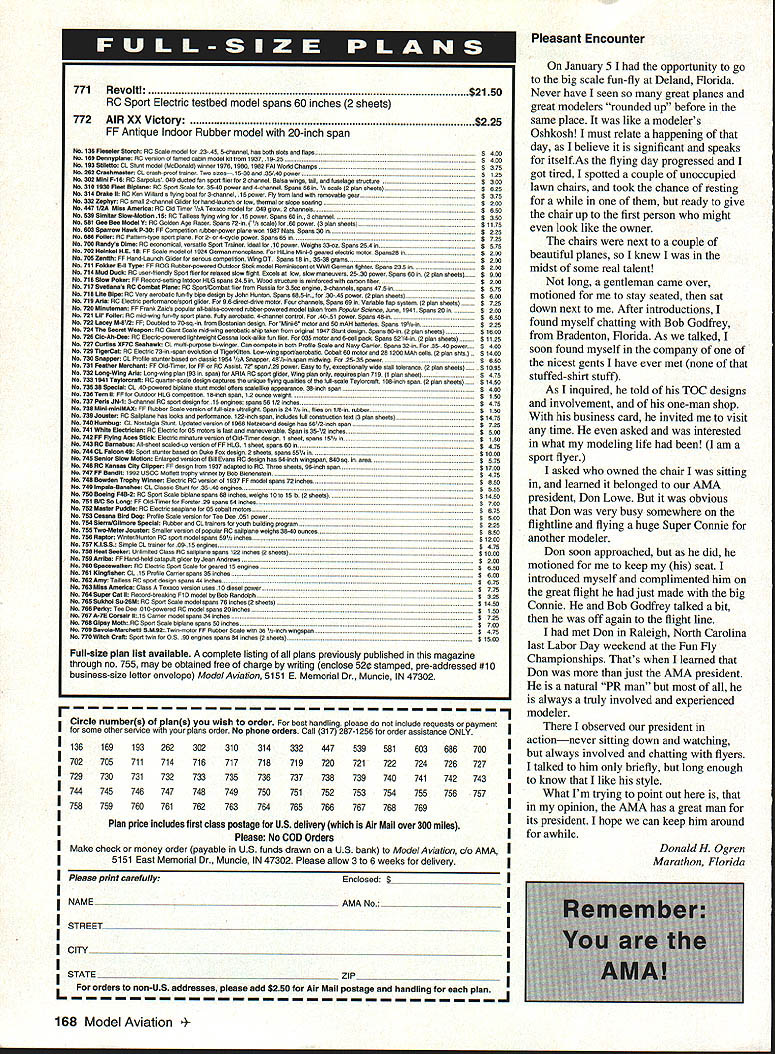
Pleasant Encounter
On January 5 I had the opportunity to go to the big scale fun‑fly at DeLand, Florida. Never have I seen so many great planes and great modelers gathered in the same place. It was like a modeler's Oshkosh! I must relate an event of that day, as I believe it is significant and speaks for itself.
As the flying day progressed and I got tired, I spotted a couple of unoccupied lawn chairs and took the chance of resting for a while, ready to give the chair up to the first person who might look like the owner. The chairs were next to a couple of beautiful planes, so I knew I was in the midst of some real talent.
Not long after, a gentleman came over, motioned for me to stay seated, then sat down next to me. After introductions, I found myself chatting with Bob Godfrey, from Bradenton, Florida. He is one of the nicest gents I have ever met. He told of his TOC designs and involvement and of his one‑man shop. With his business card he invited me to visit any time.
I asked who owned the chair I was sitting in, and learned it belonged to our AMA president, Don Lowe. Don was very busy on the flightline flying a huge Super Connie for another modeler. Don soon approached, motioned for me to keep my (his) seat, and talked with me briefly about the great flight he had just made with the big Connie. He is always involved and chatting with flyers.
What I'm trying to point out is that in my opinion the AMA has a great man for its president. I hope we can keep him around for awhile.
Donald H. Ogren Marathon, Florida
Transcribed from original scans by AI. Minor OCR errors may remain.

