
Letters to the Editor - 2001/01
Thankful for Modeling and Modelers
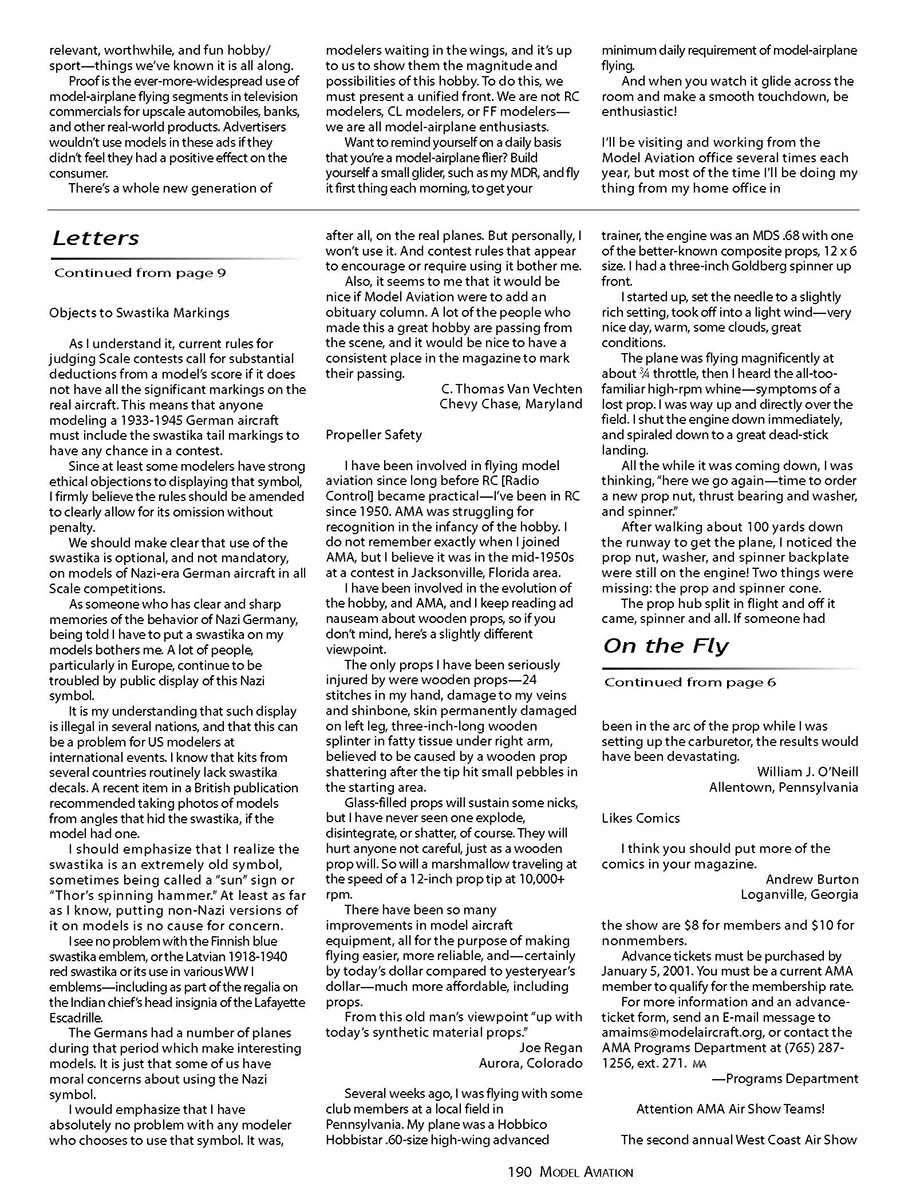
My wife of 53 2/3 years, Tina, and I spent four days at the AMA Headquarters building dedication and Celebration of Eagles II. This I consider one of the highlights of my young life of 77 years.
All the AMA functions were great—even the big wooden scissors (for the ribbon-cutting) that wouldn’t cut hot butter. Everyone got a laugh out of this, which was fun. I gave AMA Executive Director Joyce Hager a file at our NFFS (National Free Flight Society) banquet to sharpen them.
Our wonderful flying field, and now the magnificent Headquarters building with expansion of the beautiful museum, is a dream come true. It probably means more to me than any other modeler, due to my humble beginnings.
I was born in the little town of Irvington, KY, just across the Ohio River from Indiana. I was almost born a Hoosier, which wouldn’t be half bad since it’s a beautiful state. I’ve found from my many trips to Muncie that the AMA folks and the local people are the friendliest and most helpful of anywhere I’ve been.
My father was a circuit-rider Methodist preacher, and the little towns we lived in didn’t have electricity or running water. I am still a hill boy from Kentucky.
When I was nine or ten, my mother, Nell, went to Elizabethtown, KY, and bought me a model airplane kit for 25¢. She helped me cut out all the pieces using scissors, which broke most of the balsa wood. We didn’t get the model finished, so she bought me a 10¢ stick model, which would fly across the street. Today I still get a thrill—the same thrill I got then—flying models.
I went to the first of my 43 Nationals in Chicago in 1941 at age 16. I rode a Greyhound bus holding two small rubber models in my lap all night. I met many of my heroes.
My mother died last year at 100 years old. When she was 98½ she assembled a simple all-balsa model, the Centurian. She was tickled beyond words when curator Michael Smith installed it in a glass case next to one of mine in the AMA museum. She was my greatest supporter for 76 years.
In 1938 I first joined AMA when a license to fly Rubber and Glider cost 50¢. I didn’t have money for an engine, for which a license cost $1. I only built small rubber models and gliders since I couldn’t afford materials and rubber for big models. This is my 63rd competition year.
I was elected vice president of AMA for District VI in 1954 when I was 29. I have been an associate vice president for several decades under outstanding guidance from my friend and district vice president Jim McNeill. He and many others advanced AMA to where it is today.
Modeling is without a doubt the greatest of all sports. I owe my 35 years at Lockheed as a designer directly to models. Jim Wade, the employment manager of engineering, contacted me shortly after I returned from Finland as captain of the Wakefield team in 1951. I was a textile machine designer in West Point, GA, and Jim made me an offer I couldn’t refuse.
Most of my career with Lockheed was designing wind-tunnel models, which I’d almost have paid them to be able to do. I was privileged to help design some of the world’s greatest airplanes: the C-130, C-141, C-5A, and F-117 stealth fighter.
I am a full believer that God bestows special blessings to modelers. We have to do things that the average citizen is not required to do. Adding together all disciplines of modeling—Free Flight, Radio Control, Control Line, boats, race cars, and rockets—we modelers are outnumbered by over 1,000 to one by fishermen and hunters.
We modelers should consider ourselves part of a brotherhood. Few, if any, organizations are as blessed as modelers, having as many fine people as we have.
By helping the upcoming young people, like those in the Science Olympiad, we can ensure the future of modeling. Most of what we know we learned from someone else, beginning with our parents, then teachers, fellow workers, family members, and modelers. The things we have learned should be passed along, which might be a help to many.
I’m thankful every day for my modeling friends.
George Perryman Smyrna, Georgia
A Common Situation?
I am writing in response to Mr. Lance Novak’s letter in the August 2001 edition of Model Aviation concerning flying clubs and older men.
In the mid-1970s I got very interested in RC (Radio Control), so I purchased an airplane already built and ready to fly from a guy and proceeded to crash it on its first flight—imagine that! At the time, there was no such thing as a buddy cord; I was on my own at my parents’, who lived in the country.
After that I shelved the idea until a little over a year ago, when I found out that some of my coworkers were heavily involved with RC; my interest was renewed. I went straight down to the local hobby store and bought my first airplane, which was a kit.
It took me three months to build it, and I was excited to learn how to fly it. A friend of mine started taking me out to the local flying club’s field to teach me how. At the time, I did not belong to AMA or the club.
On the third visit to the field, while waiting for my friend to show up, I looked at the frequency board and noticed that my frequency was clear. So about ten minutes later I turned my transmitter on and was doing a range check with my airplane so that I would be ready to go when he showed.
Little did I know, within those ten minutes someone else had put his card on that frequency and was flying his airplane, which I ended up destroying.
When I realized what I did I readily admitted that I was the culprit. As soon as I admitted my guilt, an older man (in his 70s) came up to me and read me the riot act and made me feel even worse.
I talked with the gentleman whose airplane I crashed and paid him for the cost of his airplane, in full, about a week later with my sincere apologies. I admitted my mistake, I did the “walk of shame,” and I paid the man for his airplane. I felt, and still do feel, horrible.
Objects to Swastika Markings
As I understand it, current rules for judging Scale contests call for substantial deductions from a model's score if it does not have all the significant markings on the real aircraft. This means that anyone modeling a 1933–1945 German aircraft must include the swastika tail markings to have any chance in a contest.
Since at least some modelers have strong ethical objections to displaying that symbol, I firmly believe the rules should be amended to clearly allow for its omission without penalty.
We should make clear that use of the swastika is optional, and not mandatory, on models of Nazi-era German aircraft in all Scale competitions.
As someone who has clear and sharp memories of the behavior of Nazi Germany, being told I have to put a swastika on my models bothers me. A lot of people, particularly in Europe, continue to be troubled by public display of this Nazi symbol.
It is my understanding that such display is illegal in several nations, and that this can be a problem for U.S. modelers at international events. I know that kits from several countries routinely lack swastika decals. A recent item in a British publication recommended taking photos of models from angles that hid the swastika, if the model had one.
I should emphasize that I realize the swastika is an extremely old symbol, sometimes being called a “sun” sign or “Thor’s spinning hammer.” At least as far as I know, putting non-Nazi versions of it on models is no cause for concern.
I see no problem with the Finnish blue swastika emblem, or the Latvian 1918–1940 red swastika, or its use in various World War I emblems—including as part of the regalia on the Indian chief's head insignia of the Lafayette Escadrille.
The Germans had a number of planes during that period which make interesting models. It is just that some of us have real concerns about using the Nazi symbol.
I would emphasize that I have absolutely no problem with any modeler who chooses to use that symbol. It was, after all, on the real planes. But personally, I won't use it. And contest rules that appear to encourage or require using it bother me.
Also, it seems to me that it would be nice if Model Aviation were to add an obituary column. A lot of the people who made this a great hobby are passing from the scene, and it would be nice to have a consistent place in the magazine to mark their passing.
C. Thomas Van Vechten Chevy Chase, Maryland
Propeller Safety
I have been involved in flying model aviation since long before RC became practical—I've been in RC since 1950. AMA was struggling for recognition in the infancy of the hobby. I do not remember exactly when I joined AMA, but I believe it was in the mid-1950s at a contest in the Jacksonville, Florida, area.
I have been involved in the evolution of the hobby and AMA, and I keep reading ad nauseam about wooden props, so if you don't mind, here's a slightly different viewpoint.
The only props I have been seriously injured by were wooden props—24 stitches in my hand, damage to my veins and shinbone, skin permanently damaged on my left leg, three-inch-long wooden splinter in fatty tissue under my right arm, believed to be caused by a wooden prop shattering after the tip hit small pebbles in the starting area.
Glass-filled props will sustain some nicks, but I have never seen one explode, disintegrate, or shatter. They will hurt anyone not careful, just as a wooden prop will. So will a marshmallow traveling at the speed of a 12-inch prop tip at 10,000+ rpm.
There have been so many improvements in model aircraft equipment, all for the purpose of making flying easier, more reliable, and—certainly by today's dollar compared to yesteryear's dollar—much more affordable, including props.
From this old man's viewpoint: up with today's synthetic material props.
Joe Regan Aurora, Colorado
Several weeks ago, I was flying with some club members at a local field in Pennsylvania. My plane was a Hobbico Hobbistar .60-size high-wing advanced trainer; the engine was an MDS .68 with one of the better-known composite props, 12 x 6 size. I had a three-inch Goldberg spinner up front.
I started up, set the needle to a slightly rich setting, and took off into a light wind—very nice day, warm, some clouds, great conditions.
The plane was flying magnificently at about three-quarter throttle, then I heard the all-too-familiar high-rpm whine—symptoms of a lost prop. I was way up and directly over the field. I shut the engine down immediately and spiraled down to a great dead-stick landing.
All the while it was coming down, I was thinking, “here we go again—time to order a new prop nut, thrust bearing and washer, and spinner.”
After walking about 100 yards down the runway to get the plane, I noticed the prop nut, washer, and spinner backplate were still on the engine! Two things were missing: the prop and spinner cone.
The prop hub split in flight and off it came, spinner and all. If someone had been in the arc of the prop while I was setting up the carburetor, the results would have been devastating.
William J. O'Neill Allentown, Pennsylvania
Transcribed from original scans by AI. Minor OCR errors may remain.

