
Letters to the Editor
Corrections
In the September 2004 article "From the Ground Up: The Rest of the Engine," an error was published in the "Flight Test Results" table on page 38. The "45 Degree Climb Performance" for the 10 x 6 propeller should have been 1,200@26 — not 1,200@6.
In D.B. Mathews' September "Flying for Fun" column, on page 81 the captions for the restored OQ-2 drone before covering and the restored drone hanging in the AMA museum were switched.
The MA staff apologizes for these errors.
Pleased Inside and Out
I want to compliment you on your use of Jim Caparelli's Photoshop creation for the August 2004 cover of Model Aviation. It is a very striking picture. In the 20+ years of receiving Model Aviation, it is the first time I have considered framing a cover. Why did you put the Membership Manual sticker on the cover of this issue?
On another subject, the magazine has been a much easier and more pleasurable read since an effort has been made to keep the articles contiguous.
Leo Asnault Walnut Creek, California
Engines 101 Revisited
I read the "Revisited" ["From the Ground Up"] article in the August MA. I thought the first article was very good, especially for the novice (with only a little poetic license or errors).
Who are these guys who complained? Didn't they understand this was 101, not 401? This series of articles is very good for the novice and beginners for whom they are intended.
The series you are writing has been needed for a long time and is generally excellent. Please keep them simple so the novice can understand the principles. I appreciate your good work and think others do too.
Ron Simons Charlotte, Michigan
Shunning Safety?
With hand injuries from propeller strikes being cited as a major source of medical claims for the AMA, I was horrified to see the photos in the "From the Ground Up: The Rest of the Engine" article (in the September 2004 MA) that show someone measuring engine rpm holding the tachometer in front of a propeller turning 10,000 rpm.
The editor needs to do a better job of ensuring that proper safety techniques are represented in the AMA's official publication.
Richard Lewis via E-mail
(Editor's note: You are right that this is not an ideal situation. But in order to have the numbers on the tachometer readable in print, we had to perform these checks a bit closer in than we would have liked. In the "real world" you should make these measurements from a safer distance.)
A Bit of History
D.B. Mathews' "Flying for Fun" columns on Reginald Denny couldn't have been timed any better for our trip last week to Colorado. While visiting Tracy's Antiques in Montrose, Colorado, I noticed what looked like a large, vintage model airplane hanging from the ceiling. After asking about it, the owner told me it was one of the first remotely piloted drones and he had a write-up on the creator. It was Reginald Denny, and the article had Marilyn Monroe striking a similar pose as the picture in your September issue.
It appeared to have a two-cylinder horizontally opposed engine and was in reasonable shape from what I could see from the ground; however, the covering appeared to need some work. If I had had a way to transport it, I might have been more inquisitive about how much it was. The airplane had a two-blade propeller unlike the example in your magazine.
Thanks for an interesting bit of model airplane history, and as fate would have it, I actually got to see a bit of that history.
Thomas Gatchell Prescott, Arizona
Cardboard Construction
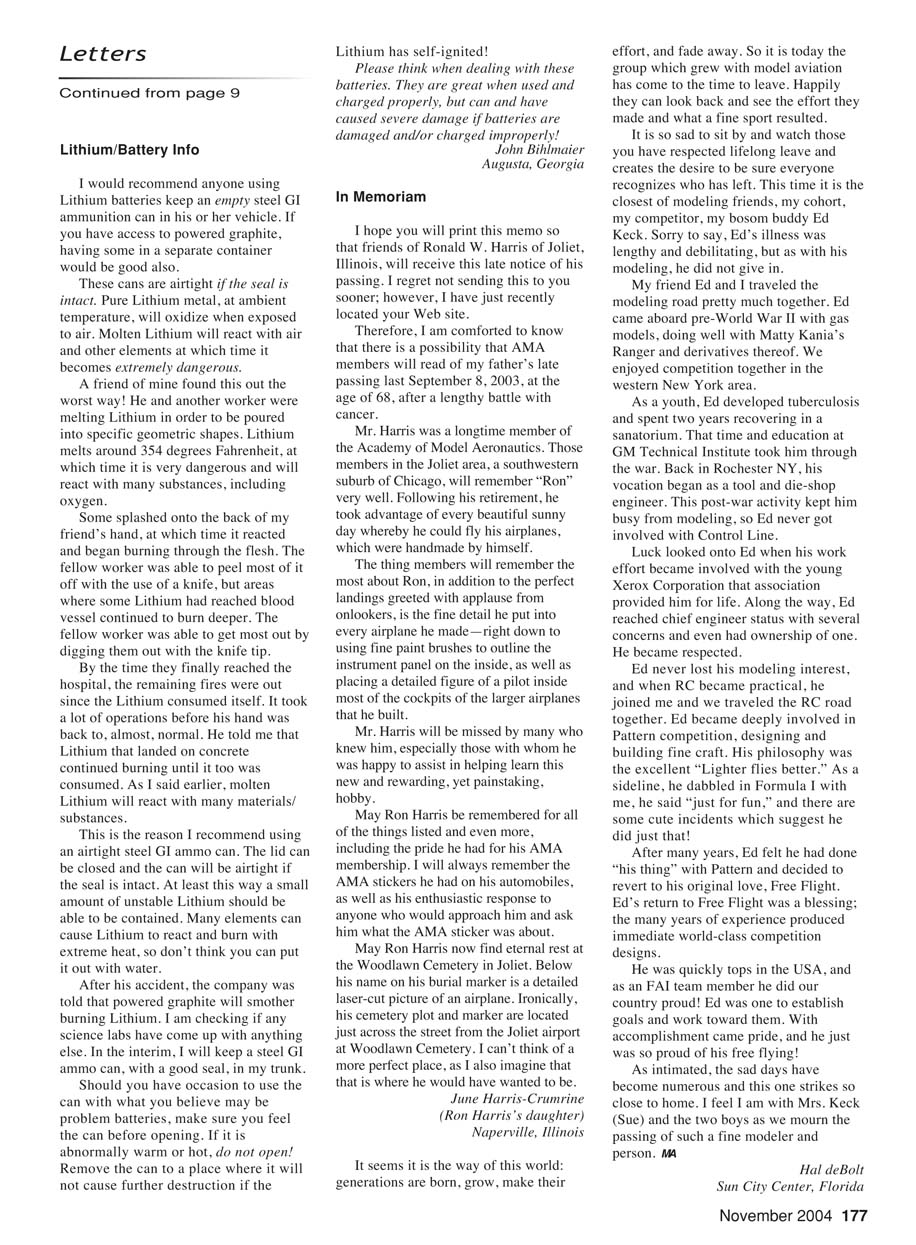
In the April and September Model Aviation, there were mentions of cardboard construction. Recently I took my best shot at cardboard construction, building this vintage aircraft totally out of cardboard. This model will make a wonderful static display in conjunction with the photos of the crash taken in 1951 plus the newspaper articles in the St. Paul Dispatch and the Minneapolis Tribune, also in 1951. Not a bad-looking airplane for about $25.
Bob Swearingen New Richmond, Wisconsin
Generous Offer
As a former AMA member for more than 30 years, I know the problems associated with flying model airplanes: no place to fly.
I have recently been flying powered paragliders and operate an ultralight flight park 18 miles west of Albuquerque, NM. I would like to offer the flight park for RC flying and competitions. The area is two miles from the highway and far from obstructions. Water, shelter, and electricity are on-site.
I hope you can put me into contact with pilots who might want to use the facility.
Ed Padilla Albuquerque, New Mexico
A Huge Asset
I recently built several Dump'r units from the design and instructions published in the October 2003 Model Aviation courtesy of Bob Kopski. I had a couple of concerns in building the Dump'r and wrote Bob with my questions. His reply was prompt and reassuring. The units work perfectly and are just what I needed for my shop!
That is not why I am writing this letter. We all owe a huge thank you to Bob for all he does for this hobby and others! I have been able to determine through Internet searches that Bob has his helpful fingerprints all over anything electrical, including ham radio. Everyone I read with Bob's name in it underscores not only his technical prowess, but his willingness to help anyone overcome a problem—for free!
In short, Bob's presence in this hobby is a huge asset which I feel compelled to recognize. He is both smart and helpful, and I'll bet if I ever get to meet him, he will also be a really nice fella to know. Thank you, Bob Kopski. You remind all of us of the importance of each person in this hobby.
Many thanks also to the fine people at AMA for providing the forum for people to help people.
Dave Thomas Seneca, South Carolina
Letters
Lithium/Battery Info
I would recommend anyone using lithium batteries keep an empty steel GI ammo can in his or her vehicle. If you have access to powdered graphite, having some in a separate container would be good also.
These cans are airtight if the seal is intact. Pure lithium metal, at ambient temperature, will oxidize when exposed to air. Molten lithium will react with air and other elements, at which time it becomes extremely dangerous.
A friend of mine found this out the worst way. He and another worker were melting lithium in order to pour it into specific geometric shapes. Lithium melts around 354 degrees Fahrenheit, at which time it is very dangerous and will react with many substances, including oxygen.
Some splashed onto the back of my friend's hand, at which time it reacted and began burning through the flesh. The fellow worker was able to peel most of it off with the use of a knife, but areas where some lithium had reached blood vessels continued to burn deeper. The fellow worker was able to get most out by digging them out with the knife tip.
By the time they finally reached the hospital, the remaining fires were out since the lithium consumed itself. It took a lot of operations before his hand was back to almost normal. He told me that lithium that landed on concrete continued burning until it too was consumed. As I said earlier, molten lithium will react with many materials/substances.
This is the reason I recommend using an airtight steel GI ammo can. The lid can be closed and the can will be airtight if the seal is intact. At least this way a small amount of unstable lithium should be able to be contained. Many elements can cause lithium to react and burn with extreme heat, so don't think you can put it out with water.
After his accident, the company was told that powdered graphite will smother burning lithium. I am checking if any science labs have come up with anything else. In the interim, I will keep a steel GI ammo can, with a good seal, in my trunk.
Should you have occasion to use the can with what you believe may be problem batteries, make sure you feel the can before opening. If it is abnormally warm or hot, do not open! Remove the can to a place where it will not cause further destruction if the lithium has self-ignited.
Please think when dealing with these batteries. They are great when used and charged properly, but can and have caused severe damage if batteries are damaged and/or charged improperly!
John Bihlmaier Augusta, Georgia
In Memoriam
I hope you will print this memo so that friends of Ronald W. Harris of Joliet, Illinois, will receive this late notice of his passing. I regret not sending this to you sooner; however, I have just recently located your Web site.
Therefore, I am comforted to know that there is a possibility that AMA members will read of my father's passing on September 8, 2003, at the age of 68, after a lengthy battle with cancer.
Mr. Harris was a longtime member of the Academy of Model Aeronautics. Those members in the Joliet area, a southwestern suburb of Chicago, will remember "Ron" very well. Following his retirement, he took advantage of every beautiful sunny day when he could fly his airplanes, which were handmade by himself.
The thing members will remember most about Ron, in addition to the perfect landings greeted with applause from onlookers, is the fine detail he put into every airplane he made—right down to using fine paint brushes to outline the instrument panel on the inside, as well as placing a detailed figure of a pilot inside most of the cockpits of the larger airplanes that he built.
Mr. Harris will be missed by many who knew him, especially those with whom he was happy to assist in helping learn this new and rewarding, yet painstaking, hobby.
May Ron Harris be remembered for all of the things listed and even more, including the pride he had for his AMA membership. I will always remember the AMA stickers he had on his automobiles, as well as his enthusiastic response to anyone who would approach him and ask him what the AMA sticker was about.
May Ron Harris now find eternal rest at the Woodlawn Cemetery in Joliet. Below his name on his burial marker is a detailed laser-cut picture of an airplane. Ironically, his cemetery plot and marker are located just across the street from the Joliet airport at Woodlawn Cemetery. I can't think of a more perfect place, as I also imagine that that is where he would have wanted to be.
June Harris-Crumpine Naperville, Illinois
It seems it is the way of this world: generations are born, grow, make their effort, and fade away. So it is today the group which grew with model aviation has come to the time to leave. Happily they can look back and see the effort they made and what a fine sport resulted.
It is so sad to sit by and watch those you have respected lifelong leave and creates the desire to be sure everyone recognizes who has left. This time it is the closest of modeling friends, my cohort, my competitor, my bosom buddy Ed Keck. Sorry to say, Ed's illness was lengthy and debilitating, but as with his modeling, he did not give in.
My friend Ed and I traveled the modeling road pretty much together. Ed came aboard pre-World War II with gas models, doing well with Matty Kania's Ranger and derivatives thereof. We enjoyed competition together in the western New York area.
As a youth, Ed developed tuberculosis and spent two years recovering in a sanatorium. That time and education at GM Technical Institute took him through the war. Back in Rochester, NY, his vocation began as a tool and die shop engineer. This post-war activity kept him busy from modeling, so Ed never got involved with control line.
Luck looked onto Ed when his work effort became involved with the young Xerox Corporation; that association provided him for life. Along the way, Ed reached chief engineer status with several concerns and even had ownership of one. He became respected.
Ed never lost his modeling interest, and when RC became practical, he joined me and we traveled the RC road together. Ed became deeply involved in pattern competition, designing and building fine craft. His philosophy was the excellent "Lighter flies better." As a sideline, he dabbled in Formula I with me; he said "just for fun," and there are some cute incidents which suggest he did just that!
After many years, Ed felt he had done "his thing" with pattern and decided to revert to his original love, free flight. Ed's return to free flight was a blessing; the many years of experience produced immediate world-class competition designs.
He was quickly tops in the USA, and as an FAI team man he did our country proud. Ed was one to establish goals and work toward them. With accomplishment came pride, and he just was so proud of his free flying!
As intimated, the sad days have become numerous and this one strikes so close to home. I feel I am with Mrs. Keck (Sue) and the two boys as we mourn the passing of such a fine modeler and person.
Hal deBolt Sun City Center, Florida
Transcribed from original scans by AI. Minor OCR errors may remain.

