
Letters to the Editor
Misdirected Emphasis?
I believe the emphasis on recruiting youth into our hobby, expressed in and by the January issue, is misdirected.
I am dismayed at the thought that we should try to get young people interested in model building and flying model airplanes because otherwise the variety of model-oriented merchandise presently available to us already in the hobby will dwindle. Not very altruistic, is it?
My first model airplane was a solid-balsa Martin B-10 bomber I received for my birthday when I was in the third grade in 1932. My mother tried to help me understand some of the unfamiliar terms, such as fuselage and empennage but beyond that was of no help, except that she always encouraged my building models because she knew where I was, and that I was out of trouble.
I was the only model airplane builder and flier in my grammar school, and never met any other model airplane enthusiasts until I was in the Naval Air Corps, but I never wavered in my love of the hobby.
I believe that the "Little League" syndrome has been so drummed into our youth that most are unable to investigate new skills and fields individually. We should help them when asked, but should let them do the initiating.
In the 1930s, airplanes were rare and romantic. Today they are commonplace. It may be time to recognize that model airplane building is a hobby that has peaked and is on a normal decline.
Now we live in an age of instant gratification. Those so afflicted will probably not wish to spend the time necessary to learn to build and fly models. Those who still have the enterprising mindset will find their own field of interest. These, who have already expressed interest in model aviation, are the ones we should encourage.
J. W. Juechter East Greenwich, Rhode Island
T-Bird
I've been in AMA for about five years now. What's a Thunderbird? I ask this question for two reasons. One, I'm interested, and two, it's not readily apparent.
If you look through the RC Modeler, Model Airplane News and Model Aviation you see plenty of mail-order outfits catering to the sport flier in RC, but what about a catalog featuring the lesser-known branches of our sport? I want to build a 1/2A Texaco R/C assist—where do I find a kit? Don't say "local hobby shop"—it's an hour and 15 minutes away.
I've read the lament in our magazine about a lack of young fliers in our hobby—where do they enter? AMA should offer a "counter-culture" catalog. One that contains control-line kits, free flight kits, electric kits, 1/2A Texaco kits, rubber-power kits, catapult gliders, etc. We would take orders and clear them through the manufacturers, with a cut for us. This catalog should be seen in youth magazines like Boys' Life. We could sell AMA "specials"—the AMA Cub, a CL special with engine, kit, lines, etc.
My father wants to build a 40- to 50-inch wingspan electric trainer for RC. Look through the aforementioned magazines and find a good quality kit with a good motor in it. A small Old-Timer with a Master Airscrew power unit would probably do. I know it's available, but where? This catalog would fill the bill.
Another idea would be to have an annual issue of Model Aviation that would feature manufacturers and their products. Then offer this issue year round in other magazines. I would gladly pay $5–$10 for one complete catalog, instead of $2–$5 each for 10 catalogs.
I know that this does not entirely pertain to free-flight, but I thought you might be receptive. What's a Thunderbird? Where can I see it and other free-flighters? I want a 1/2A Texaco to assist; where do I go? Thank you for your consideration.
Rick Ryder Danielsville, Georgia
P.S. "The Haught Corner" is great.
Editor: Rick, I think you're referring to the T-Bird, a Russ Hansen design from the 1950s. It's now flown in Nostalgia FF events, and has been kitted by Campbell's Custom Kits in Michigan.
What It's All About
A few of the big-time modelers don't realize this, but RC aeromodeling isn't about winning awards.
It's about belonging to a club, a place where you're recognized and can feel good about yourself. It's not a serious business. It's where you can go out and shoot the bull with good friends. It's laughing at mistakes and cheering on victories. It's helping a beginner, helping him through every milestone, and watching him do a solo all by himself.
A few of you modelers fly for only one reason: winning. I feel that you are missing out on the best part of our hobby.
Dave Carmichael Boulder, Colorado
Help Wanted
I'm writing to ask for any suggestions you might offer to me in my search for a set of plans for the Skylark 56, the sport/pattern/RC model once manufactured by Carl Goldberg Models, but now out of production.
I wrote to the Goldberg Co. a while back to inquire about the plans, but was informed that they are in storage and are not available. However, I later wrote to Mr. Bill Winter about the model, and he referred me to your office at Model Aviation, as the photocopied enclosure indicates.
I'd appreciate any positive leads that you could possibly offer in finding plans for the Skylark. I'm particularly interested in building the twin-engine version of the aircraft, as was advertised when the kit was on the market.
Thanks for a terrific aviation magazine.
Philip C. McNamara Santa Clara, California
Nats Comments
My view on the Nats has always been pretty much as it is now. That is, the Nats has never been a true national championships. This is mainly because you don't have to do anything to be able to compete except be an AMA member, pay your entry fees and show up and fly. I think that there should be some sort of precompetition elimination contests or some type of qualifications required, similar to the FAI programs.
A look at the winners of the 1994 Nats will give one the impression that it really is not a national contest. It would appear that 80% of the winners were from Texas or neighboring states. I know there are some great aircraft modelers from Texas, but they sure don't represent 80% of the national modelers. Naturally, those who live close by will always be the majority of the competitors. It has always been that way, I agree, but I think something should be done to simplify the Nats (fewer events) and make it less costly.
I think it would be great to host the Nats at Muncie in 1996, but 1995 will be in the Northwest, which will prove to be Northwest competition and not truly national competition.
Model aviation is a great hobby, and I have benefited greatly by my contacts with modelers in all aspects of the hobby. I learned a lot of engineering as a kid. I feel my relationships now and in the past have done much to help me morally and in so many other ways. I really can't express what it has meant to me. I wish there was some way I could do something to benefit the hobby as much as it has done for me. No, I have never won a Nats trophy, or came close to winning, but I felt I was a winner by just being involved. Therefore, if you could ever need me for anything to help out, I'm available. Thanks for doing such a good job & allowing me to put in my two cents.
Jim Perdue Gallatin, Tennessee
Why is the Nats slowly deteriorating to the point that if you show up, [and] fly one flight, you can then go home with a first-place trophy? Most dedicated modelers would hide this sort of trophy for fear of ridicule from fellow modelers. This situation, and having events canceled at the last minute after preparing for serious competition all year—national champion, huh! You have just won over who happened not to be there or a mediocre modeler who enters just because he lives near the Nats site that year.
My point here is to generate some discussion within the AMA membership and attempt to change the method of Nats contests and the possible reduction of this yearly expense. The Nats, in its present form, is nothing more than a large local contest attended mostly by local fliers and the well-heeled who can afford lengthy trips and motel bills every year, possibly leaving much better builders and fliers to languish at home due to the lack of major funds.
Now, nitpick this sort of scenario apart, if you will:
- Each district conducts a series of local, zone, area contests in each category. This is at modelers' expense and each contestant must fly a minimum of three contests with an accumulative score.
- The winners of these contests will go to a biennial district contest, this also at the modelers' expense, except for the entry fee.
- The winners of each of the eleven district contests then go to the Nats (the same biennial year) at the designated national flying site at AMA expense for competition between eleven of the best from every part of this great country.
The winner of the biennial national flying site contest (Indiana, California, Florida, or wherever) would then be a true national champion as he would have won over the best from each district. This would be something to be proud of rather than the present ridiculous situation.
I realize that a change of this form would prevent a modeler from observing other categories of competition while he is not actually competing, but what are we there for: finding a national champion, or attending a gawking party?
I also realize that this letter will raise the ire of many modelers and letters of retaliation will flow like junk mail, but remember, I got you to think about it, didn't I?
Rich Herrmann Pensacola, Florida
Cabbage Patch Nationals
A friend of mine in the Peterborough club here in England has purchased me a year's subscription for Model Aviation.
I'm now on my third month—thanks for a really enjoyable magazine, covering most of our sports activities in a single read—great! Enclosed are details of our now-famous all-control-line Cabbage Patch Nationals (June 4, 1995), so called because of the number of competitions we pack into a relatively small field.
Any of your members who may have a vacation planned in June 1995 would be made very welcome to visit us and spectate or fly. My address, telephone and fax numbers are all shown on the information sheet.
Brian Lever 3 The Park Peakirk Peterborough, England PE6 7NG
Good Work!
I would like to join others who have recently noticed that your magazine has become much easier to read. Thank you!
Your December issue came equipped with a "table of contents" for your "Roundup" section. This was one of the things I listed for improvements in your reader survey. Your last few issues were also devoid of the usual leapfrogging we've come to expect. I trust you will continue on your path of enlightenment, and allow the great material you cover to be perused with ease.
Of the seven model aircraft mags I receive, MA usually got read last. This was mostly because it was so dense, and segmented. I would often find the great material, but it was a chore to follow thought to completion. Now, I can turn to my favorite sections, read them first (like I do with the other six mags), and finish cover-to-cover when time allows.
Keep up the good work!
Joe R. Chovan North Syracuse, New York
Boyz II Men?
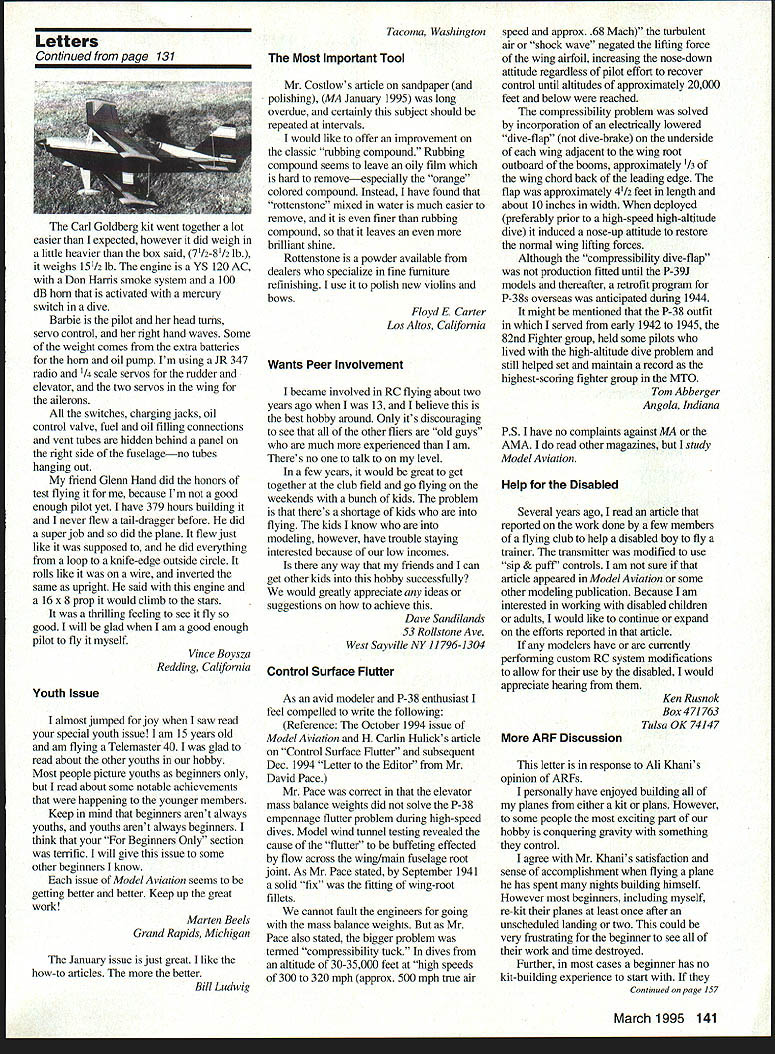
I'm new to the hobby and soloed in May of 1993. My first plane to build was a Spectra glider, and the Ultimate 10-300S is my second.
The Carl Goldberg Kit
The Carl Goldberg kit went together a lot easier than I expected, however it did weigh in a little heavier than the box said (7-1/2–8-1/2 lb.). It weighs 15-1/2 lb. The engine is a YS 120 AC, with a Don Harris smoke system and a 100 dB horn that is activated with a mercury switch in a dive.
Barbie is the pilot and her head turns, servo control, and her right hand waves. Some of the weight comes from the extra batteries for the horn and oil pump. I'm using a JR 347 radio and 1/4 scale servos for the rudder and elevator, and the two servos in the wing for the ailerons.
All the switches, charging jacks, oil control valve, fuel and oil filling connections and vent tubes are hidden behind a panel on the right side of the fuselage—no tubes hanging out.
My friend Glenn Hand did the honors of test flying it for me, because I'm not a good enough pilot yet. I have 379 hours building it and I never flew a tail-dragger before. He did a super job and so did the plane. It flew just like it was supposed to, and he did everything from a loop to a knife-edge outside circle. It rolls like it was on a wire, and inverted the same as upright. He said with this engine and a 16 x 8 prop it would climb to the stars.
It was a thrilling feeling to see it fly so good. I will be glad when I am a good enough pilot to fly it myself.
Vince Boyssa Redding, California
Youth Issue
I almost jumped for joy when I saw/read your special youth issue! I am 15 years old and am flying a Telemaster 40. I was glad to read about the other youths in our hobby. Most people picture youths as beginners only, but I read about some notable achievements that were happening to the younger members.
Keep in mind that beginners aren't always youths, and youths aren't always beginners. I think that your "For Beginners Only" section was terrific. It will give this issue to some other beginners I know.
Each issue of Model Aviation seems to be getting better and better. Keep up the great work!
Marten Beels Grand Rapids, Michigan
Bill Ludwig: The January issue is just great. I like the how-to articles. The more the better.
The Most Important Tool
Mr. Costlow's article on sandpaper (and polishing) (MA January 1995) was long overdue, and certainly this subject should be repeated at intervals.
I would like to offer an improvement on the classic "rubbing compound." Rubbing compound seems to leave an oily film which is hard to remove—especially the "orange" colored compound. Instead, I have found that "rottenstone" mixed in water is much easier to remove, and it is even finer than rubbing compound, so that it leaves an even more brilliant shine.
Rottenstone is a powder available from dealers who specialize in fine furniture refinishing. I use it to polish new violins and bows.
Floyd E. Carter Los Altos, California
Wants Peer Involvement
I became involved in RC flying about two years ago when I was 13, and I believe this is the best hobby around. Only it's discouraging to see that all of the other fliers are "old guys" who are much more experienced than I am. There's no one to talk to on my level.
In a few years, it would be great to get together at the club field and go flying on the weekends with a bunch of kids. The problem is that there's a shortage of kids who are into flying. The kids I know who are into modeling, however, have trouble staying interested because of our low incomes.
Is there any way that my friends and I can get other kids into this hobby successfully? We would greatly appreciate any ideas or suggestions on how to achieve this.
Dave Sandilands 53 Rollstone Ave. West Sayville, NY 11796-1304
Control Surface Flutter
As an avid modeler and P-38 enthusiast I feel compelled to write the following (Reference: The October 1994 issue of Model Aviation and H. Carlin Huick's article on "Control Surface Flutter" and subsequent Dec. 1994 "Letter to the Editor" from Mr. David Pace).
Mr. Pace was correct in that the elevator mass balance weights did not solve the P-38 empennage flutter problem during high-speed dives. Model wind-tunnel testing revealed the cause of the "flutter" to be buffeting effected by flow across the wing/fin/mast/fuselage root joint. As Mr. Pace stated, by September 1941 a solid "fix" was the fitting of wing-root fillets.
We cannot fault the engineers for going with the mass-balance weights. But as Mr. Pace also stated, the bigger problem was termed "compressibility tuck." In dives from an altitude of 30–35,000 feet at "high speeds" of 300 to 320 mph (approx. 500 mph true air speed and approx. .68 Mach) the turbulent air or "shock wave" negated the lifting force of the wing airfoil, increasing the nose-down attitude regardless of pilot effort to recover control until altitudes of approximately 20,000 feet and below were reached.
The compressibility problem was solved by incorporation of an electrically lowered "dive-flap" (not dive-brake) on the underside of each wing adjacent to the wing root outboard of the booms, approximately 1/3 of the wing chord back of the leading edge. The flap was approximately 4-1/2 feet in length and about 10 inches in width. When deployed (preferably prior to a high-speed high-altitude dive) it induced a nose-up attitude to restore the normal wing lifting forces.
Although the "compressibility dive-flap" was not produced (fitted) until later models and thereafter, a retrofit program for P-38s overseas was anticipated during 1944.
It might be mentioned that the P-38 outfit in which I served from early 1942 to 1945, the 82nd Fighter Group, held some pilots who lived with the high-altitude dive problem and still helped set and maintain a record as the highest-scoring fighter group in the MTO.
Tom Amberger Angola, Indiana
P.S. I have no complaints against MA or the AMA. I do read other magazines, but I study Model Aviation.
Help for the Disabled
Several years ago, I read an article that reported on the work done by a few members of a flying club to help a disabled boy to fly a trainer. The transmitter was modified to use "sip & puff" controls. I am not sure if that article appeared in Model Aviation or some other modeling publication. Because I am interested in working with disabled children or adults, I would like to continue or expand on the efforts reported in that article.
If any modelers have or are currently performing custom RC system modifications to allow for their use by the disabled, I would appreciate hearing from them.
Ken Rusnok Box 477763 Tulsa, OK 74147
More ARF Discussion
This letter is in response to Al Kiani's opinion of ARFs.
I personally have enjoyed building all of my planes from either a kit or plans. However, to some people the most exciting part of our hobby is conquering gravity with something they construct.
I agree with Mr. Kiani's satisfaction and sense of accomplishment when flying a plane he has spent many nights building himself. However most beginners, including myself, re-kit their planes at least once after an unscheduled landing or two. This could be very frustrating for the beginner to see all of their work and time destroyed.
Further, in most cases a beginner has no kit-building experience to start with. If they fly an ARF, they can learn things like flying skills, control adjustments, and the effects of CG. Hopefully, the beginner will also meet a decent person who can teach them building skills for their next project.
My final comment to Dr. Kiani is "to each his own." We as AMA members should encourage all forms of safe flight, no matter what type of aircraft we choose to fly.
Jon Yarger Rohnert Park, California
Jumpin' Geo
I returned from a very nice flying session today and must write you about my plane.
The plane I'm referring to is the Jumpin' Geo, built from Model Aviation plans.
I sent for plans and I started building shortly after I had received them. Unfortunately I just finished it for the 1994 flying season. I built the plane pretty close to the construction article, with only slight changes. I used a Fox .40 bushing engine with Futaba attack radio gear (one microservo).
The first flights were a bit touchy, but once I practiced, the plane really came alive. I really enjoy flying it and the other club members like watching.
Thanks to the author, John Hutton, MA, and all who made this plane possible.
Sam Kaplitz Johnstown, Pennsylvania
Thanks!
This is a note of thanks for the enjoyment you have brought to me over many years. And, too, enlightenment through your fine technical articles. For example, the recent piece on music wire was so informative. No other magazine in any other field brings the reader such a monthly wealth of information and instruction.
Now I am returning to models because my vision is not as sharp as required for full-size airplanes. I am partial to electric flight, and have ordered the plans for Kopksi's REVOLT!
I have been a member of the AMA for almost a quarter of a century. During that time I have noticed that interest in model making is on the decline. That is too bad.
There is so much competition for our leisure time now. And the attention span of youngsters is not as long as when I was young. But do keep up the good work in encouraging young people. Aircraft-model experience is, in my opinion, a great way to expose kids to so many important disciplines that they will need to know.
Good luck to all of you, and keep up the good work. Your organization and your magazine are both first-rate.
M. G. Heller Houston, Texas
Helping Others
I have been a member of the AMA for approximately 14 years. I started flying RC back in 1958 with Bonner servos and a reed receiver. I built a J-3 Cub and tried to teach myself how to fly it, because there was no club around and I couldn't find anyone to help me. Needless to say, I wrecked the Cub and that was the end of my RC career, at least for the time being.
After raising a family (and one heart attack) I decided I needed something less strenuous to do with my spare time. This was in 1982.
This time I found a club first. I built another J-3 Cub. Would you believe no one would help me fly it? No matter whom I asked, they all said they couldn't help me. The club didn't have an instructor(s). They were either afraid to wreck my plane or they were not all competent — I don't know.
Finally I succeeded in getting a daring member to help me get an hour to try. I soloed two months later. Incidentally, I had purchased a Futaba proportional radio system by now, so my friend liked that.
I decided that no one would ever lack for help in this club. I was the first instructor in the club and sometimes I would have as many as seven students on any given weekend. Sometimes I wouldn't have time to fly my own airplane, I was so busy. One year later I had an instructor's program going and we had as many as 12 instructors at one time.
After reading your article ("The Haught Corner") in the October 1994 Model Aviation, I was astounded to read that you couldn't believe what some of your readers are putting up with, out here in the real world! Arrogance and elitism runs rampant in this great hobby of ours, believe me!
You wrote that ten members of a club banded together and are flying from some farmer's pasture. Have you ever thought of why the IMAA doesn't have contests per se? They have fun-flys! These people also banded together to form their own club because of the arrogance and elitism of some of the club members with whom they used to fly.
You can't have a hobby strictly for fun and friendships when people like yourself are flying for prizes and glory. The two just don't mix! We're going out for fun and you're going out for blood. The competitive spirit and the discipline necessary to achieve and attain your goal will not allow you to have a relationship with a hobbyist whose only goal is to have fun for the sake of having fun. The fun flier loves airplanes. You love the competition. The fun flier will build a certain model because he loves that model. He could never afford a real one, so he builds a model. And he will never enter a contest!
He flies the model because it's very beautiful to watch fly. He doesn't care that it won't snap rolls, inverted flight, or anything spectacular. He doesn't care that you are a better flier than he is. He is out there to see his creation fly, just like the Wright brothers did on that first flight.
You state that as a competition-oriented modeler, you are especially sensitive to complaints about contest fliers' behavior. This tells me that you are not all that concerned about the Sunday flier, yet it is the Sunday flier that makes up the greatest portion of our hobby. Without them, our hobby would never survive.
I don't believe that you as a competition-oriented modeler has any more special needs than a Sunday flier. If anything I think it's the other way around. Competition fliers are only seen on the competition weekend. A few days before the competition and during the competition they do nothing for the club, and they sure don't help with the field maintenance.
Of course there are exceptions to this also, and you may see them out there now and then, but overall it's the Sunday flier that's always out there, hanging around the field doing this and doing that. This is what I believe the hobby is all about, people that love airplanes and love to fly! Nostalgia is a beautiful word and I don't think competition fliers understand its full meaning. So where is the special need?
Yes, Mr. Haught, there is arrogance and elitism in our hobby — mountains of it! What are we to do about it? Live with it and hope that those that have it are just a mere handful? And that sir, is the real world.
Keep up the good work. Enjoy reading your column, but you need more insight of the outside world.
Manuel V. Ornelas Hayward, California
Transcribed from original scans by AI. Minor OCR errors may remain.

