

Letters to the Editor
Youth/Beginner Issue Comments
Editor:
I want to express my appreciation for the recent course changes I have seen in Model Aviation. The January 1995 issue is really a standout!
I have been involved in RC aircraft and a member of the AMA since 1984. Until recently I seldom found much of interest in the magazine and perused it in minutes. However, the past few months have been refreshingly different, and the January issue deserves special recognition.
The story about the 7–12 Model Aviation Youth Academy made me proud of what so many active members are doing to stimulate creativity and have fun at the same time.
Bob Underwood's "Newcomers" section was illuminating, funny, and close to painfully true. The "Haught Corner" deserves comment because it reemphasizes the impact our hobby can have on youth.
Because I recently introduced a friend to the hobby, I cut out the articles on sandpaper, "For Beginners Only," and "Model Aircraft Covering" to copy and pass along. "Safety Comes First" has always received high priority in my club and I read it without fail.
The reason I am writing this letter is to request continued emphasis on articles that help us—building techniques, safety, helpful hints, and the occasional sharing of our hobby with those who have only recently discovered the pleasure of model aviation.
Richard Hawley Spokane, Washington
Editor:
I would like to compliment Model Aviation for the January issue that is devoted to the young people in our hobby. It is about time that the youth were again recognized as an integral and invaluable segment of the model airplane hobby. Less than a year ago I could scan any and all model aircraft publications (at that time I subscribed to six of them) and easily conclude that there were no model builders under the age of 21. In the last several months you have shown young people very nicely. You deserve recognition for doing so, and I offer my two cents. Thank you.
As I mentioned in a couple of previous letters, I strongly feel that you could again take the lead if you would add a column devoted strictly to the activities of young people in the hobby. It would certainly be as interesting and productive as the other subjects you cover. This is the kind of recognition our young need—our schools, newspapers, and other publications don't seem to feel anything is important if it's not wrapped in pigskin or you can't throw it through a hoop.
Ron Latham Apex, North Carolina
Editor:
Bill Munroe's "For Beginners Only" column was well written and certainly well illustrated, but I must take issue with his Axiom #8—specifically his suggestion to use WD‑40 on disassembled engines.
Somewhere there is a misdirected idea that WD‑40 is a substitute for oil. Let me give my experiences: years ago I purchased a new VW Beetle and experienced squeaky hinges on the driver's side door. I applied WD‑40 and it helped for a short time, then the door became harder to open. More WD‑40 and eventually the door became impossible to open; I had to use the passenger's side door. The dealer mechanic immediately recognized WD‑40 residue. It took a lot of high-pressure spraying with kerosene to flush it out.
I repair and clean antique clocks as a hobby. When a clock has been sprayed with WD‑40 it often stops running; a proper cleaning in solvent and an ultrasonic cleaner followed by correct oiling is required.
If you read the label on a can of WD‑40, nowhere will you see the word "lubricate" as a long-term substitute for proper oil. I don't think young people should be told to use WD‑40 in place of oil. Rest my case.
Ross Wert Sedona, Arizona
Terraced Airfoil
I refer to Jim Petro's article, "The Myth of the Terraced Airfoil," in the February 1995 issue. While the article contains some useful information it also has serious errors.
In the first paragraph Petro says that airfoil shapes are "generated by wind-tunnel tests." Not quite. In earlier times airfoil shapes were generated by eye or by rather arbitrary mathematical formulas (e.g., NACA four-digit sections). Later, wind-tunnel tests were used to verify or tune pressure distributions, but it is stretching to say airfoils were generated by wind-tunnel tests. Nowadays they can be generated by computer, making extensive wind-tunnel tests less necessary.
Now to the last paragraph. What is the "intriguing government airfoil test report" he mentions? Bernoulli never said that the flow over the upper surface must catch up with the lower airflow, and his equation does not imply that. That myth gets perpetuated time after time; it is simply not true. In fact, the upper-surface flow typically reaches the trailing edge ahead of the lower-surface flow. Petro will have a tough time "de-mything" Bernoulli's equation.
If the government report indeed exists and declares that there is separation at the trailing edge about equal to the difference of the upper and lower surface lengths, please give a reference. That claim would imply equal average velocities over the two surfaces and thus result in extremely small lift according to Bernoulli—an unlikely conclusion.
Robert B. Meuser Oakland, California
I read Jim Petro's "The Myth of the Terraced Airfoil" with interest. While still not persuaded by Petro's arguments regarding terraced airfoils, I was more intrigued by his closing statement, "I now have a choice project—to de-myth Bernoulli (who probably never flew a model airplane) . . ."
Let's not blame Bernoulli. He never claimed that top-curve airflow must catch up with lower airflow; that was asserted by others later. Bernoulli's experiments dealt primarily with hydraulics, and he died in 1705—long before practical flight.
Yes, pressure decreases as velocity increases, and the top of a wing often sees lower pressure than the bottom. But it's not necessarily true that this reduced pressure "sucks" the wing into the air. Lift results largely from angle of attack: tilt the wing up and it lifts more until it stalls. The wing's curvature helps smooth airflow and allows a higher angle of attack prior to stall; it's not simply to speed the airflow over the top to "suck" the wing upward.
This also explains flight by symmetrical airfoils, flat-plate airfoils, single-surface airfoils, and inverted flight—angle of attack and airflow behavior, not a simple top-surface catch-up myth.
Don Tynod Warwick, New York
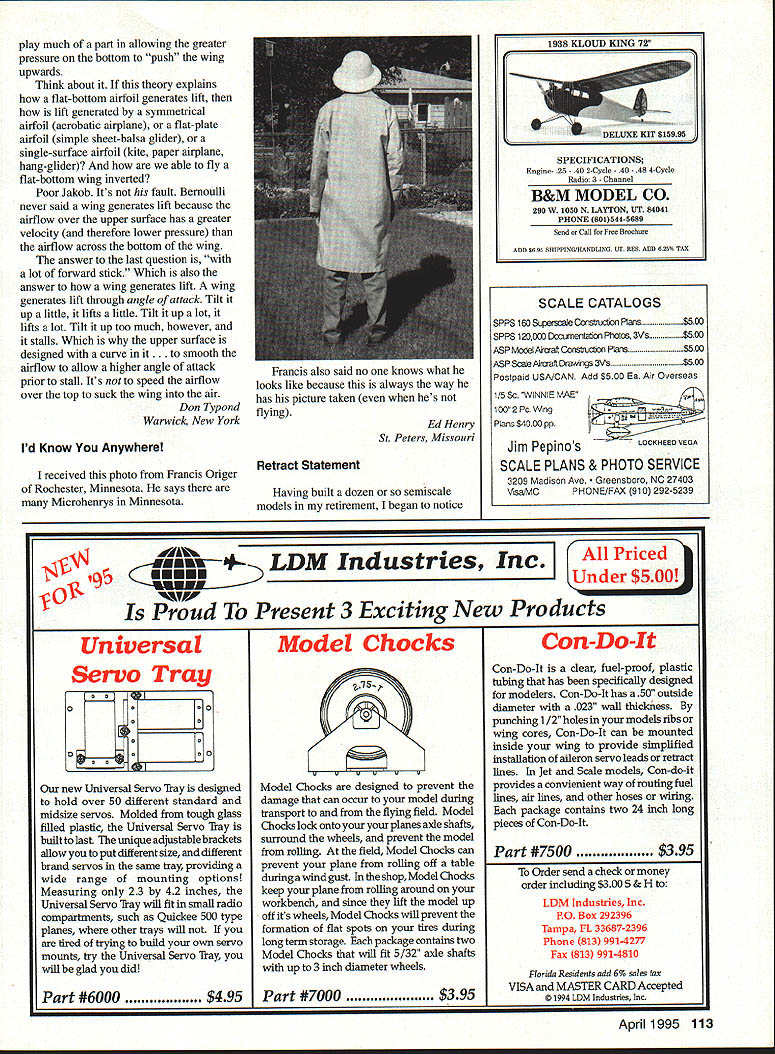
I'd Know You Anywhere!
I received this photo from Francis Origer of Rochester, Minnesota.
Retract Statement
Having built a dozen or so semiscale models in my retirement, I began to notice the difficulty of getting the right appearance of landing gear on warbirds when using the common 90° retract mechanisms. The models always looked bowlegged. I studied the angles involved.
On my .40 Royal P‑51 the dihedral is three inches at each tip. On a right triangle with one side three inches and the other 28 inches, the relation is .107; the angle is about 6°, which is enough to account for the problem. Wing thickness tapers from two inches at the root down to 1/2 inch at the tip rib, which adds a degree or so, and including a couple of degrees of camber for ground handling compounds the effect.
Bending the strut or the axle only causes the wheel to come through the top of the wing when in the well.
My conclusion: the only practical application of 90° mechanisms is for tricycle-pattern models with flat (Hershey-bar) wings and no dihedral. Any comments?
Jim Snelling Magalia, California
Ham Radio
I take strong exception to statements that a person with a ham license cannot have a non-licensed party assist in training or trimming an RC aircraft. I was challenged on this in 1991, so I called the FCC Director of the Personal Radio Branch in Washington, D.C. He said this is the same as third-party traffic and questioned why anyone would question it. I also called the southwest division director of the ARRL and he agreed it is no different than allowing third-party participation on a home-based radio station. Having a qualified flier assist in training or checkout is a definite safety factor.
If a person takes the time and effort to get a ham license, how are they going to learn to fly if the only teacher they can use is another ham? There are many fields and clubs where very few ham fliers (if any) take part. This parochial thinking is harmful to both ham radio and RC flying enthusiasts.
Vincent L. Cimino Tucson, Arizona
See Bob Underwood's Technical Director column in this month's "Focus on Competition" for more discussion of this issue.
Rose Parrakeet Update
To bring you up to date on the Parrakeet: it is being flown almost every weekend and from the very first flight has flown beautifully—wings level, thrust line level, not crabbed out on the lines, and without the fore-and-aft trim oscillations that some scale models exhibit. Long two-wheel rolling landings—requiring a touch of elevator to drop the tail to the pavement—are the norm.
Though the K&B .45 RC delivered ample power for flight, its throttle performance and the lack of a practical muffler installation were concerns. The local hobby dealer assured me that an O.S. 32 FAS, though smaller in displacement, would deliver as much or more power. The O.S. slipped right in between the existing motor mounts. It required less than eight hours' work to relocate motor-mount bolts, create new exhaust and needle-valve openings, and close up excess openings.
With the new engine the Parrakeet now functions perfectly through the entire flight cycle. Flight characteristics are unchanged, but throttle operations are completely reliable. A typical flight consists of half a dozen touch-and-go power-on landings and takeoffs, usually one contest-type taxi lap with appropriate dead stops. An added benefit is that the model is now muffled and therefore contest legal.
Frank W. Beatty Granite City, Illinois
Help Wanted
I am inquiring into the availability and whereabouts of Ralph Soldivar's plans for Dynajet RC models. He has drawn a Phantom, a U-2, and several others. I am also interested in any CL Dynajet plans you know of.
C. R. Little Baltimore, Maryland
Help wanted—A‑10 Thunderbolt II (electric vs. gas): I was disappointed to find the advertised A‑10 model was electric powered rather than gas. My dealer recalled that Combat Jet Models once made a gas-powered A‑10. If anyone knows where a gas A‑10 Thunderbolt II might still be available, please advise.
Lynn Fife 111 N. Smyth Mart, Texas 76664
Help wanted—engine blueprints: Do you have or know anyone who has blueprints to make three- or four-cylinder engines from Cox parts? I'd like to build some.
Glen E. Davis 212 S. Blaine Ave. Bradley, Illinois 60915
Jim Sears
Now and then in one's life you meet someone who makes an impression or becomes a real good friend. That has happened to me again. I've been in modeling and full-scale aircraft for 59 years and have made many great friends. The fellow who comes to mind is our outgoing Vice President, Jim Sears.
Truly I can say (from the 6th District): Jim, we will miss you at our contests, mall shows, and special events. We will really miss your input on the Executive Council for the sport.
ARFs
There are many things to consider before deciding whether to build or buy. The main question—why is the individual getting into the hobby?—should be asked right away.
As a former hobby-shop sales manager, I would ask the prospective buyer that question. Nine out of ten times the reason was they had never been to the field and thought it looked like fun. What they saw at the field was flying.
For first-time modelers, an ARF is a good recommendation. Although a bit more expensive than a kit, it often averages out because you don't have to buy all the small parts and covering. Time is a factor—many people's time is valuable. An ARF lets newcomers get to the field and fly quickly. If you buy a kit and rush it to get to the field, you may make alignment mistakes that spoil the early flying experience.
Please don't misunderstand me—kits are great and nothing beats flying something you built. But buy an ARF to get flying, then build a kit for your second airplane. I started with an ARF and now I compete in precision aerobatics and enjoy building as well.
Scott McHarg Gilbert, Arizona
Mr. Paul Kopp wrote a good rebuttal in the February issue about introducing ARF aircraft to fliers. We'll miss your tireless efforts and time spent as our representative. An excellent job well done—thanks. Jim, I've enjoyed working with you as your AVP. Now you can spend more time building the RV‑6A. Good luck.
Kenny Kern Bedford, Indiana
Teaching and Promoting
Congratulations on the January 1995 Model Aviation issue—it was a great idea and a well-crafted finished product. It blended the right amount of material for newcomers with content for experienced hobbyists.
I am a high-school junior at Bishop Stang High School. I earned my Eagle Scout Award in 1993 and am a member of an Aviation Exploring Post. I started in RC about four years ago and plan to attend Embry-Riddle and pursue a career in aviation.
To graduate from Bishop Stang I had to complete a service project. I created "First Flight!," my version of the Delta Dart program, which I've presented to campers and local scout groups. I plan to go national with the program and hope the AMA will help distribute materials.
Many kids lose interest because the "seed" wasn't planted early. Education and hands-on programs like First Flight! can change minds. I also propose a "Second Flight"—a standard for learning to fly RC that keeps youth involved, is fun, inexpensive, and helps them stay engaged until they progress to more advanced flying.
Chris Batcheller Somerset, Massachusetts
Plans
I don't want to build the model; I only want to be able to read and analyze the plans.
Because of a short-sighted, money-making policy, drawings are reproduced at a very small scale and are unreadable even with a good magnifier. Attempts to blow up the drawings using an engineering drawing printer failed.
I remember when it was possible to build free-flight models directly from magazine drawings using full-size patterns and dimensions. It's time to return to the old policy of full-size plans.
Remember the old AMA slogan: "Of, by, and for the model builder."
Al Chute North Olmsted, Ohio
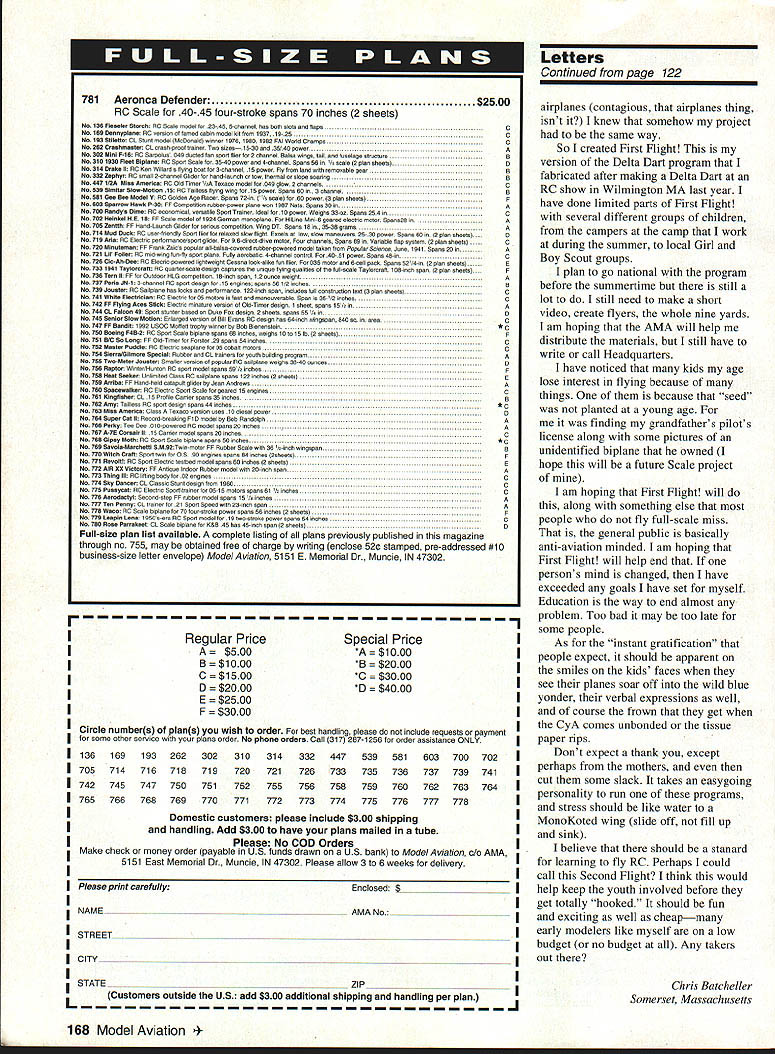
In the February 1995 "Haught Corner" Jim Haught discusses the price of plans and says, "the pricing is simply a matter of combining the square feet of the plan with the cost of shipping and handling." If that's so, why is "special pricing" necessary for rarely asked-for models? The cost per plan should be the same regardless of demand.
Example: within the past year two different CL .15 Carrier models were published (761 and 767). Prices were previously $6.00 and $7.25; now they are $20.00 and $30.00. The cost to build the airplanes is less than the plans cost. This is absurd and will only further reduce plan sales. Is that the desired effect?
Bill Bischoff Dallas, Texas
Tractor‑Pusher
In the February 1995 issue there was a letter from Walt Flugel requesting information on a unique tractor‑pusher rubber-powered airplane he built as a boy. I recalled seeing an airplane matching his description in The Boy Mechanic (7th edition, 1952). I can provide a copy from the book; if you cannot reproduce it, I'll gladly send it to anyone who sends an SASE.
Brian Roth 147 Heather Glen Coppell, Texas 75019
Ouch!
At the KRC Electric meet in Quakertown, PA last September, I was "spotting" for my son when someone shouted "look out!" and I was struck in the leg by a model traveling at high speed. Thirty-two stitches and nearly four months of treatment later, I am almost healed.
While recovering I watched the AT‑6 races on ESPN and noticed the fliers and spotters standing behind baled-hay revetments. Had those been in use at Quakertown, I would probably have been spared this ordeal.
I strongly suggest that events with many planes simultaneously airborne be required to provide some sort of flightline protection such as hay-bale revetments. They are inexpensive and could likely be borrowed and returned undamaged.
I was treated efficiently at the event and at Quakertown Community Hospital, but I would gladly have passed up the experience.
William H. Snedegar Clarion, Pennsylvania
Transcribed from original scans by AI. Minor OCR errors may remain.

