

Letters to the Editor
Send your Letters to the Editor to: Model Aviation, 5151 East Memorial Drive, Muncie, IN 47302
The Model Aircraft Project
I just wanted to let you know how very much my son and I enjoyed "The Model Aircraft Project" by Walt Grigg in the October 1995 Model Aviation. This article (the best in the magazine, we thought) certainly rekindled some long-dormant memories of a time and effort that I was just a little too young to participate in.
Frank Scott Casstown, Ohio
I wanted to make a couple of comments about Walt Grigg's great article on World War II identification models. The Bureau of Aeronautics template sheets and final assembly sheets shown on pages 56 and 57 are still available for a small copy charge from the National Air and Space Museum.
I have been collecting the wooden and plastic identification models for several years. As rare as the plastic Black IDs have become, the wooden kits are almost impossible to find. A fellow collector of mine owns a Boeing 314 model that Walt carved several years ago, and the craftsmanship is outstanding.
I have a second hobby (obsession?) of woodworking and furniture making. Because of that hobby I have a subscription to Fine Woodworking magazine. The magazine has always had a one- or two-sentence note at each article's end about the author's occupation and location.
(Robert Vaughan is a furniture maker and contributing editor to Fine Woodworking.)
(Jim Haught is a free flighter and convicted mass murderer from Muncie, Indiana.)
Just a thought and suggestion for the magazine. Keep up the good work!
John Delafosse Jamestown, North Carolina
(John Delafosse is an airline pilot and poor speller from Jamestown, North Carolina.)
John, I may have "murdered" a few models in my day, but I was never actually convicted of that other stuff.
It was with great pleasure that I read Walt Grigg's article, "The Model Aircraft Project," featured in the October 1995 issue of Model Aviation. Having started building ten- and twenty-five-cent Megow and Comet models at the tender age of ten, I signed up to build aircraft recognition models in high school in 1942.
I enjoyed model building so much that I built many more than my classmates, and it was very easy to attain my honorary captain's rank. At 15 years old I enjoyed the tough ones. I would pick the four-engine bombers like the Short Stirling and the Focke-Wulf Fw 200 K.
My all-time favorite to build was the Short Sunderland British patrol bomber. It was the largest model of them all with a wingspan of 18 13/16 inches. The fuselage was 2 x 3/4 x 15 inches. It took a lot of carving to get that fuselage out of a chunk of pine. I still have a few of the old patterns and assembly sheets.
I feel fortunate that I was able to participate in a program as a model builder that will probably never be equaled again by a bunch of high school children for the war effort. My thanks to Mr. Grigg for stirring up the aircraft modeling memories.
Brad Harrington Gonic, New Hampshire
What's in a Name?
Radio-controlled model airplanes have all the control surfaces of a full-size airplane, i.e., rudder, elevator, flaps, ailerons, and, like full-size airplanes, some have retractable landing gear and some have fixed landing gear. Some have piston engines and some have jet engines.
I don't know why we call them models. When I hear someone talk of a model, I think of a small solid-wood or plastic replica that you sometimes see on desks, hanging from ceilings, or children playing with.
In my opinion, they should be called miniature airplanes or RC airplanes when they are powered and fly with all the control surfaces—for they must obey all the laws of physics that apply to full-size aircraft.
Miniature jet engines, real honest-to-goodness turbine jet engines, have become available for these miniature aircraft and are being flown competitively by people from around the world at DeLand, Florida.
Little plastic or wood models have a wingspan measured in inches, whereas RC miniature airplanes have wingspans of 4–10 feet. The little plastic or wood models are static; they just sit there and look pretty. They have no engine, no moving control surfaces, etc.
It's time to call RC craft by a name that describes its function. I think "miniature airplane" does just that. Call RC airplanes mini airplanes, mini RC airplanes. Don't call these magnificent machines models.
George Glenfield Beverly, Massachusetts
Help Wanted
Please help. Not long ago I purchased a kit of a model of the aircraft which I flew, with some satisfaction in combat, during WWII: the A-24. The kit is not new; it was produced several years ago and the company was bought, perhaps more than once, by others who may or may not have continued production.
The problem is the plans have been lost during a residential move. The box containing the kit is very plain—not even a return address. I'm sure that the plans contained the necessary information but that is now moot. If my memory has not completely failed, the name of the company was Jensen.
I have seen many very nice renditions of the A-24 (SBD) but there is a facet in the landing gear of the full-size which would be rather difficult to duplicate. The struts not only did not have scissors but were adjustable for the bomb load to properly establish prop clearance during takeoff. Consequently, when the gear was retracted, the lower portion of the strut was pulled to the correct length so the wheels went into the wells properly. Every rendition of this plane that I have seen has the landing gear as the retractable length, which for a scale-type model with retracts is a requirement, but results in a squat appearance.
For information, and to correct the published performance data: cruise speed, 154 knots; level climb, 1,450 ft/min; our usual bomb load, 500 lbs each wing with either 1,000 or 1,600 lbs on center rack; fuel, 325 gals total in four wing tanks; consumption at cruise mixture, 31 gals per hour which gives you a bit over 1,600 miles. Of course, one doesn't stretch his or her luck over open water, so the range has to be about 1,500 nautical miles.
If anyone would be willing to supply me with a set of the plans for the kit, either original or a copy (copy preferred), please contact me at the address and/or phone number below. I will accept a collect call.
John Rawlings 1119 Wildflower Lane St. Charles, MO 63304 (314) 441-8064
WACO
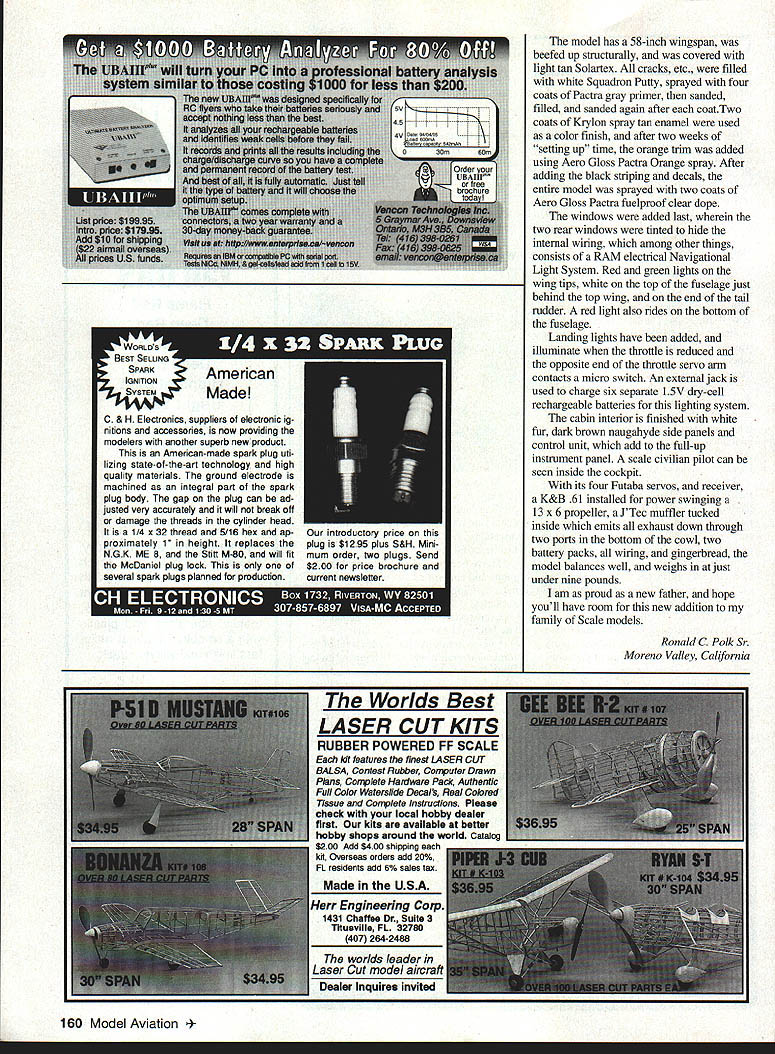
Enclosed please find photos of my recently completed WACO SRE kit by Sterling Models. I would be grateful if you could find room in your magazine for one of my photos, as I am as proud as punch over this beautiful model.
I have been modeling for more than 35 years, and am now retired doing what I like best: building and flying scale model airplanes.
Construction on this WACO began in late January 1995 and was finally completed in mid-August with a total of some nine months and over 300 hours of loving labor. Because I had built a smaller version of the Sterling WACO in 1963, when I saw this kit I jumped at it, and took my time to ensure that it would be scale-perfect and ready for static judging and flying. The proof of the pudding can be seen in the photos.
The model has a 58-inch wingspan, was beefed up structurally, and was covered with light tan Solartex. All cracks were filled with white Squadron Putty, sprayed with four coats of Pactra gray primer, then sanded, filled, and sanded again after each coat. Two coats of Krylon spray tan enamel were used as a color finish, and after two weeks of "setting up" time, the orange trim was added using Aero Gloss Pactra Orange spray. After adding the black striping and decals, the entire model was sprayed with two coats of Aero Gloss Pactra fuelproof clear dope.
The windows were added last; the two rear windows were tinted to hide the interior which was, among other things, the same as the interior of a RAM electrical navigational light system. Red and green lights on the wing tips, white on the top of the fuselage just behind the top wing and on the end of the tail rudder. A red light also rides on the bottom of the fuselage.
Landing lights have been added and illuminate when the throttle is reduced and the opposite end of the throttle servo arm contacts a microswitch. An external jack is used to charge six separate 1.5V dry-cell rechargeable batteries for this lighting system.
The cabin interior is finished with white fur, dark brown naugahyde side panels, and a control unit that add to the full-up instrument panel. A scale civilian pilot can be seen inside the cockpit.
With its four Futaba servos and receiver, a K&B .61 installed for power swinging a 13 x 6 propeller, a J-3 Tex muffler tucked inside which emits all exhaust down through two ports in the bottom of the cowl, two battery packs, all wiring, and gingerbread, the model balances well and weighs in at just under nine pounds.
I am as proud as a new father, and hope you'll have room for this new addition to my family of scale models.
Ronald C. Polk Sr. Moreno Valley, California
Boeing 314
This is to express my thanks for how you and your staff handled the article published in the July issue of Model Aviation about my Boeing 314. The layout, placement of the article in the issue, and pictures used were all excellent. I was disappointed that some of my story was cut, but I guess to be an editor means you must edit! I also appreciate the return of my original photos. Thanks! Please see that all involved in any way with this story get word of my appreciation.
I have received numerous letters not only from modelers, but also former Pan Am flight crew, among them some men who flew on the Yankee Clipper. It has indeed been a most gratifying experience for me and I thank you for spreading the story of my experience countrywide. Indeed, I have heard from two fellows from Australia.
Art Thoms Berkeley Heights, New Jersey
Likes Electrics
Bravo for your October 1995 issue of Model Aviation! There were more articles on electrics than I have seen in any magazine for over a year.
I am entering RC electrics after an absence of 38 years from modeling and glow-plug-engine flying. Actually, when I started, engines used spark plugs. During the past ten months, I have been researching to learn more about electrics. Your October issue was most rewarding.
Being an engineer, I could easily relate to the excellent article by Donald Brooks on prop thrust. His basic approach and testing was sound and well-executed. I was also impressed with Harry Cordes' article, "Static Thrust Test Stand." I have struggled with dollies dragging on tracks and calibrating springs. I agree with Harry—his principle is so simple, it's probably not a new approach. I feel frustrated that I did not think of it.
Concerning electrics, it was distressing for me to find the September 15 KRC Electric Fly Symposium, sponsored by SR Batteries, already full when I attempted to register in July. However, I do plan to attend the air shows on the 16th and 17th in Quakertown, PA. It would be helpful, for interested persons unable to attend the symposium, if proceedings of the subjects covered could be made available.
Keep up your good work of reporting and running articles on the rapidly developing field of electric-powered model airplanes.
Terrell D. Moseley Lynchburg, Virginia
(Videotapes of KRC have been available in past years; you might check Bob Kopksi's "RC Electrics" column for news on availability of tapes from this year's event.)
Sad Situation Redux
Although I don't belong to a flying club, I "chum" with some of the members of the Riverside, California Flying Club. The letter "Sad Situation" from Las Vegas in the October Model Aviation made me ashamed of the way some clubs treat newcomers. Unfortunately, this is all too often the case. I have had several people come to our club complaining of not getting help at a nearby larger-city club. Last year at least two people who had joined another club and would not get help came to us and are now active, flying members.
At our club, we check out the aircraft and equipment of a beginner very carefully and only let them fly after at least one instructor has gone over any corrections that need to be made. Then we carefully review the corrected aircraft before attempting to fly it. Frequently two members will go over the aircraft and confer to make sure nothing is overlooked.
Anyone wanting help should talk to a club officer first. Too often it is the ones with the least experience who rush up to help a newcomer. That's called enthusiasm, but it can lead to problems. Most experienced fliers will not rush in to help unless asked. They would like to know the newcomer is serious about the hobby. If you already have an airplane and equipment, that is a sure sign you are serious.
I have several requirements to teach someone to fly RC:
- Join the AMA.
- Join our club.
- Own or buy the necessary equipment.
- Arrange the time for lessons at least twice a week.
I have not lost a student yet and have only refused help once. That individual insisted on learning on a biplane and seemed to think he knew it all already.
I would suggest that "Sad Situation" talk to the president or training officer of the club he already joined. If that doesn't work, try another club. Do not worry about embarrassing the nerd who wrecked his airplane.
John G. Smith Columbia City, Indiana
I am truly sorry to hear of your experience with one of the local clubs in Las Vegas. I belong to the Dust Devils Control Line and Free Flight Club. We aren't an RC club but many of our members do fly RC, and any one of them would be willing to help you in anything that you need.
Please don't be too discouraged in your quest for flight. Feel free to call on our club or any one of our members for help: Mike Tiret, (702) 655-6429 or Doug Ellis, (702) 368-6328.
See ya out there.
Mike Tiret Las Vegas, Nevada
My Hat Goes Off to the Man!
Before I tell you about the help I've received from this man, I hope all you experts and hotshots realize that a novice at this hobby needs help and support to have success at a minimum cost.
I'm only an average sport flyer of RC airplanes. In October 1994, I had a touch of temporary insanity; I thought I would try an RC helicopter.
Lucky for me, with the job I have, I drive by a man's house every day who knows a thing or two about this hobby. He's a lucky guy to have me as his letter-carrier. I've bothered him so many times, it's embarrassing—usually interrupting his lunch break, and once I even woke him up from a nap (I felt like crawling under a rock).
He's never refused to give me help and support. He's a very patient and supportive man. If you're wondering who I'm talking about, his name is Dave Youngblood. He's an expert RC helicopter pilot and devoted supporter of the hobby. After all, he can't be too bad a teacher—he taught his son, Curtis, to fly.
Jack Heoney Bryan, Texas
Flying Model Warplanes
I have begun the next edition of my book, Flying Model Warplanes: An International Guide to Plans and Kits. To make this as comprehensive as possible, I seek to borrow complete runs of foreign model magazines from Germany, England, France, and Italy for the period 1991–1995. Parties wishing to assist may contact me directly. Let's make this a book the entire hobby can be proud of!
John C. Fredriksen 461 Loring Ave. Salem, MA 01970 (508) 745-9849
RCers' Excuses
Those of us who have been out to the flying site more than a few times have heard all of these excuses at one time or another. Listed below are the ones I have heard and remember.
Bad Flight
- Too high
- Too fast
- Too slow
- Too windy
- Too sensitive
- Too many aircraft in the air
- Too many people watching
- First or maiden flight shakes
- RF interference
Bad Landing
- Wind shear
- I'm left-handed
- Sweat got in my eyes
- Bugs got in my eyes
- I stumbled
- Someone was talking to me
- Another airplane was on the runway
Wind shear is my favorite and was given to me by Jim Turner, who has left us to go to that great flying site in the sky, where the frequency pin is always available, the temperature is always agreeable, the grass is always mowed, the wind is always calm, the batteries are always charged, the motor always starts on the first flip, the motor is always tuned just right, there are no houses close, and the model flies just like it says on the box.
Many of these are interchangeable between Bad Flight and Bad Landing, and I'm sure there are many more. If you can think of any please let me know.
Jerry Leffel Racine, West Virginia
District Reports
A recent letter to the editor written by John Franke of North Carolina concerns a constructive criticism of Model Aviation that I would also like to express my opinion on. I am in complete agreement with Mr. Franke in that this publication is, after all, the official organ of the Academy, and that club business deserves a leading spot.
My particular complaint is with the District Report section. The reports are great—why do you limit them to one page per district? This forces the authors to be very brief, and the photos are so small they lose their impact. I think your members deserve better.
I consider Model Aviation to be the best, overall, of all model publications. Thanks, and keep up the great work.
John Nataloni Amherst, New Hampshire
Typoed on Props
Re: John deVries' column, September 1995, p.76, bottom.
Propellers that rotate in opposite directions on twin-engine airplanes are counter-rotating. Propellers that are mounted coaxially on a common shaft (such as on the Macchi-Castoldi MC-72 and the Supermarine Seafire) and rotate in opposite directions are contra-rotating.
I'm surprised John made the error, and I'm disappointed you or Matthew didn't catch it. Ah well, you can't win 'em all.
Don Typond Warwick, New York
Plans: Another View
In response to Frederick G. Kocher's comment in July 1995 MA "Letters" that "the cost of your model plans are overpriced," I disagree.
Mr. Kocher has announced that he never drafted a plan and is not aware of the work involved. Accurate scale drawings, for example of an early 1930s one-of-a-kind race plane that no longer exists, can involve years of research for measurements, photos, and every scrap of information; much time and expense!
Then doing the scale drawing is tackled, with the draftsman working at his drafting board 500 to 2,000 hours. The draftsman does not expect to get paid much for his many hours of time—it's called "a labor of love." He runs ads for years, tries to endure rising printing and shipping costs, and the reality is there are never enough sales to pay the bare expense.
Our present economy reveals that everything we buy has come up in price because people have to make money for their work and pay living expenses. I suggest that Mr. Kocher try to engineer and type his own plans to build from. Only then will he realize that Model Aviation's plan prices are very reasonable!
Vern E. Clements Caldwell, Idaho
Transcribed from original scans by AI. Minor OCR errors may remain.

