
Letters to the Editor
Two Views of MA
Had some time during this awful winter weather we get in the Midwest to review back issues of Model Aviation and came across an article I had paid little attention to when it first appeared. That was Feather Merchant 72 by Alfred Lehmberg in the February 1993 magazine. What a neat feature.
Of course I am biased, being a member of SAM (Society of Antique Modelers), but what caught my eye was the enormous amount of useful information in the piece, the quality of the writing, the fine photographs, and the model plans and construction detail. I decided at once I wanted to build a Feather Merchant. But I did have a few questions about the design so I wrote to Mr. Lehmberg and sent a stamped return envelope.
What a delight to receive a reply within a week or so and with such nice information. Mr. Lehmberg gave his telephone number so I called him to thank him for the letter package. We had a splendid conversation and I learned so much about the model and also about model aviation history. He also suggested a source for a kit which I will purchase.
But my letter to you has another purpose other than to praise Mr. Lehmberg. What I noticed in looking over older issues of Model Aviation was, among other things, how much better they were a few years ago. The articles were far more substantive and the features more informative.
Yes, the type was smaller and the artwork perhaps not so glitzy, but the magazine had more "weight." And, too, I began to appreciate the "background" features; those writings on the history of our model aviation hobby and on airplanes and flying in general.
There have been complaints from some that Model Aviation should focus only on model aviation. Yes, that should generally be the case, but keep in mind that we are indeed making models of airplanes and all airplanes utilize the same principles of flight physics. By reaching out beyond the specific we learn a lot about flying machines and learning—education—is what this hobby is all about.
I realize that you have to balance out all kinds of special interest groups and I respect others in Giant, Scale, and Pattern, but please keep us old-timers in mind, and keep up the good work.
Mitchell Heller Glenview, Illinois
My wife and I were both delighted with the treatment given to the material that was submitted. We both were thrilled with the play on the Hot Canary theme that was developed by the graphics.
Head-on photos of models are seldom used in magazine articles. For that reason, I almost omitted that photo from the group submitted to you. That photo became the centerpiece for this layout.
Some months back, a Letters to the Editor writer was critical of Model Aviation covers. Recent covers are looking very good. This month's cover (March 1996) borders on being a work of art.
Frank W. Beatty Granite City, Illinois
Airship
Back in the late 1930s and early 1940s in our neighborhood in Nashville, Tennessee, school children observed what I would describe as a toy rigid airship carried overhead by very light air currents. They would appear only in the evening when the air currents were almost calm and drift just over the trees. On a few occasions we succeeded in retrieving more than one; however, we did not have the foresight to preserve any. Attempts to locate the source were not successful.
The airship was constructed of very light wire and tissue, similar to the small dime‑store rubber-powered airplanes of the same period. The air bag had the shape of a small rectangular parachute canopy glued to the wire structure with wire struts extending down to a gondola, which contained a small candle.
I have not read or heard of any type of airship similar to them since that time. I am very interested in hearing from anyone with knowledge of or hands-on experience with any type of airship similar to the one I have described.
Neil M. Turney 533 Anchorage Dr. North Palm Beach, FL 33408
Mystery Model?
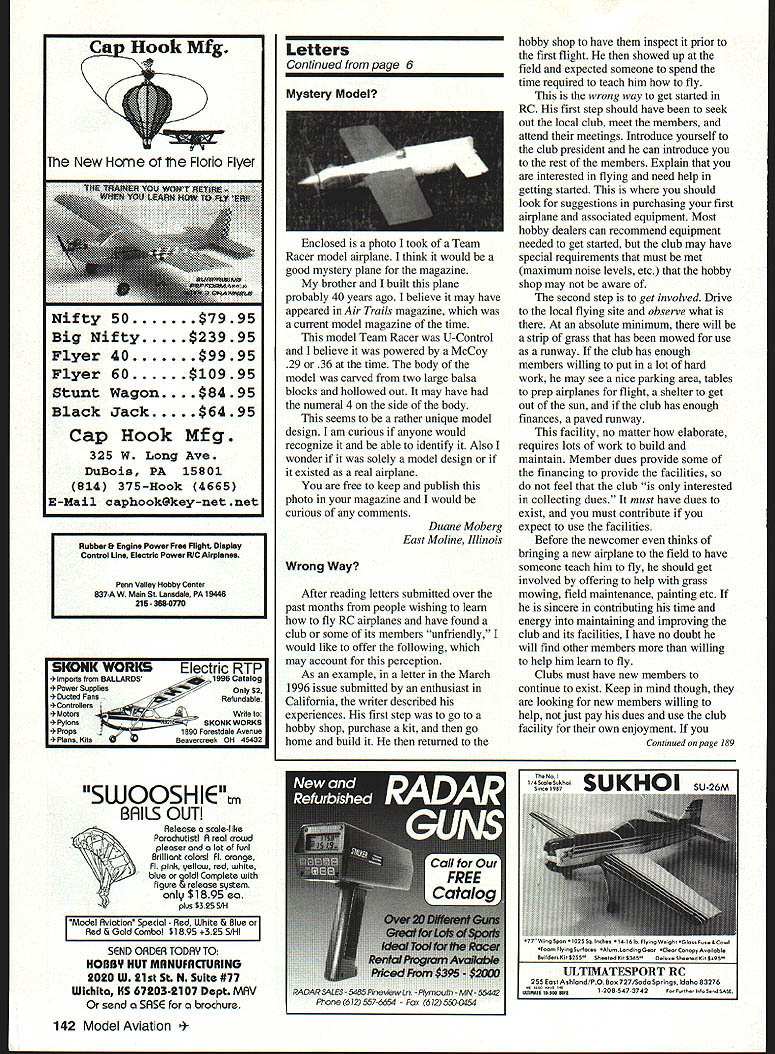
Enclosed is a photo I took of a Team Racer model airplane. I think it would be a good mystery plane for the magazine.
My brother and I built this plane probably 40 years ago. I believe it may have appeared in Air Trails magazine, which was a current model magazine of the time.
This Team Racer was U‑Control and I believe it was powered by a McCoy .29 or .35 at the time. The body of the model was carved from two large balsa blocks and hollowed out. It may have had the numeral 4 on the side of the body.
This seems to be a rather unique model design. I am curious if anyone would recognize it and be able to identify it. Also I wonder if it was solely a model design or if it existed as a real airplane.
You are free to keep and publish this photo in your magazine and I would be curious of any comments.
Duane Moberg East Moline, Illinois
Wrong Way?
After reading letters submitted over the past months from people wishing to learn how to fly RC airplanes and who have found a club or some of its members "unfriendly," I would like to offer the following, which may account for this perception.
As an example, in a letter in the March 1996 issue submitted by an enthusiast in California, the writer described his experiences. His first step was to go to a hobby shop, purchase a kit, and then go home and build it. He then returned to the hobby shop to have them inspect it prior to the first flight. He then showed up at the field and expected someone to spend the time required to teach him how to fly.
This is the wrong way to get started in RC. His first step should have been to seek out the local club, meet the members, and attend their meetings. Introduce yourself to the club president and he can introduce you to the rest of the members. Explain that you are interested in flying and need help in getting started. This is where you should look for suggestions in purchasing your first airplane and associated equipment. Most hobby dealers can recommend equipment needed to get started, but the club may have special requirements that must be met (maximum noise levels, etc.) that the hobby shop may not be aware of.
The second step is to get involved. Drive to the local flying site and observe what is there. At an absolute minimum, there will be a strip of grass that has been mowed for use as a runway. If the club has enough members willing to put in a lot of hard hours, they may have a nice parking area, tables to prep airplanes for flight, a shelter to get out of the sun, and if the club has enough finances, a paved runway.
This facility, no matter how elaborate, requires lots of work to build and maintain. Members do provide some of the financing to provide the facilities, so do not feel that the club "is only interested in collecting dues." It must have dues to exist, and you must contribute if you expect to use the facilities.
Before the newcomer even thinks of bringing a new airplane to the field to have someone teach him to fly, he should get involved by offering to help with grass mowing, field maintenance, painting, etc. If he is sincere in contributing his time and energy into maintaining and improving the club and its facilities, I have no doubt he will find other members more than willing to help him learn to fly.
Clubs must have new members to continue to exist. Keep in mind though, they are looking for new members willing to help, not just pay their dues and use the club facility for their own enjoyment. If you show up on sunny days, fly your plane, and go home without offering to help out, you are guaranteed to find the club "unfriendly."
As for learning to fly, the club has members designated to be instructors who will want to inspect the plane to be sure it is built properly and can be flown safely. The hobby shop may be reluctant to point out mistakes which may discourage you and limit further sales. Besides, the hobby shop is not the one who will be flying the plane.
It is also helpful to have the instructor or a more experienced member inspect the airplane during construction to be certain construction mistakes are not hidden during final assembly.
Stop and think about the responsibility you are placing on your instructor; if he has never seen you before at a meeting or at the field, you are asking him to assume the responsibility for flying a stranger's airplane, representing an investment of at least several hundred dollars. If the wing joint or some other structure or component fails in flight, can you accept the responsibility or just blame the instructor? If a crash occurs, can you repair the plane and continue learning or will you get discouraged and give up?
Most people must spend many hours learning with the help of the instructor. Why should he give up his valuable flying time to help you if you may not see it through to solo? The instructor will be judging your determination to the sport—whether you are mowing grass, painting tables, or learning during your first flights. If you were to just show up at our field, airplane in hand, expecting to learn to fly the first day out, I may seem "unfriendly" also.
For every member in a club there is a unique personality. There will always be a few members who are "unfriendly," disagreeable, or whatever. You can choose to ignore these people or take the time to get to know them. Chances are, they have been involved in the sport for many years and can provide invaluable assistance and advice. On the other hand, there must be enough other "friendly" helpful types also or the club will soon cease to exist.
Bob Blase Grand Rapids, Minnesota
Pinto
This letter is to compliment you on the excellent presentation of the Mohawk Pinto plan in the April 1996 Model Aviation.
I hope that you will be able to continue this quality, especially in the case of Scale models.
John E. Vorhees Sidney, Ohio
Tech Items
As a member of the AMA for three years, I have enjoyed reading your magazine. There is just one outstanding criticism of your copy. I would like to see more articles about model covering, use of tune pipes, and other technical items too numerous to mention. The reports of competition meets are good, but somewhere in between I think a good technical article is what most modelers want.
Don't get me wrong; I like your magazine. It could be more informative.
Bill DeRita Providence, Rhode Island
More Superstitions
My plane superstitions may not be that different. I can never make a plane "pretty" like some fellows. Mine must get hangar rash—holes punched in wings and tails, a few broken leading edges, etc.—before they trim out. Have tried for years to beat the odds but to no avail.
Consequently, they are covered with solid colors (which are easy for my wife to see in the Muncie sky) and about the only trim, not counting wing numbers, is the lost tag and an occasional American flag or reflective sheets.
Enjoy your work—have fun!
Roy Stewart Princeton, Indiana
Likes the Duck
I would like to take the time to express my many thanks to one of your contributing article writers, Mr. Tom Chipley. I would like others to know that I purchased one of his kits, The Mud Duck, from his company, Mud Duck Aviation, and the kit was nothing short of first-rate—both in quality of materials and in the well-planned packaging! I received all materials in great condition, thank you!
I would not hesitate to recommend doing business with Mr. Chipley because he treats his customers as they deserve! I have called upon Tom a few times and he has always returned phone calls and answered all my questions. It is great to know that there are people out there in business that know what people want and how they want to be treated! I hope that if there are any other modelers out there who are contemplating purchasing a Mud Duck kit from Tom, you will be very pleasantly surprised. Keep up the good work, Tom!
Ron & Jesse Downs Leesport, Pennsylvania
Tri‑Flite
What a beautiful photo in the Art Christensen article on page 24 (April 1996 issue)!
Gorgeous plane against a gorgeous sky. Expresses well the beauty of soaring flight. Deserved to be the cover photo.
David P. Anderson Burnsville, Minnesota
Flying Site Information
I think a booklet of places to fly throughout the U.S., as suggested by Brock Reeve in April 1996 Model Aviation, is an outstanding idea.
My "other" hobby is camping, and when traveling it would be great to be able to fly with a club located in an area we visit.
Whether compiled by Model Aviation or published by an enterprise/individual, a booklet like this is far in the future. So I'd like to thank Don Krafft for listing the AMA chartered clubs in District 1 in his monthly report. If the other Vice Presidents follow Don's example, we traveling AMA modelers can begin visiting and flying with other clubs this year.
Wayne Wilson Rochester, New York
Those of you with personal computers might also want to check out the flying site information contained in the "Model Aviation" section of the Aviation Forum of America Online.
Transcribed from original scans by AI. Minor OCR errors may remain.

