
Letters to the Editor
Send your Letters to the Editor to: Model Aviation, 5151 East Memorial Drive, Muncie IN 47302
Likes the Look Now
A few months ago, I took the time to write a long, angry letter about the amateurish use of graphics in your magazine. Well, with this month's issue, I've been forced to reconsider, and I am writing this letter to tell you that I am now satisfied with the new look of the pages.
I would like to think that I had some part in causing the improvement, but I must, in all honesty, acknowledge that it was more likely the result of a lot of hard work and practice on the part of the graphic designers. It looks like they are well along on the learning curve, and I look forward to steadily improving results. Keep up the good work!
Robert E. Gray Oxnard, California
Likes Kids Fly Graphics
Just a quick note to thank you for the fine graphic design for our Kids Fly article in the June '96 issue of Model Aviation. It was light, fun, and enhanced the article and pictures. The members of the Greater Cincinnati Radio Control Club enjoyed the article and we are now sharing copies with the Spina Bifida Association of Cincinnati as well. My hope is that other clubs will learn of the terrific enjoyment that comes from this type of club activity. Many thanks to you and the rest of the Model Aviation staff.
Bill Bryan GCRCC
Neat Models
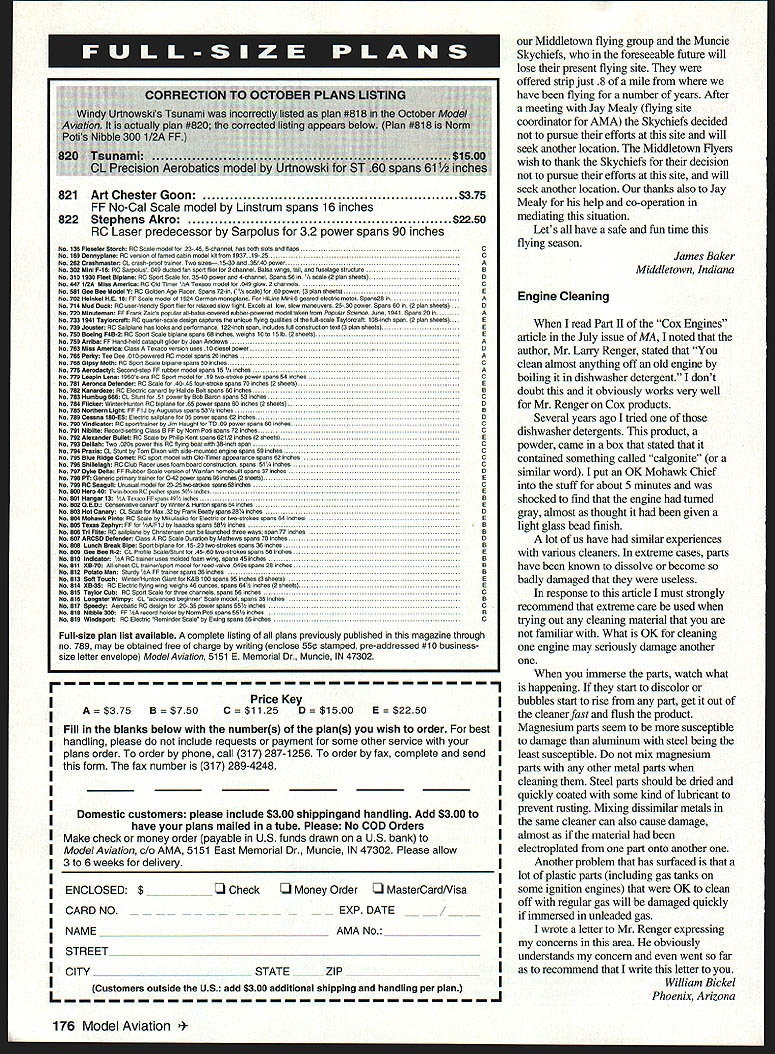
I wanted to write you about a couple of articles that you recently published in MA, namely the Flat Albert and your own Potato Man. I have been a modeler for close to 30 years; I fly RC, Control Line and used to fly FF.
When I saw those articles the old FF chaser came alive and I had to build them. In fact I built two Flat Alberts and a 50% reduced version for .010; then I built your Potato Man. I had not built a FF in over 20 years and I like them! Unfortunately the weather will delay flight testing (who wants to fly in 115° weather) but I am sure I will get a lot of enjoyment from the models—maybe even more than some of the RC models I have.
I realize the models were meant more for beginners, but I for one think that you are on the right track; don't stop publishing neat models like this. I have enclosed a Polaroid of PM. I used MonoKote because that's what was hanging around my shop; otherwise the only change was to a Ramrod-type landing gear instead of wheels. Initial glide tests are right on the money.
Thanks again for the enjoyment received. Definitely keep MA on this direction.
Jim LaBarge Yuma, Arizona
June Issue off the Mark
When I first started seeing statements in Model Aviation that you were going to put out a second Newcomers issue, I was really anxious to see it. After receiving the issue (June '96) however, I have mixed feelings about it.
I thought the regular column editors did quite well with the newcomers theme, and even most of the District VPs carried the theme through their reports. I found the article on Cox engines to be interesting and informative, but not particularly relevant to a newcomers issue. Mention was made in "The Haught Corner" in the May '96 issue that the cover picture probably would be of Bill Scott's hobby shop, and I got the impression (obviously incorrectly) that you were going to build the issue around a hobby shop theme. This seemed like a novel approach which had great possibilities, but alas, all it amounted to was the cover picture (which was excellent).
I was most disappointed though with the three lead articles. Here you presented three different types of aircraft (RC, FF, CL) which was great, but I can't imagine promoting scratch-built models for newcomers. Also these were new, relatively untested, unproven designs. Jim Haught even had to write a revision to correct an error with the RC design—more evidence that it was hardly a good project for a newcomer.
Most newcomers, be they youth or adults, would probably have little success scratch-building their first model. I think newcomers would have been much better served with in-depth articles on selecting engines and models, ARF vs. built-up models, radio selection, flying techniques, etc., than with three scratch-built models. The RC model was even hand-launched, which seems inappropriate for a newcomer.
I don't know anything about FF, but 1/2A RC or CL models are just too small to fly effectively for a newcomer, and are too hard to see and handle in the wind, in the case of RC. About their only virtues are they are cheap and may survive a crash better than a larger model. Of course, this is a consideration, so a well-written article comparing the advantages and disadvantages of 1/2A vs. larger models could have been useful. We keep hearing "bigger is better," which in the case of a newcomer would not be a quarter-scale model. But surely a .40-size model would be better than a 1/2A model.
Bill Scott even showed you the way to go, as noted in Jim Haught's column in May. After visiting Bill's shop, Jim wrote, "Bill also gave a thorough hands-on explanation of what he recommends in radios and airplanes (four-channel radios and a .40-sized model) to those who stop by the store. There weren't many questions when he was finished." I think Bill's advice is right-on. Jim obviously was listening to Bill, but apparently ignored his advice completely when preparing the RC design.
Quite frankly, the three lead articles seemed more like an ego trip for Jim Haught than a serious attempt to provide newcomers with useful information.
A newcomers issue every year or so is a great idea, but this one missed the mark. For the next issue, more thought should be given to what a newcomer needs and can actually use.
Thomas M. Mitchell Houston, Texas
June Issue: Another View
All issues of Model Aviation are wonderful, but June's is so especially so that I couldn't resist writing you about it—perhaps because it is directed specifically to a newcomer like me. As I am 72 years old, I was particularly interested in Bill Warner's article about the RFFC movement, for which I am an obvious candidate. I'd join the club immediately except for its being in California, whereas I live in Florida. It is also true that I'm just a beginner.
As a youngster I built model planes with great enthusiasm (there was no television in those days, and the only radio I wanted to listen to was one I built myself), but later I progressed to full-size ones and currently fly an old Stearman and a not-so-old Baron. I also collect, restore, and drive antique sports cars, and although retired, keep my hand in as a physics professor, which is why I haven't had time to get started in model aviation. However, I have to realize that the day will come when either the FAA or my own better judgment will say I should hang up my pilot's bars, and that's when I plan to really get into the modeling business.
But because of the June issue of Model Aviation I'm going to prepare for the future right now by ordering the full-size plans for Jim Haught's Indicator, not to mention treating myself to a Cox Killer Bee engine (I love engines).
That's a really good-looking airplane and appears to be simple enough to build so that even a klutz like me could produce an acceptable model. I must say I'm impressed with what radio control has come to in this day and age. I'll be as amazed as delighted to get into what's being done today. And I'm further delighted to count myself another old guy entering the hobby!
Thanks to all for a fine magazine.
Dean S. Edmonds Jr. Naples, Florida
Thanks
This spring a controversy arose between our Middletown flying group and the Muncie Skychiefs, who in the foreseeable future will lose their present flying site. They were offered a strip just 0.8 of a mile from where we have been flying for a number of years. After a meeting with Jay Mealy (flying site coordinator for AMA), the Skychiefs decided not to pursue their efforts at this site and will seek another location. The Middletown Flyers wish to thank the Skychiefs for their decision.
Our thanks also to Jay Mealy for his help and co-operation in mediating this situation.
Let's all have a safe and fun time this flying season.
James Baker Middletown, Indiana
Engine Cleaning
When I read Part II of the "Cox Engines" article in the July issue of MA, I noted that the author, Mr. Larry Renger, stated that "You clean almost anything off an old engine by boiling it in dishwasher detergent." I don't doubt this and it obviously works very well for Mr. Renger on Cox products.
Several years ago I tried one of those dishwasher detergents. This product, a powder, came in a box that stated that it contained something called "calgonite" (or a similar word). I put an OK Mohawk Chief into the stuff for about 5 minutes and was shocked to find that the engine had turned gray, almost as though it had been given a light glass bead finish.
A lot of us have had similar experiences with various cleaners. In extreme cases, parts have been known to dissolve or become so badly damaged that they were useless.
In response to this article I must strongly recommend that extreme care be used when trying out any cleaning material that you are not familiar with. What is OK for cleaning one engine may seriously damage another.
When you immerse the parts, watch what is happening. If they start to discolor or the bubbles start to rise from any part, get it out of the cleaner fast and flush the product. Magnesium parts seem to be more susceptible to damage than aluminum, with steel being the least susceptible. Do not mix magnesium parts with any other metal parts when cleaning them. Steel parts should be dried and quickly coated with some kind of lubricant to prevent rusting. Mixing dissimilar metals in the same cleaner can also cause damage, almost as if the material had been electroplated from one part onto another.
Another problem that has surfaced is that a lot of plastic parts (including gas tanks on some ignition engines) that were OK to clean off with regular gas will be damaged quickly if immersed in unleaded gas.
I wrote a letter to Mr. Renger expressing my concerns in this area. He obviously understands my concern and even went so far as to recommend that I write this letter to you.
William Bickel Phoenix, Arizona
Transcribed from original scans by AI. Minor OCR errors may remain.

