
Letters to the Editor
Send your Letters to the Editor to: Model Aviation, 5151 East Memorial Drive, Muncie, IN 47302
Prop Software
I have recently come across a computer program that should help the professional model builder as well as the Sunday flyer. The program is Prop Optimizer, written by Don Bates, 2742 Swansboro Road, Placerville, CA 95667.
The program works equally well for full-scale aircraft and the small aircraft we are interested in. A trial run for my Super Stik with a Fox .50 was very satisfying.
Henry Hain Green Valley, Arizona
Throttle Suggestion
This suggestion is in the interest of safety and to relieve a problem we have on the field.
When moving an airplane from one area to another with the engine running, hold the transmitter in your left hand and your thumb in front of the throttle. This holds the stick back and prevents accidentally hitting or bumping the throttle open. It also allows you to concentrate fully on what you are trying to do, and, of course, keeps you safer from hurting yourself, your equipment, or others.
You would not believe the mental relief this simple act produces while you are on the flightline.
Walter E. Bass Santa Rosa, California
Field Fix
This photo shows what happened to Buddy Campbell when his airplane had a blowout. Instead of packing up and going home, he made his own wheel out of a liner and cap from a fuel jug. His amazing idea might come in handy someday for the rest of you pilots.
Charlie Ellis Tuscaloosa, Alabama
Wasp
Maybe you can find a place in Model Aviation for this item. It is purely nostalgia, but last May I was in my local model store and came across a kit of a vintage-1940 model airplane that highly resembles Carl Goldberg's "Zipper." I noted the name of the designer, Robert E. Milligan, 1938 and 1939 Canadian Sr. Champion.
Bob and I built and flew free flight (FF) back in the '30s in Toronto and we had communicated into the late '40s and early '50s until he moved away. I lost track of him and have tried several times to locate him through Toronto-area phone books, but to no avail.
I converted it to RC and installed an Electric Turbo IQ instead of the Brown Jr. power plant with coil and condenser, etc., as shown on the drawings. Like days of old, the Wasp stood on its tail and went straight up, leveled off at 400 feet or so, and did routine maneuvers during its first ride; it is a terrific flier. The kit is marketed by Easy Built Models.
Hoping Bob might see this item, or anyone knowing of his whereabouts, I would be appreciative of anyone passing on his address to me.
Leslie Racey Kirkland, Washington
Something Extra
My son Daniel and I had a great experience that developed into one of those "once-in-a-lifetime" opportunities. None of the following events were planned out; they just fell into place. Once the ball started rolling, we enjoyed it too much to stop it.
At the Toledo show, I purchased the Midwest Extra 300S and its favorite companion, the Moki 1.8. Being a pastor from Troy, Ohio (home of BF Goodrich Aerospace) and having one of their engineers, Regan Oswalt, as a church member, I happened to mention that I might finish the model in the BF Goodrich/Patty Wagstaff color scheme. Regan told his boss about my idea, and his boss told Valerie Francis, the company coordinator of the Dayton Air and Trade Show committee. We submitted a portfolio of our previous models, and before the week was over BF Goodrich wanted to sponsor the airplane display and a flightline chalet at the '96 Dayton Air Show. This would give Daniel flightline privileges and the opportunity to meet Patty.
I began work on the model in my spare time, which was sparse because of day-to-day responsibilities and some out-of-town engagements. However, I was able to see the completed model just five days before the air show. A pedestal built using Plexiglas gave the model a realistic flying appearance. Patty Wagstaff performed twice Saturday morning, cutting up the sky in the usual BF Goodrich Extra 300S. Being in the chalet provided the best seats to see her perform aerobatics.
It was great! After her performance, she came to the BF Goodrich chalet for lunch and Valerie introduced her to Daniel and me. After making several comments about the model we were able to get her to sign our programs and autograph the left wing panel of the model. Then the BF Goodrich photographer, Bob Judson, took pictures. It was a great day for this father and son ... a time we will never forget. The hospitality of BF Goodrich went beyond our expectations. The next week I was called over to BF Goodrich headquarters and was given the photos Bob took that day. Daniel and I picked out our favorite shot and BF Goodrich made an 8 x 10 for us.
The next week, Dave Pulfer, a good flying friend and experienced Extra 300S pilot, and I flew the model. We were astounded at how straight it flew off the board, with no trim needed. As a matter of fact, Dave nearly gave me a heart attack as he put it on the knife right off the deck on the maiden flight! The Moki 1.8, coupled with the Bolly 19 x 10, provided more than enough power to fly the 15-pound airplane. Maneuvers were very crisp and no computer mix was needed in my JR XP783 for knife-edge performance.
Rick Arrowood Troy, Ohio
Help Wanted
I have need of anyone who has the Dave Brown Products, Inc. RCFS II R/C Flight Simulator for the Apple II+, IIe, or IIgs getting in touch with me. My telephone number is (801) 782-8023 or use the address below.
Harold G. Strand 3815 N 900 W Ogden, UT 84414
Letters
F-102A
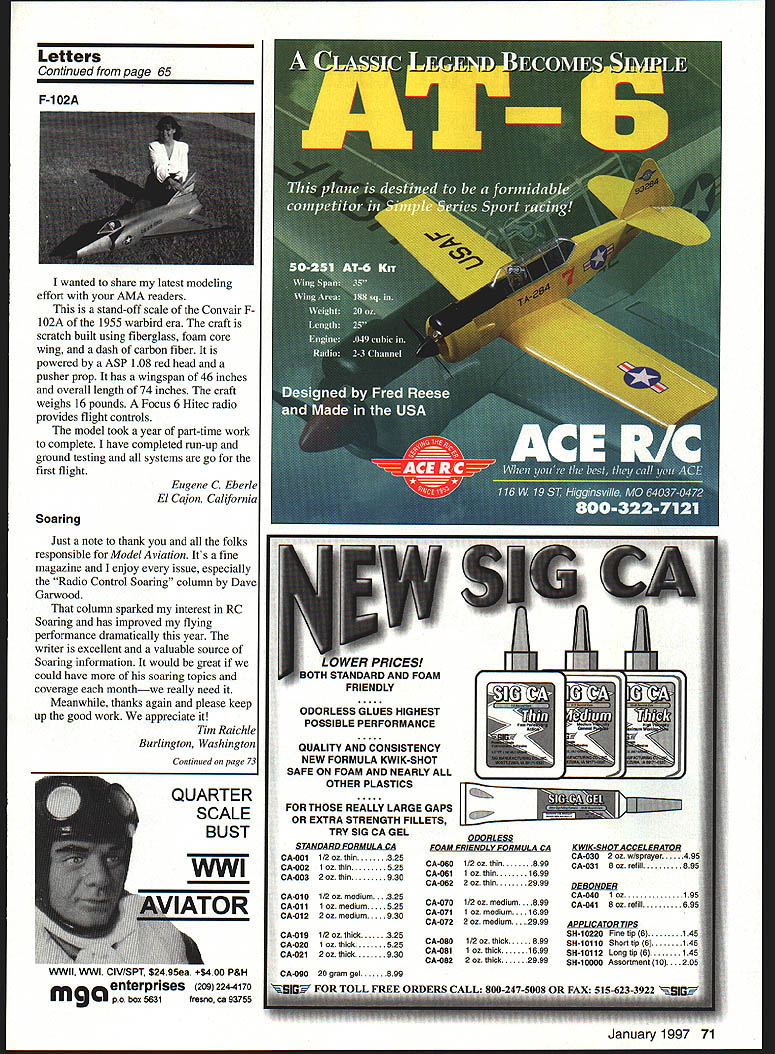
I wanted to share my latest modeling effort with your AMA readers.
This is a stand-off scale of the Convair F-102A of the 1955 warbird era. The craft is scratch built using fiberglass, foam-core wing, and a dash of carbon fiber. It is powered by an ASP .108 red head and a pusher prop. It has a wingspan of 46 inches and an overall length of 74 inches. The craft weighs 16 pounds. A Focus 6 Hitec radio provides flight controls.
The model took a year of part-time work to complete. I have completed run-up and ground testing and all systems are go for the first flight.
Eugene C. Eberle El Cajon, California
Soaring
Just a note to thank you and all the folks responsible for Model Aviation. It's a fine magazine and I enjoy every issue, especially the "Radio Control Soaring" column by Dave Garwood.
That column sparked my interest in RC soaring and has improved my flying performance dramatically this year. The writer is excellent and a valuable source of soaring information. It would be great if we could have more of his soaring topics and coverage each month—we really need it.
Meanwhile, thanks again and please keep up the good work. We appreciate it!
Tim Raichle Burlington, Washington
Letters to the Editor
Aero Commander
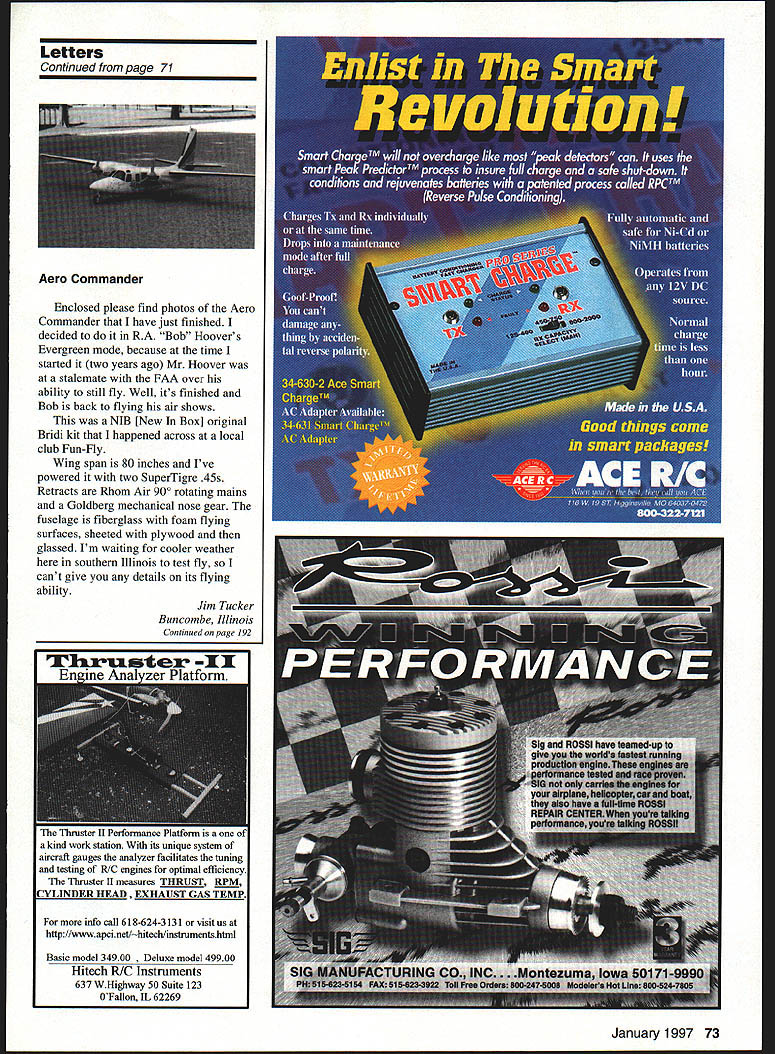
Enclosed please find photos of the Aero Commander that I have just finished. I decided to do it in R.A. "Bob" Hoover's Evergreen scheme, because at the time I started it (two years ago) Mr. Hoover was at a stalemate with the FAA over his ability to still fly. Well, it's finished and Bob is back to flying his air shows.
This was a NIB (New In Box) original Bridi kit that I happened across at a local club Fun-Fly.
Wingspan is 80 inches and I've powered it with two Super Tiger .45s. Retracts are Rhom Air 90° rotating mains and a Goldberg mechanical nose gear. The fuselage is fiberglass with foam flying surfaces, sheeted with plywood and then glassed. I'm waiting for cooler weather here in southern Illinois to test fly, so I can't give you any details on its flying ability.
Jim Tucker Buncombe, Illinois
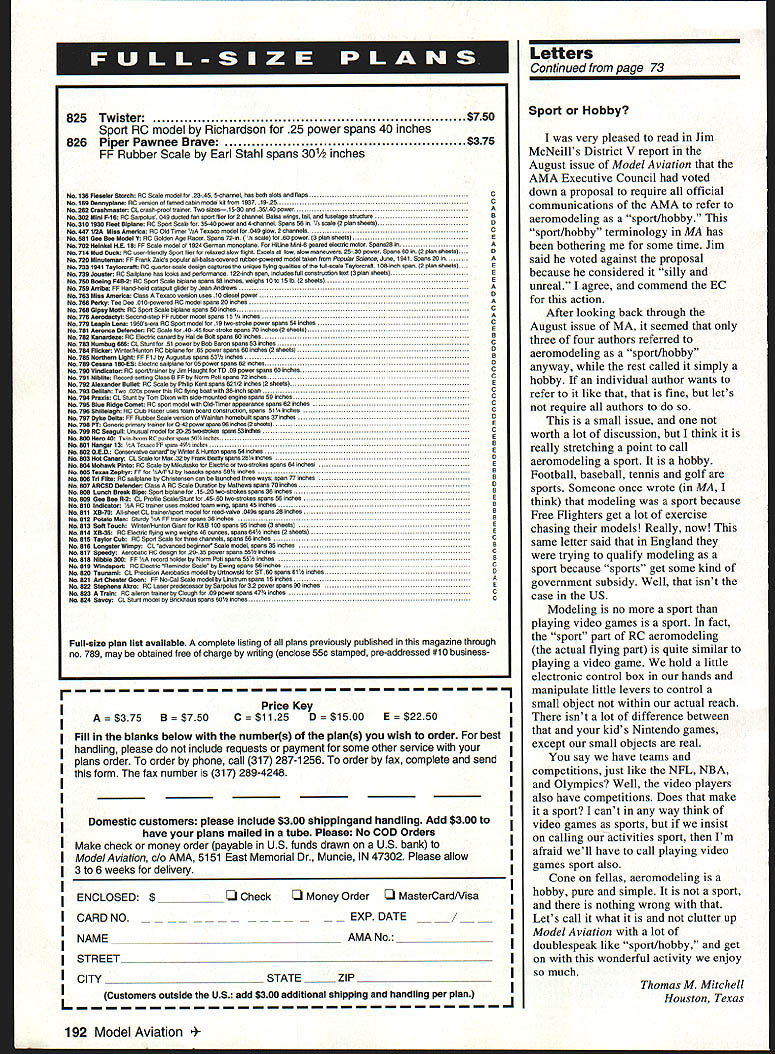
Sport or Hobby?
I was very pleased to read in Jim McNeill's District V report in the August issue of Model Aviation that the AMA Executive Council had voted down a proposal to require all official communications of the AMA to refer to aeromodeling as a "sport/hobby." This "sport/hobby" terminology in Model Aviation has been bothering me for some time. Jim said he voted against the proposal because he considered it "silly and unreal." I agree, and commend the EC for this action.
After looking back through the August issue of Model Aviation, it seemed that only three of four authors referred to aeromodeling as a "sport/hobby" anyway, while the rest called it simply a hobby. If an individual author wants to refer to it like that, that is fine, but let's not require all authors to do so.
This is a small issue, and one not worth a lot of discussion, but I think it is really stretching a point to call aeromodeling a sport. It is a hobby. Football, baseball, tennis and golf are sports. Someone once wrote (in Model Aviation, I think) that modeling was a sport because Free Flighters get a lot of exercise chasing their models! Really, now! This same letter said that in England they were trying to qualify modeling as a sport because "sports" get some kind of government subsidy. Well, that isn't the case in the U.S.
Modeling is no more a sport than playing video games is a sport. In fact, the "sport" part of RC aeromodeling (the actual flying part) is quite similar to playing a video game. We hold a little electronic control box in our hands and manipulate little levers to control a small object not within our actual reach. There isn't a lot of difference between that and our kid's Nintendo games, except our small objects are real.
You say we have teams and competitions, just like the NFL, NBA, and Olympics? Well, the video players also have competitions. Does that make it a sport? I can't in any way think of video games as sports, but if we insist on calling our activities sport, then I'm afraid we'll have to call playing video games sports also.
Come on fellas, aeromodeling is a hobby, pure and simple. It is not a sport, and there is nothing wrong with that. Let's call it what it is and not clutter up Model Aviation with a lot of doublespeak like "sport/hobby," and get on with this wonderful activity we enjoy so much.
Thomas M. Mitchell Houston, Texas
Transcribed from original scans by AI. Minor OCR errors may remain.

