
Letters to the Editor
Send your Letters to the Editor to: Model Aviation, 5151 East Memorial Drive, Muncie, IN 47302
Hobby or Sport?
Mr. Mitchell's letter in MA's January 1997 issue asked his fellow aeromodelers not to "clutter up Model Aviation with a lot of doublespeak . . ." and yet his letter took up a complete column!
The question of whether aeromodelling is a sport or a hobby has been going on for many years in different parts of the world. Does it matter? Yes, it does in some countries of the world where the activity of designing, building, flying, even crashing and repairing model planes is encouraged, supported and sponsored by governments and/or national organizations. Mr. Mitchell referred to England, where there is a Minister of Sports in the government and aeromodelling is a recognized "sport."
Does it matter in the USA? Probably not much at the present time. But it may come to have more significance in future, the nature of change being what it is—that is, things do have a habit of changing. Certain aspects of aeromodelling are already within the sphere of US Government influence—RC frequencies is one example.
Do we have to sweat for an activity to be defined as a sport? Well, Webster's third definition of sport is "diversion; recreation; pleasant pastime." I think we could all agree that aeromodelling definitely fits those descriptions.
And of the word hobby, Webster's has this to say: "An activity or interest pursued for pleasure or relaxation and not as a main occupation." I think we could all agree that as well, except perhaps those individuals for whom aeromodelling actually is their main occupation. The professionals, that is. And therein lies another long debate.
Malcolm R. Logan San Carlos, California
Pen Pal Wanted
I am currently a junior AMA member and live in Orlando, Florida. To my knowledge there is only one other junior member in this area with any interest in the hobby. This person is not very active in the hobby, though, and I would not consider him a good friend.
I am curious if you have or if you would consider starting a pen-pal program for AMA youth. I myself have tried hard to bring the hobby out in my community but there is still a lack of interest among the youth in the area. It would be a great pleasure to me to have someone else my age to talk to in the hobby world that is on my horizon. Thank you for your time and consideration.
John Baldauf 811 Hallowell Circle Orlando, FL 32828
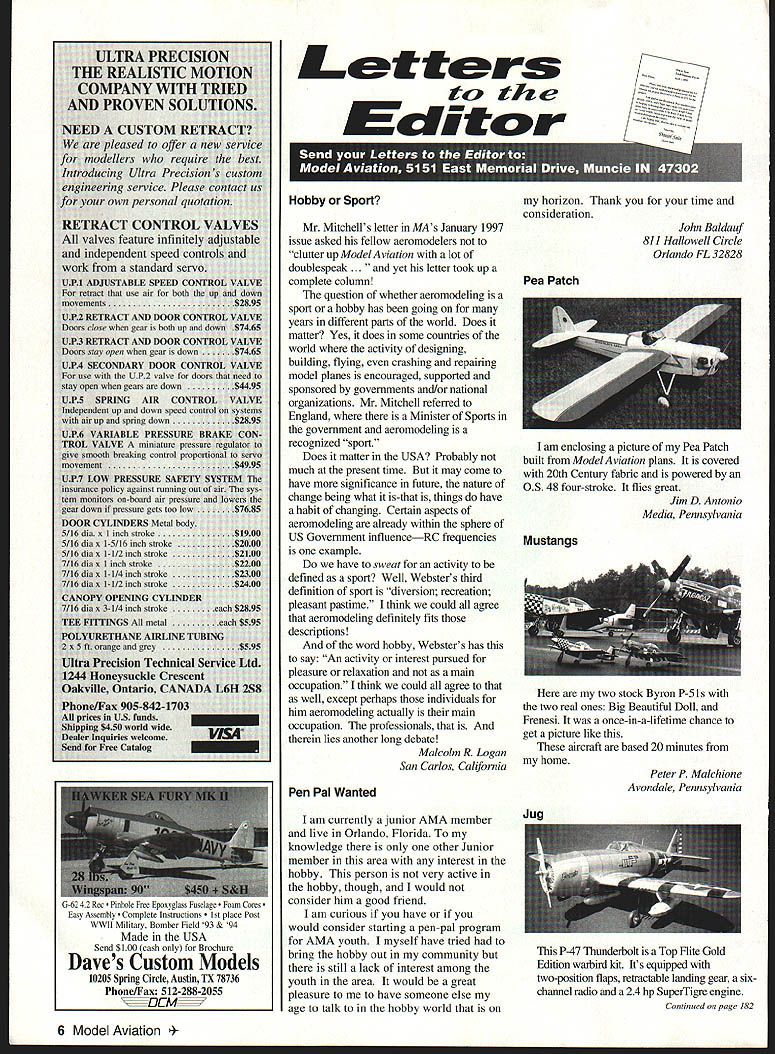
Pea Patch
I am enclosing a picture of my Pea Patch built from Model Aviation plans. It is covered with 20th Century fabric and is powered by an O.S. .48 four-stroke. It flies great.
Jim D. Antonio Media, Pennsylvania
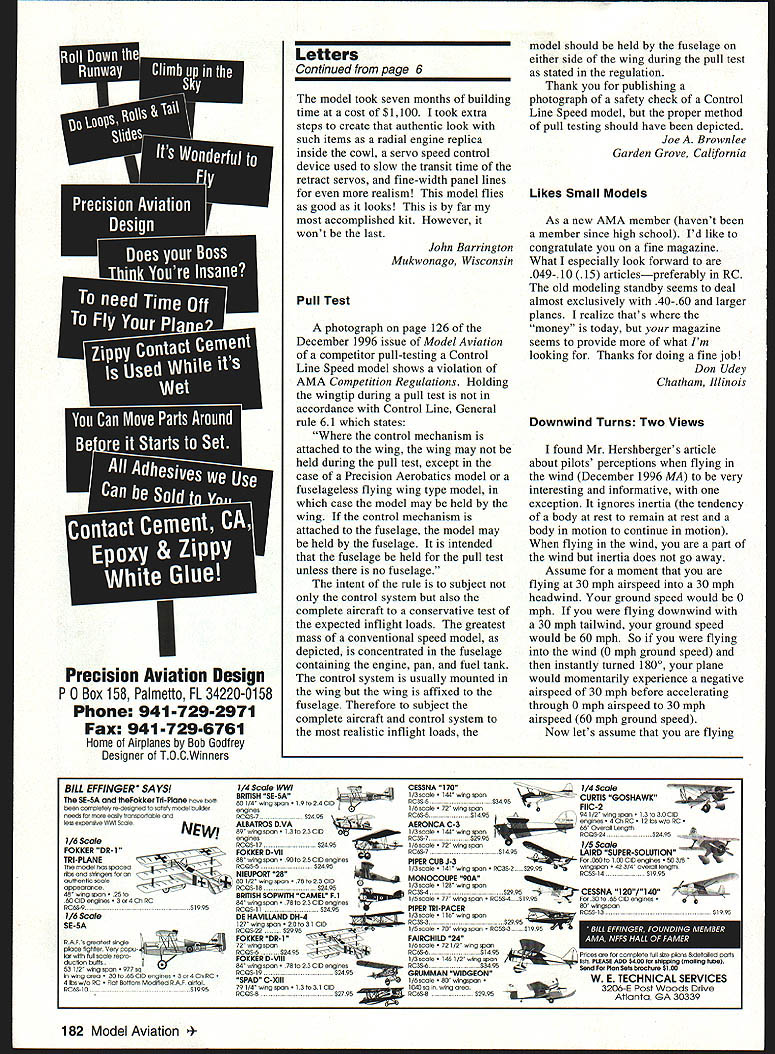
Mustangs
Here are my two stock Byron P-51s with the two real ones: Big Beautiful Doll and Frenesi. It was a once-in-a-lifetime chance to get a picture like this.
These aircraft are based 20 minutes from my home.
Peter P. Malchione Avondale, Pennsylvania
Jug
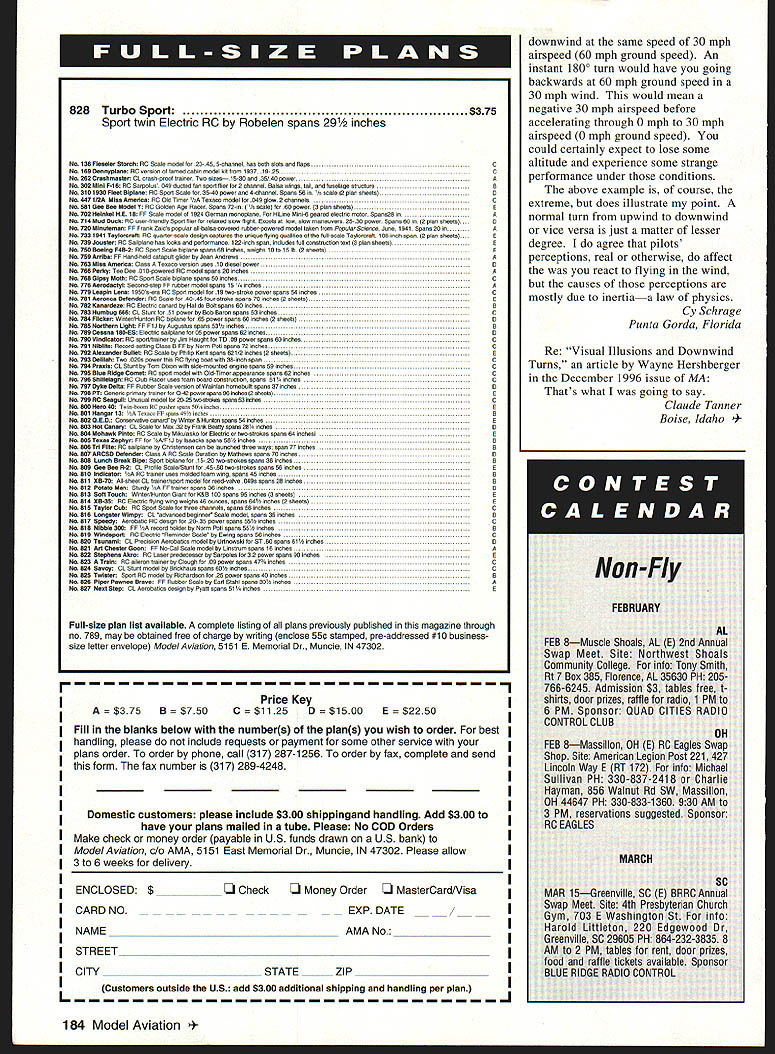
This P-47 Thunderbolt is a Top Flite Gold Edition warbird kit. It's equipped with two-position flaps, retractable landing gear, a six-channel radio and a 2.4 hp SuperTigre engine.
The model took seven months of building time at a cost of $1,100. I took extra steps to create that authentic look with such items as a radial engine replica inside the cowl, a servo speed control device used to slow the transit time of the retract servos, and fine-width panel lines for even more realism! This model flies as good as it looks! This is by far my most accomplished kit. However, it won't be the last.
John Barrington Mukwonago, Wisconsin
Pull Test
A photograph on page 126 of the December 1996 issue of Model Aviation of a competitor pull-testing a Control Line Speed model shows a violation of AMA Competition Regulations. Holding the wingtip during a pull test is not in accordance with Control Line, General rule 6.1 which states:
"Where the control mechanism is attached to the wing, the wing may not be held during the pull test, except in the case of a Precision Aerobatics model or a fuselageless flying wing type model, in which case the model may be held by the wing. If the control mechanism is attached to the fuselage, the model may be held by the fuselage. It is intended that the fuselage be held for the pull test unless there is no fuselage."
The intent of the rule is to subject not only the control system but also the complete aircraft to a conservative test of the expected inflight loads. The greatest mass of a conventional speed model, as depicted, is concentrated in the fuselage containing the engine, pan, and fuel tank. The control system is usually mounted in the wing but the wing is affixed to the fuselage. Therefore, to subject the complete aircraft and control system to the most realistic inflight loads, the model should be held by the fuselage on either side of the wing during the pull test as stated in the regulation.
Thank you for publishing a photograph of a safety check of a Control Line Speed model, but the proper method of pull testing should have been depicted.
Joe A. Brownlee Garden Grove, California
Likes Small Models
As a new AMA member (haven't been a member since high school), I'd like to congratulate you on a fine magazine. What I especially look forward to are .049–.10 (.15?) articles—preferably in RC. The old modeling standby seems to deal almost exclusively with .40–.60 and larger planes. I realize that's where the "money" is today, but your magazine seems to provide more of what I'm looking for. Thanks for doing a fine job!
Don Udley Chatham, Illinois
Downwind Turns: Two Views
I found Mr. Hershberger's article about pilots' perceptions when flying in the wind (December 1996 MA) to be very interesting and informative, with one exception. It ignores inertia—the tendency of a body at rest to remain at rest and a body in motion to continue in motion. When flying in the wind, you are a part of the wind but inertia does not go away.
Assume for a moment that you are flying at 30 mph airspeed into a 30 mph headwind. Your ground speed would be 0 mph. If you were flying downwind with a 30 mph tailwind, your ground speed would be 60 mph. So if you were flying into the wind (0 mph ground speed) and then instantly turned 180°, your plane would momentarily experience a negative airspeed of 30 mph before accelerating through 0 mph airspeed to 30 mph airspeed (60 mph ground speed).
Now let's assume that you are flying downwind at the same speed of 30 mph airspeed (60 mph ground speed). An instant 180° turn would have you going backwards at 60 mph ground speed in a 30 mph wind. This would mean a negative 30 mph airspeed before accelerating through 0 mph to 30 mph airspeed (60 mph ground speed). You could certainly expect to lose some altitude and experience some strange performance under those conditions. The above example is, of course, the extreme, but does illustrate my point. A normal turn from upwind to downwind or vice versa is just a matter of lesser degree. I do agree that pilots' perceptions, real or otherwise, do affect the ways you react to flying in the wind, but the causes of those perceptions are mostly due to inertia—a law of physics.
Cy Schrage Punta Gorda, Florida
Re: "Visual Illusions and Downwind Turns," an article by Wayne Hershberger in the December 1996 issue of MA: That's what I was going to say.
Claude Tanner Boise, Idaho
Transcribed from original scans by AI. Minor OCR errors may remain.

