


Letters to the Editor
Send your Letters to the Editor to: Model Aviation, 5151 East Memorial Drive, Muncie IN 47302
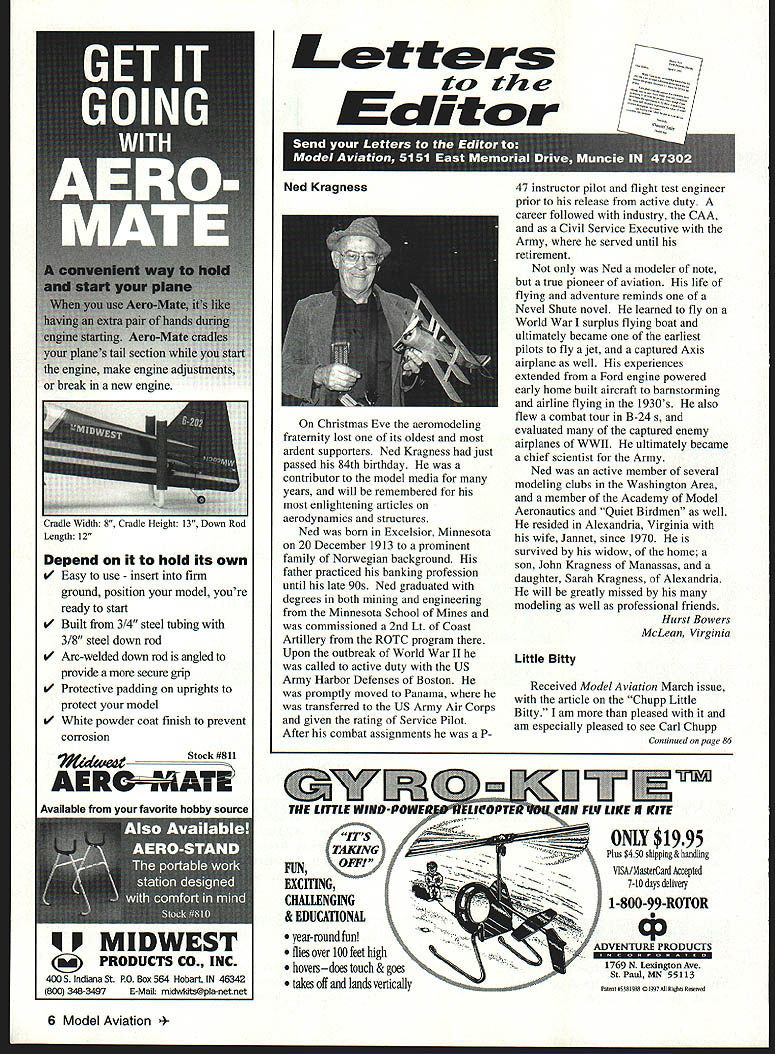
Ned Kragness
On Christmas Eve the aeromodeling fraternity lost one of its oldest and most ardent supporters. Ned Kragness had just passed his 84th birthday. He was a contributor to the model media for many years, and will be remembered for his most enlightening articles on aerodynamics and structures.
Ned was born in Excelsior, Minnesota, on 20 December 1913 to a prominent family of Norwegian background. His father practiced his banking profession until his late 90s. Ned graduated with degrees in both mining and engineering from the Minnesota School of Mines and was commissioned a 2nd Lt., Coast Artillery from the ROTC program there. Upon the outbreak of World War II he was called to active duty with the US Army Harbor Defenses of Boston. He was promptly moved to Panama, where he was transferred to the US Army Air Corps and given the rating of Service Pilot. After his combat assignments he was a P-47 instructor pilot and flight test engineer prior to his release from active duty. A career followed with industry, the CAA, and as a Civil Service executive with the Army, where he served until his retirement.
Not only was Ned a modeler of note, but a true pioneer of aviation. His life of flying and adventure reminds one of a Nevil Shute novel. He learned to fly on a World War I surplus flying boat and ultimately became one of the earliest pilots to fly a jet, and a captured Axis airplane as well. His experiences extended from a Ford-engine-powered early home-built aircraft to barnstorming and airline flying in the 1930s. He also flew a combat tour in B-24s, and evaluated many of the captured enemy airplanes of World War II. He ultimately became a chief scientist for the Army.
Ned was an active member of several modeling clubs in the Washington area, a member of the Academy of Model Aeronautics, and of the "Quiet Birdmen." He resided in Alexandria, Virginia with his wife, Jannet, since 1970. He is survived by his widow; a son, John Kragness of Manassas; and a daughter, Sarah Kragness of Alexandria. He will be greatly missed by his many modeling as well as professional friends.
Hurst Bowers McLean, Virginia
Little Bitty
I received the March issue of Model Aviation with the article on the "Chupp Little Bitty." I am more than pleased with it and am especially pleased to see Carl Chupp recognized for his work.
In response to your efforts with the article, I am donating the airplane to the museum. I will fill out deed-of-gift papers upon delivery. I am 71 years old and need to wait for good weather to make the trip to Muncie. I will need a table to assemble it upon arrival. I have corresponded with Carl Chupp’s daughter, who owns the engine, with the hope that she will donate it to the AMA Museum to be displayed alongside the airplane.
I will correspond with you if this can be done. Thank you very much for the article and I will be in touch prior to airplane and possibly engine delivery.
Wesley DeLong Toledo, Ohio
Diesel Tip
“Diesel Model Engines” (2/97) was an excellent introduction to a fine power source. I have enjoyed flying with diesel engines and appreciate their benefits.
One area not addressed in the article was exhaust color as an indicator of engine adjustment. Adjust the compression to produce a translucent, cocoa-brown exhaust. Avoid a black exhaust. Black indicates the engine is overcompressed and running hot.
If you route the exhaust away from the fuselage through clear plastic tubing your model will stay cleaner and the exhaust color will be easily visible.
Robert Horn Durham, Connecticut
Help Wanted
I have a miniMax 1/4-scale kit sold by Hobby Lobby Int., purchased in 1987, missing assembly instructions. If any readers have a set, please photocopy and forward to me at the address below.
I have asked for assistance in finding a set of assembly instructions in other model magazines, but have received no responses.
Mark Isenberg 16 Rolling Meadow Dr. Wallingford, CT 06492
Harold Lake
I am 73 years old, and have been building and flying model airplanes for 60 years. I always loved the Golden Age racers, and have built most of them except two: Art Chester's Jeep racer and the Hall Bulldog racer. If anyone out there has or knows where I can get the plans for .40-size models of the above planes it would be gratefully appreciated by an old-timer.
Harold Lake RD1 Box 1323 Tamaqua, PA 18252
Pleasant Experience
I had a very pleasant experience with one of our hobby's retract specialists recently and would like to relate it to you.
Over the years I have had several different brands of retracts, among them Spring Air from Spring Air Products, Satellite Beach, Florida. I recently took a set of their gear that I had used in several planes and installed them on a Top Flite P-47. I learned the hard way several years ago to check them on the ground before flying. When I did so, I found these to be intermittent in operation. I returned them to Bill Watton of Spring Air Products along with a note giving them the authority to repair them and charge it to my MasterCard.
I called several days later to inquire if they had received the gear and they said they had, but he hadn't had a chance to repair them. He did state that he "noted they were an older model and he would 'update' them when he repaired them." I asked about the cost and he said it wouldn't be that much, so I told him to go ahead.
Four days later I got the gear back via priority mail and a statement with "NC" (no charge) for the repair. He didn't even charge me for the cost of the priority mail! I don't think many manufacturers would rebuild one of their products that was out of warranty by several years, return it to you via priority mail, and not even charge you for the postage.
Needless to say, I shall certainly use Spring Air gear for any plane that uses retracts of the size they market.
Gary Sparks Tucson, Arizona
Drive System for Twins
I have been interested in twins for many years and would like to build a P-38. However, bad experiences of others with twins have kept me from putting a lot of effort into a project that could be lost just because an engine quits. Like many other weekend fliers, I frequently have problems with engine performance and the prospects of having a major crash every time that happens would not be enjoyable.
Is it possible that many of the problems with twins could be solved if a single engine was used to drive the two props? I guess I got this idea from the drive system used in the electric P-38 by Kress Jets. Has anyone tried this approach with fuel (non-electric) engines?
Such a setup might cause some problems. Probably the most important question concerns the loss of efficiency. However, if the reduction in thrust is not excessive, it could be compensated for by light construction and low wing loading. Other problems such as engine starting and cooling might be dealt with as in ducted fan and helicopter models.
I would like to receive any information you might have on this type of drive system for fuel engines.
Dan Loegering Delmar, New York
Re: Mr. Walter E. Bass' suggestion about throttle safety thumb (January 1997 issue)
I have been flying proportional RC since 1964, instructor since about 1965, and not long after that I always had my novice fliers apply that safety. It apparently drifted to California, like my procedure of starting engines at low or idle throttle setting.
One never thinks of passing things like that along, or says, "I am going to do it," but rather does, as in my case.
May I add to his suggestion in your "Letters": fliers who use a neck strap for flying — I have no comments about the practice while flying — but I always ask my students to unhook the transmitter from the strap before taxiing near the taxi strip to the pit. If the transmitter isn't removed, as the flier bends down to make a last-minute correction, the transmitter will swing forward as the flier reaches for the trim/rudder to make corrections, and on the swing back the transmitter will brush the tummy and move the throttle stick to high with the result of a plane dashing into the pit area, and the parked planes, or the legs of fliers preparing their own planes. Not removing the transmitter from the neck strap as soon as the landing is complete is very dangerous.
R.A. Garceau Laval, Quebec Canada
Plan-Building
In the February 1997 issue, I noticed in "Contents" you refer to the Next Step as being for first-time plan-builders. I was not aware that Mr. Troy ("RC Scale" columnist) was now writing the entire magazine. As far as I can tell (I read four other model magazines cover-to-cover each month), Jeff Troy is the only person in the entire hobby who uses this phrase, so he must be responsible.
It's bad enough that he is allowed to do it in his column; permitting it outside the column is outrageous, particularly when the author, Mr. Pryatt, doesn't even use the offending term anywhere in his article.
If the AMA wants to put this to a vote, that's fine; otherwise, leave the current terminology alone. While there may be no official dictionary of modeling terms, we only need look at what the living legends of modeling say in their articles: Ziroli, deBolt, Platt, Hostetler, Randolph, Uravitch — this list goes on and on. Please don't throw wrenches. If it's not from a kit, it's scratch-built!
Steve Kauffman Baldwin, Maryland
Noise Challenge
We, the Hill Country Aeromodelers of Austin, Texas, have a noise challenge at our flying field. We are located in a city park on the southern outskirts of Austin, quite near residential areas. While most of our "neighbors" come to the park and our field to watch us fly, a few do not appreciate our proximity to their homes.
We have a five-year lease on our field, with about a year-and-a-half to go. We have an excellent field, with a 500 x 50-foot paved runway, paved taxiways and pilot pits, a 35 x 40 operations building, and a stabilized parking lot. We built the field at no cost to the city, and the park managers are pleased with the way we keep our field. Many local spectators come out, more each weekend, to enjoy the flying of our 150-plus members (not all at once, of course).
However, we are in danger of losing our lease unless we can reduce the noise level. We are doing everything possible to reduce noise. We have gone to bigger props, and we require our pilots to have an "effective" muffler. We have recently restricted flying daily before 9 a.m., and on Sundays and national holidays before 11 a.m. We have met with the complaining neighbors, along with the city park council to establish these restrictions, yet we remain in jeopardy.
We believe it's time for some help from the model industry itself, primarily the engine manufacturers. We are not alone. Many clubs face the same problems. One letter may not cure the problem, but it might help. We need your continued help to keep restating the problem of noise and searching for solutions.
William D. Moll Hill Country Aeromodelers of Austin, Texas
Transcribed from original scans by AI. Minor OCR errors may remain.

