
Letters to the Editor
Send your Letters to the Editor to: Model Aviation, 5151 East Memorial Drive, Muncie, IN 47302
Correction
The Paillet/Hazel prop diameters mentioned in the "Genie" construction article (July 1997 MA) were incorrectly listed as being six inches in diameter; the correct diameter is 6½ inches.
Bill Winter
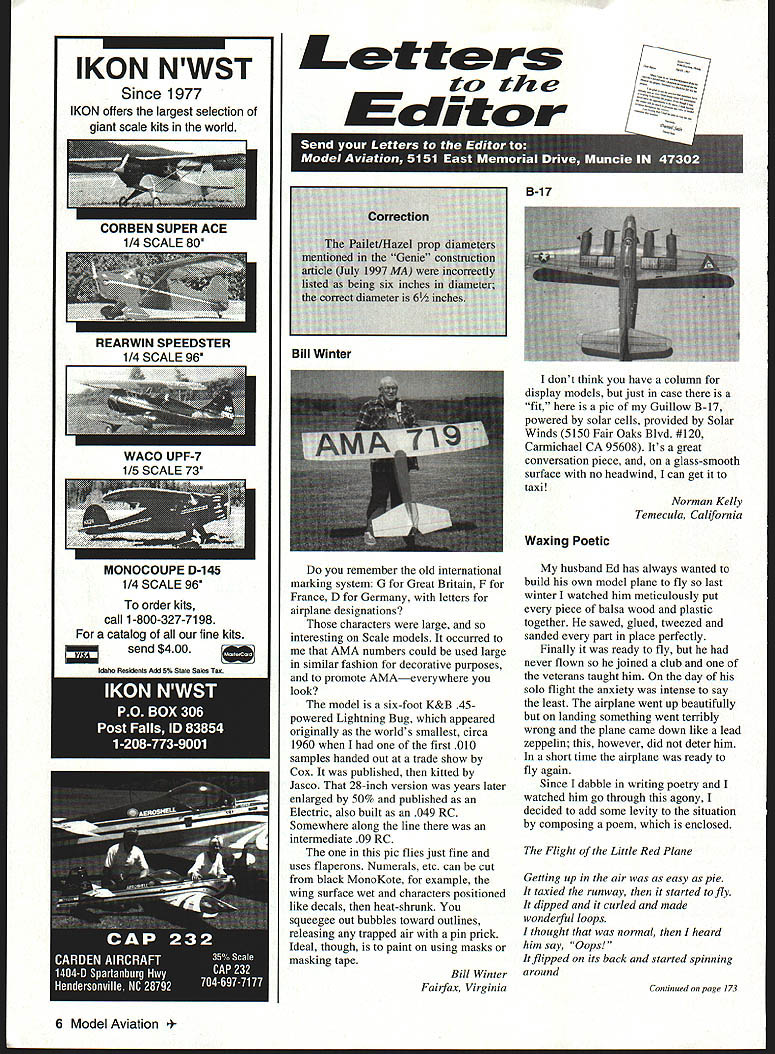
Do you remember the old international marking system: G for Great Britain, F for France, D for Germany, with letters for airplane designations?
Those characters were large and so interesting on scale models. It occurred to me that AMA numbers could be used large in a similar fashion for decorative purposes and to promote AMA—everywhere you look.
The model is a six-foot K&B .45-powered Lightning Bug, which appeared originally as the world's smallest, circa 1960, when I had one of the first .010 samples handed out at a trade show by Cox. It was published, then kitted by Jasco. That 28-inch version was years later enlarged by 50% and published as an electric, also built as an .049 RC. Somewhere along the line there was an intermediate .09 RC.
The one in this pic flies just fine and uses flaperons. Numerals, etc., can be cut from black MonoKote; for example, wet the wing surface and position the characters like decals, then heat-shrink. Squeegee out bubbles toward the outlines, releasing any trapped air with a pin prick. Ideal, though, is to paint on using masks or masking tape.
Bill Winter Fairfax, Virginia
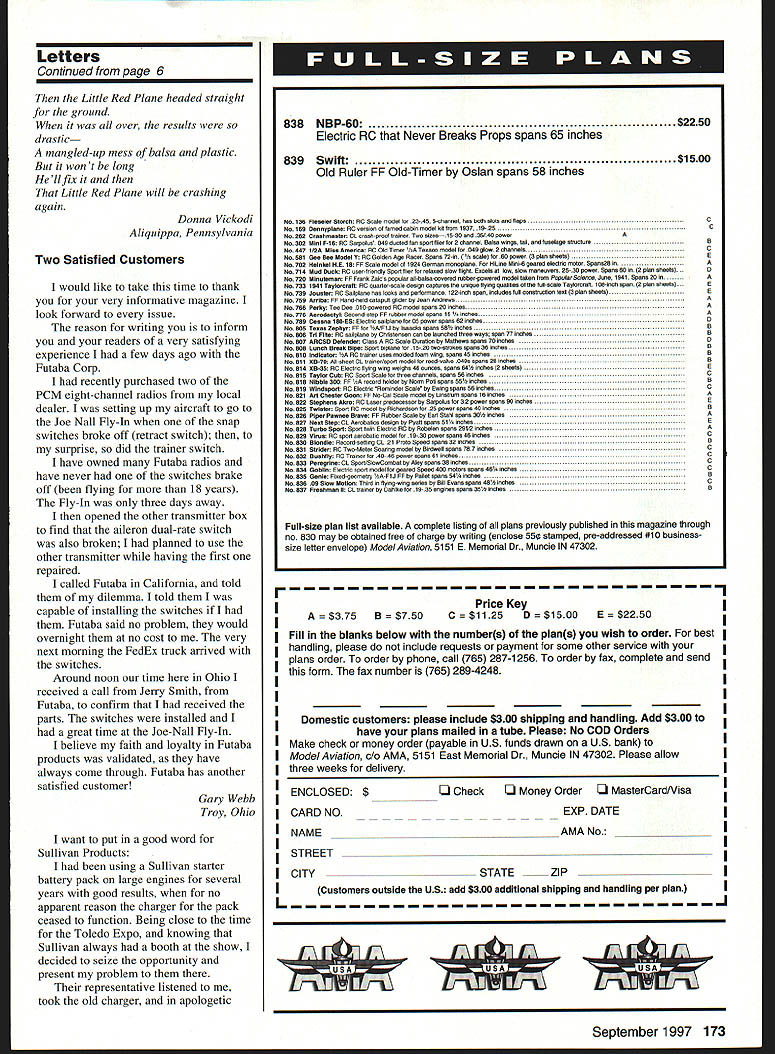
(unnamed)
I don't think you have a column for display models, but just in case there is a "fit," here is a pic of my Guillow B-17, powered by solar cells provided by Solar Winds (5150 Fair Oaks Blvd., #120, Carmichael, CA 95608). It's a great conversation piece, and, on a glass-smooth surface with no headwind, I can get it to taxi!
Norman Kelly Temecula, California
Waxing Poetic
My husband Ed has always wanted to build his own model plane to fly, so last winter I watched him meticulously put every piece of balsa wood and plastic together. He sawed, glued, tweezed and sanded every part in place perfectly. Finally it was ready to fly, but he had never flown, so he joined a club and one of the veterans taught him.
On the day of his solo flight the anxiety was intense, to say the least. The airplane went up beautifully, but on landing something went terribly wrong and the plane came down like a lead zeppelin; this, however, did not deter him. In a short time the airplane was ready to fly again.
Since I dabble in writing poetry and I watched him go through this agony, I decided to add some levity to the situation by composing a poem, which is enclosed.
The Flight of the Little Red Plane
Getting up in the air was as easy as pie. It taxied the runway, then it started to fly. It dipped and it curled and made wonderful loops. I thought that was normal, then I heard him say, "Oops!" It flipped onto its back and started spinning around. Little Red Plane headed straight for the ground; the results were drastic — a mangled-up mess of balsa and plastic. Won't last long — he'll fix Little Red Plane; we'll be crashing again.
Donna Vickodi Aliquippa, Pennsylvania
Two Satisfied Customers
I would like to take this time to thank you for your very informative magazine. I look forward to every issue.
The reason for writing is to inform you and your readers of a very satisfying experience I had a few days ago with the Futaba Corp.
I had recently purchased two PCM eight-channel radios from my local dealer. I was setting up my aircraft to go to the Joe Nall Fly-In when one of the snap switches broke off (retract switch); then, to my surprise, so did the trainer switch.
I have owned many Futaba radios and have never had one of the switches break off (been flying for more than 18 years). The Fly-In was only three days away.
I then opened the other transmitter box to find that the aileron dual-rate switch was also broken; I had planned to use the other transmitter while having the first one repaired.
I called Futaba in California and told them of my dilemma. I told them I was capable of installing the switches if I had them. Futaba said no problem—they would overnight them at no cost to me. The very next morning the FedEx truck arrived with the switches.
Around noon our time here in Ohio I received a call from Jerry Smith, from Futaba, to confirm that I had received the parts. The switches were installed and I had a great time at the Joe Nall Fly-In.
I believe my faith and loyalty in Futaba products was validated, as they have always come through. Futaba has another satisfied customer!
Gary Webb Troy, Ohio
I want to put in a good word for Sullivan Products:
I had been using a Sullivan starter battery pack on large engines for several years with good results, when for no apparent reason the charger for the pack ceased to function. Being close to the time for the Toledo Expo, and knowing that Sullivan always had a booth at the show, I decided to seize the opportunity and present my problem to them there.
Their representative listened, took the old charger, and, in an apologetic tone, said they would send me a new one soon. Within one week I had a new charger, and, guess what? Sullivan even paid the postage, which, as I remember, was about $3. I have told my friends about this and we are all now singing a song for Sullivan.
Being a loyal member of AMA for about 57 years (with a couple of breaks in there), I thought your readers would want to know about this.
John Edris Bluffton, Indiana
Worst Nightmare?
I am your worst nightmare—an old (that's old) time free-flighter who still hand-cranks and chases on foot. The airplanes you show, except for a few FF pages, as far as I'm concerned are pretty, show outstanding craftsmanship and respect for great airplanes, but the engines and flying are too modern for my taste.
Generally I carefully read the new hardware section as well as the new FF pages and look at the pictures, laugh at Microhenrys (Henry could collapse free-flighters with a few well-placed cartoons like retrieving models from trees and pig-pens, and arriving at the contest site while leaving critical parts at home, like the tail) and read the "Contest Calendar."
I also like to read CL speed to get ideas for powerplants. Many years ago, I learned of the Dooling .29 in CL articles and found it to be outstanding when combined with 60% nitro and Dooling-supplied free-flight propellers.
The July issue had a great building article on the Genie by Jean Paillet. His description of how to fly the airplane and the retrieval system was enlightening. The retrieval system sounds like a winner, especially if you're on foot as I am. The cost is about $700, so unless I win the lottery, I'll depend on my glasses. I've read very few construction articles that tell not only "how" but also "why." If I don't care what Jean flies, I'll read the article!
Charles L. Klivans Redondo Beach, California
Scratch-Built Redux
I am writing this letter to respond to the letter by Steve Kauffman regarding scratch-building (May 1997 issue).
I must disagree with the statement, "if it's not a kit, it's scratch-built." In my opinion when you build from plans that you did not draw, you plan-build. Most plans used to "scratch-build" are obtained from sources that most likely started with a blank sheet and finished with a refined flying prototype, i.e., from scratch.
To me, if I then buy the plans of this airplane, half of the scratch work has already been done. In many cases the "scratch-built" plan suppliers also offer cowls, canopies, wing cores (if foam) and sometimes even wood kits.
I have noticed that many magazine articles and specialty picture captions contain phrases like, "built from Ziroli plans," "scratch-built from ABC plans," etc. Is this scratch-building or plan-building? A true scratch-built, in my opinion, is when you start with a blank sheet and finish with a flying prototype.
Kenneth McDaniel Tucson, Arizona
Can't Wait to Fly
Hello, my name is Timothy Joseph Smith. I'm ten years old and I'm now getting into radio-controlled airplanes. My dad is a teacher at Shelby County High School in Kentucky.
Mr. Nigel Hood works there and flies radio-controlled airplanes. He gave me a Tower Hobbies catalog and a Model Aviation magazine. Then he had me over one day to show me his models. He got out and taxied around. Then later he got out an airplane that he had told my dad about, who told me about it. It was the Butterball. After showing it to me, he said, "Want to take it home today?" Later he gave me more magazines, including an updated one. He told us what to order for the airplane he gave us. I'm very glad I'm getting into this hobby! I can't wait to fly!
Timothy Joseph Smith Bagdad, Kentucky
Transcribed from original scans by AI. Minor OCR errors may remain.

