
Letters to the Editor
Send your Letters to the Editor to: Model Aviation, 5151 East Memorial Drive, Muncie, IN 47302
Proud to be a Member
As a result of having cancer, my present condition does not allow me to partake in the hobby I loved dearly. Sadly, this is why I have not renewed my membership in the past four years. Having received your letter the other day, June 19, 1997, I was amazed that you had not reassigned my license number to another RC pilot.
Due to my present disabilities I cannot walk or even hold my control radio without pain; however, I still manage on good days to drive over to our local airfield and watch the pilots fly.
I was proud to be a member of the AMA and the organization will always be fondly remembered by me, and all the great friends and fellowship the AMA promoted. I would like to say hello to any of my good friends in the West Jersey Radio Control Club in New Jersey.
Thomas V. Haines Port Richey, Florida
Having Fun
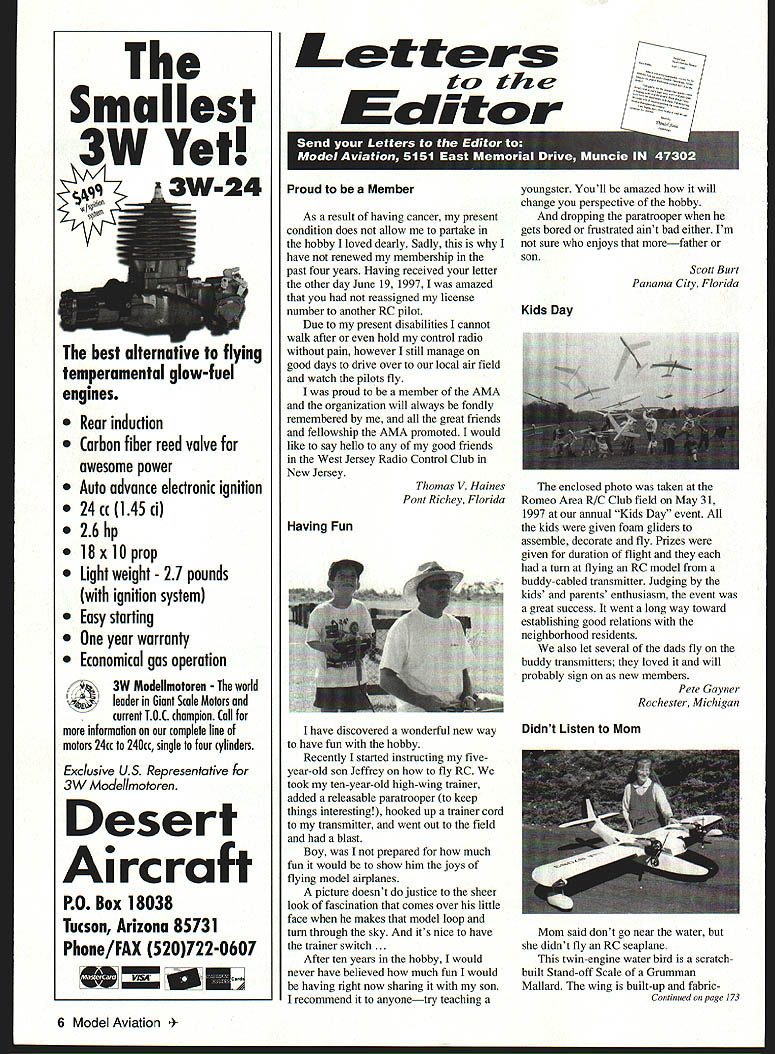
I have discovered a wonderful new way to have fun with the hobby.
Recently I started instructing my five-year-old son Jeffrey on how to fly RC. We took my ten-year-old high-wing trainer, added a releasable paratrooper (to keep things interesting!), hooked up a trainer cord to my transmitter, and went out to the field and had a blast.
Boy, was I not prepared for how much fun it would be to show him the joys of flying model airplanes.
A picture doesn't do justice to the sheer look of fascination that comes over his little face when he makes that model loop and turn through the sky. And it's nice to have the trainer switch...
After ten years in the hobby, I would never have believed how much fun I would be having right now sharing it with my son. I recommend it to anyone—try teaching a youngster. You'll be amazed how it will change your perspective of the hobby.
And dropping the paratrooper when he gets bored or frustrated isn't bad either. I'm not sure who enjoys that more—father or son.
Scott Burt Panama City, Florida
Kids Day
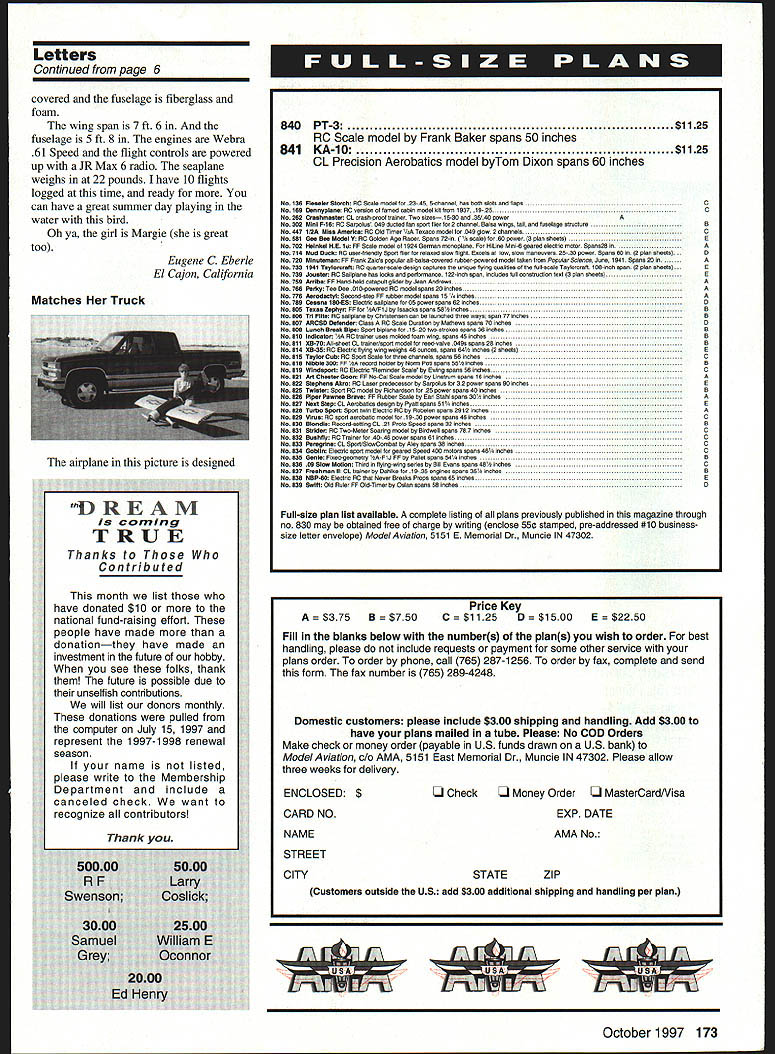
The enclosed photo was taken at the Romeo Area R/C Club field on May 31, 1997 at our annual "Kids Day" event. All the kids were given foam gliders to assemble, decorate, and fly. Prizes were given for duration of flight and they each had a turn at flying an RC model from a buddy-cabled transmitter. Judging by the kids' and parents' enthusiasm, the event was a great success. It went a long way toward establishing good relations with the neighborhood residents.
We also let several of the dads fly on the buddy transmitters; they loved it and will probably sign on as new members.
Pete Gayner Rochester, Michigan
Didn't Listen to Mom
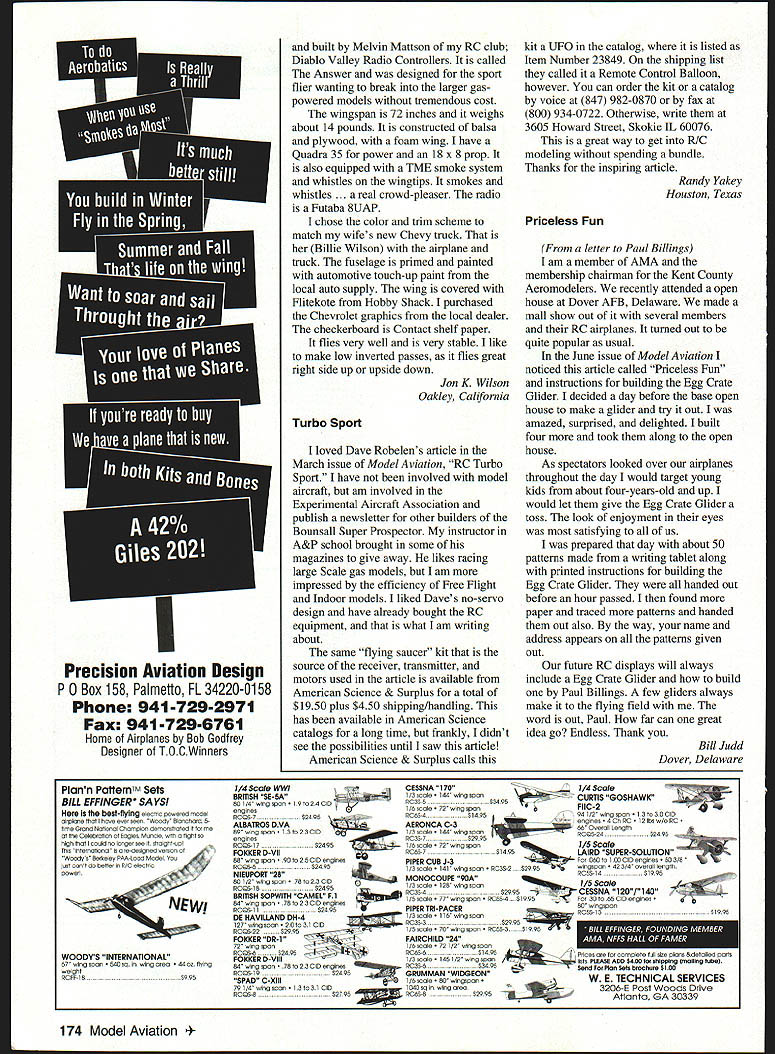
Mom said don't go near the water, but she didn't fly an RC seaplane.
This twin-engine water bird is a scratchbuilt Stand-off Scale of a Grumman Mallard. The wing is built-up and fabric-covered and the fuselage is fiberglass and foam.
The wingspan is 7 ft. 6 in. and the fuselage is 5 ft. 8 in. The engines are Webra .61 Speed and the flight controls are powered up with a JR Max 6 radio. The seaplane weighs in at 22 pounds. I have 10 flights logged at this time, and I'm ready for more. You can have a great summer day playing in the water with this bird. Oh yeah, the girl is Margie (she is great too).
Eugene C. Eberle El Cajon, California
The Answer (built by Melvin Mattson)
This model was built by Melvin Mattson of my RC club, Diablo Valley Radio Controllers. It is called The Answer and was designed for the sport flier wanting to break into the larger gas-powered models without tremendous cost.
The wingspan is 72 inches and it weighs about 14 pounds. It is constructed of balsa and plywood, with a foam wing. I have a Quadra .35 for power and an 18 x 8 prop. It is also equipped with a TME smoke system and whistles on the wingtips. It smokes and whistles—a real crowd-pleaser. The radio is a Futaba UAP.
I chose the color and trim scheme to match my wife's new Chevy truck. That is her (Billie Wilson) with the airplane and truck. The fuselage is primed and painted with automotive touch-up paint from the local auto supply. The wing is covered with Flitekote from Hobby Shack. I purchased the Chevrolet graphics from the local dealer. The checkerboard is Contact shelf paper.
It flies very well and is very stable. I like to make low inverted passes, as it flies great right side up or upside down.
Jon K. Wilson Oakley, California
Turbo Sport
I loved Dave Robelen's article in the March issue of Model Aviation, "RC Turbo Sport." I have not been involved with model aircraft, but am involved in the Experimental Aircraft Association and publish a newsletter for other builders of the Bounshall Super Prospector. My instructor in A&P school brought in some of his magazines to give away. He likes racing large scale gas models, but I am more impressed by the efficiency of Free Flight and Indoor models. I liked Dave's no-servo design and have already bought the RC equipment, and that is what I am writing about.
The same "flying saucer" kit that is the source of the receiver, transmitter, and motors used in the article is available from American Science & Surplus for a total of $19.50 plus $4.50 shipping/handling. This has been available in American Science catalogs for a long time, but frankly, I didn't see the possibilities until I saw this article! American Science & Surplus calls this kit a UFO in the catalog, where it is listed as Item Number 23849. On the shipping list they called it a Remote Control Balloon, however. You can order the kit or a catalog by voice at (847) 982-0870 or by fax at (800) 934-0722. Otherwise, write them at 3605 Howard Street, Skokie, IL 60076.
This is a great way to get into R/C modeling without spending a bundle. Thanks for the inspiring article.
Randy Yakey Houston, Texas
Priceless Fun
(From a letter to Paul Billings)
I am a member of AMA and the membership chairman for the Kent County Aeromodelers. We recently attended an open house at Dover AFB, Delaware. We made a small show out of it with several members and their RC airplanes. It turned out to be quite popular as usual.
In the June issue of Model Aviation I noticed the article called "Priceless Fun" and the instructions for building the Egg Crate Glider. I decided a day before the base open house to make a glider and try it out. I was amazed, surprised, and delighted. I built four more and took them along to the open house.
As spectators looked over our airplanes throughout the day I would target young kids from about five- or six-years-old and up. I would then give them the Egg Crate Glider as a toss. The look of enjoyment in their eyes was most satisfying to all of us.
I was prepared that day with about 50 patterns made from a writing tablet along with printed instructions for building the Egg Crate Glider. They were all handed out before an hour passed. I then found more paper and traced more patterns and handed them out also. By the way, your name and address appears on all the patterns given out.
Our future RC displays will always include an Egg Crate Glider and how to build one by Paul Billings. A few fliers always make it to the flying field with me. The word is out, Paul. How far can one great idea go? Endless. Thank you.
Bill Judd Dover, Delaware
Transcribed from original scans by AI. Minor OCR errors may remain.

