
Letters to the Editor
Send your Letters to the Editor to: Model Aviation, 5151 East Memorial Drive, Muncie IN 47302
Pulse Jet Information
I am making engineering drawings of all the American-manufactured model pulse-jet engines and am seeking information and a history on the following companies:
- Minijet Motors, Pasadena, California
- Minnesota Engine Works (M.E.W.), St. Paul, Minnesota
- Turbocraft Engineering Co., Spartanburg, S.C. or Myrtle Beach, S.C. — especially their pulse-jet engines P-80, P-82, P-83 and P-51
Any and all help most welcome and appreciated. Thank you for your kind attention to this project.
Donald E. Laird 4706 Diane Drive Ashtabula, OH 44004
Cub Ad Correction
The wording on our AMA coupon was not exactly correct. In our haste to make the deadline for publication, we stated that the "special" was $7 off list price. We apologize; the statement should have read, "a total saving of $13.50." For the price of $16.95, the coupon customer receives an OK Cub .049 engine with decals and an extra glow plug (list $16.95); our complete engine and parts catalog (list $2.00); the standard order shipping cost of $6.50 is waived ($6.50); and one of our pewter collector pins is included free (list $5.00).
I am sorry for any misunderstanding this error may have caused.
T. R. Brebeck Director of Operations OK Engines/Streamliners Box 355 Mohawk, New York 13407
More from Hal deBolt
Thanks for using my letter-to-editor bit. People are already telling me "it tells it like it was." Pleased!
One point I never used that should be made — and which I hope might supply inspiration for AMA officials — is the role major corporations once played in promoting model aviation. Their promotion and cooperation brought model aviation to the general public's attention and made it attractive to potential modelers. Examples, in no particular order:
- U.S. Navy: Provided facilities and manpower for major meets, each event attracting thousands of spectators.
- TV: "Wide World of Sports" featured Nats competition for two years — excellent exposure.
- Newspapers: New York Mirror Flying Fair — one-day event that drew 1,000 entries and 10,000 spectators.
- Philadelphia Bulletin flying circus (1945): Outstanding success; the paper enlarged the event in postwar years with similar results.
- Junior Birdmen of America (Hearst Newspapers): Divided into 17 districts with local papers; ran a weekly "Model Aviation" column, sponsored two contests a year in each district (34 meets), plus two national championships and specialty events.
- Scripps-Howard Newspapers: "Jimmie Allen" promotion — meets conducted for Jimmie Allen models.
- Plymouth Motor Model League: Chrysler dealers were urged to sponsor AMA contests nationwide. Any AMA club could obtain sponsorship; Plymouth culminated each season with an invitational "International Meet" in Detroit drawing large crowds.
There probably are others I don't recall. It has been said that the "glory" that made these things possible is gone, but one has to wonder. The modern presentation then was rudimentary Free Flight and Control Line — no comparison to the attraction RC offers today.
We do see spectator interest today when sought — consider: the Top Gun event draws much interest beyond modelers; the Tournament of Champions is corporation-sponsored and apparently well attended. I would hope the AMA would look back and see what brought us here for ideas and inspiration.
Hal deBolt Sun City Center, Florida
Interested Kids
I'm responding to "Hal deBolt Speaks Out" in your December issue.
Young people are interested in RC and will fly if given the chance. My friend has two gliders and I have an electric sailplane; both of us (age 11) really enjoy flying. I think kids would love to fly RC airplanes — the problem is RC is just not well known.
A friend who liked airplanes started flying near soccer games and picked up the hobby. In our area we have two fields (gas and glider/electric) with about 60 acres to fly. The thing I really like about the field is the friendly people. Pilot Sherman Knight was really helpful; he trained us to fly and was friendly and patient. Young pilots are excited about the sport.
Brian Gehring Kirkland, Washington
Responsibility
Dave Brown's October 1997 President's Perspective, "Growth & Responsibility," carried some interesting comments about today's aeromodeling industry. AMA members agree that many entry-level modelers are consumer types interested mainly in buzzing around the sky. Industry manufacturers have successfully created and marketed ARFs (Almost Ready to Fly) and grown sales. I find little wrong with the products themselves — competition produces quality, affordable models that benefit both beginners and experienced modelers.
However, two combined trends have produced frustration for experienced club members and volunteers: 1) consumer-style newcomers arriving with little intention to invest time in learning and building, and 2) industry and organizations assuming that experienced modelers will provide unpaid support and after-sale service. This has produced a love/hate relationship in some clubs.
Personally, I no longer help a beginner unless I see a willingness to treat RC flying as more than a passing consumer whim. I have spent countless hours correctly reassembling a neophyte's model while their attention wandered elsewhere. After several flying sessions they often disappear for weeks or months, only to reappear after tiring of some other hobby, yet expect you to fix and prepare the model. Tell them they need to do these chores themselves and you're labeled an unhelpful jerk!
Two things please me immensely in RC aeromodeling: time spent building and flying my own models, and coaching/counseling a genuinely interested student. The consumer types can apply elsewhere.
A "grow or die" attitude may be the current business and AMA motto but it has its warts. Successful marketing directed toward the newcomer and resultant membership growth has peaked due to one simple forgotten element: the burden placed on current members' enthusiasm. If growth continues to be a burden for clubs and individuals who gain little or nothing from consumer-level interest, some experienced modelers simply won't support it. Industry makes money, AMA makes money, but the experienced modeler gets to do most of the unpaid work.
Enthusiasm is the glue that binds any sport or hobby. I still see that bond between many modelers, old and new alike, but I also see more caution exercised today when approached by a new face. That caution is welcome when the person seems sincere, and necessary when the newcomer only wants to know where to buy one just like yours and expects you to help him fly it this Sunday.
The modeling industry and the AMA need to recognize the erosion taking place. Once the sale is made, the experienced modeler should not be left to do the vendor's support work gratis. Industry and AMA must manage growth responsibly.
For me there will always be the AMA and RC modeling, hopefully for many years to come. But enthusiasm, time and rewards are reserved for my own RC pleasure and those folks who approach with sincere interest.
Dick Trisiano Visalia, California
Passing It On
Remember when you first found out about model airplanes? It might have been a sleek Control Line model in the '50s or a stick-and-tissue creation a generation before that. It may have been an RC trainer just a few years ago. The important thing was that you discovered that flight was literally at your fingertips.
Aeromodeling has become an important part of your life. Your flying buddies have become some of your best friends. Modeling may even have helped you learn sportsmanship and friendly competition. Construction, engineering and finishing skills you learned have helped you at work and at home. Spending a day outside with good friends has added an important dimension to your life.
Few hobbies offer the variety of opportunities for skill development and personal reward that model aviation has brought to generations. The opportunity to pass on the gifts we have all received from this great hobby is within our reach.
Wouldn't your nine-year-old nephew with his nose glued to a computer screen be delighted to receive a subscription to a model magazine? Perhaps your son, granddaughter, or any bright-eyed youth would be fascinated with some basic building tools. If they are already interested but have not yet started, the resurgence of Control Line offers a great low-cost way to learn building and flying skills.
How about taking a young person out to the field next Sunday? Now is a great time to plant the seeds that will grow into the next generation of modelers who enjoy the arcane art of gluing their fingers together ... just like you do.
If you have had the pleasure of passing on the joy and fine values of aeromodeling to a beginner, jot down the experience, throw in a few photos if you have them, and send them to your favorite modeling publication. It's a simple thing to do and well worth the effort.
Jack Zimmanck Marlboro, Massachusetts
Terminology
The topic about which I'm writing has been bugging me for a long time.
As an old-timer in aeromodeling — an AMA member since the 1930s, a Contest Director, and one of the Associate Vice Presidents of my district — I'm often asked to decipher initials or acronyms that pop up in magazine articles. Our club has given the magazine to a few local schools. Many times a student or teacher asks me to explain an abbreviation or two. I shouldn't have to do this.
A good example is CIAM. I cannot find any description of this in any AMA literature that I have. The article in the August 1997 issue (page 167) is a good example. I also had more than one teacher ask me why a kit manufacturer had any say in the running of a contest when the article referenced a "SIG." I could explain it to him, but how many others did not have someone to ask?
G. W. Poythress Saugerties, New York
CIAM, loosely translated from French, is the International Aeromodelling Commission, which is part of the FAI (Fédération Aéronautique Internationale), the international governing body for aeronautics.
SIG (uppercase letters) is an acronym for Special Interest Group, as affiliated with AMA; "Sig" (capitalized as a name) is also the last name of the founders of Sig Manufacturing, the well-known supplier of modeling products.
Seniors
Our small group volunteered to establish a model-building club at a local senior center. Our leader, Ken Lazarus, has had a lot of experience teaching groups of high-school students to build models.
We planned a three-month program of once-a-week instruction with monthly flying sessions using Peanut-sized models in the community gym. Two-and-one-half years later we're still building and flying.
Watching a 70-year-old "retread student" grin after his first model flight in 50 years is extremely rewarding. It keeps us coming back.
Focus on bringing in new youthful beginners, but don't forget the seniors.
Bob Munson Cincinnati, Ohio
Building From Plans
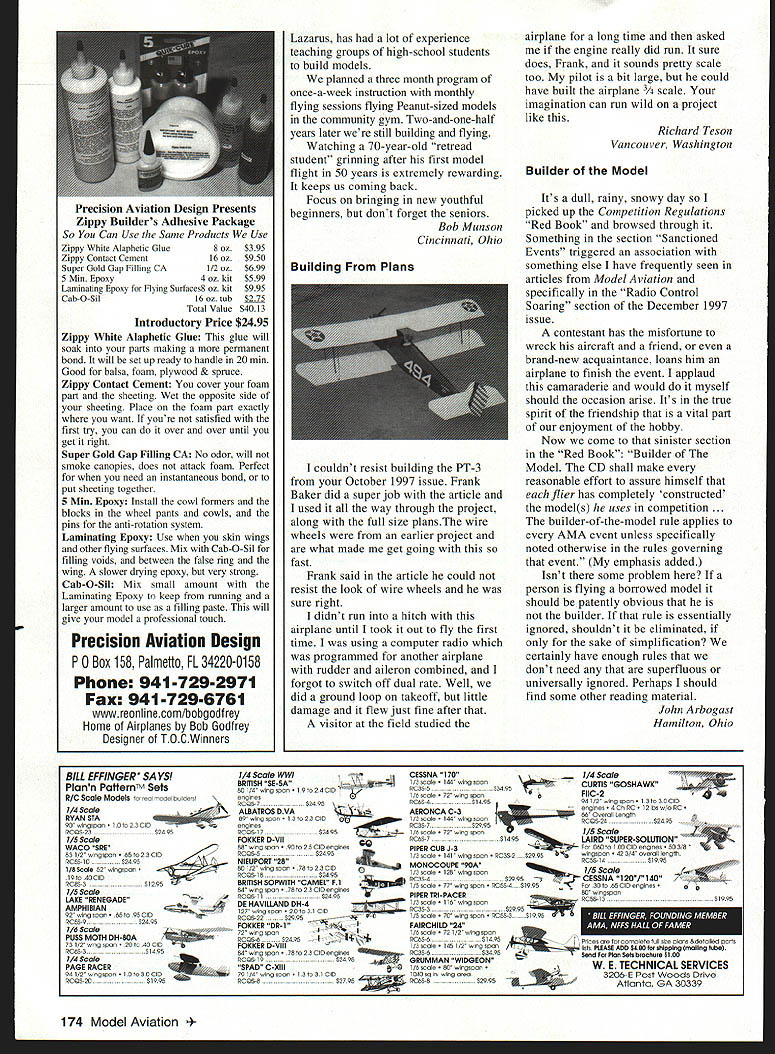
I couldn't resist building the PT-3 from your October 1997 issue. Frank Baker did a super job with the article and I used it all the way through the project, along with the full-size plans. The wire wheels were from an earlier project and are what made me get going on this so fast.
Frank said in the article he could not resist the look of wire wheels — he was sure right.
I didn't run into a hitch with this airplane until I took it out to fly the first time. I was using a computer radio which was programmed for another airplane with rudder and aileron combined, and I forgot to switch off dual rate. We ground-looped on takeoff, but there was little damage and it flew just fine afterward.
A visitor at the field studied the airplane for a long time and then asked me if the engine really did run. It sure does, Frank, and it sounds pretty scale too. My pilot is a bit large, but he could have been built 3/4 scale. Your imagination can run wild on a project like this.
Richard Teson Vancouver, Washington
Builder of the Model
It's a dull, rainy, snowy day so I pulled out the Competition Regulations "Red Book" and browsed through it. Something in the "Sanctioned Events" section triggered an association with something else I frequently see in Model Aviation articles, specifically in the "Radio Control Soaring" section.
A contestant has the misfortune to wreck his aircraft and a friend, or even a brand-new acquaintance, loans him an airplane to finish the event. I applaud this camaraderie and would do it myself should the occasion arise. It's in the true spirit of friendship that is a vital part of our enjoyment of the hobby.
Now we come to that sinister section in the "Red Book": "Builder of The Model. The CD shall make every reasonable effort to assure himself that each flier has completely 'constructed' the model(s) he uses in competition ... The builder-of-the-model rule applies to every AMA event unless specifically noted otherwise in the rules governing that event." (My emphasis added.)
Isn't there some problem here? If a person is flying a borrowed model it should be patently obvious that he is not the builder. If that rule is essentially ignored, shouldn't it be eliminated, if only for simplification? We certainly don't need rules that are superfluous or universally ignored.
John Arbogast Hamilton, Ohio
Transcribed from original scans by AI. Minor OCR errors may remain.

