

Letters to the Editor
Send your Letters to the Editor to: Model Aviation, 5151 East Memorial Drive, Muncie, IN 47302
Value Received
I have been a member of AMA for more than 25 years, and a model builder since 1930 (with a 24-year hiatus, starting with military service in 1942). Because my interest has been almost solely in Free Flight spark-ignition-powered vintage models, I was somewhat dubious as to the value and need of AMA membership.
In July of last year I was out on Lucerne dry lake near my home, preparing to fly Schoenbrun's Gladiator powered by an Ohlsson .60 big port, when, in the process of advancing the spark lever, the back of my hand invaded the arc of the prop.
Some six months later, summing up the cost of the resulting cut tendon on my right middle finger, I found that Medicare and my retiree insurance coverage had paid more than $10,000 on my behalf but I was still out of pocket about $1,200! It then struck me, "Hey, AMA says they have some medical insurance, why not try it?"
A month or so after filing a claim with the necessary forms promptly sent to me by Deanna Hunt at AMA Headquarters, a check for more than $1,100 arrived in the mail!
Right off the "dubious" in the paragraph above! While many of us think of the liability insurance as the only reason for membership, it is clear to me now there are certainly other valuable aspects, too. Now I make sure my dues are paid, and paid on time.
Thanks for the help, AMA.
Larry Clark Lucerne Valley, California
Single-Stick
In response to the letter from Herbert Williams in the Feb. '98 issue, he should look into using a single-stick transmitter if he wants rudder/aileron mixing—it's a natural thing.
I would like to see some articles on multiengine aircraft, especially fuel management systems. I am presently flying an OV-10 that I built using Rich Uravitch plans. I stuffed two two-ounce tanks in each nacelle. That way I've plenty of fuel to keep one engine running while starting and adjusting the other. The plane weighs ten pounds and flies beautifully on two .25 Magnum engines. It also flies and lands well on either engine.
Thank you for doing what you're doing.
Robert E. Berg Harbor City, California
Comeback
In the "Letters to the Editor" column of the February issue of Model Aviation, the "Comeback" letter by E. Charles Rolwing of Brandenburg, Kentucky sure hit home with me.
I was born in 1924 and built solid rubber-powered models, tried hand-launched gliders until World War II came along. Served my time and after the war got into gas-powered Free Flight and Control Line flying. Gave it all up in the early '50s to earn a living.
Upon retiring 40 years later, I decided to get back into the hobby, so I visited the local club's flying field. What a shock that was! I liked the idea of radio control, but all of those hotshot aerobatic maneuvers were not for this old-timer.
Until one day as I arrived at the field for one last look, I saw a 1940 Playboy making a beautiful three-point deadstick landing. I went over to the owner, who happened to be the vice president of the club, and asked him if they were still flying those airplanes, and he said that they sure were.
Well, that did it. I joined the AMA and the local club and have been building and flying these old-time airplanes ever since.
Charles Rolwing was right when he wrote that the AMA should publish two magazines with one strictly aimed at newcomers who can't afford the ARF kits, etc., and for the old-timers who would like to get back into the modeling world they grew up in.
The AMA is important for the insurance but I for one rely on another model magazine for articles and plans and have joined SAM, the Society of Antique Modelers, and also get their great bimonthly magazine, SAM Speaks, edited by Bruce Augustus, who does a great job in publishing all of the activities of that organization.
I think that an alternate-choice magazine is an idea whose time has come. There are a lot of people out there who would like to get back into the hobby for the first time or want to start up again but who might be turned off after a perchance reading an issue of Model Aviation or watching all the hotshots tooling across the sky at the local club field. Model airplanes mean much more than just that.
Ross Wert Sedona, Arizona
Letters to the Editor
Food for Thought
Over the last year I have come across a couple of items that may be of importance to fellow clubs and modelers:
- Food concessions at events:
- For those clubs that have food concessions at events, please check with your local Health Services or those who govern food service in your area. Our club had to contact them for rules concerning food service at last year's swap shop. The criteria for legal food service is unbelievable.
- At least in Michigan, we would almost have to set up a restaurant condition at the event or flying field. It is not legal to sell food from an outdoor grill. We would have to provide wash-up areas for cooks, equipment, servers, and guests. Even pop sold from coolers is in question.
- Then there are the inspections for certification. It would prove to be an expensive endeavor, so we have decided to terminate cooked food sales. It is OK to barbecue for ourselves, but it's not to be given or sold to non-club members. The Health Service indicated that our club was on the list for a surprise visit this coming year, and the violation fines would have been heavy.
- We will now only offer prepackaged food (i.e., chips and junk food) and all future club event advertising will include "Bring your own food and drinks." If lost revenue is a concern, try raffling a TV or restaurant gift certificates to spectators. This has proven to be a successful alternative.
- Nitromethane concerns:
- While doing a term paper for a college environmental course, I found that nitromethane is a terrible pollutant that is also a carcinogen. Nitro fumes are inhaled and it can be absorbed directly into the blood through the skin. Once in the body it collects in the liver and accumulates to dangerous levels. It can also cause nervous system damage.
- Of course, these findings were in lab rats that were fed the stuff in quantity, but I think I will make a little effort to keep my hands out of the fuel. A refueling overflow capture will also be used in the future. We all notice the little brown spots caused by refueling overflows, and that squirt or two lost at each refuel may add up to a gallon or so by year's end.
- The trouble with the overflow is that with each rain the nitro is washed into the water system. The ground does not filter it out, and most treatment stations are not capable of removing it from the water.
These are not views intended to change the way any of us conducts business. These are just food for thought. Check with your local Health Services and look up nitro on the Web.
— John M. Gray Dearborn Heights, Michigan
Battery Pack Failure
Just recently, I purchased an ARF. To go along with the airplane, I also bought a new engine and a new transmitter—I won't mention the name of the manufacturer at this point. I have two of their computer-type transmitters, with no problems, and purchased one of their inexpensive ones as a spare to eliminate tying up my other transmitters.
A few weeks back, I put it all together, charged transmitter and battery pack with their charger, and went to the field where I did the usual checks of making sure everything was working properly and including checking there was a full charge on the transmitter and battery pack. Took off and outside of making the usual minor adjustments of trim, everything was fine.
The next afternoon, again, after the night charge, I went to the field and again checked all connections, tested the battery pack and transmitter to make sure all was OK. Took off with no problems and in the process of leveling out, suddenly there was no control. The airplane kept going higher and behaving erratically.
As I was having some difficulty keeping track of the airplane, I called one of the members over and asked him to put all the down trim in, which he did. Nothing worked at all and I knew I was going to lose the airplane.
I did, and fortunately, it crashed in the back yard of a nice, forgiving couple. The airplane was a total basket case, including damage to the engine. Took it home and found the covering on the battery pack was shriveled, as if by heat. The bottom of the pack seemed as if a couple of the cells had shorted out, or as was said, "fried." Called the service department and was told to ship everything, emphasis on everything, back to them.
A few weeks later—they never bothered to call me—I called them and was told by some rep they had checked the transmitter and found nothing wrong. Of course, they never said anything about the battery pack, but if they hadn't checked the battery pack, those individuals needed glasses in a bad way or decided to ignore same. Without going into details, they denied liability, and in so many words, told me to peddle my papers.
Now, my question to your staff and perhaps any of your readers:
I have been in RC airplanes for 20 years and have never had any problems with transmitters or battery packs and certainly, hooking up same to the receiver and what else, one does not have to be a computer scientist, so assuming I did everything properly, what could have caused that type of a short in the battery pack? The way that rep talked, one would think they have never produced a faulty electrical part, which I find hard to believe. I would appreciate any comments I can get on this matter.
Lew Calamia 6816 Hillside Drive Pewee Valley, KY 40056
Getting Exposure
Ever since I have been a member of AMA I have always saved Model Aviation and other model airplane magazines that I have subscribed to. I always go through each magazine and clip out or make copies of any articles that I wish to save.
A few years ago I got rid of all the old issues of these magazines. Now the magazines are starting to accumulate again.
A few months ago I found out that my sister was a volunteer at the Sturgis Memorial Hospital. Her job is to take magazines to all of the waiting rooms and patients and keep them up to date. I asked her if she would take some of my RC model magazines. She agreed to distribute them at the hospital.
At one time or another we have all been sitting in a waiting room and found the magazine selection is not too great.
As of now I have only mailed the magazines to my dentist's office, doctor's office and a laundromat; the hospital and Thurston Woods Village (a retirement and nursing home) want more to go.
I make sure that at least one magazine is our AMA Model Aviation in a waiting room. What a good, cheap way to get exposure to our hobby—have members take their back issues of these magazines to any place there is a waiting room. Just think about it.
Dillon Fritz Sturgis, Michigan
More on Aerial Photography
I have also been experimenting with aerial photography for the last two years. The first "flying camera" was a Kodak disposable on the belly of a Great Planes PT-40, tripped by a fifth servo. The snow was on the ground and I wanted to take pictures of my son-in-law's house in the country. I took off (with skis as a landing gear), gained altitude and headed above the house 600 feet away. Took a picture. Landed. Rewind. Took off. Next picture. When the film was developed, only the snowy field was on it, but no house.
So I bought a $25 camera with automatic advance and started over. Several hundred pictures later I finally framed the house and also our "runway" together with the little pond where we occasionally take our airplanes for a swim.
Not being able to fly for a few weeks because of weather, I started sorting through my box of pictures and got an interesting idea: Would it be possible to see the country in 3D?
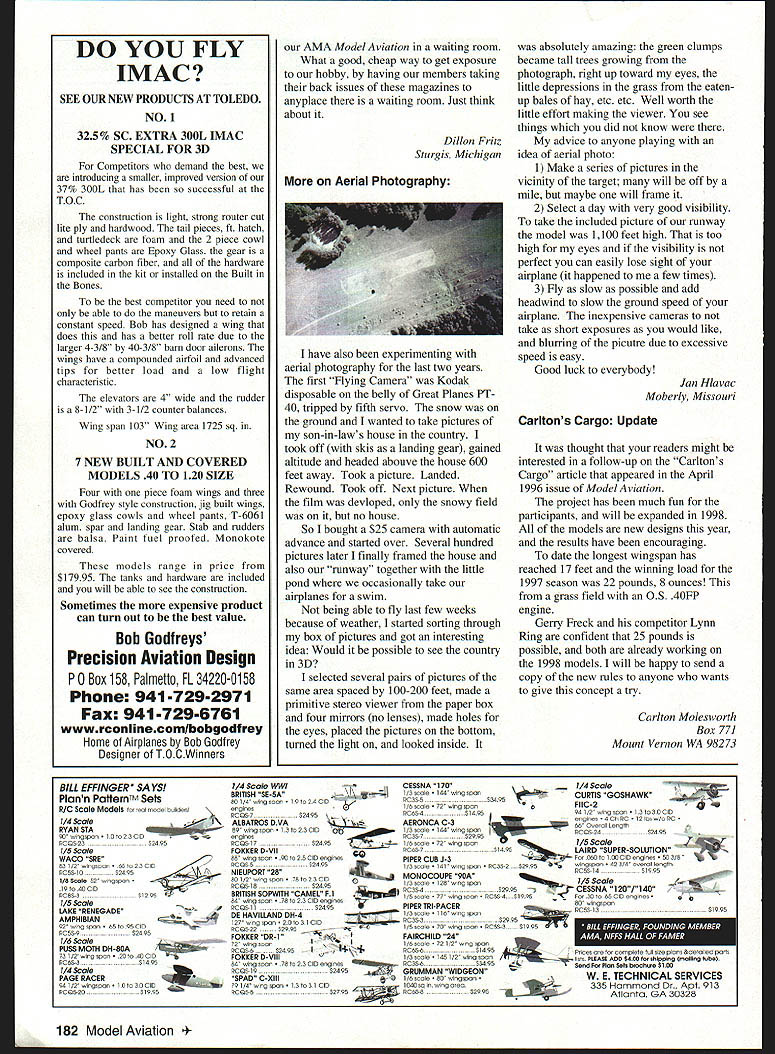
I selected several pairs of pictures of the same area spaced by 100–200 feet, made a primitive stereo viewer from a paper box and four mirrors (no lenses), made holes for the eyes, placed the pictures on the bottom, turned the light on, and looked inside. It was absolutely amazing: the green clumps became tall trees growing from the photograph, right up toward my eyes, the little depressions in the grass from the eaten-up bales of hay, etc. Well worth the little effort making the viewer. You see things which you did not know were there.
My advice to anyone playing with the idea of aerial photos:
- Make a series of pictures in the vicinity of the target; many will be off by a mile, but maybe one will frame it.
- Select a day with very good visibility. To take the included picture of our runway the model was 1,100 feet high. That is too high for my eyes and if the visibility is not perfect you can easily lose sight of your airplane (it happened to me a few times).
- Fly as slow as possible and add headwind to slow the ground speed of your airplane. The inexpensive cameras do not take as short exposures as you would like, and blurring of the picture due to excessive speed is easy.
Good luck to everybody!
Jan Hlavacek Moberly, Missouri
Carlton's Cargo: Update
It was thought that your readers might be interested in a follow-up on the "Carlton's Cargo" article that appeared in the April 1996 issue of Model Aviation.
The project has been much fun for the participants, and will be expanded in 1998. All of the models are new designs this year, and the results have been encouraging.
To date the longest wingspan has reached 17 feet and the winning load for the 1997 season was 22 pounds, 8 ounces! This from a grass field with an O.S. .40FP engine.
Gerry Freck and his competitor Lynn Ring are confident that 25 pounds is possible, and both are already working on 1998 models. I will be happy to send a copy of the new rules to anyone who wants to give this concept a try.
Carlton Molesworth Box 771 Mount Vernon, WA 98273
Transcribed from original scans by AI. Minor OCR errors may remain.

