
Letters to the Editor
Flies Great!
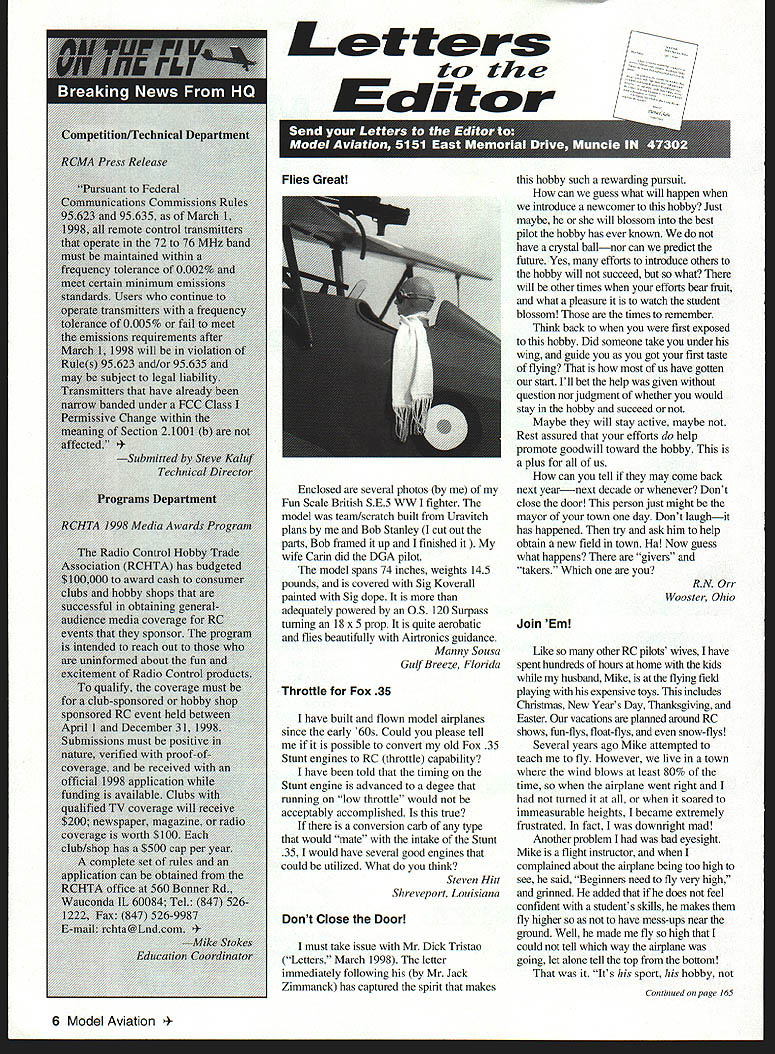
Enclosed are several photos (by me) of my Fun Scale British S.E.5 WW I fighter. The model was team/scratch-built from Uravitch plans by Bob Stanley and me (I cut out the parts; Bob framed up and finished it). My wife, Carin, did the DGA pilot.
The model spans 74 inches, weighs 14.5 pounds, and is covered with Sig Koverall painted with Sig dope. It is more than adequately powered by an O.S. 120 Surpass turning an 18 x 5 prop. It is quite aerobatic and flies beautifully with Airtronics guidance.
Manny Sousa Gulf Breeze, Florida
Throttle for Fox .35
I have built and flown model airplanes since the early ’60s. Could you please tell me if it is possible to convert my old Fox .35 Stunt engines to RC (throttle) capability? I have been told that the timing on the Stunt engine is advanced to a degree that running on “low throttle” would not be acceptably accomplished. Is this true?
If there is a conversion carb of any type that would mate with the intake of the Stunt .35, I would have several good engines that could be utilized. What do you think?
Steven Hitt Shreveport, Louisiana
Don't Close the Door!
I must take issue with Mr. Dick Tristao ("Letters," March 1998). The letter immediately following his (by Mr. Jack Zimmanck) has captured the spirit that makes this hobby such a rewarding pursuit.
How can we guess what will happen when we introduce a newcomer to this hobby? Just maybe he or she will blossom into the best pilot the hobby has ever known. We do not have a crystal ball—nor can we predict the future. Yes, many efforts to introduce others to the hobby will not succeed, but so what? There will be other times when your efforts bear fruit, and what a pleasure it is to watch the student blossom! Those are the times to remember.
Think back to when you were first exposed to this hobby. Did someone take you under his wing and guide you as you got your first taste of flying? That is how most of us have gotten our start. I’ll bet the help was given without question or judgment of whether you would stay in the hobby and succeed or not.
Maybe they will stay active, maybe not. Rest assured that your efforts do help promote goodwill toward the hobby. This is a plus for all of us.
How can you tell if they may come back next year—next decade or whenever? Don’t close the door! This person just might be the mayor of your town one day. Don’t laugh—it has happened. Then try and ask him to help obtain a new field in town. Ha! Now guess what happens? There are “givers” and “takers.” Which one are you?
R. N. Orr Wooster, Ohio
Join ’Em!
Like so many other RC pilots’ wives, I have spent hundreds of hours at home with the kids while my husband, Mike, is at the flying field playing with his expensive toys. This includes Christmas, New Year’s Day, Thanksgiving, Easter—vacations are planned around RC shows, fun-flys, float-flys, and even snow-flys.
Several years ago Mike attempted to teach me to fly. However, we live in a town where the wind blows at least 80% of the time, so when the airplane went right and I had not turned it at all, it soared to immeasurable heights. I became extremely frustrated; in fact, I was downright mad. Another problem I had was bad eyesight. Mike is a flight instructor, and when I complained about the airplane being too high to see, he said, “Beginners need to fly very high,” and grinned. He added that he does not feel confident with a student’s skills, so he makes them fly higher to avoid mess-ups near the ground. Well, he made me fly so high that I could not see where the airplane was going, let alone tell top from bottom! That was it. “It’s his sport, his hobby,” I thought.
So I spent time elsewhere. Occasionally I’d hang out and help at events, but I did fly last summer and something odd happened. Some invisible bug must have crawled up my pants leg and into my brain while I was flying. Mike stood pridefully watching and I decided to ask him to teach me to fly. Something very different this time, though: when the wind caused the airplane to veer right I simply gave some left, climbed a little and down—the clincher—I took off, landed and hooked! I could actually fly the airplane rather than flying what I wanted to fly at the time, just like Mike.
Fortunately we live five miles from the flying field and I am able to fly two or three times per week. As my confidence improved, Mike bought me an Ugly Stik. He wants to buy his own airplane; I love the Stick with black and bright yellow trim—it stands out and I have very little trouble seeing it. Also I am flying at much lower altitude now. Other students who know Mike makes us fly higher have to work on improving skills; it stings a little, but Mike says to fly low when ready. I have reached my initial goal: good enough to fly low enough to enable me to see the airplane.
Anyway, to all fellow RC wives who thought they weren’t interested in flying—give it some thought. The biggest thrill is seeing Mike’s eyes light up when he talks about his flights. I’m very happy to share this beloved hobby. So give it a chance, ladies—can’t beat ’em, join ’em. We need some company—it's really fun.
Sandy Bailey Flagstaff, Arizona
Natural Barrier
I couldn’t agree more with the principle of E. Charles Rowling’s letter on p. 182 of Model Aviation for February 1998.
However, there is convincing evidence in history to show that “junior magazines” are not viable. In amateur radio at least two failed (Radio Fun and Ham Radio Horizons) and in the model airplane world Junior American Modeler failed. The concept is OK but a closer look shows that an unnatural barrier is set up between the novice and the more advanced modelers. Where does being a novice end? The novice wants to be part of the whole group.
A better approach, in my opinion, is the inclusion of columns and material geared to the novice; typically Bob Underwood’s “Newcomers” column in Model Aviation.
The AMA and the rest of the model press have to cultivate the novices to assure the continuation of our hobby as it is today. If they do not, the basic nature of our hobby will change. We will become another group of people that operate purchased equipment.
George Wilson Marstons Mills, Massachusetts
Help Wanted
I am building a Zero from an old set of Top Flite plans, kit #25, designed by Hal Parenti. I would like to put this model, when finished, on a center-mounted float with two wing sponsons. I have worked out mounting procedures for the three floats, but I need help to determine the size of the center float.
The wingspan will be 61 inches; the length, 49½ inches. The weight will be nine pounds, including a .90 four-stroke engine but less center float.
Any help regarding length, width, and depth of the float will be appreciated. I will make the float out of foam and finish in glass cloth.
Irwin Perlman 6052 Sunberry Circle Boynton Beach, FL 33437
Transcribed from original scans by AI. Minor OCR errors may remain.

