
Letters to the Editor
Art's Son
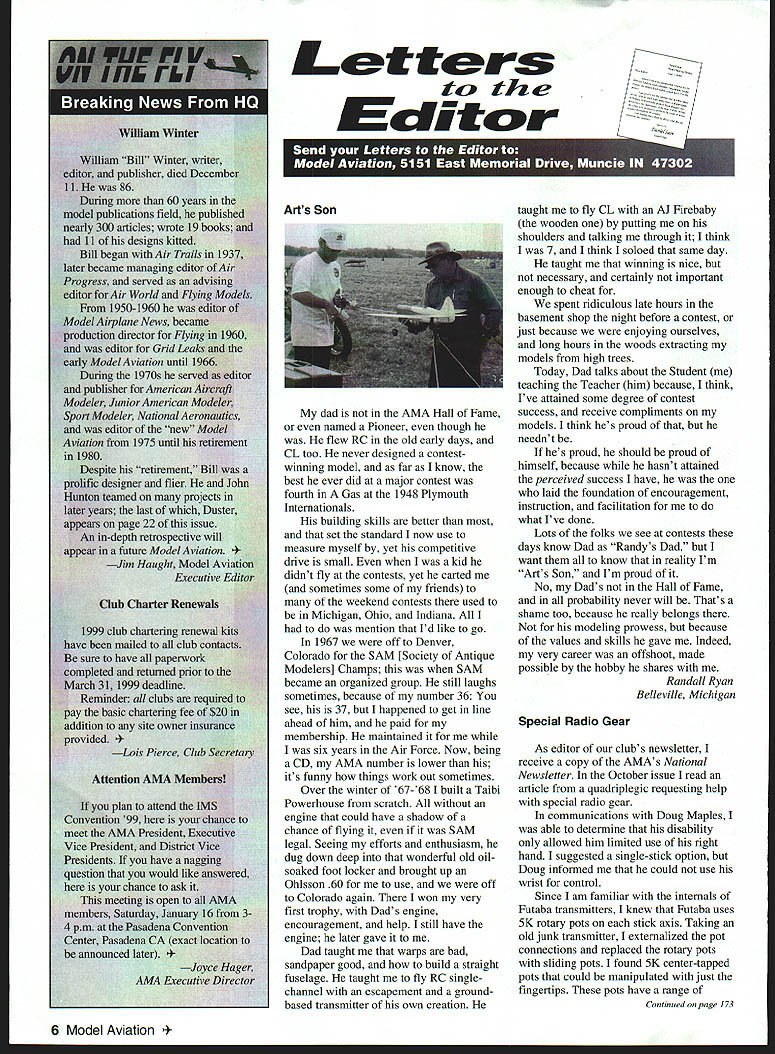
My dad is not in the AMA Hall of Fame, or even named a Pioneer, even though he was. He flew RC in the old early days, and CL too. He never designed a contest-winning model, and as far as I know, the best he ever did at a major contest was fourth in A Gas at the 1948 Plymouth Internationals.
His building skills are better than most, and that set the standard I now use to measure myself by, yet his competitive drive is small. Even when I was a kid he didn't fly at the contests, yet he carted me (and sometimes some of my friends) to many of the weekend contests there used to be in Michigan, Ohio, and Indiana. All I had to do was mention that I'd like to go.
In 1967 we were off to Denver, Colorado for the SAM (Society of Antique Modelers) Champs; this was when SAM became an organized group. He still laughs sometimes, because of my number 36; you see, his is 37, but I happened to get in line ahead of him, and he paid for my membership. He maintained it for me while I was six years in the Air Force. Now, being a CD, my AMA number is lower than his; it's funny how things work out sometimes.
Over the winter of '67–'68 I built a Taibi Powerhouse from scratch. All without an engine that could have a shadow of a chance of flying it, even if it was SAM legal. Seeing my efforts and enthusiasm, he dug down deep into that wonderful old oil-soaked foot locker and brought up an Ohlsson .60 for me to use, and we were off to Colorado again. There I won my very first trophy, with Dad's engine, encouragement, and help. I still have the engine; he later gave it to me.
Dad taught me that warps are bad, sandpaper good, and how to build a straight fuselage. He taught me to fly RC single-channel with an escapement and a ground-based transmitter of his own creation. He taught me to fly CL with an AJ Firebaby (the wooden one) by putting me on his shoulders and talking me through it; I think I was 7, and I think I soloed that same day.
He taught me that winning is nice, but not necessary, and certainly not important enough to cheat for.
We spent ridiculous late hours in the basement shop the night before a contest, or just because we were enjoying ourselves, and long hours in the woods extracting my models from high trees.
Today, Dad talks about the Student (me) teaching the Teacher (him) because, I think, I've attained some degree of contest success, and receive compliments on my models. I think he's proud of that, but he needn't be.
If he's proud, he should be proud of himself, because while he hasn't attained the perceived success I have, he was the one who laid the foundation of encouragement, instruction, and facilitation for me to do what I've done.
Lots of the folks we see at contests these days know Dad as "Randy's Dad," but I want them all to know that in reality I'm "Art's Son," and I'm proud of it.
No, my Dad's not in the Hall of Fame, and in all probability never will be. That's a shame too, because he really belongs there. Not for his modeling prowess, but because of the values and skills he gave me. Indeed, my very career was an offshoot, made possible by the hobby he shares with me.
Randall Ryan Belleville, Michigan
Special Radio Gear
As editor of our club's newsletter, I receive a copy of the AMA's National Newsletter. In the October issue I read an article from a quadriplegic requesting help with special radio gear.
In communications with Doug Maples, I was able to determine that his disability allowed him limited use of his right hand. I suggested a single-stick option, but Doug informed me that he could not use his wrist for control.
Since I'm familiar with the internals of Futaba transmitters, I knew that Futaba uses 5K rotary pots on each stick axis. Taking an old junk transmitter, I externalized the pot connections and replaced the rotary pots with sliding pots. I found 5K center-tapped pots that could be manipulated with just the fingertips. These pots have a range of motion of about 75 mm in the direction mounted. Two pots in a forward/backward configuration on the right fingertip would control elevator; a pot side-to-side motion would control ailerons. Another pot, also made up in the same configuration, used on the right thumb would control throttle and rudder. Testing my controller, I was surprised I could remain in complete control; it felt very natural. The prototype was rather ugly; I'm going to assemble a new unit. After testing I'll see if Doug can use it. I have suggested Doug modify a buddy box to incorporate fingertip controls to fly until he feels safe to fly solo.
Futaba transmitters can be modified to accommodate persons with disabilities. MA readers aware of a person with special needs who would be happy to see what could be developed can contact me afternoons; I always respond to e-mail.
Jerry Bernor Tampa, Florida jbernor@aol.com
Response to "Help Wanted"
This letter is in response to "Help Wanted" by Bob Stewart in the December 1998 "Letters to the Editor."
I read your call for help, and I have a suggestion:
You commented that you had a fair amount of electronic skill. My computer joystick has ailerons and stabilizer controls just like an RC transmitter, but it uses a twisting of the joystick from right to left to act as rudder control. If you can take something like this and modify it to have a trigger throttle, much like RC car throttles, this would give you the capabilities of a four-channel receiver. If you wanted more channels than that, maybe you can adapt the joystick further to utilize the various buttons that are on the joystick.
Tom Diamond Ogden, Utah
It's a Dirty Job!
Over the weekend of Oct. 24–25, 1998 it was my pleasure to attend the Sierra Vista, Arizona Air Show as ground crew for one of the 10 premier air show acts performing there. We tour the entire US and Canada—a spectacular way to spend a season!
Many of these shows add an RC club display and flight demo to their program for local interest, as was the case in Sierra Vista. I always attempt to make contact with these local RC fliers, and have always found them glad to meet another RCer. We're never really away from home!
Upon discovering that the gentleman doing the incredible flying job with the very large Ultimate Bipe was none other than Chip Hyde, I had to make arrangements to meet him. After introductions, I inquired as to the possibility of Chip and Bill Hempel (who also did a super demo) bringing their models to the full-scale performers' area for some photos; they agreed and seemed delighted. Our air show pilots, as most, are also RC fliers and were very honored to meet them.
I also made arrangements with the local club vice president, Don Sanders of the Mesquite Modelers, to swap newsletters. Our performance was enjoyed by the large, enthusiastic crowd, as were all the other acts.
The show begins with an intense acro routine in a stock 220 HP Stearman (with lots of smoke, of course) followed by an incredible acro sequence using an Enstrom heli, with smoke and pyro.
Our finale features Royce Baar of River Falls, Wisconsin transferring from the front seat of the Stearman to the landing strut of the heli; no hooks, no devices, no chute—he just grabs on and hangs by his arm. We then land him right in front of the awed crowd.
I just completed our fifth season, and can't wait for 1999. If any modelers see us at these shows, be sure to look us up, as our love of airplanes is the same—only the size is different!
Jerry Deebach Mohr Barnstorming Cottage Grove, Minnesota
Flying Aces
It was appropriate, gratifying, and significant that the article on the Flying Aces National Meet at Geneseo, N.Y., appeared in the January 1999 issue of Model Aviation. This organization represents the fundamentals of our hobby in promoting relatively inexpensive models of historical significance, whether they are scale models of full-scale aircraft or reproductions of endurance models designed before World War II.
There was, however, an error in the article: the modeler who was awarded the plaque for more than 400 first-place victories at the victory banquet was Gordon Roberts, a member of the Cleveland Free Flight Society (Stork Squadron). Dave Rees is a fine modeler indeed, and was awarded the Grand Champion in the 1998 contest, but as of last January he had earned a total of 126 wins, whereas Gordon Roberts had 387 at that time.
I would also like to take this opportunity to comment on the suggestion by Louis Joyner regarding professionally built models sold to "fliers." In my opinion, this is totally inappropriate. Beginning modelers would be well-advised to join the Flying Aces movement to develop their construction and adjusting skills on models costing only a few dollars.
In prewar years, Wakefield models could be flown by proxy fliers by prior arrangement with their builders because of the expense of international travel, etc., but this was far different from selling models to the general public! Furthermore, I find it difficult to believe that a winner would feel very satisfied if he had not built his own model. (Chances are that a non-builder would not win a major contest anyway.)
I encourage the AMA to continue to support the Flying Aces movement. It is a significant and historical branch of the hobby. Thank you for the article.
Steve Griebling Akron, Ohio
Transcribed from original scans by AI. Minor OCR errors may remain.

