
Letters to the Editor
All letters will be carefully considered; those of general interest will be used. Send to Model Aviation, 815 15th St., N.W., Washington, D.C. 20005.
The Cub Still Lives
I read with interest your For Openers of June 1979 and it got me to thinking about my own affair with the J-3 Cub, which continues even today. As a young student pilot in 1962, I bought a 1941 (wood-spar) J-3 and recovered the wings along with many other smaller repair jobs required to pass FAA inspection. I learned lots about the Cub and its history in those weeks I spent fixing it up.
One item you failed to mention about the Cub is that it had to be flown solo from the rear seat. Now, this sounds awkward to the junior pilot of this modern day, but it was old hat to us Cub pilots. Rear-seat flying was so ordinary to me that the one time I flew from the front (with a passenger) it seemed all wrong.
Some more little details I remember about the J-3 include the high-set cowling and its exposed engine cylinders, which forced one to look out the side windows to taxi and to "S" turn to see directly ahead. Who can forget those words: "Switch off, pull 'er through, brakes and contact!" Hand starting, or "propping off" as it was called, was an art in itself. Few student pilots today ever learn to step right up to a live prop and grab-a-hold.
I could write many pages of facts and experiences of my own and of others I know who have owned and flown the J-3 Cub. The Cub is not dead yet. Did you know that new ones can still be had? Wag-Aero of Lyons, Wis., markets a complete kit to build the real Cub!
In reference to the mention you made about the Berkeley Cub and the Hollinger article in Air Trails, I've been looking for years for a copy of the Jan. 1955 issue of Air Trails, just to read the text and pictures of this article. I have a set of Hobby Helpers' plans for the Cub and I believe they are still in print!
Alvin E. Johnson Oxford, PA
The Cub we soloed was flown from the rear — the empty instructor's seat was spooky on solo. After the war, the Cub was certificated to be flown from either seat.
Walt Good Sailing Along
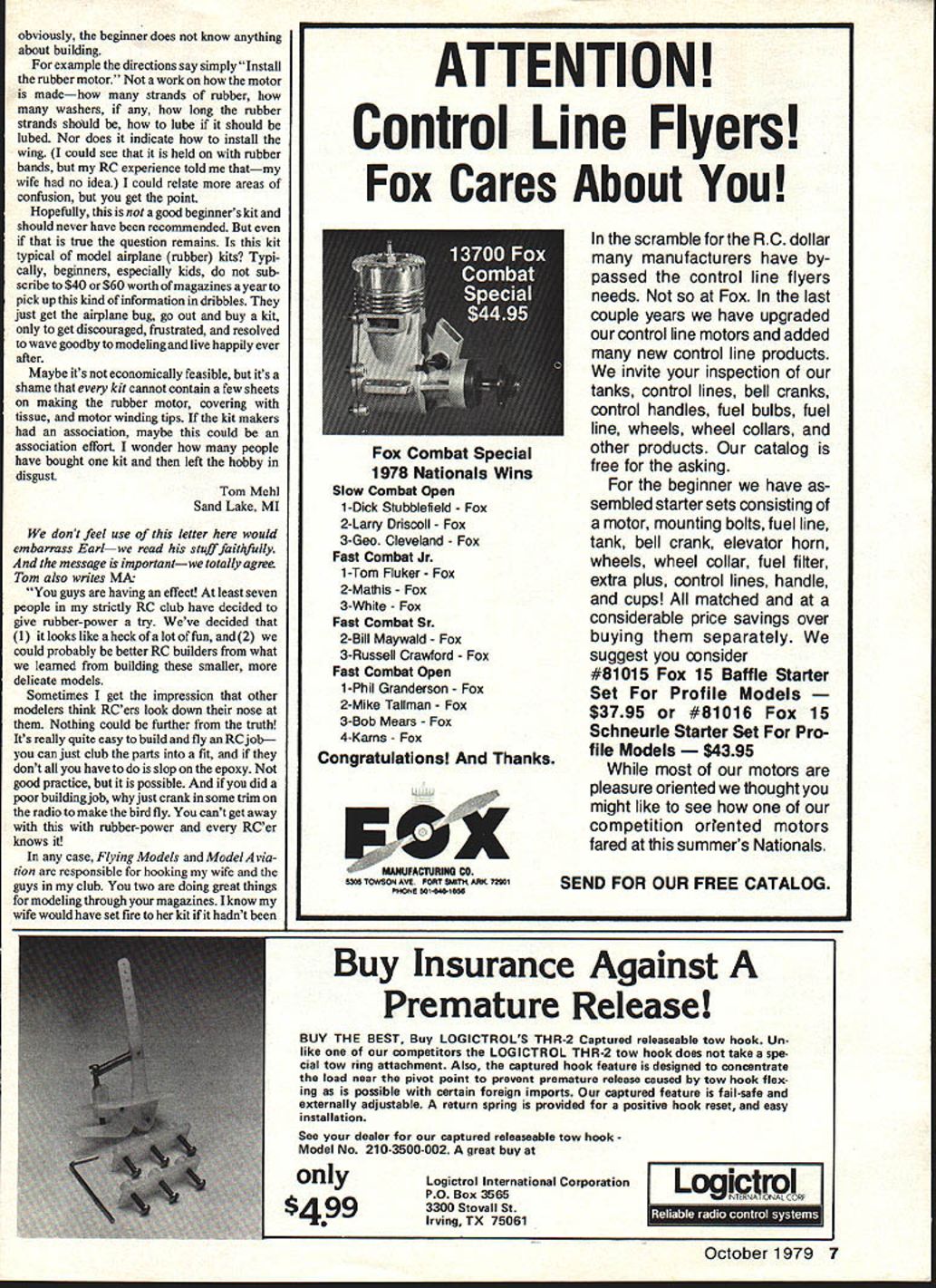
Just a note to tell you how much I enjoy your efforts in bringing us Model Aviation. While I've been an RC'er for many years, the breadth of MA helps keep perspective on all activities.
The enclosed photo of "Old Walt" Good was taken on May 20, 1979, in Orlando, FL after he spent an afternoon learning how to make a racing yacht move. This is my RC pastime now and we introduced Walt to it then.
Dick Jansson Maitland, FL
Likes Classic Scale
Just wanted to congratulate you on the excellent format of your magazine. This month, for example, the fine article and drawings of the Fairchild FC-2. Used to be dozens of these north of here; the Canadian bush and in Alaska. Long-time favorite of these pilots: durable, simple, carry a huge load and simple to maintain in primitive conditions. I think most of them though were the later slightly different 71 models.
Keep articles and drawings of these fine old-timers coming; will you? They make beautiful models and the drawings have real historic value too. For one, I get very tired of WW I, WW II and the later military jets. Like plastic models—everyone has 'em.
Chuck Wood Seattle, WA
To Earl VanGorder, copy MA
A copy of this letter is going to Bill Winter of Model Aviation for his possible interest, as the main point of this letter touches on attracting and keeping newcomers to modeling. I'm not sure it's cricket to address magazine competitors, but here goes.
Based on a recent experience that I'll try to relate briefly, I'm wondering if the nature of airplane kits does not frustrate and discourage newcomers, especially youngsters. Here 'tis:
A while ago, to my surprise and delight, my wife, who never showed a lot of interest in airplanes or modeling, asked me to get her a Peanut kit! So we checked the various columns, talked to the hobby dealer, etc., and based on all that we selected a kit marketed as a good beginner kit. It was touted to us as being just that. (At this point I should point out that the only modeling I know about is RC, so I was ignorant and no help to my wife in this matter.)
Attempting to build this kit proved to be a very frustrating experience for both of us. Here's why. This kit assumes that the builder knows about some critical aspects of building. And quite obviously, the beginner does not know anything about building.
For example the directions say simply "Install the rubber motor." Not a word on how the motor is made—how many strands of rubber, how many washers, if any, how long the rubber strands should be, how to lube it if it should be lubed. Nor does it indicate how to install the wing. (I could see that it is held on with rubber bands, but my RC experience told me that—my wife had no idea.) I could relate more areas of confusion, but you get the point.
Hopefully, this is not a good beginner's kit and should never have been recommended. But even if that is true the question remains: Is this kit typical of model airplane (rubber) kits? Typically, beginners, especially kids, do not subscribe to $40 or $60 worth of magazines a year to pick up this kind of information in dribbles. They just get the airplane bug, go out and buy a kit only to get discouraged, frustrated, and resolved to wave goodbye to modeling and live happily ever after.
Maybe it's not economically feasible, but it's a shame that every kit cannot contain a few sheets on making the rubber motor, covering with tissue, and motor-winding tips. If the kit makers had an association, maybe this could be an association effort. I wonder how many people have bought one kit and then left the hobby in disgust.
Tom Mehl Sand Lake, MI
We don't feel use of this letter here would embarrass Earl—we read his stuff faithfully. And the message is important—we totally agree. Tom also writes to MA:
"You guys are having an effect! At least seven people in my strictly RC club have decided to give rubber-power a try. We've decided that (1) it looks like a heck of a lot of fun, and (2) we could probably be better RC builders from what we learned from building these smaller, more delicate models.
"Sometimes I get the impression that other modelers think RC'ers look down their nose at them. Nothing could be further from the truth! It's really quite easy to build and fly an RC job—you can just cut the parts into a fit, and if they don't all go together do a slop on the epoxy. Not good practice, but it is possible. And if you did a poor building job, why just crank in some trim on the radio to make the bird fly. You can't get away with this with rubber-power and every RC'er knows it!
"In any case, Flying Models and Model Aviation are responsible for hooking my wife and the guys in my club. You two are doing great things for modeling through your magazines. I know my wife would have set fire to her kit if it hadn't been for the great VanGorder columns to straighten her out."
Humongous It Is!
Keep the progress reports coming on that humongous General Aristocrat project! It's just like dropping in on one of the locals to swap deep secrets and opinions. The Dremel deserves a plug; I haven't lost a finger in 5 yrs. with mine. Just wish it was even faster to unship the blade and fish it through a drilled hole to make those inside cuts.
It's fun to be back modeling again, with no pressure and absolutely no desire to compete, other than conquering the aerodynamics (and rotor geometry!) of autogyros.
William O. Murtland Atlanta, GA
The Aristocrat inches along. You scale types will recall our striking a plans bonanza in the original drawings submitted for ATC approval in 1929. This should shake up everybody—they didn't follow their own plans. Diagonals differ, changes in rib spacing, etc. There is no such animal as an authentic source—unless you find an actual airplane to check. We are passing on the same suggestion to Dremel as Bill made.
Fair Shake for Combat
Hooray! After these many years, a major modeling publication has finally seen the light and published an informative and scholarly article on combat ship design (July 1979). Howard Rush, besides being an aeronautical engineer, is one of the foremost combat model designers in this country. I hope this is the herald of many future articles on combat, the most popular sport in aeromodelling today.
William R. "Bud" Bodzioch, Jr. Palatine, IL
Quarter-Scale C-5!
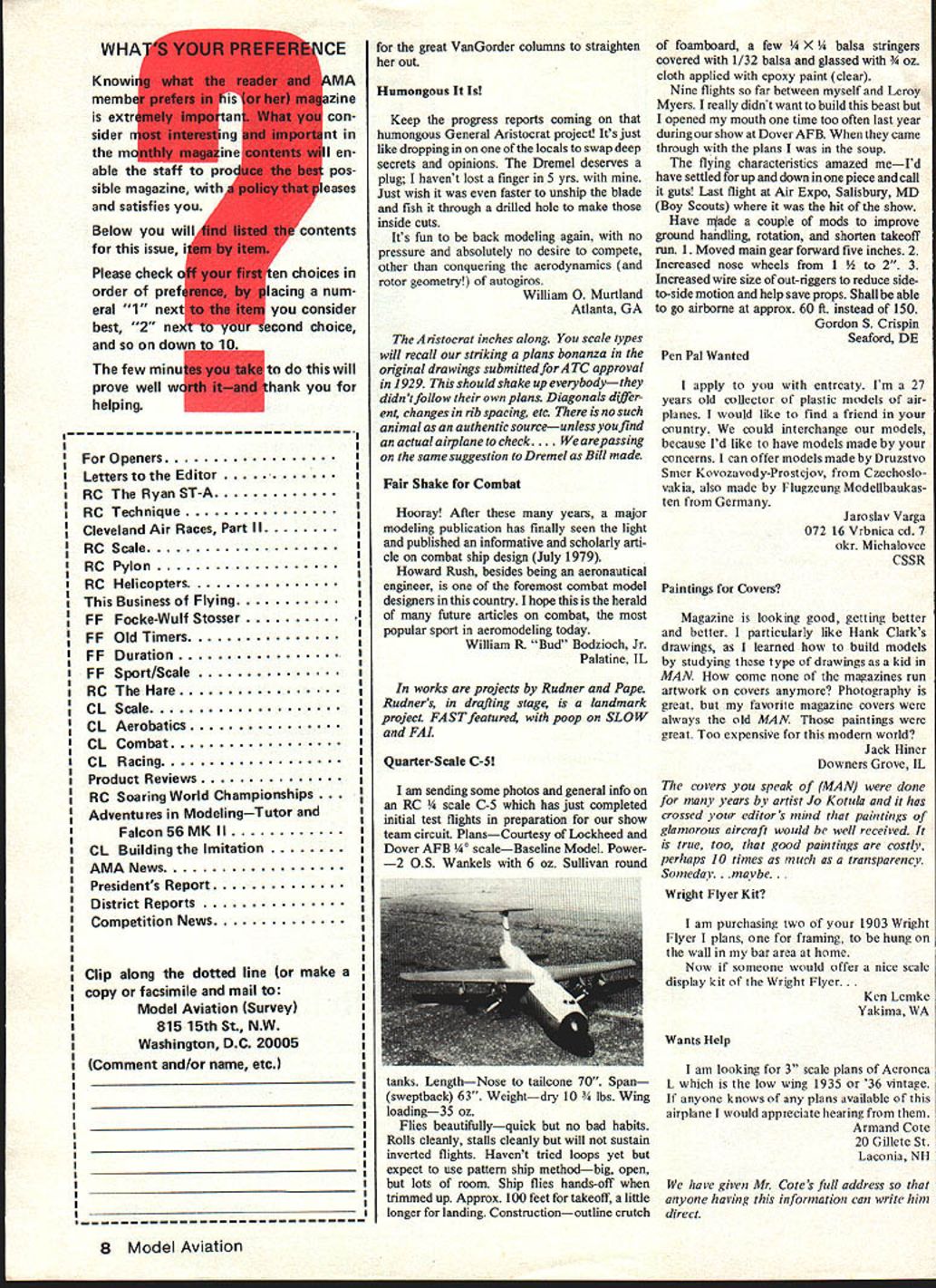
I am sending some photos and general info on an RC 1/4-scale C-5 which has just completed initial test flights in preparation for our show team circuit.
Plans — Courtesy of Lockheed and Dover AFB. 1/4" scale — Baseline model. Power — 2 O.S. Wankels with 6 oz. Sullivan round tanks. Length — Nose to tailcone: 70". Span — (sweptback): 63". Weight — dry: 10 3/4 lbs. Wing loading — 35 oz.
Flies beautifully—quick but no bad habits. Rolls cleanly, stalls cleanly but will not sustain inverted flights. Haven't tried loops yet but expect to use pattern-ship method—big, open, but lots of room. Ship flies hands-off when trimmed up. Approx. 100 feet for takeoff, a little longer for landing.
Construction — outline crutch of foamboard, a few 1/4" x 1/4" balsa stringers covered with 1/32" balsa and glassed with 1/2 oz. cloth applied with epoxy paint (clear).
Nine flights so far between myself and Leroy Myers. I really didn't want to build this beast but I opened my mouth one time too often last year during our show at Dover AFB. When they came through with the plans I was in the soup.
The flying characteristics amazed me—I'd have settled for up and down in one piece and called it quits! Last flight at Air Expo, Salisbury, MD (Boy Scouts) where it was the hit of the show.
Have made a couple of mods to improve ground handling, rotation, and shorten takeoff run:
- Moved main gear forward five inches.
- Increased nose wheels from 1 1/2" to 2".
- Increased wire size of out-riggers to reduce side-to-side motion and help save props.
Shall be able to go airborne at approx. 60 ft. instead of 150.
Gordon S. Crispin Seaford, DE
Pen Pal Wanted
I apply to you with entreaty. I'm a 27-years-old collector of plastic models of airplanes. I would like to find a friend in your country. We could interchange our models, because I'd like to have models made by your concerns. I can offer models made by Druzstvo Smer Kovozavody–Prostejov, from Czechoslovakia, also made by Flugzeug Modellbaukasten from Germany.
Jaroslav Varga 072 16 Vrbnica od. 7 okr. Michalovce CSSR
Paintings for Covers?
Magazine is looking good, getting better and better. I particularly like Hank Clark's drawings, as I learned how to build models by studying those type of drawings as a kid in MAN. How come none of the magazines run artwork on covers anymore? Photography is great, but my favorite magazine covers were always the old MAN. Those paintings were great. Too expensive for this modern world?
Jack Hiner Downers Grove, IL
The covers you speak of (MAN) were done for many years by artist Jo Kotula and it has crossed our editors' minds that paintings of glamorous aircraft would be well received. It is true, too, that good paintings are costly, perhaps 10 times as much as a transparency. Someday... maybe...
Wright Flyer Kit?
I am purchasing two of your 1903 Wright Flyer I plans, one for framing, to be hung on the wall in my bar area at home.
Now if someone would offer a nice scale display kit of the Wright Flyer...
Ken Lemke Yakima, WA
Wants Help
I am looking for 3" scale plans of Aeronca L which is the low-wing 1935 or '36 vintage. If anyone knows of any plans available of this airplane I would appreciate hearing from them.
Armand Cote 20 Gillette St. Laconia, N.H.
We have given Mr. Cote's full address so that anyone having this information can write him direct.
Transcribed from original scans by AI. Minor OCR errors may remain.

