
Letters to the Editor
Prompted by Modeling
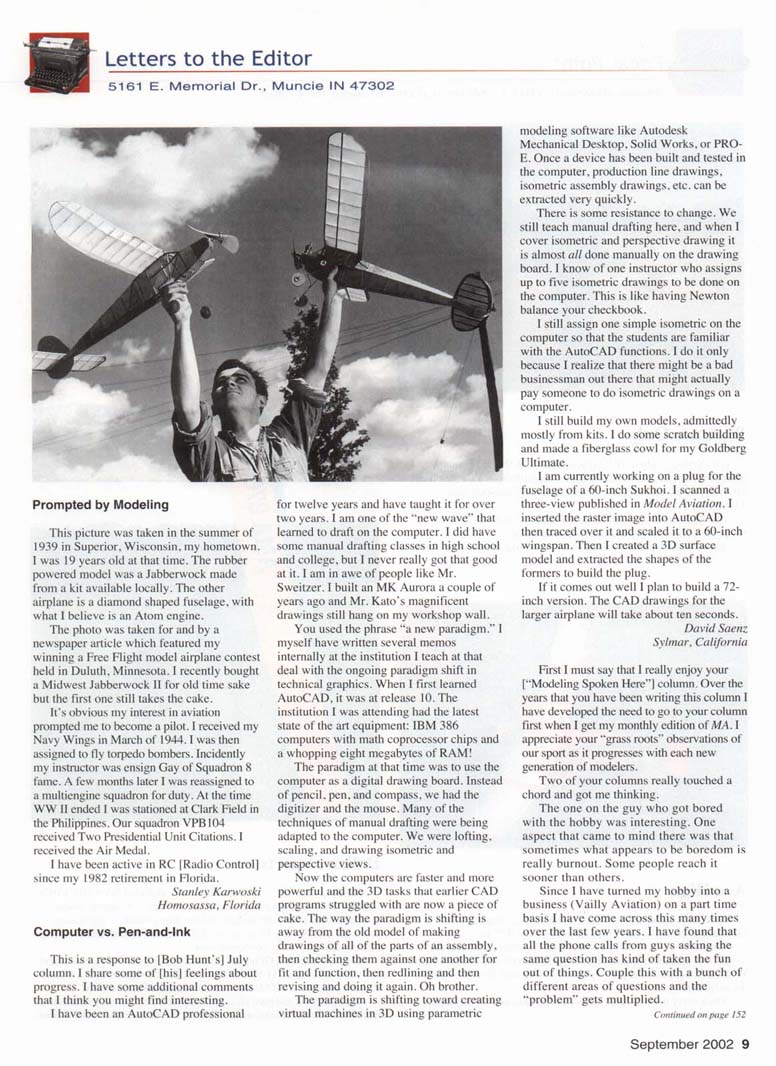
This picture was taken in the summer of 1939 in Superior, Wisconsin, my hometown. I was 19 years of age at that time. The rubber-powered model was a Jabberwock made from a kit available locally. The other airplane is a diamond-shaped fuselage with what I believe is an Atom engine.
The photo was taken for and by a newspaper article that featured my winning a Free Flight model airplane contest held in Duluth, Minnesota. I recently bought a Midwest Jabberwock II for old times’ sake, but the first one still takes the cake.
It's obvious my interest in aviation prompted me to become a pilot. I received my Navy wings in March of 1944. I was then assigned to fly torpedo bombers. Incidentally, my instructor was Ensign Gay of squadron-8 fame. A few months later I was reassigned to a multi-engine squadron for duty. At the time WWII ended I was stationed at Clark Field in the Philippines. Our squadron, VPB-104, received two Presidential Unit Citations. I received the Air Medal.
I have been active in RC (radio control) since my 1982 retirement in Florida.
Stanley Karwoski Homosassa, Florida
Computer vs. Pen-and-Ink
This is a response to Bob Hunt’s July column. I share some of his feelings about progress and have a few additional comments that I think you might find interesting.
I have been an AutoCAD professional for twelve years and have taught it for over two years. I am one of the "new wave" who learned to draft on the computer. I did have some manual drafting classes in high school and college, but I never really got that good at it. I am in awe of people like Mr. Sweitzer. I built an MK Aurora a couple of years ago and Mr. Kato's magnificent drawings still hang on my workshop wall.
You used the phrase "a new paradigm." I have written several memos at the institution where I teach about the ongoing paradigm shift in technical graphics. When I first learned AutoCAD, it was at Release 10. The institution I was attending had the latest state-of-the-art equipment: IBM 386 computers with math coprocessor chips and a whopping eight megabytes of RAM! The paradigm at that time was to use the computer as a digital drawing board. Instead of pencil, pen, and compass, we had the digitizer and the mouse. Many manual drafting techniques were being adapted to the computer. We were lofting, scaling, and drawing isometric and perspective views. Now the computers are faster and more powerful, and the 3-D tasks that earlier CAD programs struggled with are now a piece of cake.
The paradigm is shifting away from the old model of making drawings of all the parts of an assembly, checking them against one another for fit and function, redlining, revising, and repeating. The paradigm is shifting toward creating virtual machines in 3-D using parametric modeling software like Autodesk Mechanical Desktop, SolidWorks, or Pro/E. Once a device has been built and tested in the computer, production drawings, isometric assembly drawings, etc., can be extracted very quickly.
There is some resistance to change. We still teach manual drafting here, and when I cover isometric and perspective drawing it is almost all done manually on the drawing board. I know one instructor who assigns up to five isometric drawings to be done on the computer. This is like having Newton balance your checkbook.
I still assign one simple isometric on the computer so students are familiar with AutoCAD functions. I do it only because I realize that there might be a businessman out there who would actually pay someone to do isometric drawings on a computer.
I still build my own models, admittedly mostly from kits. I do some scratch building and made a fiberglass cowl for my Goldberg Ultimate. I am currently working on a plug for the fuselage of a 60-inch Sukhoi. I scanned a three-view published in Model Aviation, inserted the raster image into AutoCAD, then traced over it. I enjoy the creative side of it. But then the business side sets in and the menial tasks sometimes take over. This causes a loss of enthusiasm for sure. So much so that in some cases I have stopped going to fly-ins and contests just to stay away from all the questions. I'd rather spend the afternoon with my buddies at our own field and simply enjoy the day.
How does one cope with "burnout"? Tough question that sometimes needs drastic answers. I have chosen to get back into car restoration. Here is a hobby I can do by myself in the peace and quiet of the garage where no one knows me.
Don't get me wrong: I still model a lot, I still run the business, and I still go to contests, but not like I used to. The hobby has become too much like work and the enjoyment has been watered down a bit. I know I'll get back to it sometime soon as I have been modeling for over 45 years now. But for now I feel I need a vacation from the "public." I often wonder if other top designers have experienced the same thing.
Your other article that was very interesting was the latest on hand-drawn vs. CAD-generated plans. I draw all my model plans by hand. I love the feel of the pencil as it "lays down lead." It is almost like you can feel the creative juices flowing from your brain down your arm and out the pencil. I love to draw. I also like to put my own personality into the drawing. CAD drawings have no personality. They are relatively "cold."
Now don't get me wrong: there is nothing wrong with CAD when used in the right places and context. In my day job I head up a design group where we use a variety of CAD packages. We do all sorts of mechanical, electrical, and optical designs on some really high-powered CAD systems. We use different systems depending on the task at hand.
One thing I have seen in the 30+ years I've been in the aerospace industry is that many of the new CAD designers have very little experience in how to make a part. With this lack of experience come very difficult—almost unmakable—designs. These CAD designers also have no "feel" for sizes, as everything is just an image on the screen.
A pen-and-ink drafter has the advantage of seeing things in the proper scale. He "feels" the design. I am constantly amazed at some of the comments from my designers when I show them a finished part in the flesh. They all say, "So that is what it looks like." "Didn't you design this thing?" I ask. "Yeah, but I wasn't sure how big it would be," is the response I get. Scary. This is a long-time problem in our industry today.
Periodically I run courses to show the guys how to "design for manufacturing" and even teach some old manual drafting techniques just to show them the roots of the industry.
Seems there will be fewer and fewer hand-drawn designs coming our way. But me, I'll continue to "spread lead" the old-fashioned way. It's more fun.
MA Roy Vaillancourt Syosset, New York
Transcribed from original scans by AI. Minor OCR errors may remain.

