
Letters to the Editor
All letters will be carefully considered; those of general interest will be used. Send to Model Aviation, 815 15th St., N.W., Washington, D.C. 20005.
Sky Pilot Speaks
Magnifique! I refer to the outstanding successive September/October issues of Model Aviation. In my humble opinion they have exceeded anything yet published on this special kind of craziness we call modeling.
My particular area of interest is in C/L precision aerobatics. So, naturally, Ted Fancher's illuminating and informative treatise on the design of the Imitation was a real highlight. But speaking of doubling your pleasure... imagine, after waiting impatiently for Part II of Ted's article, flipping open the magazine to find another gem in Bob Harrah's experiences with Top Flite's Tutor. And that color photography is out of this world! Like frosting on a cake!
Although I've stated my main attraction to the hobby, I am nevertheless intrigued by all aspects of our sport. I'm developing a minor passion about C/L scale, and have been trying and experiencing the thrill of 3-line throttle control on a couple of basic sport-biplane types. (One of my "next" projects will pursue this new interest.) So, I find a wealth of knowledge and experience available to me by avidly reading all the articles in Model Aviation on all facets of the hobby. It's all useful to each of us in some way, regardless of area of interest.
As a personal note, I was the founder of The Wire Flyers, an AMA-chartered club in Sylvania, Ohio. Last year my family and I moved to Kentucky, where I am pursuing my Master of Divinity degree from Lexington Theological Seminary. I serve as Student Pastor for our church here in Cave City (near Mammoth Cave), and make a weekly trip to Lexington to fulfill my studies. Needless to say, my modeling activities have been greatly curtailed as a result of these priorities. But I still keep a hand in by giving an occasional flying demonstration (i.e., Bible school, grade school classes, Boy Scouts, etc.). And I look forward to the time when I can make balsa chips and paint spray fly again! However, for now I have my hands full in following the plans that the "Man Upstairs" has laid down for me. And I do that gladly!
I also want to express my appreciation for your highly informative Adventures in Modeling. The We-Fly Lab is an outstanding perspective of modeling concerns. Bob Harrah's efforts in helping the young boy with his free-flight (August issue) is what it is all about. It would be impossible to number the times a "Bob Harrah" has helped and kept a youngster from suffering defeat out of his frustration and lack of know-how. That kind of willingness to share is truly among the greatest of modeling's generous benefits. The rewards are vivid and long-lasting. Thank you for allowing Model Aviation to be about "people" instead of just "things."
I would enjoy corresponding with anyone who would like to share their stunt and/or scale modeling knowledge and experience.
W. Frank Hibbard 334 North Dixie Hwy. Cave City, KY 42127
Editor: We are delighted to include this fine letter.
"This Business of Flying"
I would like to make comment, and also to make a recommendation, concerning the article "This Business of Flying," by Tom Burdin.
First of all, I believe it to be the most complete and thorough writing of its kind that I have ever seen. I would like to suggest that you forward a suggestion to whomever would have jurisdiction over the matter, that the AMA publish, issue, or sell pamphlets for students and instructors of this article. Also, that pads of the FLI Student Progress Chart be made available through the AMA supply system.
It would certainly behoove those that make decisions within the AMA headquarters to consider the above suggestion. I believe that in the long run, it would add to the safety records, and be a tremendous boon to the individual.
Richard G. Wyckoff Kingston, WA
Editor: Model Aviation has received other similar requests. The matter is being looked into.
Some Quarter Scale
The photograph of Mr. Crispin's C-5A (page 8, Oct. '79) displays a true accomplishment. It is a beautiful and distinctive model.
I question, though, if the title writer's calculator batteries are fully charged: 1/2" = 1' is not the same as 3" = 12". I don't want to diminish Mr. Crispin's accomplishment but a true quarter-scale C-5 is pushing the big model rules just a shade. Would be interesting to judge, though; the stand-off scale circle would allow the judges to lay on the flight deck and look down into the cargo hold.
Paul R. Proefrock Wellington, KY
Editor: Having done one of those terrible double-takes upon seeing the magazine in print, we were prepared for a barrage of "Dear Sir, You dope" letters. There were three. Evidently, there is a slight difference between 1/40 scale and 1/48 scale. We'd like to blame it on the typographicals, but can only think of those little "TV" scrubbing-brush guys who go down the drain after scooting and grouting the muck. Substitute the staff's usual police for those characters with scissors and paste pots flying about, and you know the "pilot error" is quite easily explained. Mr. Crispin checked in, so we'll give you his comments below. Since C-5 1/40 scale is bigger than 1/48 scale, we will not be printing full-size plans. Sorry. For everything.
Gordon S. Crispin — C-5A
Enjoyed seeing my C-5 in the Letters to the Editor, October '79.
Small error in the caption and letter body—the ship is a 1/40th scale not 1/4 scale. At 1/4 scale the wing would be 50 feet long.
The mods improved takeoff run greatly but it must be eased off now or the tail section will strike the ground. Once clear you can ease back for a good climb out.
Again thanks for publishing the photo of my beast—gave me a helluva ego.
Gordon S. Crispin Seaford, DE
The Versatile Falcon
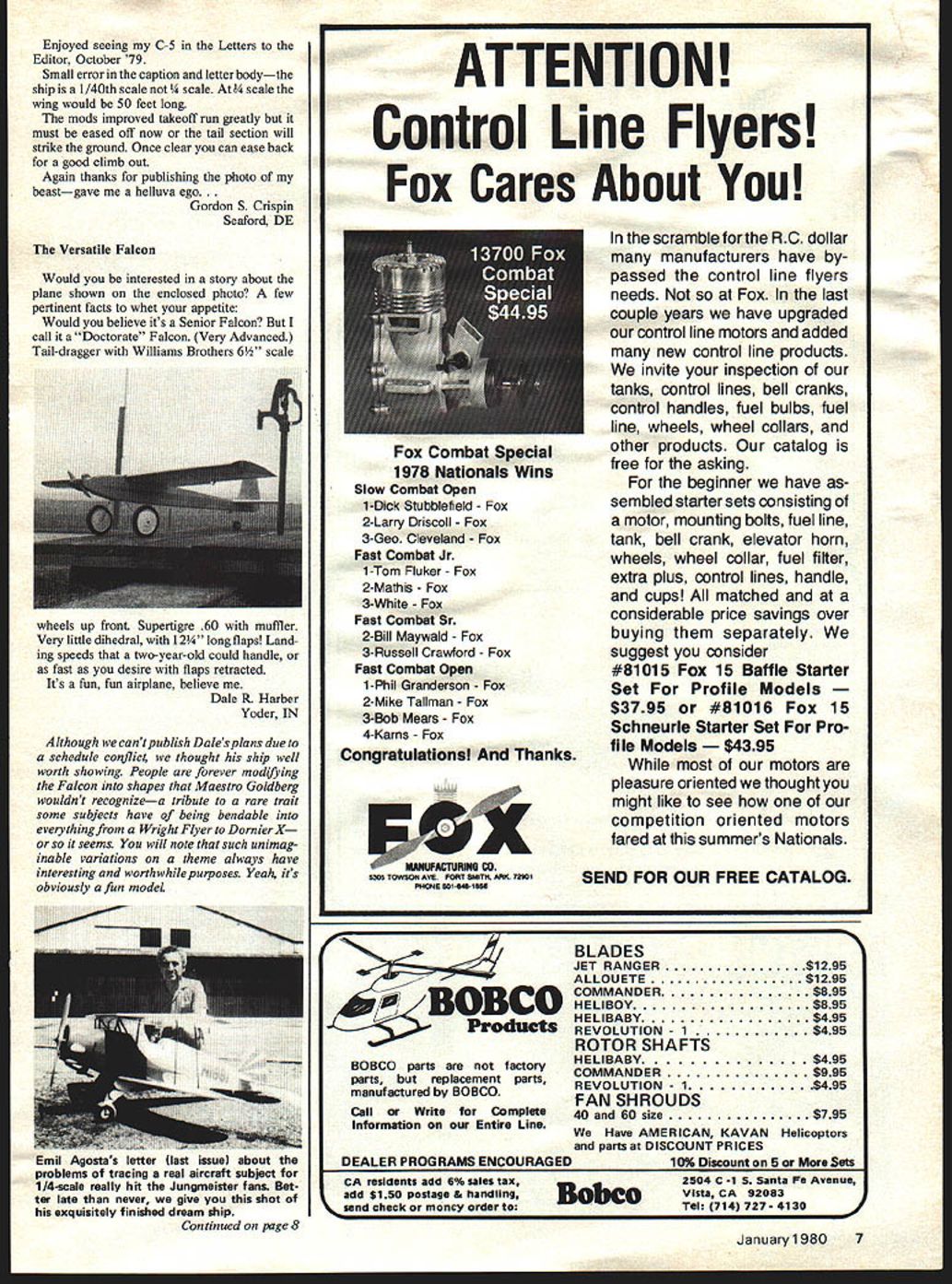
Would you be interested in a story about the plane shown on the enclosed photo? A few pertinent facts to whet your appetite:
Would you believe it's a Senior Falcon? But I call it a "Doctorate" Falcon. (Very advanced.) Tail-dragger with Williams Brothers 6-1/2" scale wheels up front. Supertigre .60 with muffler. Very little dihedral, with 1 1/2" long flaps! Landing speeds that a two-year-old could handle, or as fast as you desire with flaps retracted.
It's a fun, fun airplane, believe me.
Dale R. Harber Yoder, IN
Editor: Although we can't publish Dale's plans due to a schedule conflict, we thought his ship well worth showing. People are forever modifying the Falcon into shapes that Maestro Goldberg wouldn't recognize—a tribute to a rare trait some subjects have of being bendable into everything from a Wright Flyer to Dornier X—or so it seems. You will note that such unimaginable variations on a theme always have interesting and worthwhile purposes. Yeah, it's obviously a fun model.
Move Over Guys!
Now that women are stepping up and being seen and heard in all kinds of jobs and sports, I want to speak up for women in RC. I am sure there are more women fliers that are not known about. And ladies, I say if we can't lick them (which we can't), join them!
When I first started saying that I was going to learn to fly, I don't think I really meant it. But my husband called my bluff. He ordered a Falcon 56 for me and I immediately began to build it. Gosh, it was really fun! I spent every free minute downstairs gluing and sanding. Of course, I had his full support and he coached me, which made it real easy to build. I must say that the experience of building was good for me as I learned a lot.
My husband is the kind of person that anything done is worth doing right. He was very strict that I used plenty of glue and reinforcement and got the rudder and stabilizer straight. He assembled the radio and engine and covered it with MonoKote.
I started building it Aug. 7 and on Sept. 14 was the big day to try it out. It flew like a dream! And, fortunately, we had beautiful fall weather. I was so proud when I could take it home without a scratch. I began counting the flights which were something like 20. But I had been staying high and slow so I had time to recover from mistakes. I was getting more confident and as I made a right turn coming toward me, I gave it the wrong control. My husband grabbed the controls, but it was too late and it was down behind the trees. Everything happens so fast when you are in trouble. I just knew it would be in a million pieces. But that's the time when a good job of building pays off. It wasn't damaged bad at all. We started repairing it and had it ready to fly the next day.
I began my takeoffs. I found that taxiing on the ground was harder than it looked — to keep it straight on the runway until I had enough speed to lift off. Then I had a tendency to pull it all the way. Some of my takeoffs were almost straight up.
Well, the ground met it once again and damaged the wing. A friend was also learning to fly with a 56 Falcon. He had an extra wing that someone had given him. He was generous and said, "Why don't I use it until I get mine repaired?" That was a real Godsend, since I didn't want to waste the few beautiful days we had before it would be too cold.
I flew several days and one morning there were three of us learners. We would fly high and it was a challenge to compete, trying different maneuvers. I got mine inverted and when I came out of it I was confused and handed the radio to my husband. Just as he took it, I saw the wing falling and the fuselage coming straight down. The wing had completely come apart at the spars because it had not been glued. This ruined the carburetor on the engine and we had to send the servos in for repair. But again a good job of building saved the fuselage and I was able to repair and had my original wing repaired. It's like new again waiting for spring.
We learned a valuable but expensive lesson in accepting the wing. It isn't a good idea to use something unless you know their work or can check it out really well.
Well, here it is almost a year later and I'm still flying my Falcon 56. A few more crashes but still having fun. I haven't learned to land yet, but I like to try loops and rolls. I stay high enough to stay safe. I may never learn to be a pro, but it's fun. So I say try it, ladies — you will like it.
Nancy Tenary Canton, MI
(continued from page 8)
Likes Half-A Scale
Just a few lines to let you know that I think your choice of construction projects is excellent. I was particularly impressed with the Wildcat (do Bowers and Srull have any more of these around?) and the B-25 in the March issue. I would like to encourage you to publish additional Frank Baker multi-part projects. The A-26 looks very interesting.
J. C. Sloane East Hanover, NJ
Editor: Alas, J.C., we don't. But we've got one in the works. Hurst is cooking up a Lockheed Air Express.
This Goes on All the Time
I have always thought (as I'm sure many have) that it would be fun to someday sit down and design my own airplane. However, the more I ponder it, the more I realize how really little I know about what makes an airplane work. I understand how the wing causes lift, but that's about it. I'm sure that there's a lot of formulas and stuff. I read in your magazine a lot of words I don't understand. One being "wing loading," and so on.
Now I realize that this is something that may have been gone over a hundred times in your magazine, but I'm kind of new to all this. So what I'm asking is if you could recommend a book or something that might help an ordinary guy like me to understand it.
Jeff Rankin Reasnor, IA
Editor: There are many good books on aircraft design, but precious few on model airplane design. RCM regularly advertises a series of excellent books relating to RC model design, and we suggest all interested readers check that magazine. We asked Bill Hannan to recommend some titles on aircraft design—for Mr. Rankin—since Bill is deep into books and stuff. In fact, during 1980 we will publish Bill's coverage of all model books ever printed—there are hundreds.
Plans for the Waterman?
Do you know if plans are available for a Waterman Aeromobile? I am not sure of the spelling of Aeromobile, as it was back in the '30s when the aircraft was built.
I will appreciate any information on this.
Ferrell Stephens Gadsden, AL
Editor: Waldo Waterman was one of the most innovative designers during the 1920s and early '30s. His Aeromobile was designed for a CAA-conducted safety-design competition shortly after 1930. It was a sweptback cabin pusher, with big twin fin rudders. Plans appeared in a back issue of the Aviation Historical Album, published by Paul Matt, P.O. Box 33, Temple City, CA 91780. Matt has been producing these books for many years, and they are outstanding by world standards, with excellent drawings of a vast number of aircraft.
Can You Help?
I am looking for a set of plans for a U/C Sterling Skylark Kit S27, wingspan 52½", length 40", engine .35. Can you help me?
George A. Rawson 136 Delancey Dr. Pittsburgh, PA 15235
For Jerry and His Kids
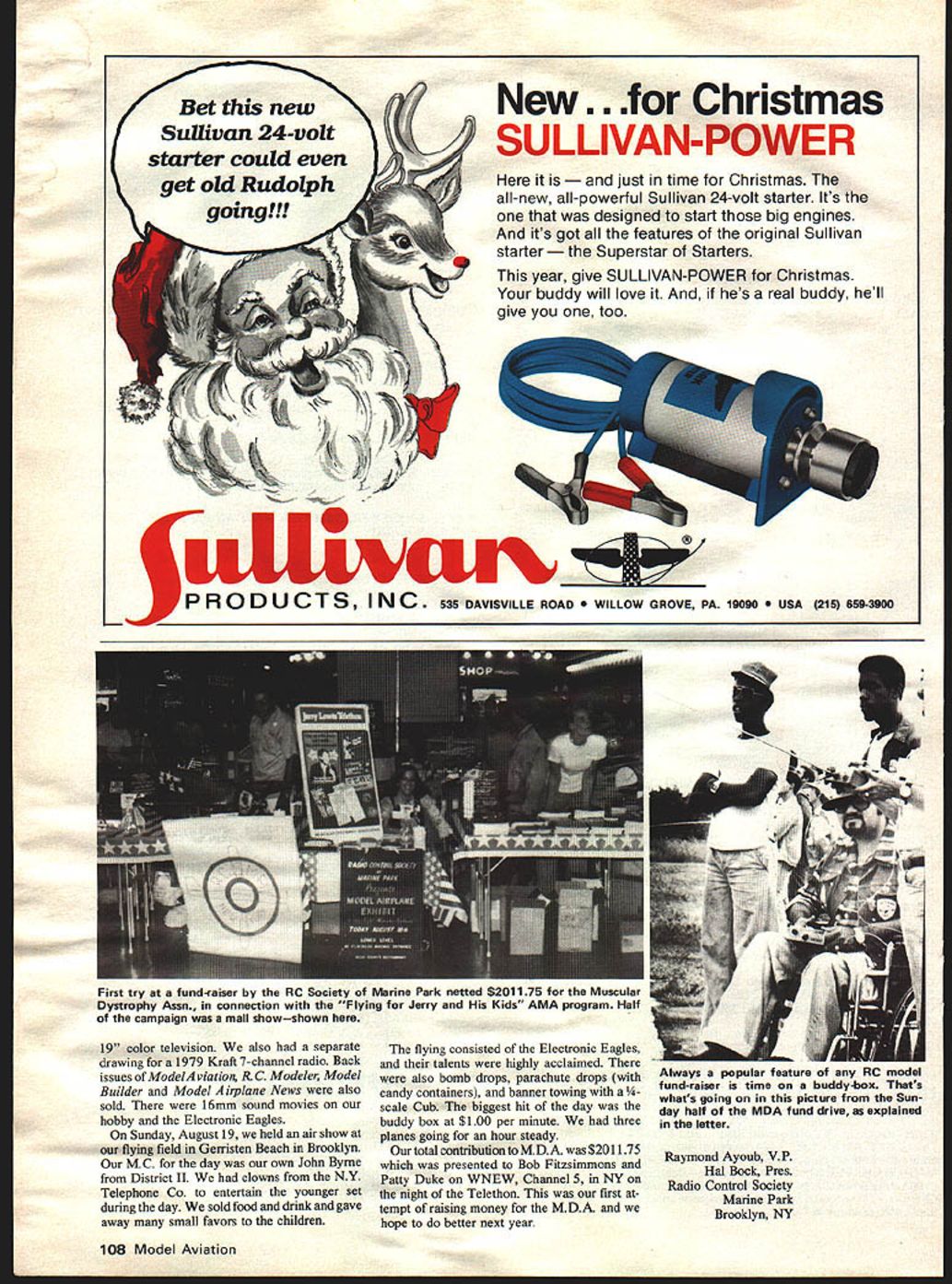
In regard to the AMA's program of "Flying for Jerry and His Kids," we thought you would be interested in what our club did on behalf of Muscular Dystrophy.
We have about 75 members and we were the only club in the New York area to stage a drive to raise money for the M.D.A.
On Saturday, August 18, we held a static display of about 30 aircraft at the King's Plaza Shopping Mall in Brooklyn, NY. At this display we sold stickers, balloons and we had a raffle; prizes were donated or purchased. Our grand prize was a 19" color television. We also had a separate drawing for a 1979 Kraft 7-channel radio. Back issues of Model Aviation, R.C. Modeler, Model Builder and Model Airplane News were also sold. There were 16mm sound movies on our hobby and the Electronic Eagles.
On Sunday, August 19, we held an air show at our flying field in Gerritsen Beach in Brooklyn. Our M.C. for the day was our own John Byrne from District II. We had clowns from the N.Y. Telephone Co. to entertain the younger set during the day. We sold food and drink and gave away many small favors to the children.
The flying consisted of the Electronic Eagles, and their talents were highly acclaimed. There were also bomb drops, parachute drops (with candy containers), and banner towing with a 1/4-scale Cub. The biggest hit of the day was the buddy box at $1.00 per minute. We had three planes going for an hour steady.
Our total contribution to M.D.A. was $2,011.75 which was presented to Bob Fitzsimmons and Patty Duke on WNEW, Channel 5, in NY on the night of the Telethon. This was our first attempt at raising money for the M.D.A. and we hope to do better next year.
Raymond Ayoub, V.P. Hal Bock, Pres. Radio Control Society Marine Park Brooklyn, NY
Editor: Always a popular feature of any RC model fund-raiser is time on a buddy box. That's what's going on in this picture from the Sunday half of the MDA fund drive, as explained in the letter.
Transcribed from original scans by AI. Minor OCR errors may remain.

