

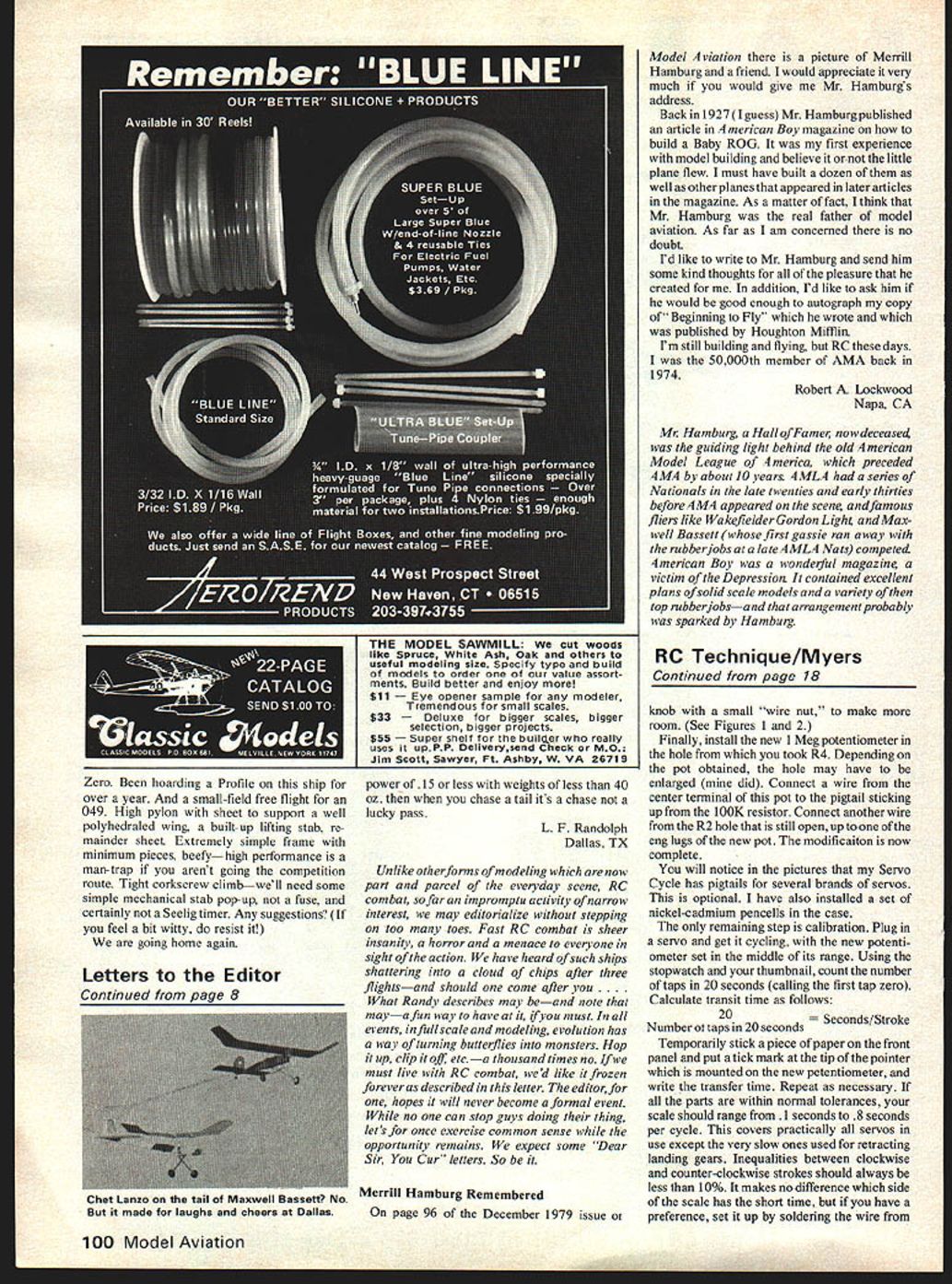
Letters to the Editor
All letters will be carefully considered; those of general interest will be used. Send to Model Aviation, 815 15th St., N.W., Washington, D.C. 20005.
Spooky Spook
In 1978 I cracked up the model that I had been flying in our club's sport pylon races. Having the model shown in the photo already built, using a DeBolt wing with ailerons built in and the dihedral reduced to make them more effective, I decided to use it in the next week's race.
When first flying this model a couple of years before, I found that the ailerons were very ineffective, but it was the only whole aircraft I had at the time. Knowing that during the late '20s real aircraft changed to the Frise-type aileron for the same reason, I decided to improve its bad habits by doing something short of completely rebuilding them.
The "collectors" shown in the photo were the solution and the ailerons are now super sensitive. Its snap rolls are very fast. The fuselage has now been lengthened for better takeoff and its vertical fin area decreased for spins. Spook now rounds pylons in style.
These collectors are only effective if the gap between them and the aileron is small. Also, the collector itself is an inverted airfoil shape, the leading edge of which is placed as far forward as possible without hampering the aileron's down movement. What this does is equalize the drag of the down aileron by the leading edge of the collector; on the other aileron coming down, it scoops air to be jetted up between the aileron and collector.
Also, in this action, the down aileron–collector forward gap is closed to minimize the drag.
Spook got its name from these first spooky flights. I am now completely revamping it with a symmetrical airfoil and Frise-type ailerons. The wing will greatly improve its speed while the Frise-type ailerons should be as effective as those described here. One can learn much by experimenting with an ornery model—just don't give up, providing you can keep it in one piece long enough.
George H. Clapp Central Square, NY
Oh Well, We Tried
Just a short note from a small town in Kansas to cover several items. Your January "For Openers" contains some suggestions on bringing newcomers into our sport. Perhaps my experience in this area could be helpful to others. I tried your suggestion of inviting interested people to fly one of my airplanes. I put a stack of the enclosed flyers on the counter of the local hobby shop; they all eventually disappeared but I only got one call. I'm obviously not an advertising executive, but I had hoped for a better response than that.
Several of the local fliers discussed this lack of response and surmised that the problem might be the reluctance of a beginner to telephone a complete stranger and effectively say, "I'd like to drive your $300 to $400 airplane around the sky." I now think that better results could be attained if the hobby dealer, or some individual where your advertising is posted, would take the name and phone number of the interested beginner; tell him/her that an experienced instructor would be in touch; and pass the beginner's name to that flier. The experienced flier could then initiate contact. Perhaps this approach would better break the ice.
I am somewhat of a perfectionist—aren't we all—and the photo at the top of page 28 of January's issue bothered me. At least two of the safety items mentioned in Mr. Preston's "Safety Comes First" column are being violated.
Chuck Snyder Coffeyville, KS
MA appreciates thoughtful inputs like this one. Should anyone try Mr. Snyder's suggested approach of helping the newcomer, we'd appreciate being briefed on the outcome. As to that picture which worries Mr. Snyder, we suppose the concern is the implication of the possible attributes of an aircraft to such an engine. Big airplanes are here to stay, but it would appear beneficial if we all sought to be conscious of the point of discretion in all the things we build: how big, how fast, where we fly them—this refers to a wide spectrum of types, not just RC biggies. Put it this way—always consider fellow fliers' welfare; each affects the other(s).
Slow, Slow (RC) Combat
I thought you might get a kick out of the enclosed photo; the quality is not good but you can get the idea. These are two Dragonflys, built from Model Builder plans, with 30-foot crepe-paper streamers attached and they are in combat. These airplanes are two fox-trotters powered by 1.5 non-hot engines; straight down they won't go 30 mph.
After watching the flying with RC combat airplanes scatter themselves all over the flying field like anti-tank missiles, the sight of these overgrown ROGs, locked in mortal combat, is a thing of beauty. Seldom are they over 30 feet from each other and they can fight just as well at 10 feet altitude as at a hundred without fear of destruction to life and property; speeds range from 30 mph all the way down to almost zero. Fun, fun, fun to watch, and more fun to fly.
It seems like a good idea to limit combat flying to airplanes of 700 sq. in., wing area or more and...
(Editor's note) Unlike other forms of modeling which are now part and parcel of the everyday scene, RC combat, so far an impromptu activity of narrow interest, allows us to editorialize without stepping on too many toes. Fast RC combat is sheer insanity, a horror and a menace to everyone in sight of the action. We have heard of such ships shattering into a cloud of chips after three flights—and should one come after you...
What Randy describes may be—and I note that may be—a fun way to have at it, if you must. In all events, in full scale and modeling, evolution has a way of turning butterflies into monsters. Hop it up, clip it off, etc.—a thousand times no. If you must live with RC combat, we'd like it frozen forever as described in this letter. The editor, for one, hopes it will never become a formal event. While no one can stop guys doing their thing, let's for once exercise common sense while the opportunity remains. We expect some "Dear Sir, You Cur" letters. So be it.
Zero.
Been hoarding a profile on this ship for over a year. And a small-field free flight for an .049. High pylon with sheet to support a well-polyhedral wing, a built-up lifting stab, remainder sheet. Extremely simple frame with minimum pieces, beefy—high performance is a man-trap if you aren't going the competition route. Tight corkscrew climb—we'll need some simple mechanical stab pop-up, not a fuse, and certainly not a Selig timer. Any suggestions? (If you feel a bit witty, do resist it!)
We are going home again.
Power of .15 or less with weights of less than 40 oz.; then, when you chase a tail it's a chase, not a lucky pass.
L. F. Randolph Dallas, TX
Merrill Hamburg Remembered
On page 96 of the December 1979 issue of Model Aviation there is a picture of Merrill Hamburg and a friend. I would appreciate it very much if you would give me Mr. Hamburg's address.
Back in 1927 (I guess) Mr. Hamburg published an article in American Boy magazine on how to build a Baby ROG. It was my first experience with model building and, believe it or not, the little plane flew. I must have built a dozen of them as well as other planes that appeared in later articles in the magazine. As a matter of fact, I think that Mr. Hamburg was the real father of model aviation. As far as I am concerned there is no doubt.
I'd like to write to Mr. Hamburg and send him some kind thoughts for all of the pleasure that he created for me. In addition, I'd like to ask him if he would be good enough to autograph my copy of Beginning to Fly which he wrote and which was published by Houghton Mifflin.
I'm still building and flying, but RC these days. I was the 50,000th member of AMA back in 1974.
Robert A. Lockwood Napa, CA
Mr. Hamburg, a Hall of Famer, is now deceased. He was the guiding light behind the old American Model League of America (AMLA), which preceded AMA by about ten years. AMLA had a series of Nationals in the late twenties and early thirties before AMA appeared on the scene, and famous fliers like Wakefielder Gordon Light and Maxwell Bassett (whose first gas job ran away with the rubber jobs at a late AMLA Nats) competed. American Boy was a wonderful magazine, a victim of the Depression. It contained excellent plans of solid scale models and a variety of then-top rubber jobs—and that arrangement probably was sparked by Hamburg.
Transcribed from original scans by AI. Minor OCR errors may remain.

