
Letters to the Editor
Aero Sled
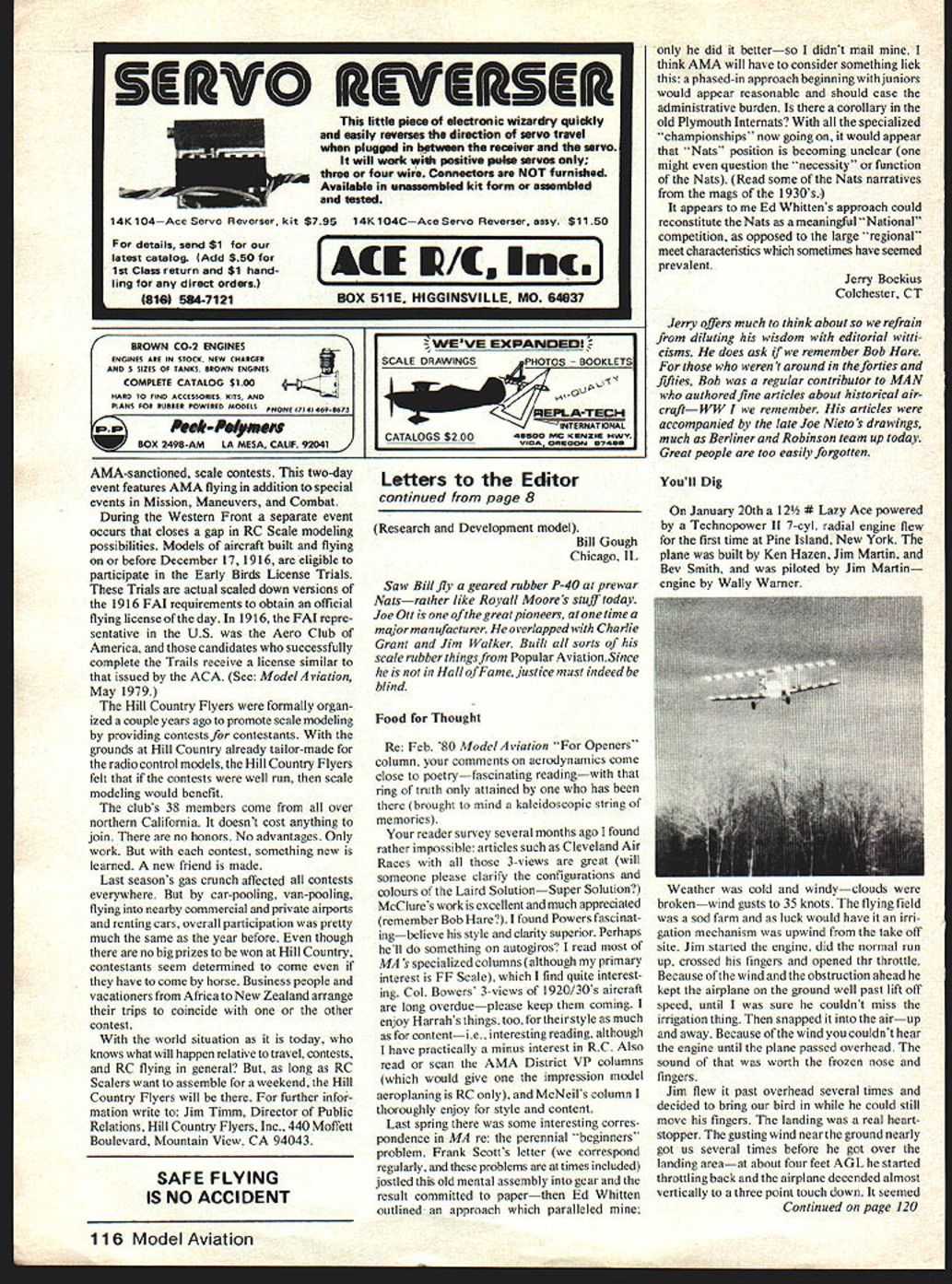
My experimental twin pusher model is named "Aero Sled." The idea was a twin, easy to build; good climb, not much glide. Also to use no dihedral. That seemed logical because of opposite-rotation propellers—no one-sided torque problem. I am very pleased with the results so far (although the model is small). Powered on two strands of 3/16" flat rubber per prop; double that for a high climb.
The thought was to come up with a twin pusher different than any in past years. It seems this design is it. Also the fuselage sticks are in line with the flight to reduce frontal-area drag.
I have been building models 55 years and have time now to enjoy this wonderful, artistic, and inventive hobby more than ever (started in 1925). My first instructor was Frank Nekimkin (I was eight at the time). He was one of the most expert at the time. Then Carl Goldberg and Don Lockwood of the Illinois Model Aero Club.
The twin Aero Sled's balance is simple: glide flat; use clay weight on the front or back planes to balance. The model glides beautifully on less power and smaller props. Long and smooth.
Enclosed is a picture of my indoor-outdoor Fokker D-8. A nice, smooth flier (made from an old Cleveland plan). It now hangs in a dentist's office to amuse child patients. I wish all my models had a nice spot like that.
See Joe Ott often. He is 80 now. Enclosed is a picture of a "Tandem" model I've made for him. (Research and development model.)
Bill Gough Chicago, IL
Saw Bill fly a geared rubber P-40 at prewar Nats—rather like Royall Moore's stuff today. Joe Ott is one of the great pioneers, at one time a major manufacturer. He overlapped with Charlie Grant and Jim Walker. Built all sorts of his scale rubber things from Popular Aviation. Since he is not in the Hall of Fame, justice must indeed be blind.
Food for Thought
Re: Feb. '80 Model Aviation "For Openers" column — your comments on aerodynamics come close to poetry; fascinating reading, with that ring of truth only attained by one who has been there (brought to mind a kaleidoscopic string of memories).
Your reader survey several months ago I found rather impossible; articles such as "Cleveland Air Races" with all those 3-views are great (will someone please clarify the configurations and colors of the Laird Solution—Super Solution?). McClure's work is excellent and much appreciated (remember Bob Hare?). I found Powers fascinating—believe his style and clarity superior. Perhaps he'll do something on autogiros. I read most of MA's specialized columns (although my primary interest is free flight scale) and find them quite interesting. Col. Bowers' 3-views of 1920s/30s aircraft are long overdue—please keep them coming. I enjoy Harrah's pieces for their style as much as for content—i.e., interesting reading, although I have practically no interest in RC. I also read or scan the AMA District VP columns (which would give one the impression model aeroplaning is RC only), and McNeil's column I thoroughly enjoy for style and content.
Last spring there was some interesting correspondence in MA regarding the perennial "beginners" problem. Frank Scott's letter (we correspond regularly, and these problems are at times included) jostled this old mental assembly into a gear and the result committed to paper—then Ed Whitten outlined an approach which paralleled mine; only he did it better—so I didn't mail mine. I think AMA will have to consider something like this: a phased-in approach beginning with juniors would appear reasonable and should ease the administrative burden. Is there a corollary in the old Plymouth Internationals? With all the specialized "championships" now going on, it would appear that the "Nats" position is becoming unclear (one might even question the necessity or function of the Nats). (Read some of the Nats narratives from the mags of the 1930s.)
It appears to me Ed Whitten's approach could reconstitute the Nats as a meaningful "National" competition, as opposed to the large "regional" meet characteristics which sometimes seem prevalent.
Jerry Bockius Colchester, CT
Editor: Jerry offers much to think about so we refrain from diluting his wisdom with editorial witticisms. He does ask if we remember Bob Hare. For those who weren't around in the forties and fifties, Bob was a regular contributor to MA who authored fine articles about historical aircraft—WW I we remember. His articles were accompanied by the late Joe Nieto's drawings, as Berliner and Robinson team up today. Great people are too easily forgotten.
You'll Dig
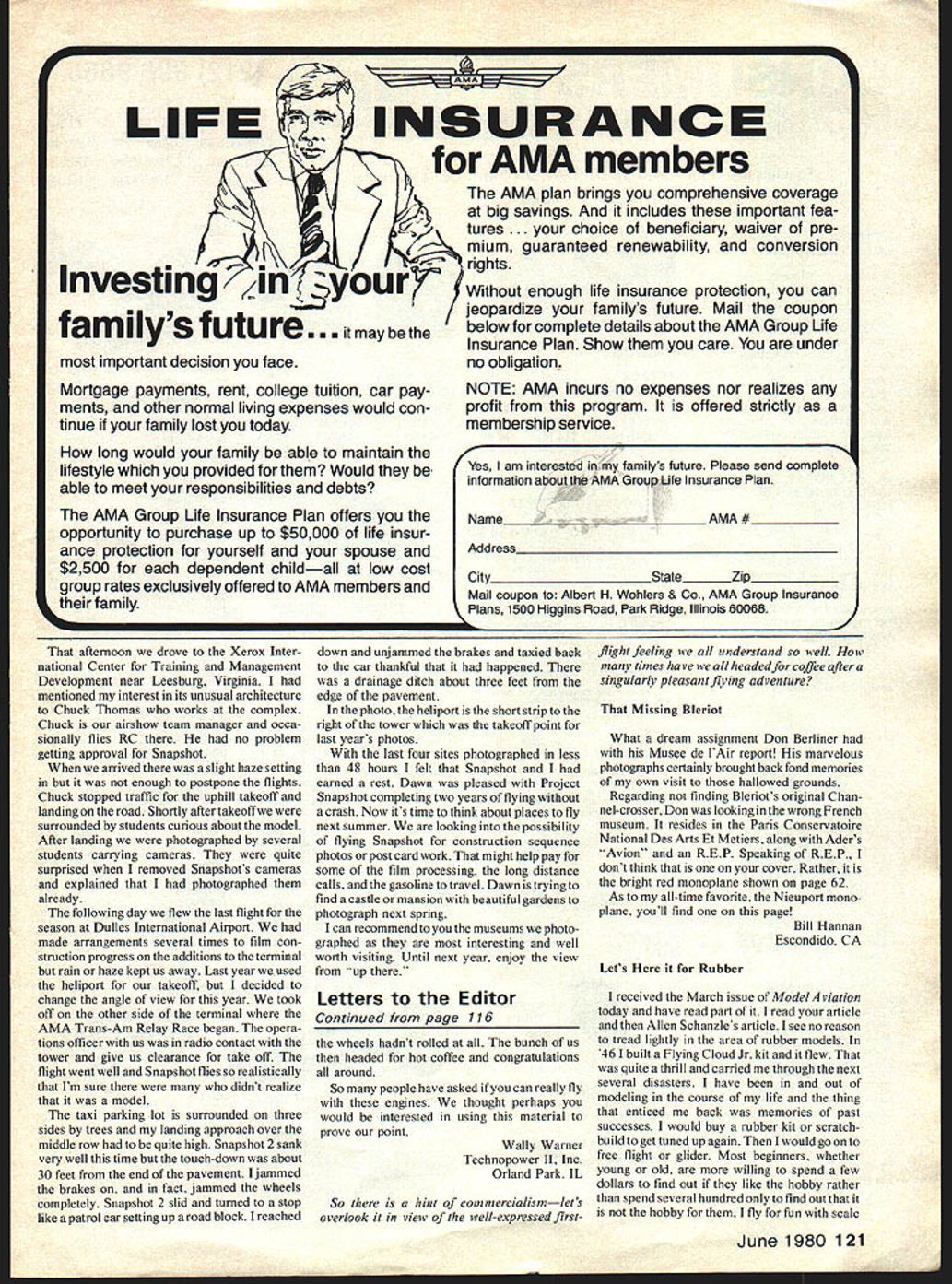
On January 20th a 12½ lb Lazy Ace powered by a Technopower II seven-cylinder radial engine flew for the first time at Pine Island, New York. The plane was built by Ken Hazen, Jim Martin, and Bev Smith, and was piloted by Jim Martin—engine by Wally Warner.
Weather was cold and windy—clouds were broken—wind gusts to 35 knots. The flying field was a sod farm and, as luck would have it, an irrigation mechanism was upwind from the takeoff site. Jim started the engine, did the normal runup, crossed his fingers, and opened the throttle. Because of the wind and the obstruction ahead, the plane kept on the ground well past liftoff speed. I waited until I was sure he couldn't miss the irrigation thing, then he snapped it into the air—up and away. Because of the wind you couldn't hear the engine until the plane passed overhead. The sound of that was worth the frozen nose and fingers.
Jim flew it past overhead several times and decided to bring our bird in while he could still feel his fingers. The landing was a real heart-stopper. The gusting wind near the ground nearly got us several times before he reached the landing area—at about four feet AGL the airplane stalled and thudded back, then descended almost vertically to a three-point touchdown. It seemed the wheels hadn't rolled at all. The bunch of us then headed for hot coffee and congratulations all around.
So many people have asked if you can really fly with these engines. We thought perhaps you would be interested in using this material to prove our point.
Wally Warner Technopower II, Inc. Orland Park, IL
Editor: So there is a hint of commercialism—let's overlook it in view of the well-expressed first-flight feeling we all understand so well. How many times have we all headed for coffee after a singularly pleasant flying adventure?
That Missing Bleriot
What a dream assignment Don Berliner had with his Musée de l'Air report! His marvelous photographs certainly brought back fond memories of my own visit to those hallowed grounds.
Regarding not finding Bleriot's original Channel-crosser, Don was looking in the wrong French museum. It resides in the Paris Conservatoire National des Arts et Métiers, along with Ader's "Avion" and an R.E.P. Speaking of R.E.P., I don't think that is on our cover. Rather, it is the bright red monoplane shown on page 62.
As to my all-time favorite, the Nieuport monoplane, you'll find one on this page!
Bill Hannan Escondido, CA
Let's Hear It for Rubber
I received the March issue of Model Aviation today and have read part of it. I read your article and then Allen Schanzle's article. I see no reason to read lightly in the area of rubber models. In 1946 I built a Flying Cloud Jr. and it flew. That was quite a thrill and carried me through the next several disasters. I have been in and out of modeling in the course of my life and among the things that excited me back was memories of past successes. I would buy a rubber kit or scratch-build to get tuned up again. Then I would go on to free flight or glider. Most beginners, whether young or old, are more willing to spend a few dollars to find out if they like the hobby rather than spend several hundred dollars to find out that it is not the hobby for them. I try for fun with scale.
Please have some more rubber construction articles.
Russell A. Millar San Angelo, TX
One World
I am a Czechoslovak aeromodeller. I have been constructing RC aerobatics pattern ships for a few years but now I am very interested in biplanes and RC pylon-racing models. I have little experience in these categories and especially in pylon racing models there is a shortage of suitable materials in our country.
I have read in detail every individual issue of Model Aviation. I shall be looking forward to every piece of information about biplanes and RC pylon. But I don't have the chance to read your magazine regularly. I have only several copies a year. Therefore I am writing to try to enlist your help with my problem. I am still very short of experience and information on biplanes and RC pylon-racing models and I would greatly appreciate it if any of your readers would contact me and grant me their experience and advice.
Many thanks in anticipation for publishing my appeal.
Bohumil Matous Pod nemocnicí 478/III 339 01 Klatovy Czechoslovakia
Editor: We have included Matous' full address for your convenience and strongly urge our readers to render him the assistance he needs.
Bonanza a Rarity?
I am curious as to why the Beech Bonanza, an aircraft in continuous production for almost 34 years, is rarely represented in the model aviation field. This aircraft is an undisputed "classic" in every respect from beauty to performance. We, the Bonanza-loving public, need some long overdue support—articles, plans, and kits!
Daniel Habaugh U.S. Army, MED-SAO APO, NY 09671
Editor: Sig has a new big .60 Bonanza and we think House of Balsa had a good half-A. Dan is overseas and, like many others, doesn't hear all the scuttlebutt. Inventory prevents MA assigning a Bonanza but our dear editorial friends may please copy.
Transcribed from original scans by AI. Minor OCR errors may remain.

