
Letters to the Editor
All letters will be carefully considered; those of general interest will be used. Send to Model Aviation, 815 15th St., N.W., Washington, D.C. 20005.
Darn Those Errors!
I've noticed that errors and omissions seem to be creeping into your plans and articles as your otherwise fine magazine has grown in size.
- In the November '80 issue, p. 8, the fuselage length is not specified for the Minute Man. Judging roughly from the photo, it should be about seven times the wing chord (3 in.), or 21 in.—but it should have been specified on the drawing.
- Then, on p. 7 (the foam rubber model) the photo caption says the wingspan is 5½ in., but the drawing scale would say it was 9.6 in. However, the plan words also say the wheel size is 3/8 in. diameter, which is what the drawing scale would give. But if the drawing scale is increased to give the correct wingspan, then the wheel diameter would only scale to be 5/8 in.
These are pretty bad errors, and I think you should definitely print corrections in the next possible issue.
P.S. That "outdoor" duration (for Srull's rubber-power foamie) must be in thermal air if the indoor duration is only 30 sec. You should state this.
W. F. McCombs Dallas, TX
Reply:
We try very hard not to have errors, but complete elimination has eluded us (and that also was true when we had fewer pages). The Minute Man fuselage length should be 18 in. Perhaps Mr. McCombs failed to notice that the fuselage is made from 3/4 in. sq. by 18 in. Re the Srull foamie, we had meant to knock out the scale ruler before printing (it had been called to our attention that it was incorrect), but this detail got away from us. We now see that the only thing wrong with the scale ruler is that the values should be halved (1 in. should be 1/2 in., 2 in. should be 1 in., and so on). Also, the wheel diameter should have been indicated as 7/16 in.
On the P.S. item, Don Srull says that the no-lift still-air duration is in the 30-sec. range, and that 1½ min. is fairly common in outdoor buoyant air.
---
Wants Joy Jenny Plans
I would appreciate it very much if you could insert in your column a request for one set of building instructions for the 6-ft. Joy Jenny kit. I realize that they are no longer in business, but I will gladly pay a reasonable price for a set if someone has a set or would copy theirs from a kit they might have.
Richard A. Vancoe 114 - 7th St. Honesdale, PA 18431 Tel: day (717) 253-1150 night (717) 253-1345
---
Cake Cutting
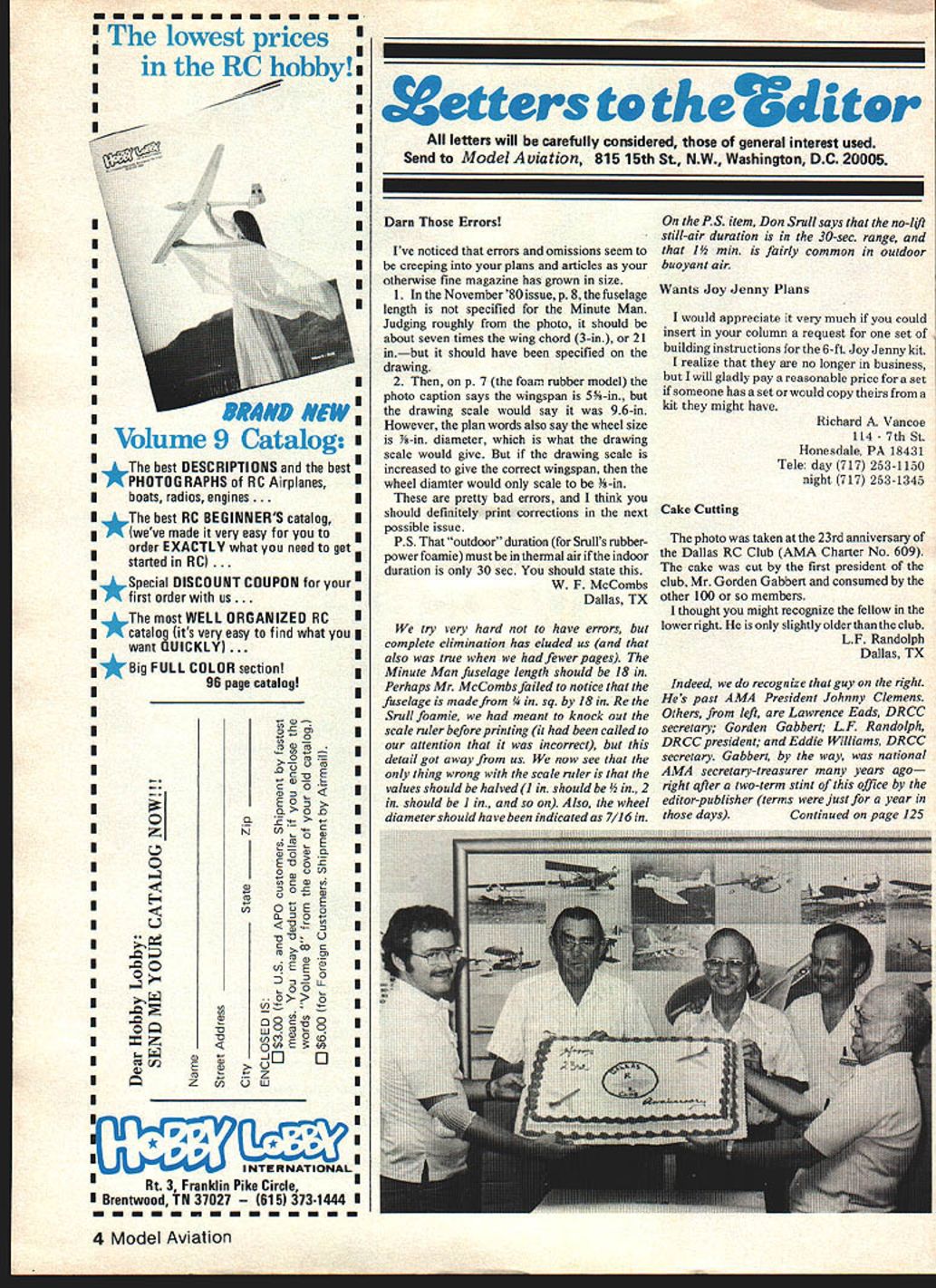
The photo was taken at the 23rd anniversary of the Dallas RC Club (AMA Charter No. 609). The cake was cut by the first president of the club, Mr. Gordon Gabbert and consumed by the other 100 or so members.
I thought you might recognize the fellow in the lower right. He is only slightly older than the club.
L. F. Randolph Dallas, TX
Reply:
Indeed, we do recognize that guy on the right. He's past AMA President Johnny Clemens. Others, from left, are Lawrence Eads, DRCC secretary; Gordon Gabbert; L.F. Randolph, DRCC president; and Eddie Williams, DRCC secretary. Gabbert, by the way, was national AMA secretary-treasurer many years ago—right after a two-term stint of this office by the editor-publisher (terms were just for a year in those days).
Powered FF Folders
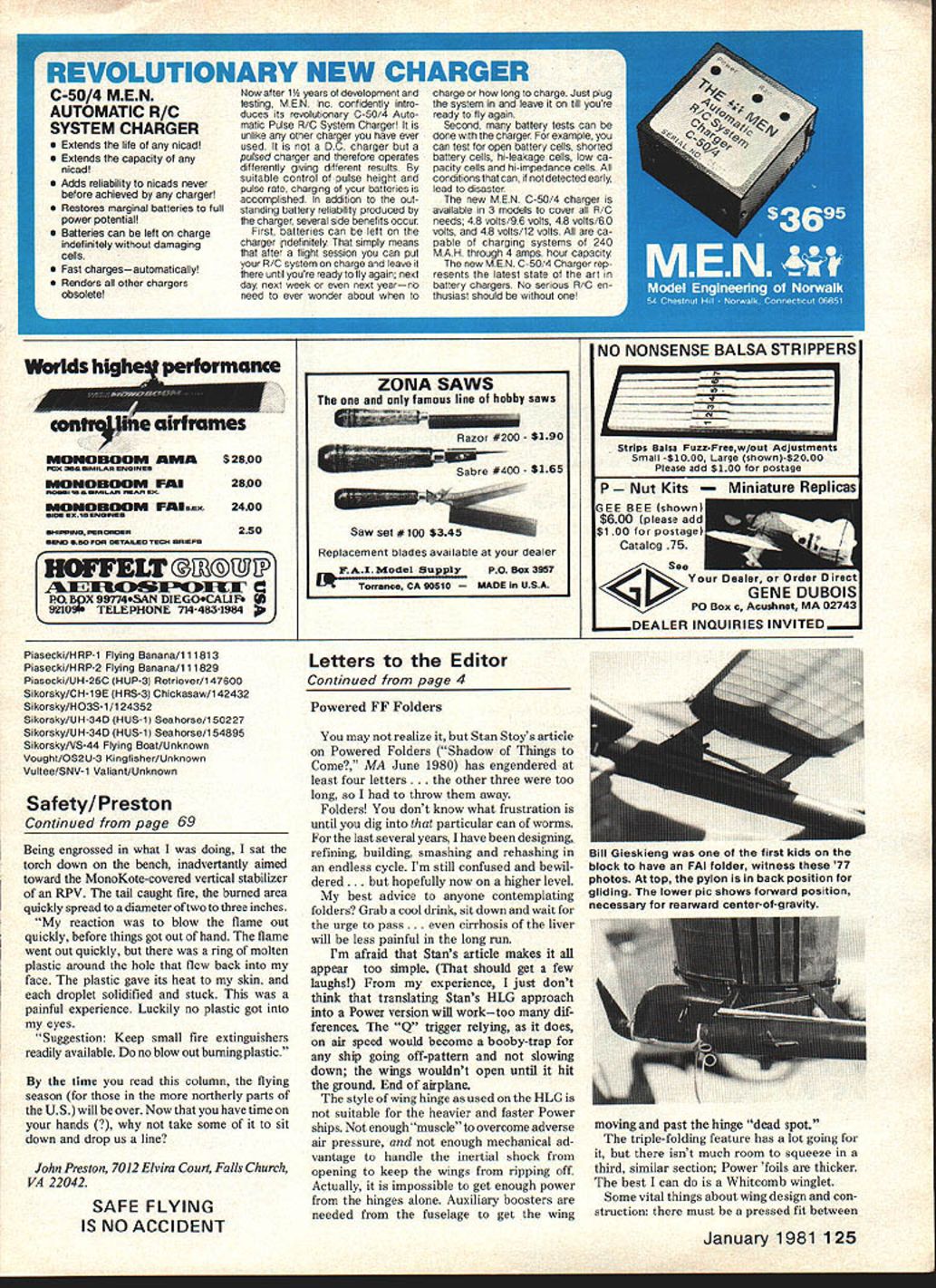
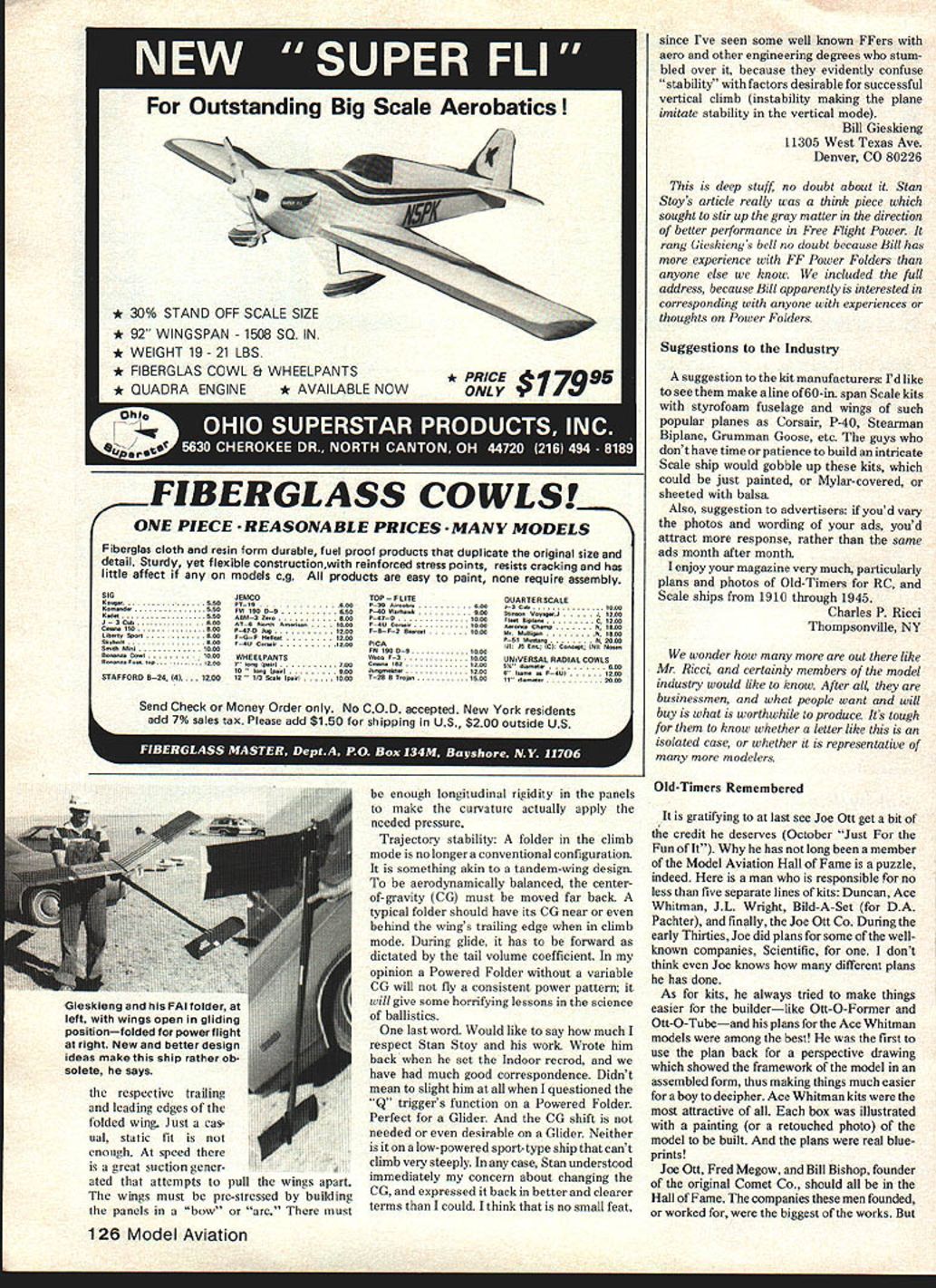
You may not realize it, but Stan Stoy's article on Powered Folders ("Shadow of Things to Come?," MA June 1980) has engendered at least four letters ... the other three were too long, so I had to throw them away.
Folders! You don't know what frustration is until you dig into that particular can of worms. For the last several years, I have been designing, refining, building, smashing and rehashing in an endless cycle. I'm still confused and bewildered ... but hopefully now on a higher level. My best advice to anyone contemplating folders? Grab a cool drink, sit down and wait for the urge to pass ... even cirrhosis of the liver will be less painful in the long run.
I'm afraid that Stan's article makes it all appear too simple. (That should get a few laughs!) From my experience, I just don't think that translating Stan's HLG approach into a Powered version will work—too many differences. The "Q" trigger relying, as it does, on air speed would become a booby-trap for any ship going off-pattern and not slowing down; the wings wouldn't open until it hit the ground. End of airplane.
The style of wing hinge as used on the HLG is not suitable for the heavier and faster Power ships. Not enough "muscle" to overcome adverse air pressure, and not enough mechanical advantage to handle the inertial shock from opening to keep the wings from ripping off. Actually, it is impossible to get enough power from the hinges alone. Auxiliary boosters are needed from the fuselage to get the wing moving and past the hinge "dead spot."
The triple-folding feature has a lot going for it, but there isn't much room to squeeze in a third, similar section; Power foils are thicker. The best I can do is a Whitcomb winglet.
Since I've seen some well known FFFers with aero and other engineering degrees who stumbled over it, because they evidently confuse "stability" with factors desirable for successful vertical climb (instability making the plane imitate stability in the vertical mode).
Bill Gieskieng 11305 West Texas Ave. Denver, CO 80226
Reply:
This is deep stuff, no doubt about it. Stan Stoy's article really was a think piece which sought to stir up the gray matter in the direction of better performance in Free Flight Power. It rang Gieskieng's bell no doubt because Bill has more experience with FF Power Folders than anyone else we know. We included the full address, because Bill apparently is interested in corresponding with anyone with experiences or thoughts on Power Folders.
Suggestions to the Industry
A suggestion to the kit manufacturers: I'd like to see them make a line of 60-in. span Scale kits with styrofoam fuselage and wings of such popular planes as Corsair, P-40, Stearman Biplane, Grumman Goose, etc. The guys who don't have time or patience to build an intricate Scale ship would gobble up these kits, which could be just painted, or Mylar-covered, or sheeted with balsa.
Also, suggestion to advertisers: if you'd vary the photos and wording of your ads, you'd attract more response, rather than the same ads month after month.
I enjoy your magazine very much, particularly plans and photos of Old-Timers for RC, and Scale ships from 1910 through 1945.
Charles P. Ricci Thompsonville, NY
Reply:
We wonder how many more are out there like Mr. Ricci, and certainly members of the model industry would like to know. After all, they are businessmen, and what people want and will buy is what is worthwhile to produce. It's tough for them to know whether a letter like this is an isolated case, or whether it is representative of many more modelers.
Old-Timers Remembered
It is gratifying to at last see Joe Ott get a bit of the credit he deserves (October "Just For the Fun of It"). Why he has not long been a member of the Model Aviation Hall of Fame is a puzzle, indeed. Here is a man who is responsible for no less than five separate lines of kits: Duncan, Ace, Whitman, J.L. Wright, Bird-A-Set (for D.A. Pachter?), and, finally, the Joe Ott Co. During the early Thirties, Joe did plans for some of the well-known companies, Scientific, for one. I don't think even Joe knows how many different plans he has done.
As for kits, he always tried to make things easier for the builder—like Ott-O-Former and Ott-O-Tube—and his plans for the Ace Whitman models were among the best! He was the first to use the plan back for a perspective drawing which showed the framework of a model in an assembled form, thus making things much easier for a boy to decipher. Ace Whitman kits were the most attractive of all. Each box was illustrated with a painting (or a retouched photo) of the completed model, not the bare plank-of-the-plan. Joe Ott, Fred Megow, and Bill Bishop, founder of the original Comet Co., should all be in the Hall of Fame. They were the biggest of the works. But because the gas model got, and still gets, the lion's share of publicity, these men are, by and large, ignored. The Hall of Fame is top-heavy with past presidents of AMA, and most of the rest have to do with gas models.
I would remind all concerned that gas models were a very small portion of the model aviation activity of the Thirties and early Forties. The manufacturing companies were able to survive only by the sales of the lowly "cheap" kits! You know, the 10-cent through one dollar jobs. For example, Jim Walker's famous Fireball. This model actually lost money! It was so expensive to manufacture, using so much balsa, and the complicated process of turning and hollowing the fuselage, that had Walker made only this kit, he would have been almost instantly bankrupt. Only the sales of hundreds of thousands of the little ready-to-fly gliders and rubber models enabled him to do what he did.
Comet's Sailplane and Zipper were not very profitable. These were prestige kits. The Comet people were a bit sensitive to the criticism of their little kits, but they had no reason to be, as these were great kits for a kid! I built many of them, along with the Ace Whitman, and Megow. People were constantly trying to compare the "cheap" kits to the line put out by Cleveland, but those building Cleveland stuff were older than the boys who bought Comet and the other 10-centers.
Comet did their fabulous Gulfhawk, which was more true-to-scale than any of the other kit models of the time. The work that went into this kit was reflected in the price. Consequently, it was not very successful, although it won more contests than any other one Scale model of the time. Fred Megow told me that, in retrospect, he felt they would have been better off to have stuck with the top-of-their-line Rubber Scale Stinson, and ignored the gas models, as they were not profitable.
What I am taking so long to say is that, for every gas model kit sold, there must have been several thousand of the little Rubber Scale kits bought and built (or attempted). I had not heard of Charles Grant, Henry Struck, or any others, because I did not read model magazines in the late Thirties. The money was spent for kits. Older boys bought magazines and built from the plans therein, but I had other use for my 25c — namely a Megow, Comet, or Ace Whitman kit, and with the remaining 15c one could get a 5c tube of glue, a coke, and a candy bar. What more would one need for complete happiness?
So, let's look back, and see what really made the model industry grow to the proportions that it did, from 1934, when the first 10-cent kit arrived, to 1942, when war-time restrictions nearly killed the model companies. Yes, dear hearts, what made modeling big was the lowly "cheap" kit.
— Walter E. Grigg Orlando, FL
Power Glider Returned
My public thanks to young Mr. Bryan Hochheiser for finding my RC glider, and having the good common sense to contact AMA. ("Letters," November 1980, "At Last: Put on Numbers!") The ship had belonged to a friend of mine, now deceased, and was in need of extensive repairs. One Friday night, I began ambitiously to work on it, and when repairs were completed, lo and behold, it was light outside! Dawn had broken. Without taking additional time to affix my AMA numbers or name and address, it was out to the field to test fly. The rest is history. It flew too high, too far, and too well, without proper charging and tuning.
I certainly would have gotten it back much sooner had my license number and/or name and address been attached. Incidentally, I'm sending it to Bryan as a reward. Thanks again to him, and to you for printing his letter.
Danny Shields Randallstown, MD
Reply:
We're glad to have helped, Danny. We had another letter from a reader who was upset that someone had the gall to suggest that he would barter the return of the model he had found for a smaller one. We shared some of those feelings, but they were tempered when we found out that Bryan Hochheiser is at the tender age of 12, and doubtlessly the model he found had instilled a great desire for him to become involved in airplane modeling.
We had a third letter, this one unsigned, which objected to our suggestion for putting AMA numbers on models and, if possible, also the full name and address of the owner. This letter writer felt it was better to risk loss of a model—even if several hundred dollars were involved—rather than chance the possibility of a lawsuit in this sue-happy time we live in. I guess we are old-fashioned, but we think a person with responsibility for something shouldn't duck from it. Just think of the black eye that would give to modeling. And remember that AMA membership provides insurance which protects against possible liability when flying according to the AMA Safety Code.
We still advise, as a minimum, to always put your AMA numbers on your ships. And if your model type allows, we also recommend including your full name, address, and phone number.
Transcribed from original scans by AI. Minor OCR errors may remain.

