
Letters to the Editor
Cyanoacrylates with Small Pieces
I've been having very little success with cyanoacrylate glues on small stick-and-paper or microfilm models. It doesn't seem to work on the framework of 1/32 sq. balsa, though it works fine on larger jobs. I've tried Jet and Hot Stuff. Is there a technique I'm missing? Can you explain?
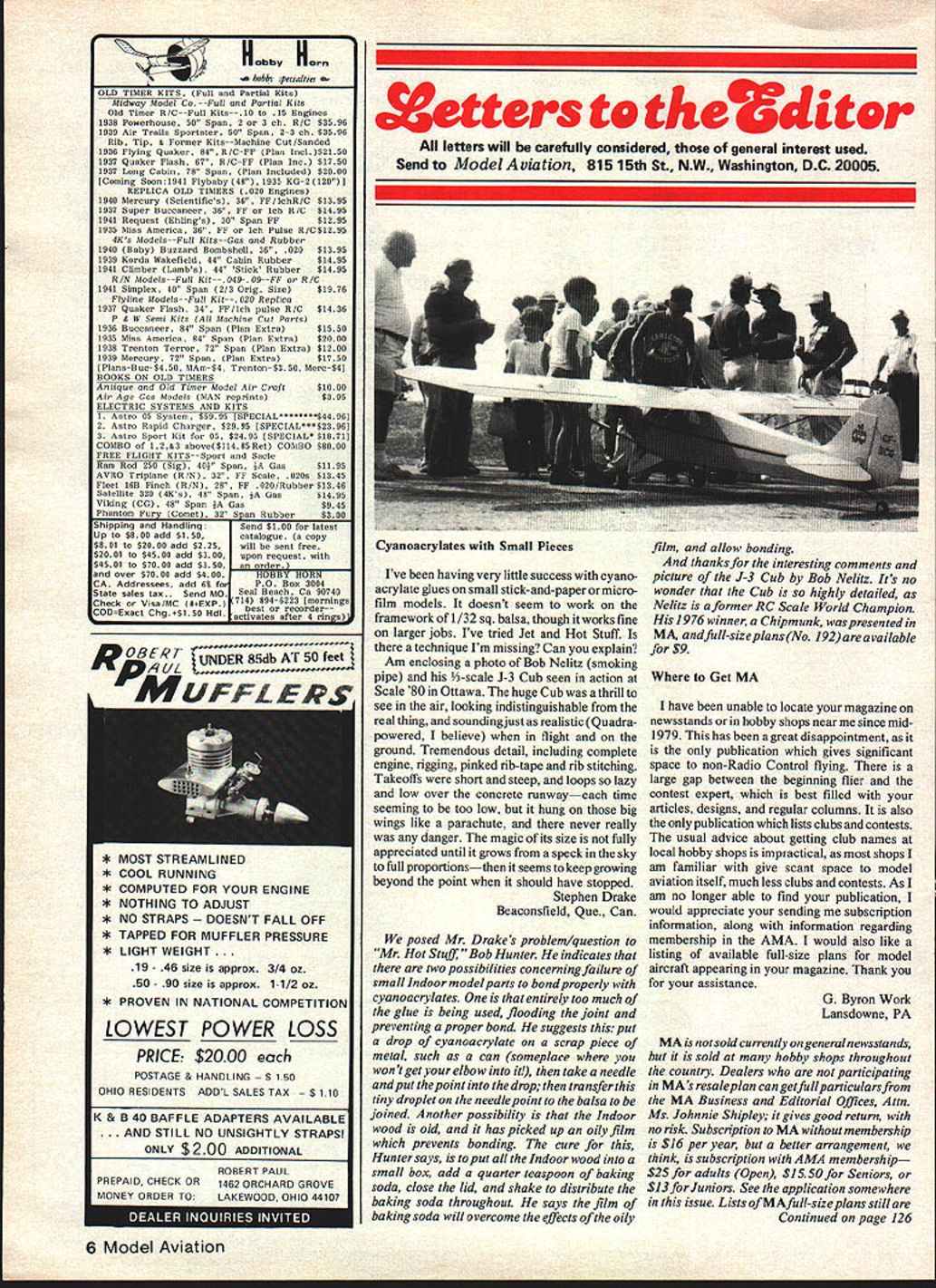
I am enclosing a photo of Bob Nelitz (smoking pipe) and his 1/8-scale J-3 Cub seen in action at Scale '80 in Ottawa. The huge Cub was a thrill to see in the air, looking indistinguishable from the real thing, and sounding just as realistic (Quadra-powered, I believe) when in flight and on the ground. Tremendous detail, including complete engine rigging, pinked rib-tape and rib stitching. Takeoffs were short and steep, and loops so lazy and low over the concrete runway—each time seeming to be too low, but it hung on those big wings like a parachute, and there never really was any danger. The magic of its size is not fully appreciated until it grows from a speck in the sky to full proportions—then it seems to keep growing beyond the point when it should have stopped.
Stephen Drake Beaconsfield, Que., Can.
We posed Mr. Drake's problem/question to "Mr. Hot Stuff," Bob Hunter. He indicates that there are two possibilities concerning failure of small indoor model parts to bond properly with cyanoacrylates.
One is that entirely too much of the glue is being used, flooding the joint and preventing a proper bond. He suggests this: put a drop of cyanoacrylate on a scrap piece of metal, such as a can (someplace where you won't get your elbow into it), then take a needle and put the point into the drop; transfer the tiny droplet on the needle point to the balsa to be joined.
Another possibility is that the indoor wood is old and has picked up an oily film which prevents bonding. The cure for this, Hunter says, is to put all the indoor wood into a small box, add a quarter teaspoon of baking soda, close the lid, and shake to distribute the baking soda throughout. He says the baking soda will overcome the effects of the oily film and allow bonding.
And thanks for the interesting comments and picture of the J-3 Cub by Bob Nelitz. It's no wonder that the Cub is so highly detailed, as Nelitz is a former RC Scale World Champion. His 1976 winner, a Chipmunk, was presented in MA, and full-size plans (No. 192) are available for $9.
Where to Get MA
I have been unable to locate your magazine on newsstands or in hobby shops near me since mid-1979. This has been a great disappointment, as it is the only publication which gives significant space to non-Radio Control flying. There is a large gap between the beginning flier and the contest expert, which is best filled with your articles, designs, and regular columns. It is also the only publication which lists clubs and contests. The usual advice about getting club names at local hobby shops is impractical, as most shops I am familiar with give scant space to model aviation itself, much less clubs and contests. As I am no longer able to find your publication, I would appreciate your sending subscription information, along with information regarding membership in the AMA. I would also like a listing of available full-size plans for model aircraft appearing in your magazine. Thank you for your assistance.
G. Byron Work Lansdowne, PA
MA is not currently sold on general newsstands, but it is sold at many hobby shops throughout the country. Dealers who are not participating in MA's resale plan can get full particulars from the MA Business and Editorial Offices, Attn: Ms. Johnnie Shipley; it gives good return, with no risk. Subscription to MA without membership is $16 per year, but a better arrangement is subscription with AMA membership: $25 for adults (Open), $15.50 for Seniors, or $13 for Juniors. See the application somewhere in this issue. Lists of MA full-size plans are still free: just enclose a pre-addressed and stamped business-size envelope with each request.
Continued from page 6
New Dimension of RC Flight?
The recent trend toward adoption of a symmetrical airfoil for aerobatic aircraft is a nice practical example for the pilot who flies upside down as often as right-side up. It also answers the novice's common question, in response to being told that an airfoil is inherently designed to provide lift on the upper surface as a means of flight (Bernoulli's Theorem), how it is then even possible to fly upside-down.
However, flight is thus attained only by tilting the whole airframe in order to achieve a positive angle of attack of the wing chord. In this mode, the thrust angle is increased above the direction of flight.
It would seem that the symmetrical airfoil may open up a whole new option for aircraft control and maneuverability for the aerobatic plane, and for the creative and courageous pilot.
This option would be to mount each wing so that it could rotate on an axis located along the spar of the wing, or about 1/3 of the chord. With this configuration, the angle of attack could be increased while the thrust was still directly forward, providing direct level vertical lift! Or, as another of the many possible examples, the elevator could be used to nose the plane (and thrust) very high upward while the wing was rotated downward relative to the aircraft, but still upward relative to the ground and to the flight-path, enabling slow flight or bird-like landings! Note, also, that no ailerons would be needed, as wings could be operated together or in opposition relative to each other. Hence no further controls are needed in total, but a whole new dimension may be available for maneuverability.
J. M. Chamberlin Pensacola, FL
Are there any creative types out there who would be interested in giving this a try? We'd be interested in the results.
Where to Start in RC
I have been reading Model Aviation since September 1980, and I would like to say I really enjoy it. Before I started reading Model Aviation, I had little interest in RC, but since then my interest has grown. But I have one question. Could you recommend in which area I should start? That is where I have the most trouble deciding. And so, to conclude this letter, I would like to say two things. Thank you for encouraging my interest, and for printing such a great magazine.
Ty Conard Chicago, IL
What kind of RC modeling for one to get into depends upon what kind of modeling background the person already has, and also the kind of RC modeling being done by guys who may be able to assist. For instance, if modeling so far has been Free Flight, it might be quite natural for first RC experiences to be with sailplanes, or a sailplane with a power pod—or it might be with a tame sport-type high-wing trainer.
The other point is that it's much easier to be successful with something when help and/or advice is available from someone who already is involved. Naturally, there's a benefit in starting with the type of model recommended by the people giving assistance. One way to meet modelers who can help or advise is by joining a club. Listings of AMA Clubs were printed in the June and July 1980 MA issues. Reprints are available from AMA HQ (enclose a pre-addressed and stamped business-size envelope). Or you might visit a nearby RC flying field and strike up conversations with fliers there.
SAM Champs Revisited
I flew Rubber Cabin and Stick in the recent SAM Champs, and found your article on the event (November 1980 MA) very interesting. It was the first contest for me in 25 years, and I've never had more fun!
As for all of the Stick models being one-design, that's not quite so. Both my Cabin and Stick entries were the 1936 versions (yes, with free-wheeling propeller). The ships were built exactly as shown in Zaic's 1937 Yearbook (page 13), except for the addition of the derailer and rear rubber peg. Both ships were flown between 8:30 and 10:00 a.m. in dead air, and they got by strictly on their own merits. You can advise your readers that old freewheelers are better than you'd expect.
Jerry Nolin Fairborn, OH
Transcribed from original scans by AI. Minor OCR errors may remain.

