
Letters to the Editor
All letters will be carefully considered; those of general interest will be used. Send to Model Aviation, 815 15th St., N.W., Washington, D.C. 20005
C/L End-Wrappings
Much of the coated copper wire now supplied to the small motor or electrical coil industry is bondable with heat, or in some cases with a solvent such as M.E.K.
I obtained samples of such wire from a friend in the motor business and have found it very easy to use in wrapping the ends of control lines or lead-outs. The wrapping is done the same way as if the ends were to be soldered. However, instead of applying the heat of a soldering iron and molten solder, I simply heat the wrapped ends with a match.
I have included a few samples of lead-out and control line ends done in this way. I have pull-tested these lead-outs and lines without any problem.
Arthur J. Johnson Rockford, IL
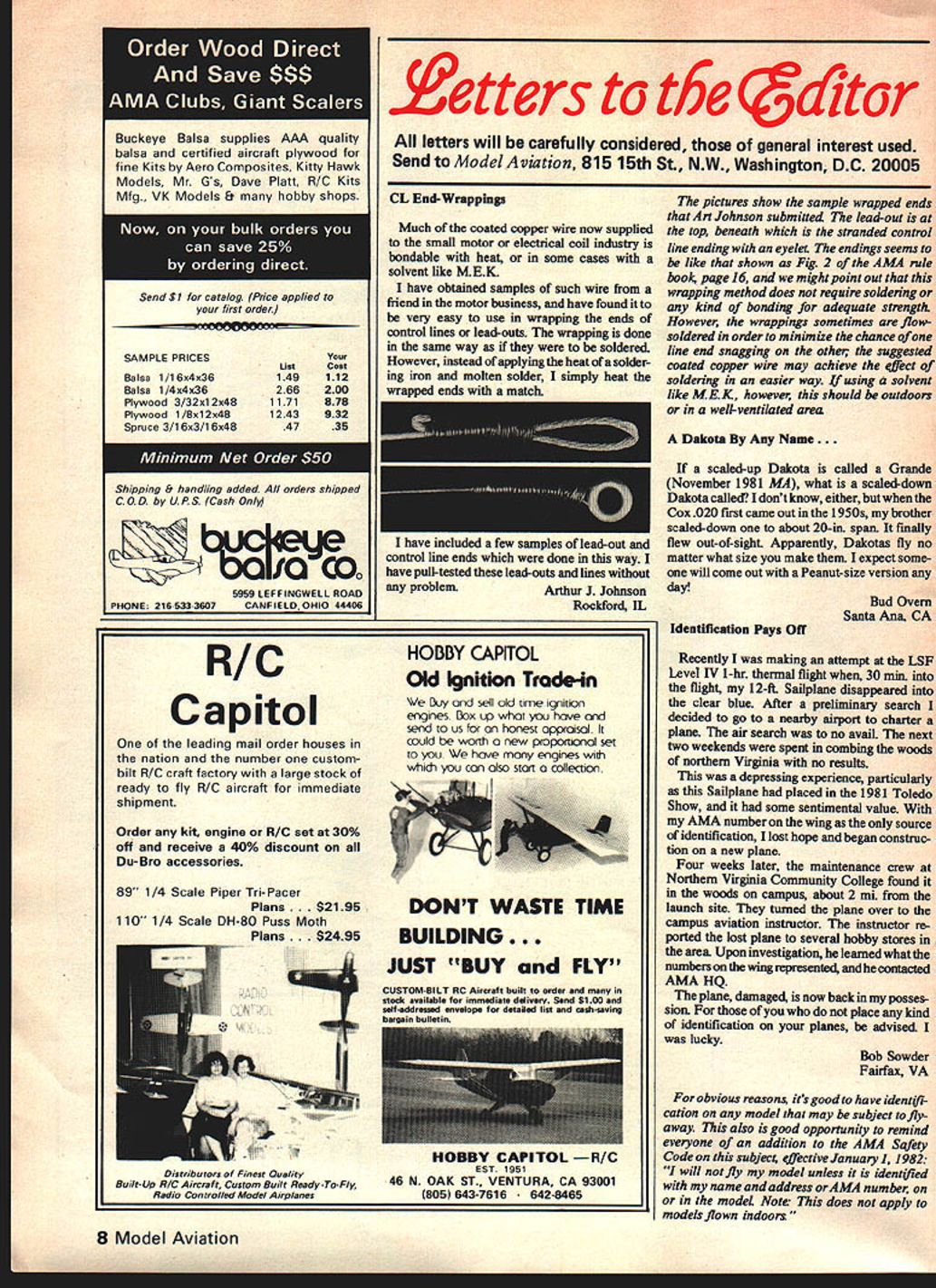
The pictures show the sample wrapped ends that Arthur J. Johnson submitted. The lead-out is at the top; beneath it is the stranded control line ending with an eyelet. The endings resemble the example shown as Figure 2 of the AMA rulebook (page 16). We might point out that this wrapping method does not require soldering or any other kind of bonding for adequate strength. However, wrappings are sometimes flow-soldered to minimize the chance of one line end snagging on another; the suggested coated copper wire may achieve the effect of soldering in an easier way. If using a solvent such as M.E.K., this should be done outdoors or in a well-ventilated area.
A Dakota By Any Name . . .
If a scaled-up Dakota is called a Grande (November 1981 MA), what is a scaled-down Dakota called? I don't know either, but when the Cox .020 first came out in the 1950s, my brother scaled one down to about a 20‑in. span. It finally flew out of sight. Apparently, Dakotas fly no matter what size you make them. I expect someone will come out with a Peanut-size version any day!
Bud Overn Santa Ana, CA
Identification Pays Off
Recently I was attempting the LSF Level IV 1-hour thermal flight when, 30 minutes into the flight, my 12‑ft. sailplane disappeared into the clear blue. After a preliminary search I decided to go to a nearby airport to charter a plane. The air search was to no avail. The next two weekends were spent combing the woods of northern Virginia with no results. This was a depressing experience, particularly as the sailplane had placed in the 1981 Toledo Show and had some sentimental value. With my AMA number on the wing as the only source of identification, I lost hope and began construction on a new plane.
Four weeks later the maintenance crew at Northern Virginia Community College found it in the woods on campus, about 2 mi. from the launch site. They turned the plane over to the campus aviation instructor. The instructor reported the lost plane to several hobby stores in the area. Upon investigation he learned what the numbers on the wing represented and he contacted AMA HQ. The plane, damaged, is now back in my possession. For those of you who do not place any kind of identification on your planes, be advised. I was lucky.
Bob Sowder Fairfax, VA
For obvious reasons, it's good to have identification on any model that may be subject to flyaway. This is also a good opportunity to remind everyone of an addition to the AMA Safety Code on this subject, effective January 1, 1982:
"I will not fly my model unless it is identified with my name and address or AMA number on or in the model. Note: This does not apply to models flown indoors."
Transcribed from original scans by AI. Minor OCR errors may remain.

