
Letters to the Editor
Wanted in Springfield
As most aviation buffs realize, Springfield, MA, is noted for the famous Gee Bee racers of the Thirties. It is a heritage that should not be forgotten. We already have on display a substantial number of pictures, memorabilia, and the Zeta sport plane on permanent exhibit at the Science Museum.
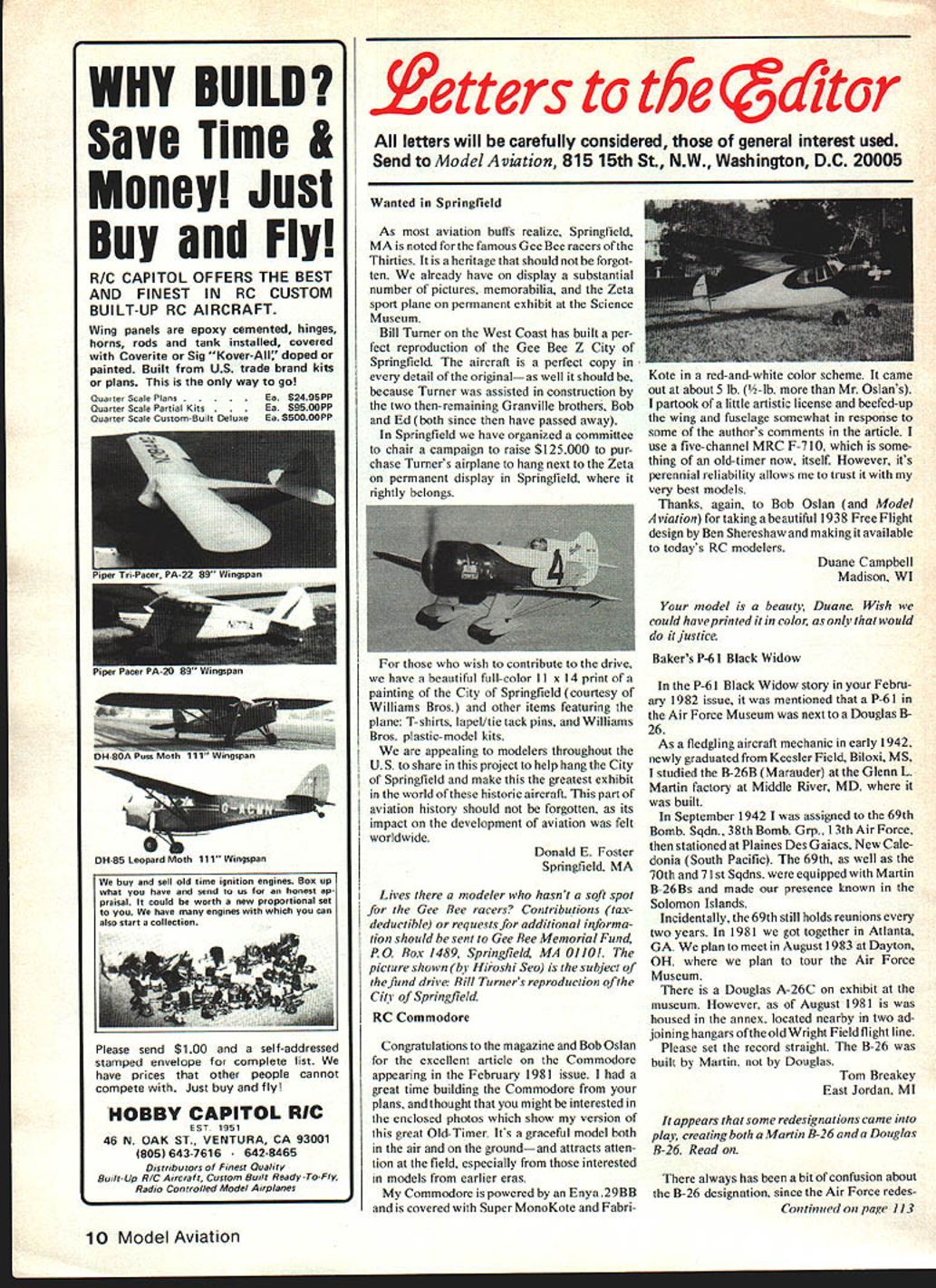
Bill Turner on the West Coast has built a perfect reproduction of the Gee Bee Z, City of Springfield. The aircraft is a perfect copy in every detail of the original—as well it should be, because Turner was assisted in construction by the two then-remaining Granville brothers, Bob and Ed (both since then have passed away).
In Springfield we have organized a committee to chair a campaign to raise $125,000 to purchase Turner's airplane to hang next to the Zeta on permanent display in Springfield, where it rightly belongs.
For those who wish to contribute to the drive, we have a beautiful full-color 11 x 14 print of a painting of the City of Springfield (courtesy of Williams Bros.) and other items featuring the plane: T-shirts, lapel/tie tack pins, and Williams Bros. plastic-model kits.
We are appealing to modelers throughout the U.S. to share in this project to help hang the City of Springfield and make this the greatest exhibit in the world of these historic aircraft. This part of aviation history should not be forgotten, as its impact on the development of aviation was felt worldwide.
Donald E. Foster Springfield, MA
RC Commodore
Congratulations to the magazine and Bob Oslan for the excellent article on the Commodore appearing in the February 1981 issue. I had a great time building the Commodore from your plans, and thought you might be interested in the enclosed photos which show my version of this great Old-Timer. It's a graceful model both in the air and on the ground and attracts attention at the field, especially from those interested in models from earlier eras.
My Commodore is powered by an Enya .29BB and is covered with Super MonoKote and Fabri-Kote in a red-and-white color scheme. It came out at about 5 lb. (1/2 lb. more than Mr. Oslan's). I partook of a little artistic license and beefed up the wing and fuselage somewhat in response to some of the author's comments in the article. I use a five-channel MRC F-710, which is something of an old-timer now, itself. However, its perennial reliability allows me to trust it with my very best models.
Thanks, again, to Bob Oslan (and Model Aviation) for taking a beautiful 1938 Free Flight design by Ben Shereshaw and making it available to today's RC modelers.
Duane Campbell Madison, WI
Baker's P-61 Black Widow
In the P-61 Black Widow story in your February 1982 issue, it was mentioned that a P-61 in the Air Force Museum was next to a Douglas B-26. As a fledgling aircraft mechanic in early 1942, newly graduated from Keesler Field, Biloxi, MS, I studied the B-26B (Marauder) at the Glenn L. Martin factory at Middle River, MD, where it was built.
In September 1942 I was assigned to the 69th Bombardment Squadron, 38th Bombardment Group, 13th Air Force, then stationed at Plaine des Gaiacs, New Caledonia (South Pacific). The 69th, as well as the 70th and 71st Squadrons, were equipped with Martin B-26Bs and made our presence known in the Solomon Islands.
Incidentally, the 69th still holds reunions every two years. In 1981 we got together in Atlanta, GA. We plan to meet in August 1983 at Dayton, OH, where we plan to tour the Air Force Museum.
There is a Douglas A-26C on exhibit at the museum. However, as of August 1981 it was housed in the annex, located nearby in two adjoining hangars of the old Wright Field flight line. Please set the record straight: the B-26 was built by Martin, not by Douglas.
Tom Breakey East Jordan, MI
Get Your FCC RC License!
I read with considerable interest Mr. Mark Isenberg's comments in the January 1982 Letters column.
If we modelers who use the airways in pursuit of our hobby do not comply with the license requirements of the FCC, and the results are that we bargain for frequencies from a position of weakness, then we have no one to blame but ourselves.
I contend that membership in the AMA should require all who intend to enter into any form of modeling that uses RC equipment to submit proof of compliance with FCC licensing rules prior to issuance of AMA licenses.
Ham radio enthusiasts hold their spectrum of the radio frequencies very dear. Amateur radio operators go to great lengths to protect and police their ranks to ensure that they don't lose or abuse their privileges.
We had better do the same, lest we be given undesirable and unusable segments of the radio spectrum. If we aren't careful, we could end up with expensive, complex radio equipment to satisfy poor frequency assignments.
Dennis Finch Houston, TX
We wrote Mr. Finch that we thought it would be a mistake for AMA to require an FCC license before issuing AMA membership, though the thought is well-intentioned. On the other hand, there just isn't any reason why anyone should hold back from obtaining an FCC RC license. They're free! FCC application forms may be obtained from AMA HQ; please include a pre-addressed and stamped envelope with each request.
Transcribed from original scans by AI. Minor OCR errors may remain.

