

Letters to the Editor
All letters will be carefully considered, those of general interest used. Send to Model Aviation, 815 15th St., N.W., Washington, D.C. 20005.
We Needed That!
Congratulations on the October issue of Model Aviation — it is a truly fine issue!
Most modelers like pictures and sketches, along with a liberal sprinkling of color, and this issue "fills the bill." As you may already know, you had only 9 pages out of a total of 100 (including front and back covers) which did not have any pictures or sketches. This compares favorably with one of the most popular model magazines sold today, RC Modeler. I checked two random issues of RCM and found that they had five pages out of 140 pages and six pages out of 156 pages without any sketches or pictures. Based on this, it certainly appears that you are on the right track.
Again, congratulations on this latest issue; it is most outstanding.
Guy F. Farris AMA 4262 Nashville, TN
MA naturally is pleased by Guy's approbation (and no, we didn't know), but let's not misconstrue the reference to RCM. MA is pleased to be compared with RCM, or any of the other popular magazines.
Making "Swirls"
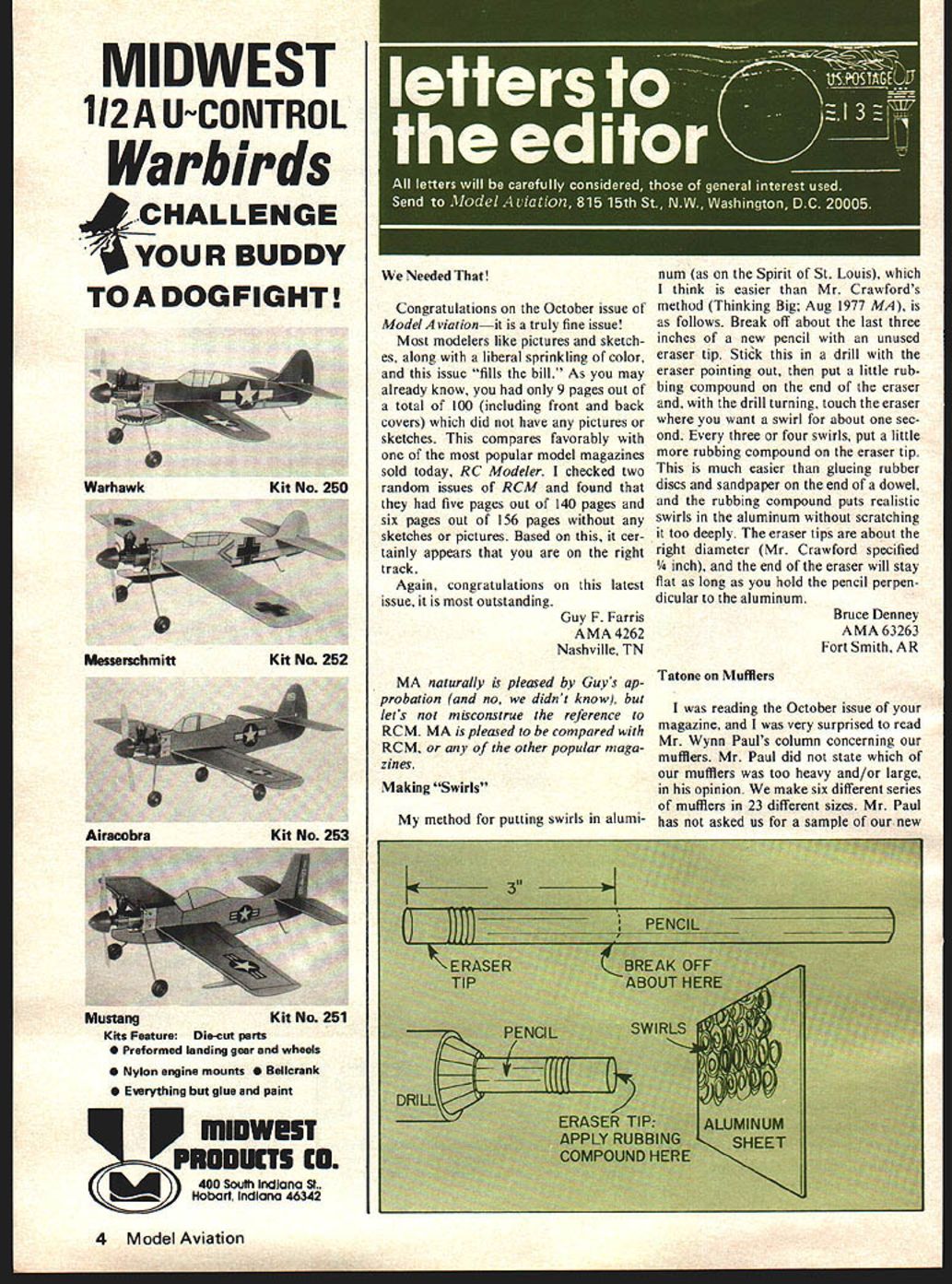
My method for putting swirls in aluminum (as on the Spirit of St. Louis), which I think is easier than Mr. Crawford's method (Thinking Big: Aug 1977 MA), is as follows. Break off about the last three inches of a new pencil with an unused eraser tip. Stick this in a drill with the eraser pointing out, then put a little rubbing compound on the end of the eraser and, with the drill turning, touch the eraser where you want a swirl for about one second. Every three or four swirls, put a little more rubbing compound on the eraser tip. This is much easier than gluing rubber discs and sandpaper on the end of a dowel, and the rubbing compound puts realistic swirls in the aluminum without scratching it too deeply. The eraser tips are about the right diameter (Mr. Crawford specified 1/4 inch), and the end of the eraser will stay flat as long as you hold the pencil perpendicular to the aluminum.
Bruce Denney AMA 63263 Fort Smith, AR
Tatone on Mufflers
I was reading the October issue of your magazine, and I was very surprised to read Mr. Wynn Paul's column concerning our mufflers. Mr. Paul did not state which of our mufflers was too heavy and/or large, in his opinion. We make six different series of mufflers in 23 different sizes. Mr. Paul has not asked us for a sample of our new 'Muf-L-It' series mufflers, which weigh the same or less than some of the mufflers in his stable of "pets." Further, we have an even more advanced, patented, series of mufflers called the "Silencer" Series. This series is ultra-light and we feel is capable of at least as good noise suppression as any of the mufflers Mr. Paul mentioned.
In addition, the purpose of an engine muffler is not to be large or small, heavy or light, but to protect the environment by suppressing noise. We pioneered the use of mufflers and made the first commercially available muffler years ago, when very few people realized the significance of this product. We felt that protection of the environment would mean enough to modelers to warrant our significant investment in this product. We were right—we have sold over 25,000 mufflers, and sales continue to increase.
John Tatone San Francisco, CA
Taft Scale Judging Defended
On reading the write-up of the Taft Free-Flight Championships 1977 by Clarence Haught, I was struck by his negative comments re scale, and I would like to answer his criticisms.
His primary concern seemed to be that each contestant was "...required to judge his own airplane," and that a qualified and experienced judging team was not present. Without getting into whether or not individual contestants are over serious about "winning," I would venture to say that my experience with this type of judging has been that it works well. Not only do contestants get a close look at all the planes entered (often seeing things they might otherwise have missed), but they have the advantage of a wider range of opinions. Judging only one category (e.g., wing), a contestant can more readily and fairly evaluate his own, and can actually have little effect on eventual outcomes.
In regard to the "qualified and experienced judging team," the people who fly scale are generally what I would call fairly qualified. I can't think of anyone better qualified than people who seriously re-
Letters to the Editor
search and build scale. Maybe I have been spoiled by having grown up flying against guys like Bill Hamann, Walt Mooney, Bill Stroman, Russ Barrera, and on and on.
Finally, his comment that flight duration was over-emphasized is not a criticism of how the event was run, but of the AMA rules which set up the point balance. As my WACO biplane placed higher (2nd) with low flight points indoor over a couple of long-flying Fikes, I'm not sure I would agree that duration was all that important.
I think that the essence of any model meet is fun. When meets "tighten up" to the point where most of the joy is gone (such as with the strictness of the Nats), then I think it is time to fly a different event. The people who participate in the event and their interaction as friends are what makes any contest worthwhile. To most of us in Flightmasters, the contest is a means not an end.
P.S. I enjoyed judging Mr. Haught's plane!
Bill Warner Santa Monica, CA
Those Small Angles—Again
I read and reread Mr. Joel Chesler's comments and calculations relative to the article on drawing small angles. (Editor: The article appeared in the July issue, Mr. Chesler's letter in September.) His detailed and technical dissertation, carried to an excessive length, tends to discredit the procedure in its entirety, insinuating to the reader that it is inaccurate and therefore useless.
Mr. Chesler's calculations, and his conclusions therefrom, are strictly an academic exercise in trigonometry, precise on paper but impossible to achieve in actual drafting practice. While he points out errors (inaccuracies would be a more suitable term) in my procedures, he does not propose an alternative procedure that is easy to understand for the layman, simple to use, and which is completely devoid of any inaccuracies, however small.
The text of the article does not imply that the results of using the procedures would be infinitesimally accurate for all angles up to 90°. I purposely ended the table at 10°. In the text, I purposely revealed the methods and computations whereby the table and procedures evolved. I believe that it is quite obvious to the readers that inaccuracies of minute proportions entered my computations when, for the sake of simplicity, I chose to round out the original radius of 57.2959 inches to 57.3 inches, and again to 57-5/16 inches. Additionally, the dimensions given in my table were also rounded out to the nearest 1/16th of an inch. Smaller increments of an inch would have no viable effect on the procedure.
As the title of the article indicated, the method presented was for the drawing of small angles. There is no logical reason to use this method for angles of 30°, 45°, etc. Drawing angles of 15° and larger in increments of 15° may be easily accomplished by various arrangements of two drafting triangles, one 30-60°, and one 45°. Inaccuracies exist in drawing instruments and equipment, defeating Mr. Chesler's quest for infinite accuracy. I personally tested no less than ten 18°-30°-60° triangles, made by a well-known firm and quite expensive, before I found one with an acceptable amount of error.
Using the figures given in Mr. Chesler's table, the following table indicates both in degrees and in inches, the actual amount of inaccuracy occurring in my procedures. It does not take into account the additional cumulative inaccuracies introduced by the proficiency of the draftsman, the accuracy of his instruments, the dimensional stability of his drafting paper, or any other contributing factors. It will be noted that the total amount of inaccuracy occurring in a 20° angle, for which my procedure was not intended, is so miniscule as to be properly disregarded entirely.
Warren D. Shipp San Diego, CA
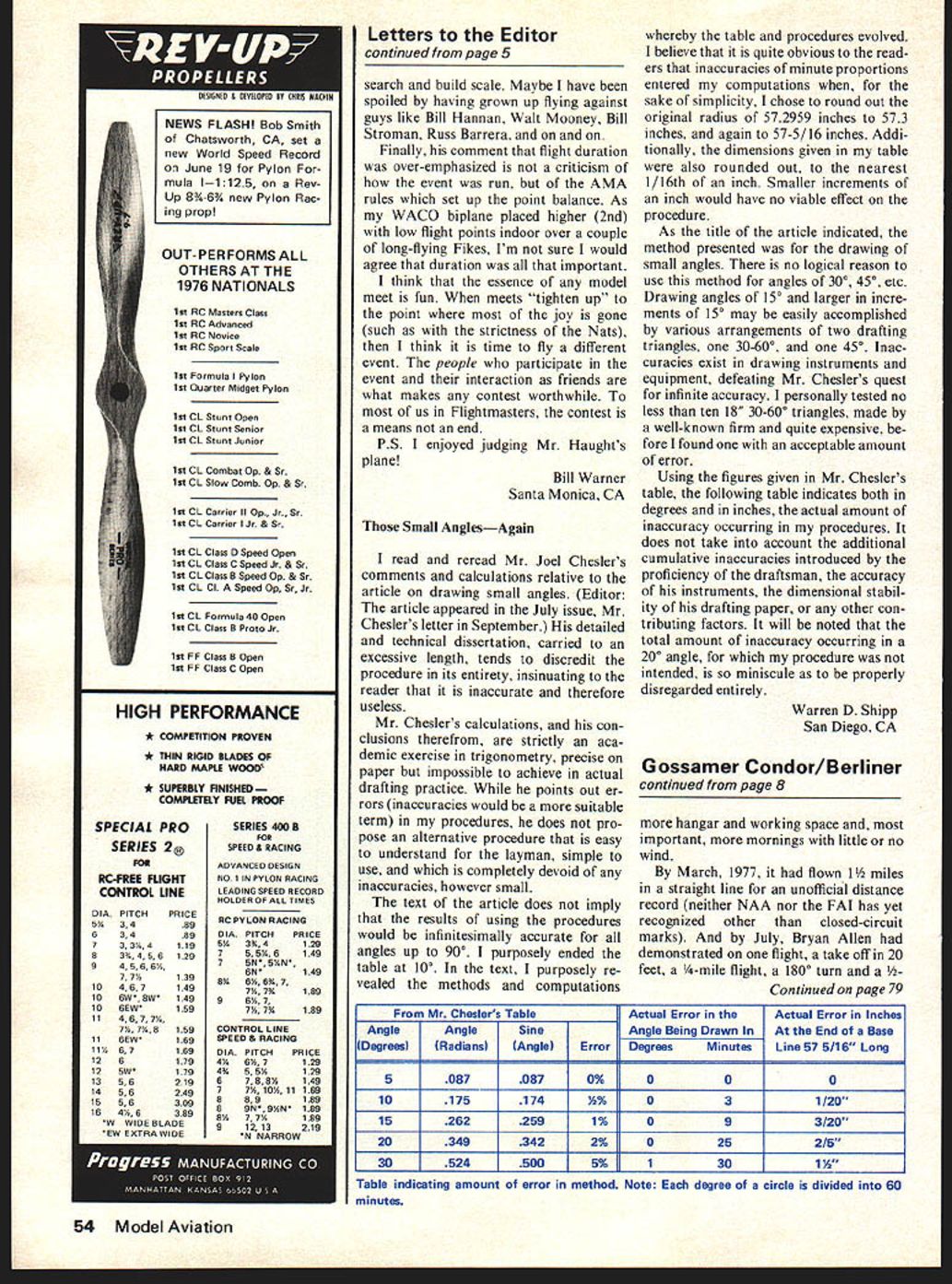
From Mr. Chesler's Table Angle (Degrees) Angle (Radians) Sine (Angle) Error Actual Error in the Angle Being Drawn in Degrees Minutes Actual Error in Inches At the End of a Base Line 57 5/16" Long 5 .087 .087 0% 0 0 0 10 .175 .174 1/2% 0 3 1/20" 15 .262 .259 1% 0 9 3/20" 20 .349 .342 2% 0 25 2/5" 30 .524 .500 5% 1 30 1½"
Table indicating amount of error in method. Note: Each degree of a circle is divided into 60 minutes.
Transcribed from original scans by AI. Minor OCR errors may remain.

