
Letters to the Editor
City of Springfield Returns Home for a Visit
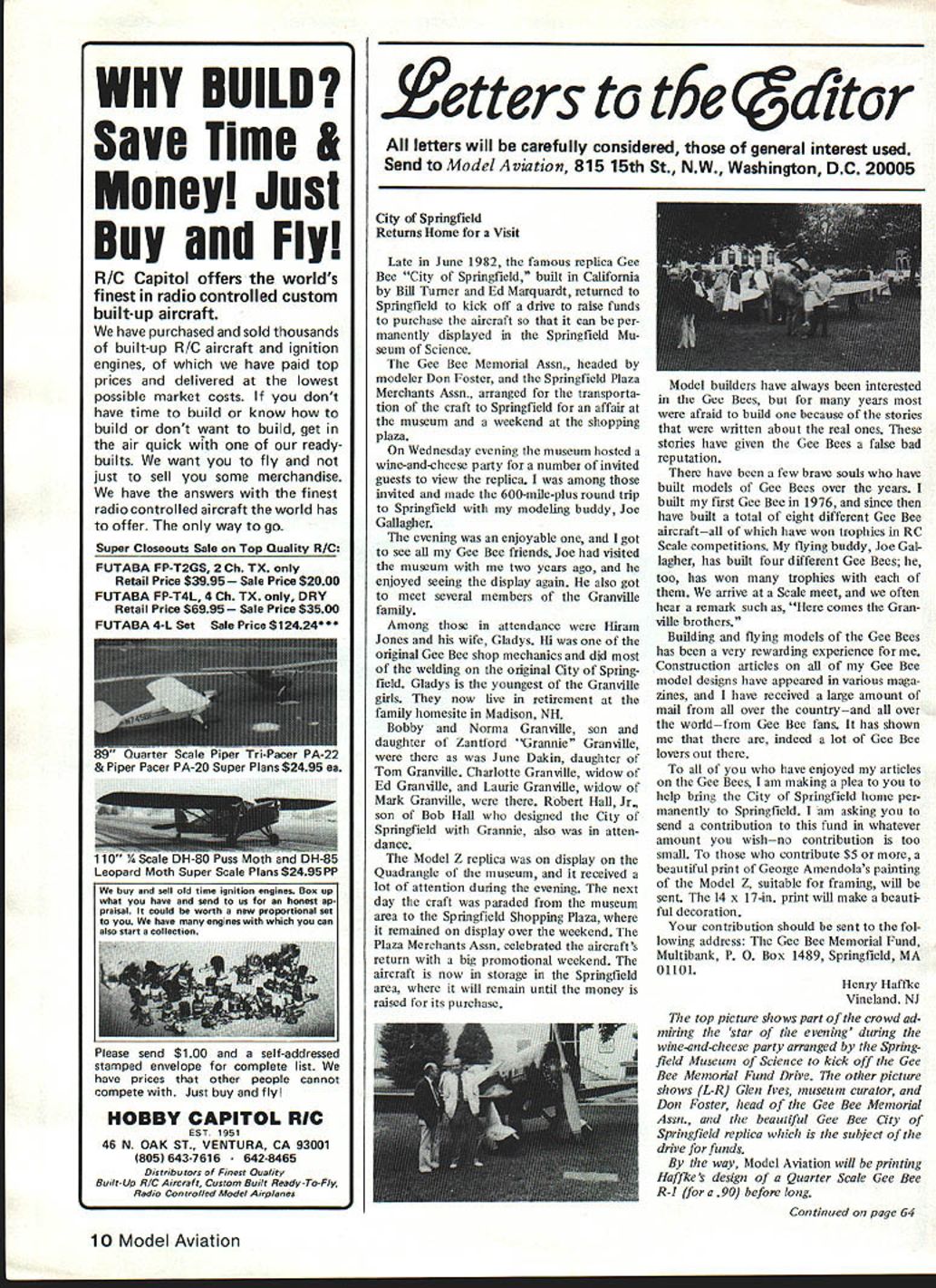
Late in June 1982, the famous replica Gee Bee "City of Springfield," built in California by Bill Turner and Ed Marquardt, returned to Springfield to kick off a drive to raise funds to purchase the aircraft so that it can be permanently displayed in the Springfield Museum of Science.
The Gee Bee Memorial Assn., headed by modeler Don Foster, and the Springfield Plaza Merchants Assn. arranged for the transportation of the craft to Springfield for an affair at the museum and a weekend at the shopping plaza.
On Wednesday evening the museum hosted a wine-and-cheese party for a number of invited guests to view the replica. I was among those invited and made the 600-mile-plus round trip to Springfield with my modeling buddy, Joe Gallagher.
The evening was an enjoyable one, and I got to see all my Gee Bee friends. Joe had visited the museum with me two years ago, and he enjoyed seeing the display again. He also got to meet several members of the Granville family.
Those in attendance included:
- Hiram Jones and his wife, Gladys. Hiram was one of the original Gee Bee shop mechanics and did most of the welding on the original City of Springfield. Gladys is the youngest of the Granville girls. They now live in retirement at the family homesite in Madison, N.H.
- Bobby and Norma Granville, son and daughter of Zantford "Grannie" Granville.
- June Dakin, daughter of Tom Granville.
- Charlotte Granville, widow of Ed Granville.
- Laurie Granville, widow of Mark Granville.
- Robert Hall, Jr., son of Bob Hall, who designed the City of Springfield with Grannie.
The Model Z replica was on display on the Quadrangle of the museum and received a lot of attention during the evening. The next day the craft was paraded from the museum area to the Springfield Shopping Plaza, where it remained on display over the weekend. The Plaza Merchants Assn. celebrated the aircraft's return with a big promotional weekend. The aircraft is now in storage in the Springfield area, where it will remain until the money is raised for its purchase.
Model builders have always been interested in the Gee Bees, but for many years most were afraid to build one because of the stories that were written about the real ones. These stories have given the Gee Bees a falsely bad reputation.
There have been a few brave souls who have built models of Gee Bees over the years. I built my first Gee Bee in 1976, and since then have built a total of eight different Gee Bee aircraft—all of which have won trophies in RC scale competitions. My flying buddy, Joe Gallagher, has built four different Gee Bees; he, too, has won many trophies with each of them. We arrive at a scale meet and often hear a remark such as, "Here comes the Granville brothers."
Building and flying models of the Gee Bees has been a very rewarding experience for me. Construction articles on all of my Gee Bee model designs have appeared in various magazines, and I have received a large amount of mail from all over the country—and all over the world—from Gee Bee fans. It has shown me that there are, indeed, a lot of Gee Bee fans out there.
To all of you who have enjoyed my articles on the Gee Bees, I am making a plea to help bring the City of Springfield home permanently to Springfield. I am asking you to send a contribution to this fund in whatever amount you wish—no contribution is too small. To those who contribute $5 or more, a beautiful print of George Amendola's painting of the Model Z, suitable for framing, will be sent. The 14 × 17 in. print will make a beautiful decoration.
Your contribution should be sent to the following address: The Gee Bee Memorial Fund, Multibank, P. O. Box 1489, Springfield, MA 01101.
Henry Haffke Vineland, NJ
Mailing Address Correction
Letters returned as undeliverable: To those folks for whom we were able to provide the correct address, thank you; for anyone else who may have had a problem and didn't let us know, the full address is as follows:
M. Scott Blynder Sabal Chase–Glenshire 11024 S.W. 112th St. Miami, FL 33176
How Props Work
In answer to a question posed in an earlier issue regarding what mechanism is at work to cause a propeller to propel, I did some digging in my old aero texts and found that momentum theory is a good first-approximation method, but it is in no way associated with rotating bodies. It merely describes the change in velocity of air using the Force = Mass × Acceleration law. Daniel Dommasch, in Airplane Aerodynamics, cites blade-element theory as a reasonable (90%+ accuracy) assessment of propeller thrust.
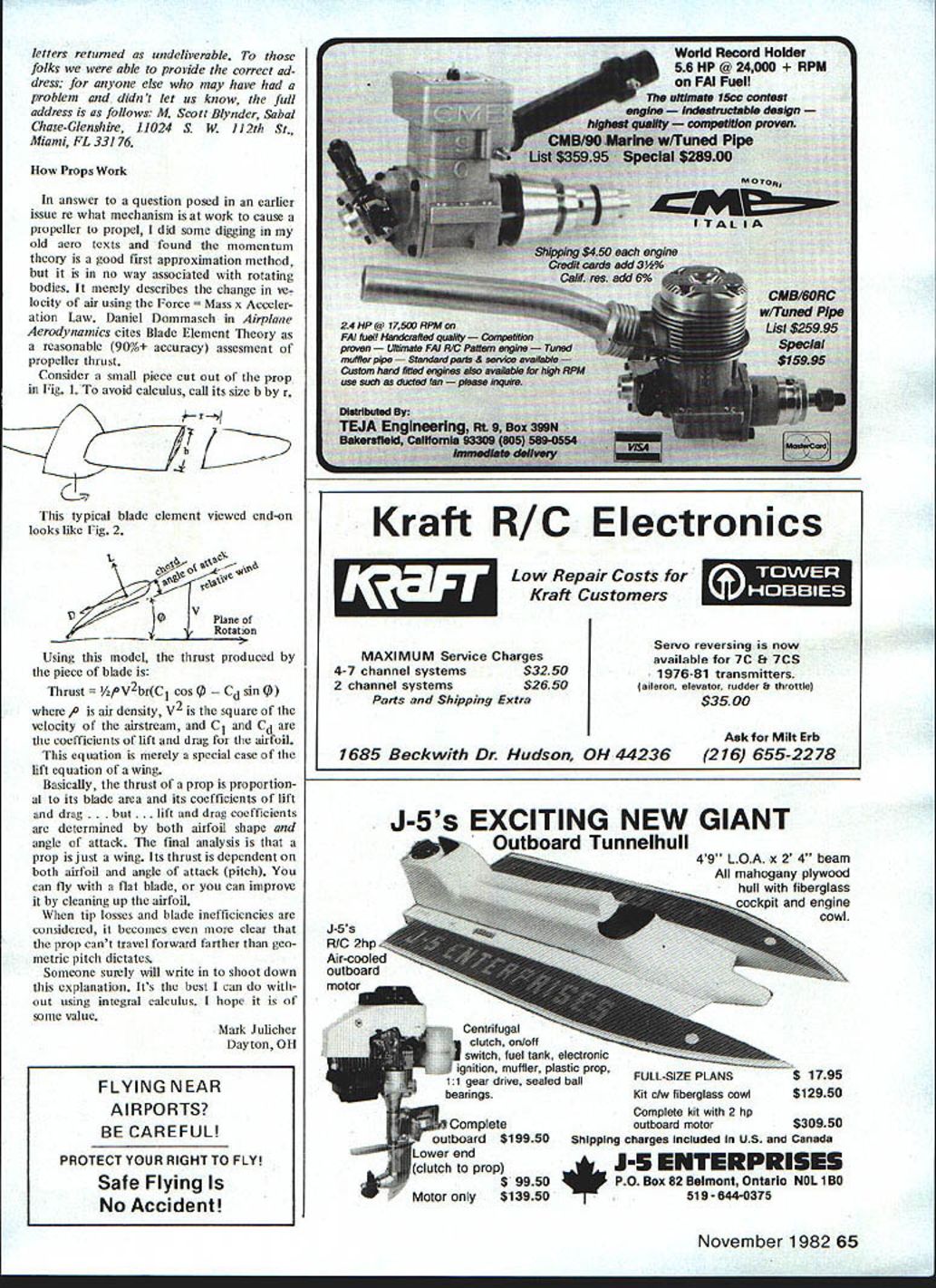
Consider a small piece cut out of the prop in Fig. 1. To avoid calculus, call its size r. This typical blade element, viewed end-on, looks like Fig. 2.
Using this model, the thrust produced by the piece of blade is:
Thrust = 1/2 ρ V^2 b r (C_l cos φ − C_d sin φ)
where ρ is air density, V^2 is the square of the velocity of the airstream, and C_l and C_d are the coefficients of lift and drag for the airfoil.
This equation is merely a special case of the lift equation of a wing. Basically, the thrust of a prop is proportional to its blade area and its coefficients of lift and drag — but lift and drag coefficients are determined by both airfoil shape and angle of attack. The final analysis is that a prop is just a wing. Its thrust is dependent on both airfoil and angle of attack (pitch). You can fly with a flat blade, or you can improve it by cleaning up the airfoil.
When tip losses and blade inefficiencies are considered, it becomes even more clear that the prop can't travel forward farther than geometric pitch dictates.
Someone surely will write in to shoot down this explanation. It's the best I can do without using integral calculus. I hope it is of some value.
Mark Julicher Dayton, OH
Transcribed from original scans by AI. Minor OCR errors may remain.

