
Letters to the Editor
All letters will be carefully considered; those of general interest will be used. Send to Model Aviation, 815 15th St., N.W., Washington, D.C. 20005
TGD Double Win
After the 1982 Nats, Stan Stoy kindly sent a note informing me that his brother, Mike, had set another record of sorts at the Nats. With his win in Open HL Glider, Mike is the first and only two-time winner of the much-revered Tulsa Glue Dobbers Trophy.
To understand the magnitude of Mike's win: NFFS records go back to 1947 in listing winners of the TGD Trophy; until now, no one's name had appeared twice. During the last decade, competition to get that second win has been fierce, and the number of near misses includes such names as Dan Domina, Joe Mekina — and until 1982, Mike Stoy. To give Mike his due, I've included a picture of the man at work. Congratulations, Mike!
Larry Kruse Liberal, KS
In the photo, Mike isn't waving to a buddy; he's releasing cattail fluff as an aid in detecting thermals. Similar effects can be had from bubble generators and Mylar streamers, but cattail fluff is much more portable. Mike is flying his own-design Wasp HL Glider. His Wasp VI was published in the August 1981 issue, and full-size plans are available for $1 (specify Plan No. 343).
Nieuport 11-C
Enclosed are photos of my 2-in.-to-the-foot-scale Nieuport 11-C triplane, built for Sport Scale with OS Wankel power. It flies nicely, but I need more documentation and wonder if any readers can help. I believe I have exhausted U.S. documentation sources, including the National Air and Space Museum.
Frank Hoffer 12213 Kensington Rd. Cleveland, OH 44111
Anyone who can help Mr. Hoffer, please write directly to him at the address given. We are printing one of the pictures of this very interesting airplane.
Big Space Shuttle
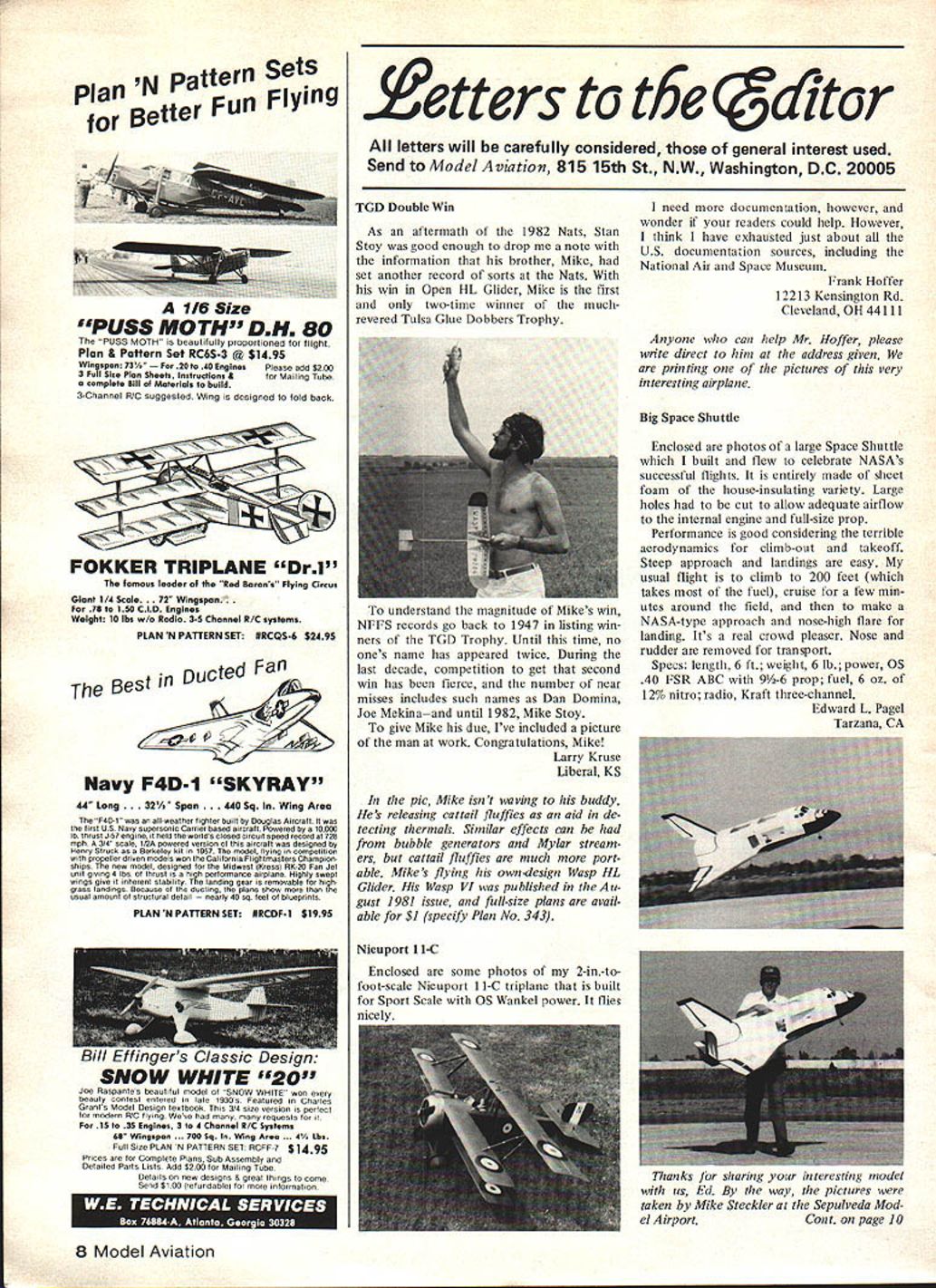
Enclosed are photos of a large Space Shuttle which I built and flew to celebrate NASA's successful flights. It is entirely made of sheet foam of the house-insulating variety. Large holes had to be cut to allow adequate airflow to the internal engine and full-size prop.
Performance is good considering the terrible aerodynamics for climb-out and takeoff. Steep approaches and landings are easy. My usual flight is to climb to 200 feet (which takes most of the fuel), cruise for a few minutes around the field, and then make a NASA-type approach with a nose-high flare for landing. It's a real crowd pleaser. Nose and rudder are removed for transport.
Specs:
- Length: 6 ft.
- Weight: 6 lb.
- Power: OS .40 FSR ABC with 9x6 prop
- Fuel: 6 oz. of 12% nitro
- Radio: Kraft three-channel
Edward L. Pagel Tarzana, CA
Revco Embryo?
I believe the picture of the Embryo Endurance model held by Darold Jones on page 58 of the November issue, which was indicated as a Revco kit model, is a Jetco bird — or a very good copy. Revco? Never heard of them. Could it be Jetco?
Albin Zaic C. A. Zaic Co., Inc. (Jetco) Brooklyn, NY
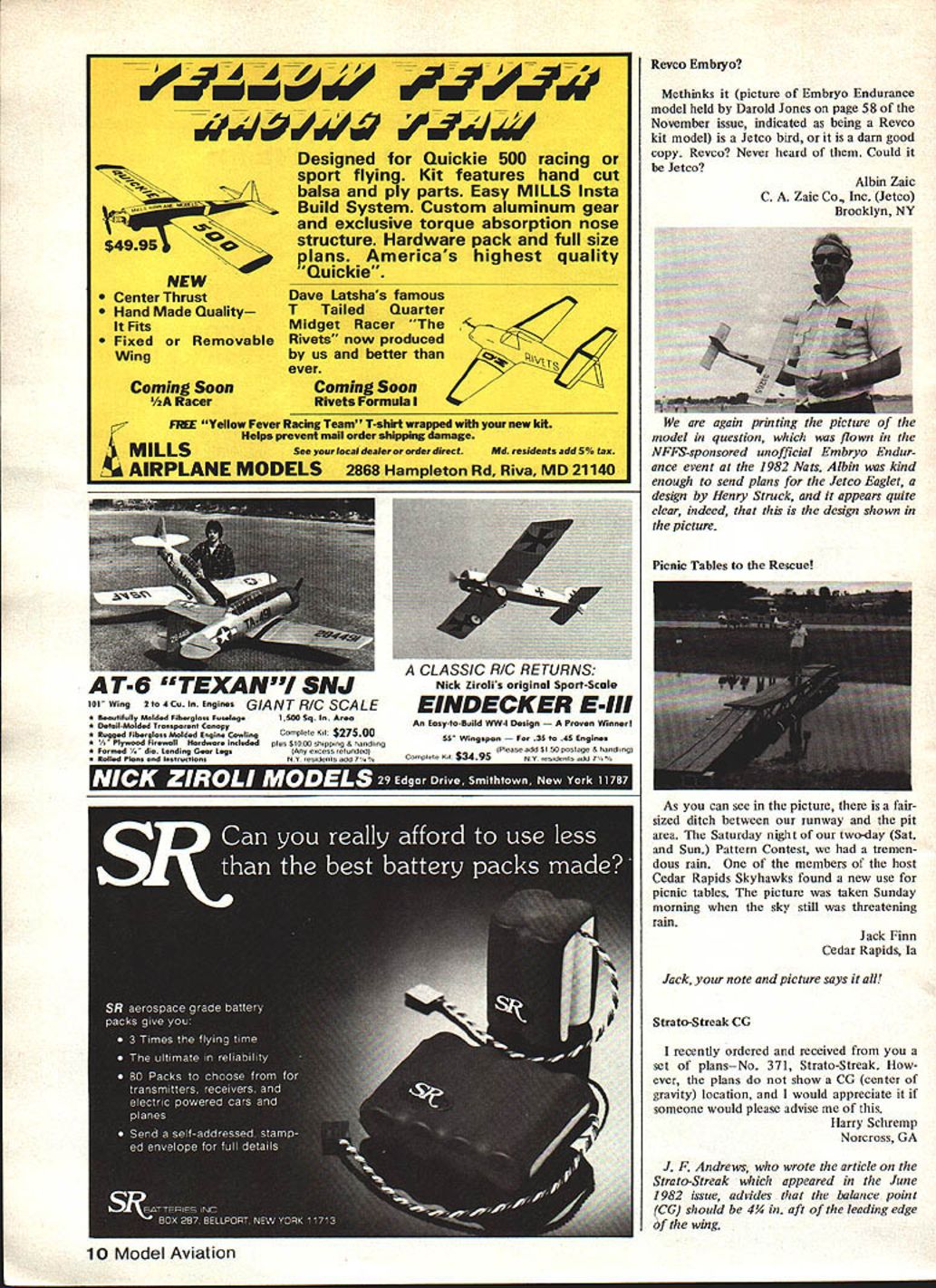
We are again printing the picture of the model in question, which was flown in the NFFS-sponsored unofficial Embryo Endurance event at the 1982 Nats. Albin was kind enough to send plans for the Jetco Eagle, a design by Henry Struck, and it appears quite clear that this is the design shown in the picture.
Picnic Tables to the Rescue!
As you can see in the picture, there is a fair-sized ditch between our runway and the pit area. The Saturday night of our two-day (Sat. and Sun.) Pattern Contest we had a tremendous rain. One of the members of the host Cedar Rapids Skyhawks found a new use for picnic tables. The picture was taken Sunday morning when the sky still was threatening rain.
Jack Finn Cedar Rapids, IA
Jack, your note and picture say it all!
Strato-Streak CG
I recently ordered and received from you a set of plans — No. 371, Strato-Streak. However, the plans do not show a CG (center of gravity) location, and I would appreciate it if someone would advise me of this.
Harry Schremp Norcross, GA
J. F. Andrews, who wrote the article on the Strato-Streak which appeared in the June 1982 issue, advises that the balance point (CG) should be 4 1/4 in. aft of the leading edge of the wing.
Transcribed from original scans by AI. Minor OCR errors may remain.

