
Letters to the Editor
All letters will be carefully considered; those of general interest will be used. Send to Model Aviation, 1810 Samuel Morse Dr., Reston, VA 22090.
It's a Fairchild PT-19, not PT-22!
For all scale buffs, the rubber-powered model pictured at the top of page 16 in the February issue is not a Fairchild PT-22, but a PT-19. The PT-22 was the military version of the Ryan STA and had a Kinner radial engine. (I not only owned a PT-19, but earned my Private Pilot License in it.) One other bit of trivia—the difference between the BT-13 and the BT-15: both were made by Vultee and were identical in all respects, except the BT-13 had a Pratt & Whitney 450-hp engine, while the BT-15 had a Wright engine of slightly less horsepower. I was a part-owner of a BT-13 and have quite a few hours in one.
I might add that I was an avid (and successful) model builder from the very early 1930s to the early 1940s. When I retired recently, I decided that the time had come to get back into modeling. I am now trying to fill the 40-year gap in my modeling experience, and hope to solo my first RC model this spring.
In a recent issue of Model Aviation, the name of Stan Corcoran jumped out at me. I would appreciate any information about this former neighbor, friend, and fellow modeler from the 1930s. By the way, I think that I took one of the very earliest photographs from a model in flight. It was with a 65-cent camera mounted in a rubber-powered model in 1935.
Joe Richardson Monrovia, CA
We also had a few other letters calling our attention to the incorrect designation of Allan Schanzle's model which was shown in Bill Winter's "Just For the Fun of It" column. It turns out that Bill had phoned in a correction to the column before it was printed, but somehow the correction wasn't made. Darn! We weren't of much help with Stan Corcoran's address, as none of the Corcorans in the AMA files seemed to match a Stan.
International System of Units
I am, of course, delighted that the FCC has finally approved the NPRM authorizing new RC frequencies. I was appalled, however, that the AMA would announce this to the world with incorrect and inconsistent usage of the International System of Units — with "Mhz" instead of "MHz" in large type at the top of page 83 of the February Model Aviation, and throughout page 84.
The International System of Units (SI) has been in common use throughout the world (including the U.S.A.) for a generation. It was approved by an international commission to establish a consistent set of symbols for units of all physical measurements. Since the Latin and Greek alphabets did not contain sufficient characters to satisfy the needs, it was agreed that units derived from the names of scientists such as V, A, Ω, and Hz (after Alessandro Volta, André Ampère, Georg Ohm, and Heinrich Hertz) would use capital letters. Units not derived from names, such as s, m, and g (for second, meter, and gram) would use lower-case letters. The prefixes were generally capitalized for multipliers and lower case for dividers. M is used for mega (×1,000,000) and m is used for milli (×10^-3). The exception to this rule is k for kilo (×1,000).
Modelers all over the country look to the AMA for setting standards, which is precisely what the center-spread sheet was for. Let's be fussy about setting uniform standards correctly. American modelers should also recall that the decibel is named for Alexander Graham Bell, so let's use dB, MHz, kHz, ms, and other SI units correctly and consistently in all official AMA publications.
The International System of Units is described in detail in Special Publication 330, National Bureau of Standards, Boulder, CO, 1974.
Frank Kelly Long Beach, CA
We plead guilty, and we'll try to do better. We've found that Special Publication 330 is available from the U.S. Government Printing Office for $4.75 (we have ordered two copies). If readers wish to obtain a copy, they should request Publication SN 003-003-02-380-9 and mail payment (checks payable to the Superintendent of Documents) and requests to: Superintendent of Documents, U.S. Government Printing Office, Washington, DC 20402.
Glad You Like It!
I wish to congratulate you for the superb job you are doing with Model Aviation. In terms of all-round coverage and interest, in my view it ranks number one.
My main interests are in RC sport, scale, and what I would call unorthodox aircraft. Being an all "scratchbuilder," I really appreciate your occasional articles and three-views on historic aircraft; these all go into my collection. I hope that you can carry more of these from time to time. Keep up the good work!
I was delighted to see in the December 1982 issue an article on autogiros, which have fascinated me for years. I built the second prototype of Dennis Neale's RoBar design, which was published in the English Aeromodeller magazine in 1951! Since then I have designed and built quite a few, both rubber-powered and gas free flight.
A couple of years ago, getting a little jaded with conventional models, I decided to build an RC version using this experience. This past summer, with version No. 3, I have a design which is flying well. It has a single three-bladed rigid rotor, an OS .15 for power, three channels, no wing, and no complicated rotor controls. I hate building wings, anyway! Time permitting this winter, a stand-off RC scale Pitcairn or Kellett autogiro is at the top of my list.
Alan G. Baker Ross Valley, PA
Converting RC Sailplanes to Electric
Murphy's Law strikes again. It seems that Radio Shack has discontinued the push-push switch I recommended in the September 1982 article on converting RC sailplanes to electric power. However, they now have a similar switch that should do the job just as well, part number 275-1535, and Astro Flight (13311 Beach Ave., Venice, CA 90291) carries the original switch, part number 4021.
Sorry for any inconvenience this may have caused. You might run this in the letters column to alert others who might want to use this switch.
Mitch Poling Seattle, WA
Bob Granville
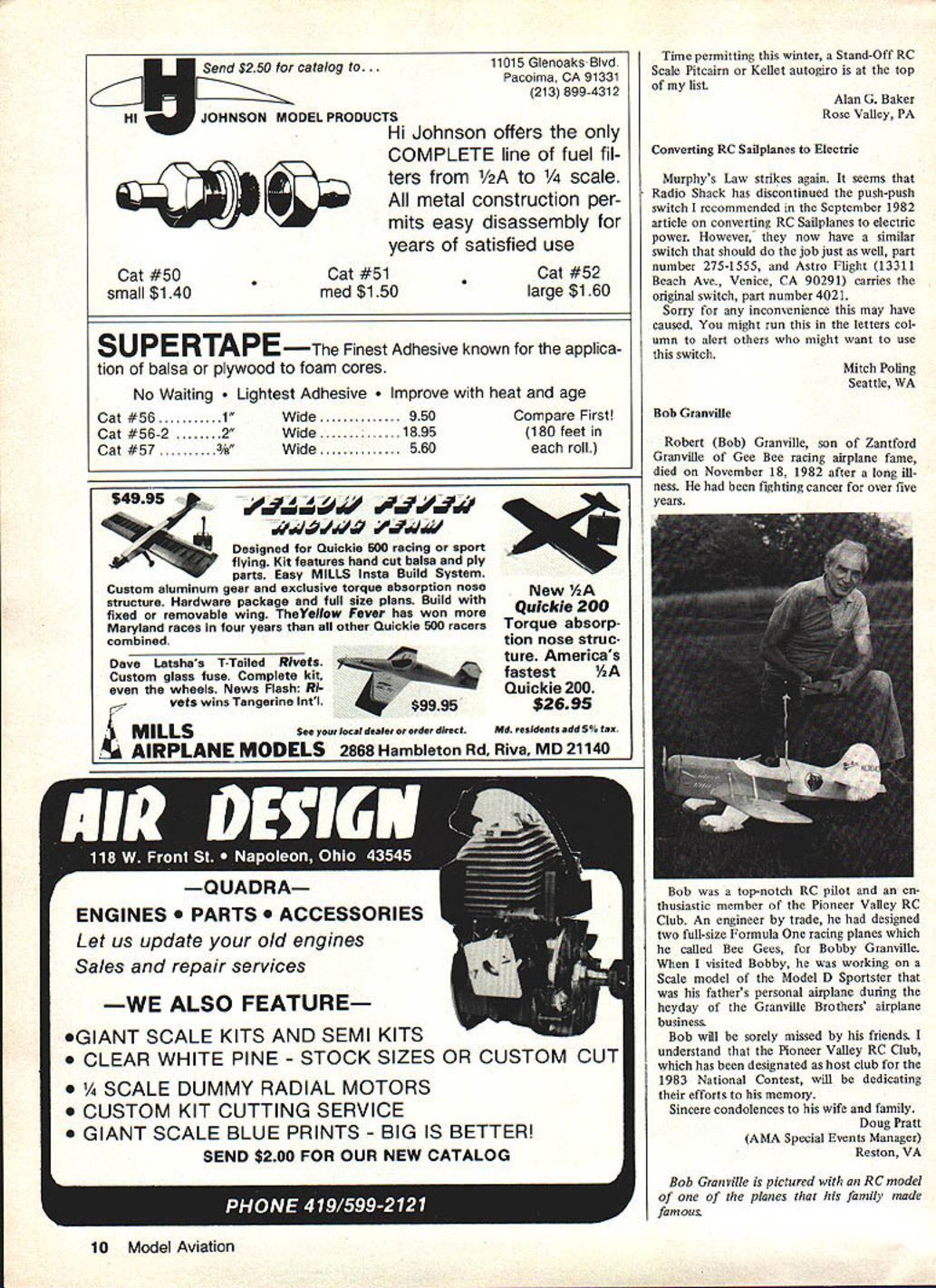
Robert (Bob) Granville, son of Zantford Granville of Gee Bee racing airplane fame, died on November 18, 1982 after a long illness. He had been fighting cancer for over five years.
Bob was a top-notch RC pilot and an enthusiastic member of the Pioneer Valley RC Club. An engineer by trade, he had designed two full-size Formula One racing planes which he called Bee Gees for Bobby Granville. When I visited Bobby, he was working on a scale model of the Model D Sportster that was his father's personal airplane during the heyday of the Granville Brothers' airplane business.
Bob will be sorely missed by his friends. I understand that the Pioneer Valley RC Club, which has been designated as host club for the 1983 National Contest, will be dedicating their efforts to his memory.
Sincere condolences to his wife and family.
Doug Pratt AMA Special Events Manager Reston, VA
Transcribed from original scans by AI. Minor OCR errors may remain.

