
Letters to the Editor
All letters will be carefully considered; those of general interest will be used. Send to Model Aviation, 1810 Samuel Morse Dr., Reston, VA 22090.
Winnie Mae Round-the-World
A fiftieth anniversary is upon the aviation world that stands as one of aviation's greatest feats, and it was flown with one of the slickest planes to model. The Winnie Mae, in which Wiley Post flew solo around the world in July 1933, landed back at Floyd Bennett Field, Brooklyn, NY, his starting point, at 11:55 p.m. on July 22. That was seven days, 18 hours, and 49 minutes after departure. This issue should be in your hands just before that time—but fifty years later.
Post flew the Winnie Mae over the Atlantic, across Europe, and into Asia and Russia, with five landings there—bone-weary, catching sleep only during refueling. Over Siberia, he passed Jimmy Mattern (downed in a crash) who helped Post by radio, for it was IFR (chancy in those days) all the way across the Bering Sea. That was formidable—instruments for 13 hours!
Then he got lost in fierce weather while looking for Fairbanks. In desperation he landed at the mining town of Flat, where the dirt strip ended in a ditch—into which the Winnie Mae dove on roll-out. That cracked the right landing gear and bent the controllable prop. At this point Post was ahead of his 1931 time with Harold Gatty by 33 hours, but he had to collapse mentally and physically into a bunk while a radio summoned Joe Crosson, noted bush pilot and mechanic, with a fixed-blade prop. A mining crew of super guys jacked up the hull so that the gear could be fixed and the prop could be replaced. Then Wiley had to follow Joe Crosson to Fairbanks, because of ADF trouble, to pick up fuel.
Then he faced 1,450 miles on IFR to Edmonton, enough to make most any present-day pilot turn back. There were peaks to 15,000 ft., obscured in clouds, so Post hit 20,000 (giving birth to his later strato flights). Post balanced a wrench on his knee so that it would awaken him by falling off if he went to sleep.
From Edmonton he faced 2,044 miles to New York, most of this on a newly developed Sperry autopilot, so he could doze going across Canada, the Great Lakes, and the entire northeast Appalachians.
As he neared Floyd Bennett, his radio went nuts with clamor. Untold thousands had blocked Flatbush Ave. into Brooklyn and Queens with impossible traffic, as throngs wanted to watch the world's only one-eyed pilot, Wiley Post, land. (All of this is from Book No. 8 of the National Air and Space Museum, $4.)
As an artist who loves to paint great aircraft, I was moved to paint this very important airplane in dedication to the man (Editor: you see it reproduced here), and it will likely be hung in the NASM next to the genuine Winnie Mae.
It depicts Post landing on the dark moonlit runway with, in the distance, a jewel box of lights from the bedlam of cars at 11:55 p.m. on July 22, 1933, 21 hours better for the circling than he flew with Gatty in 1932. With one eye! (And I still foul up on VORs.) The Navy formed squads to protect the plywood airplane. Otherwise, the enthusiastic mob would surely have splintered her, such was the spirit of that famous flight in the ’30s.
My bike and I missed that arrival, and I fret to this day.
Hank Clark Dumont, NJ
Balsa Stripper Revisited
I have some questions about the article in the March 1983 issue by Mark Drela which had the title, "Ingenious Balsa Stripper." How do you attach the screws, nuts, beam, etc.? The construction was said to be simple and self-explanatory, but not for me.
John Bryan Kelly Garden City South, NY
We passed on Mr. Kelly's letter to Mark Drela, who kindly provided the following information.
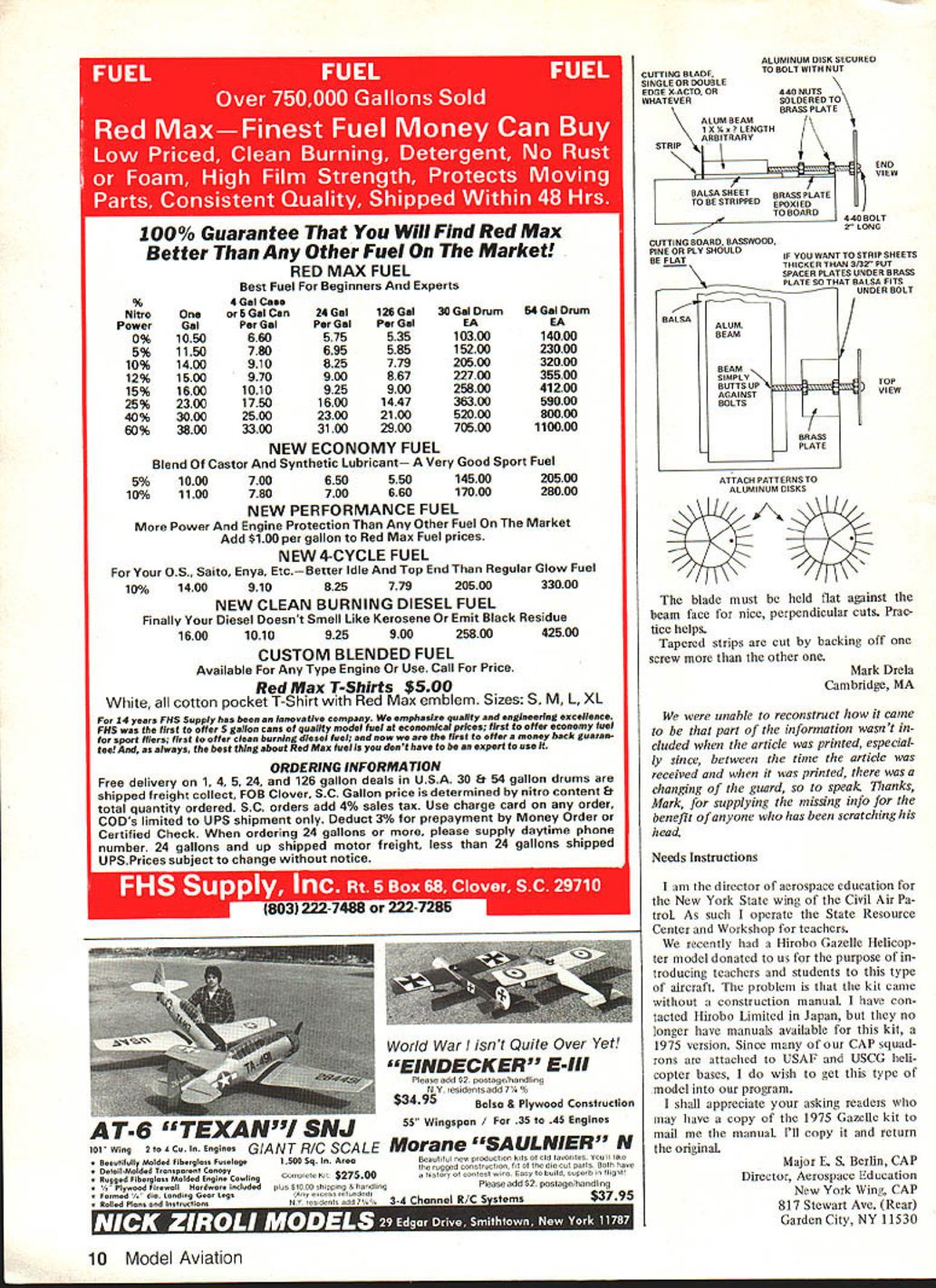
It's unfortunate that the article was not published in whole. When I submitted the article to the magazine, I included detailed drawings of the screw mountings; the drawings never got published. The part of the text explaining how to use the stripper was also deleted.
I've included a sketch of the screw mountings. I hope it will clarify things.
To use the stripper:
- Tape balsa sheet to the cutting board.
- Put the aluminum beam on top of the balsa, butting it against the screws.
- Turn the screws so that the beam edge is near the balsa sheet edge, and make a waste cut.
- Back off both screws by an amount equal to the desired strip width, keeping the beam butted against them, and cut the strip. Repeat this step for the next strip.
Note that 4-40 screws have 40 threads per inch. Therefore, one complete revolution of the screws moves the beam by 0.025 in. I've included disk patterns which have 25 divisions around their perimeters. One division, therefore, corresponds to one-thousandth of an inch (0.001). The dot on each disk helps to keep track of the number of screw revolutions.
It helps to make several light passes with the blade rather than to cut the whole strip with one heavy cut. The blade must be held flat against the beam face for nice, perpendicular cuts. Practice helps.
Tapered strips are cut by backing off one screw more than the other.
Mark Drela Cambridge, MA
We were unable to reconstruct how it came to be that part of the information wasn't included when the article was printed, especially since, between the time the article was received and the time it was printed, there was a changing of the guard, so to speak. Thanks, Mark, for supplying the missing info for the benefit of anyone who has been scratching his head.
Needs Instructions
I am the director of aerospace education for the New York State Wing of the Civil Air Patrol. As such I operate the State Resource Center and Workshop for teachers.
We recently had a Hirobo Gazelle helicopter model donated to us for the purpose of introducing teachers and students to this type of aircraft. The problem is that the kit came without a construction manual. I have contacted Hirobo Limited in Japan, but they no longer have manuals available for this kit, a 1975 version. Since many of our CAP squadrons are attached to USAF and USCG helicopter bases, I do wish to get this type of model into our program.
I shall appreciate your asking readers who may have a copy of the 1975 Gazelle kit to mail me the manual. I'll copy it and return the original.
Major E. S. Berlin, CAP Director, Aerospace Education New York Wing, CAP 817 Stewart Ave. (Rear) Garden City, NY 11530
Transcribed from original scans by AI. Minor OCR errors may remain.

