
Letters to the Editor
All letters will be carefully considered; those of general interest will be used. Send to Model Aviation, 1810 Samuel Morse Dr., Reston, VA 22090.
Good Tern's Prop
In the November 1983 issue, referencing the Good Tern FF, I don't see much help on how to come up with the propeller. Can you give me a hand here?
R. S. Demitz St. Louis, MO
Response from the author, Bill Noonan:
It was an oversight on my part that I did not make reference to the fact that it is a 7-in. Peck-Polymers plastic propeller. This is commonly available at model shops or by mail directly from Peck-Polymers, Box 2498, La Mesa, CA 92041. Obviously, a good carved prop would work just as well. The plastic one has the advantage of being able to take considerable abuse without breakage.
Bill Noonan San Diego, CA
Electric Sparky
I want to thank Don Srull for his model designs. I especially liked his Electric Sparky as published in the July 1983 issue. I have just commenced constructing one. I am an experienced Sunday flier and anticipate no trouble with building or flying the plane, but as this is my first experience with RC electrics, I hope that I can get the answers to a few questions.
Is the Leisure 05 with 2½:1 reduction still the first-choice motor for this model? When the article was written, Don hadn't tried a seven-cell battery pack. Did he? If so, was seven cells preferable to six? Does use of seven cells require a prop change? Is 11-7 still the best prop to start with?
I do not have any charger at present. Assuming I get a Leisure 05 motor, what charger should I get? I would like one that is trouble-free, reliable, and simple.
I know I'll enjoy building the plane, and would appreciate any recommendations.
Albert Wahrhaftig Sebastopol, CA
Don Srull's response:
The Leisure 2.5:1 05 motor or the newer 3.6:1 05 are both good choices for the Sparky. For the simplest way to start, I would suggest the 2.5:1 and a six-cell battery pack. The seven-cell pack will add another minute or so to the Sparky's dead-air flight time (from about 9 min. to 10 min.), but the seven cells are more of a hassle to charge with a simple charger.
The best commercial prop I found for the 2.5:1 Leisure and six-cell combo was a Rev-Up 11-7½. If you do use seven cells, go down to an 11-7 prop. As far as chargers go, both Astro and Leisure carry a number of good units. I would recommend that you invest enough to get a charger with at least the following: an ammeter that shows charge rate and an adjustable charge rate. I use the Astro AC/DC Auto Charger (which can also be used in my workshop by plugging it into an AC outlet) and find it to be versatile and very easy to use.
Another tool of great value is a small, portable digital voltmeter to monitor the battery during charging. Radio Shack carries a very good and inexpensive one.
I'm still flying my Sparky regularly—both for sport and experiments with the motor, battery, and props. If you can keep your model at about 40 oz., it will be a good flier with six cells. By the way, if you modify an 11-7½ prop into a folder, it will help the glide tremendously. It will also help prevent bending the rather small-diameter prop shaft of your motor.
Don Srull McLean, VA
George A. Page, Jr.
I feel that I would be neglectful if I did not report the passing of one of the earliest model aviation experts, George A. Page, Jr., who died in a nursing home in Columbus, OH in October 1983. Page was a member of the first model aero club in the U.S. in New York City—founded in about 1907. He was a competitive flier, breaking records including one held by Percy Pierce. Page went on to become a pilot and engineer for the Curtiss Airplane Company.
He gave contestants in the Mulvihill event at the 1925 Nats a tour through the Curtiss plant at Hempstead, Long Island, which included some racing planes and the aluminum prop shop. Page was later instrumental in the design of the Curtiss Condor and other planes of the era at the Curtiss St. Louis plant. He was transferred to the Columbus, OH plant, where he retired a few years ago.
His ambition was to build a gas model of his own design, but illness prevented completion of the project—but he was a modeler to the very end of his life.
We all have to go someday, but I think that the great ones should be remembered as an inspiration to the living.
Bert Pond Longmeadow, MA
Adopt-A-School
This is in response to your recent appeal for AMA Chartered Clubs (August 1983 issue, page 101) to "Adopt-A-School."
The Joint Military RC Flyers Club has been involved in a school program for the past year, basically through the efforts of one member, Frank Smith. Frank's program has been two-pronged:
- Teaching "building and flying RC aircraft" at local high school adult evening classes. The first classes were conducted during the fall 1982 semester at Vista High School. It proved to be highly successful with 14 students, of which eight joined our club after the course was over. The Blade-Tribune (one of our local newspapers) ran a lengthy article on the subject, which provided good public relations for our club and the sport.
- Frank Smith has also been working with the Vista School District giving flying demonstrations to 650 students and parents at Casita Elementary School (grades 1 through 7). In October he presented a program to over 900 students (kindergarten through 7th grade) at the Santa Fe and California Elementary Schools. His program consists of a show-and-tell of about 15 minutes and then a flying demonstration from the school grounds.
Can you imagine receiving 900 thank-you notes—handwritten by the students on all sizes of paper? Frank did, and he brought approximately a 10% sample to our October club meeting. Reading the kids' comments made every member present realize what a wonderful program this really was. Who knows how many aeromodeling seeds were planted in those 900 boys and girls that will germinate in the future. Those letters show that the kids appreciate something different in their curriculum which is both interesting to hear about and fun to watch.
The big difference in the Academy's Adopt-A-School program and how our program is being worked is the fact that we do not have a teacher involved. Frank is employed by the Vista School District, so he already has an "in" with the various principals and teachers. Therefore, the usual letter writing and groundwork normally associated with getting your foot in the door wasn't needed.
We are going to try to expand the program to the Oceanside School District using the Academy's guidelines.
The Adopt-A-School project is most interesting, and I know it will be very rewarding to anyone who cares to get involved.
Marlin Kinney Oceanside, CA
Interested folks might want to look back in the August 1983 issue, page 101 for the program announcement and details. The Academy's Public Relations Department can help you get a program going in your area.
Continued from page 8
Those Chopper Ads
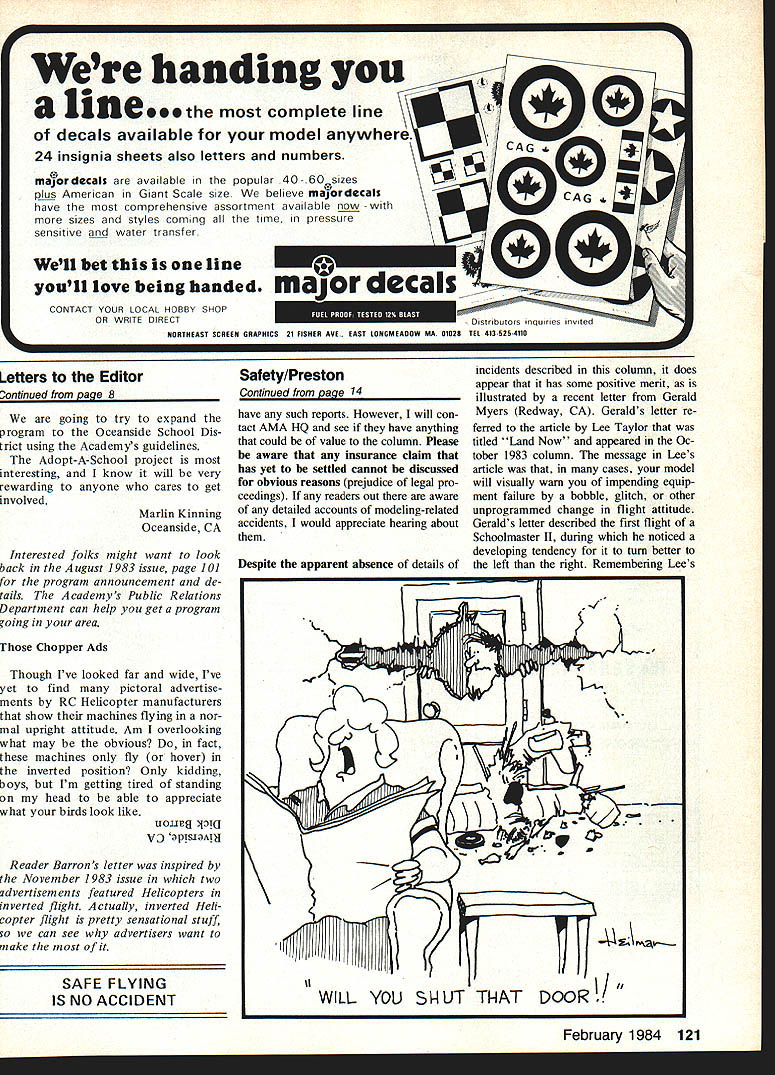
Though I've looked far and wide, I've yet to find many pictorial advertisements by RC helicopter manufacturers that show their machines flying in a normal upright attitude. Am I overlooking what may be obvious? Do, in fact, these machines only fly (or hover) in the inverted position? Only kidding, boys, but I'm getting tired of standing on my head to be able to appreciate what your birds look like.
Reader Barron's letter was inspired by the November 1983 issue in which two advertisements featured helicopters in inverted flight. Actually, inverted helicopter flight is pretty sensational stuff, so we can see why advertisers want to make the most of it.
Field Safety
A recent incident illustrates the value of following safety advice at the flying field. When a pilot received a message to "land now" after something strange was observed, he did just that—and managed to get the model down unscathed. An examination of the model showed that the rudder pushrod attachment to the servo had partially backed out of the pushrod connector. So, thanks to Lee's advice to modelers via this column, a model was saved and a potential accident was averted.
One last word on promoting safety at the RC flying field: NEVER turn on your transmitter until you have checked to see which frequencies are in use! If your club has a transmitter impound system in effect—use it all of the time. There is no shortcut to safety. Just remember—when you "shoot down" another flier's model by turning on your transmitter at the wrong time, his plane may hit something (or somebody!) besides the ground.
Have a safe month.
John Preston c/o Model Aviation, 1810 Samuel Morse Dr., Reston, VA 22090
For Fun/Winter
Continued from page 26
Total land is about 200 acres and, best of all, just one mile from town. It is a truly busy place and open for public use.
To wander a bit, I've mentioned many planes I'd like to build, and my frustration is allayed by guys who then build them—like Koerner's electric-powered "Little George" and the Flamingo in an accompanying photo. Heinz built that and a long-winged Connie with four electric motors. The Connie is a true bird, a sailplane compared with a DC-7, even an old full-size one. So back to Eldon Wilson.
I was amused by your mention of the electric-powered Connie. I see it has been done, but the question is, "Was it done right?" A friend, "Little George" McIntyre, was chief pilot for Lockheed during the Connie series. During his later years on the Super Connie he was referred to by P-80 jocks as "granddad." One day, a P-80 operator did an Immelmann turn on takeoff, and the younger guys went ape. (The Blue Angels did that with Bearcats as part of their act—and close to the ground.) Well, George didn't see anything so hot about that and offered a wager of a month's pay to do the same thing with a Connie. It was done. George did retire, but at the insistence of the FAA (after 33 years, he said he was ready, anyway).
The wing loading, range, and power were far less favorable on the P-80 than on a Super Connie, this fellow would have you know. (Don't ask me. I only live here.)
When the Cuban Air Force bought Vegas and installed the radio loops on top and close to the ground instead of under the nose as recommended, George went to Cuba but could not convince them to move the loops. So he took a Vega up to 14,000 ft, killed the engines, rolled to inverted, and dead-sticked down 4,000 ft to demonstrate that it had to work. He rolled out, restarted, and landed—the general was convinced. Dead stick for 10,000 ft wasn't even mentioned; just normal in that period. Little George is retired now, living in Del Rio. His latest log book quit at 16,000 hours, but he still flies a Beech Baron.
So when you build your Connie, learn what it will do, and thrill the crowd. (I sure hope this doesn't scare the wits out of Heinz Koerner!)
I especially like all the strange types of models you picture, says Eldon, getting back to what matters most. "Strange is what I am. WW I and strange types. My latest is the Loening M-8 in Sport Scale. A 60- to 70-in. plane is easy to transport. My newest is a Wildcat. Fully functional—I enjoyed the retract system. Did all the good model checks, and it is a bird-on-a-string capable of delighting at the flying field."
Transcribed from original scans by AI. Minor OCR errors may remain.

